
Turn recordings into transcripts and summaries in minutes
Upload audio or video for multilingual transcription, AI notes, and action items
Have you ever counted: every week, you spend at least 5 hours in Google Meet meetings, plus another 2 hours rewatching recordings, jotting down notes, or summarizing conclusions—leaving less time for actual work.
Many people assume that upgrading to a higher-resolution camera solves everything. But in reality, video conferencing issues often go beyond image quality; even with a clear picture, meeting content still isn't properly captured.
So, this article won't just throw a bunch of spec sheets at you. I'll start from the perspective of a typical office worker, first discussing how to choose a Google Meet camera, then explaining how Tinrec complements meeting notes and post-meeting organization, ensuring your meetings are not only clear to see but also easy to remember and find.
What Can a Google Meet Camera Do for You?
Scenario 1: Look More Professional When Working from Home
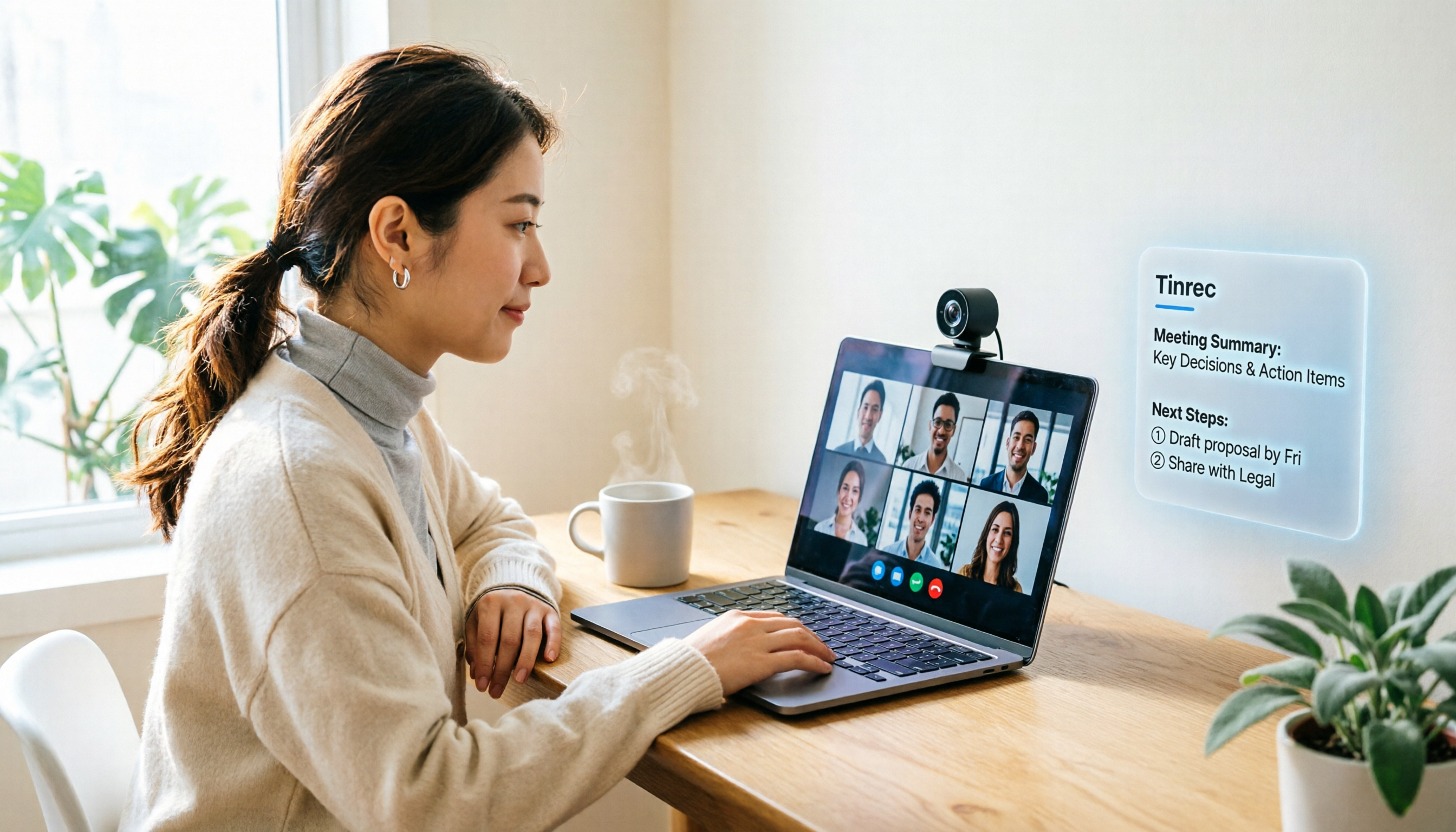
Many people use their laptop's built-in camera for meetings, which often results in dim, low-angle shots where others only see your chin and the ceiling. Switching to an external camera that clips onto your monitor offers the most immediate benefit of a more natural eye-level angle and steadier video.
Scenario 2: Get Everyone in the Frame in Small Meeting Rooms
If 3 or 4 people are gathered around a single laptop in a meeting room, the built-in camera usually isn't wide enough, cutting off people on the sides. Choosing a model with a wider field of view lets more people fit in the frame, reducing the need to huddle around the lens.
Scenario 3: Quickly Find Key Discussion Points After the Meeting
Even with a crystal-clear picture, if no meeting record is kept, you'll still have to rewatch recordings or rely on memory to fill in the gaps afterward. With Tinrec, for example, you can record Google Meet's system audio directly from your desktop—no need to invite a bot to the meeting—while generating real-time transcripts, summaries, and action items, ensuring that content beyond the video is fully captured.
What Are the Core Capabilities of a Google Meet Camera?
1. Plug-and-Play Without Extra Drivers
Most external cameras connect via USB, and Google Meet can detect them right away. When shopping, prioritize models that don't require additional drivers to avoid setup hassles before meetings.
2. Microphone and Noise Cancellation
In video conferences, audio often matters more than video quality. If the built-in microphone doesn't capture sound well, others will hear muffled audio or even echoes. Some models emphasize noise cancellation, which is useful in slightly noisy environments.
3. Resolution and Low-Light Performance
1080p is already the baseline for video conferencing. Rather than chasing 4K, it's more practical to check whether the camera renders natural skin tones and clear images under typical indoor lighting. Often, noise from insufficient light affects the viewing experience more than resolution.
4. Compatibility with Meeting Tools
Google Meet generally has excellent compatibility with USB cameras, but it's still wise to choose models that support the UVC standard. This way, you can continue using the camera if you switch to Zoom, Microsoft Teams, or Webex in the future.
5. Continuity in Handling Meeting Content
The camera only handles video, but what truly matters in a meeting are the conclusions and action items. Tinrec's value lies in this: you can not only record Google Meet's audio but also use AI summaries, chapters, and action item extraction to turn content beyond the video into actionable data.
Practical Use Cases
Use Case 1: Individual Remote Work
You can mount a compact external camera on top of your monitor for a more eye-level angle. During the meeting, use the Tinrec desktop app to record Google Meet's system audio. As soon as the meeting ends, transcripts and summaries are already generated—no need to rely on memory for meeting notes.
Stop organizing recordings by hand
Upload audio or video and automatically get a transcript, summary, and action items
Use Case 2: Small Team Meeting Rooms
If the meeting room has both in-person and remote participants, besides using a wide-angle camera to capture everyone, you can also run Tinrec on the meeting room computer. Both remote audio and in-person discussions will be recorded, and afterward, you can extract each person's key points from the transcript.
Use Case 3: Client Interviews or Requirement Discussions
These meetings are where you can least afford to miss details mentioned by the client. You can conduct the interview via Google Meet while recording and transcribing with Tinrec. Later, simply search for keywords like "budget" or "timeline" to quickly find the relevant discussion segments.
5 Things to Watch When Buying a Google Meet Camera
1. Assess Your Meeting Type Before Deciding on High-End Models
If you're only doing individual video calls, an entry-level to mid-range USB camera is usually sufficient. Large meeting rooms may require PTZ or models with stronger zoom capabilities. Don't overspend on specs you won't use.
2. Check Your Computer's USB Interface and Power Supply
Some high-end cameras require more power and may be unstable when connected via a USB hub. Before purchasing, confirm whether your computer or meeting room host can supply power directly to avoid sudden video drops during meetings.
3. Audio Quality Deserves More Attention Than Video Quality
A slightly dim image can be fixed with ambient light, but poor microphone pickup directly hampers communication. If your budget is limited, prioritize models with stable built-in mics or consider pairing with an external microphone.
4. Determine If You Really Need a Built-In Speaker
Some video conferencing devices integrate speakers, but if you already have external audio equipment, this feature may go unused. Focusing your budget on video and audio quality is usually more practical.
5. Don't Forget Meeting Content Organization Tools
The camera solves the "clear picture" part, but the value of a meeting lies in whether the content is preserved. Tinrec can record Google Meet's system audio, generate real-time transcripts and summaries, and let you continue organizing key points with AI Q&A or export features afterward. This way, you don't need to scramble to take notes during the meeting.
Frequently Asked Questions
What If Google Meet Can't Find My Camera?
First, try unplugging and reconnecting the USB cable, and check if your browser has granted Google Meet permission to use the camera. If it's still not detected, go to your operating system's privacy settings to ensure camera access isn't disabled.
Do External Cameras Require Driver Installation?
Most USB cameras that comply with the UVC standard don't need additional drivers; they work as soon as you connect them to Google Meet. Before buying, check if the product is labeled as driver-free or plug-and-play.
Can I Use My Phone as a Google Meet Camera?
Yes, but a phone's lens angle and stability usually aren't as good as a dedicated external camera. If it's a one-off situation, a phone can work as a stopgap; for long-term remote work, a dedicated camera is more reliable.
Can Tinrec Record Google Meet Meetings?
Yes. The Tinrec desktop app can capture your computer's system audio directly, so you don't need to invite a bot to your Google Meet. Once you manually start recording, it generates transcripts, summaries, and action items in real time.
What Should I Keep in Mind When Using Meeting Recording Tools?
Before recording or transcribing, comply with local laws and obtain consent from participants when necessary. Tinrec's transcripts and summaries are meant to assist with organization; for critical decisions, always refer back to the original recording and transcript.
Conclusion
When choosing a Google Meet camera, what really matters isn't chasing the highest resolution, but ensuring it consistently makes you look clear and sound natural.
But here's the bigger takeaway: a clear picture is only a small part of the meeting. If meeting content isn't recorded and organized, you'll still spend time after the meeting rewatching and rewriting notes.
If you have regular Google Meet meetings every week, consider using Tinrec as your post-meeting organization tool. Recording, transcription, summaries, and action items are all handled in one go, turning every meeting into searchable, trackable data.
References
Turn every recording into actionable outcomes
Get 60 free transcription minutes when you sign in. No credit card required.
Related Reading
You might also like

for mac google meet: Audio Permissions, Recording, and Transcript Handoff for Google Meet on Mac
Recording Google Meet on a Mac usually gets stuck not because you cannot find the record button, but because macOS separates 'capture system audio' and 'use microphone' into two independent authorizations. This article proceeds in three parts—permission setup, recording, and post-meeting organization—explaining how to determine which layer is causing meeting audio not to be recorded, and how to organize the recording into a transcript, summary, and to-dos and hand it off to a colleague.

How to Change Your Google Meet Background on Mobile: Check Account and Version Requirements First, Then Follow the Pre-Meeting or In-Meeting Path
When you're told to join a client-facing meeting and only have your phone on hand, the last thing you want is to discover five minutes before the call that you can't find the background option. This article first explains what's required to use backgrounds on mobile (account type, app version, device permissions), then walks through two paths step by step—one before you join the meeting and one during it—and closes with a pre-meeting checklist and alternatives if you can't find the option.

Google Meet 2026 APK Installed: Choosing a Meeting Notes Tool on Android — First Look at the Mobile vs. Desktop Organization Gap
Installing the Google Meet 2026 APK is just the first step. This article uses four dimensions to narrow down meeting notes tools that claim to 'support Google Meet' to two or three options, focusing on the real-world gap between Android mobile and desktop post-meeting organization. Each dimension includes specific questions you should confirm with the product page or vendor.

Google Meet 2026 Meeting Notes Capability Review: Where Built-in Transcription Ends and How to Split Post-Meeting Action Items and Deliverables
A practical mid-level manager's review of Google Meet 2026 recording and transcription coverage, explaining the responsibility boundaries for post-meeting summaries, action items, and deliverables, with recommendations for Chinese and mixed Chinese-English meetings, data storage, and team handoffs.

Which Google Meet 2026 APK Should You Install? Android Install Source Guide, Meeting Prerequisites, and Backup Recording Handoff Order When Nothing Was Recorded
When you're assigned to join a Google Meet on an Android phone and handle post-meeting notes, first clarify whether you're attending, hosting, or responsible for organizing. Then decide whether to install from the official app store or a third-party APK source, what prerequisites are needed to sign in, and how to use audio recording and transcription in order to fill in the transcript and action items and hand them off when the meeting wasn't recorded.

Google Meet 2026 Meeting Notes Capabilities: Where Built-In Transcription Ends and How to Split Post-Meeting To-Dos and Deliverables
Google Meet 2026 recording and transcription are not automatically enabled by default, and post-meeting summaries, to-dos, and deliverables still have coverage boundaries. This article walks through the actual workflow to assess built-in platform capabilities, explains the differences in organizing Chinese and mixed Chinese-English meetings, the distinction between data storage and team spaces, and offers recommendations for dividing post-meeting to-dos, deliverables, and data storage.
How to Choose a Google Meet Note-Taking Tool for Windows: Four Dimensions to Narrow Down from Cross-Device Gaps to Two or Three Options
Meetings happen on Google Meet on a Windows PC, but organizing often gets picked up on a phone or another device. This article uses four dimensions (how audio gets in, how far post-meeting output goes, the organizing gap between Windows and phone, and whether data stays in a personal or team space) to narrow down candidate tools to two or three, with specific questions to ask product pages or vendors for each dimension.
How to Choose a Google Meet Meeting Notes Tool for PC: Narrow a Dozen Options to Two or Three with Four Dimensions, and What to Confirm with Vendors for Each
After a Google Meet call on a Windows PC, what you actually need to deliver is decisions, owners, deadlines, and an archivable record. This article uses four dimensions to help you narrow a dozen tools that claim Google Meet support down to two or three, with specific questions to confirm on product pages or with vendors for each dimension.

What You Need for Google Meet: Pre-Meeting Role Checklist and Post-Meeting Handoff
From the perspective of administrative assistants and project coordinators, this guide breaks down the prerequisites for joining or hosting a Google Meet by role, including account requirements, organizational settings, recording permissions, and extra conditions for external attendees. It also provides a pre-meeting checklist and a post-meeting handoff sequence for transcripts, decisions, and action items.