

Turn recordings into transcripts and summaries in minutes
Upload audio or video for multilingual transcription, AI notes, and action items
What File Are iPhone Recordings? Once You Understand the Format, the Real Problem Begins
If you open the iPhone's built-in "Voice Memos," record a segment, and want to transfer it to a computer for playback, the first question that usually comes up is: What file is this?
The answer is clear: iPhone Voice Memos saves recordings in .m4a format by default. This is an AAC-encoded audio file that plays fine within the Apple ecosystem, but may not open on some Windows computers or older players.
So the first thing many people do after recording is look for an online conversion tool to convert .m4a to MP3.
But after converting, the problem isn't really solved.
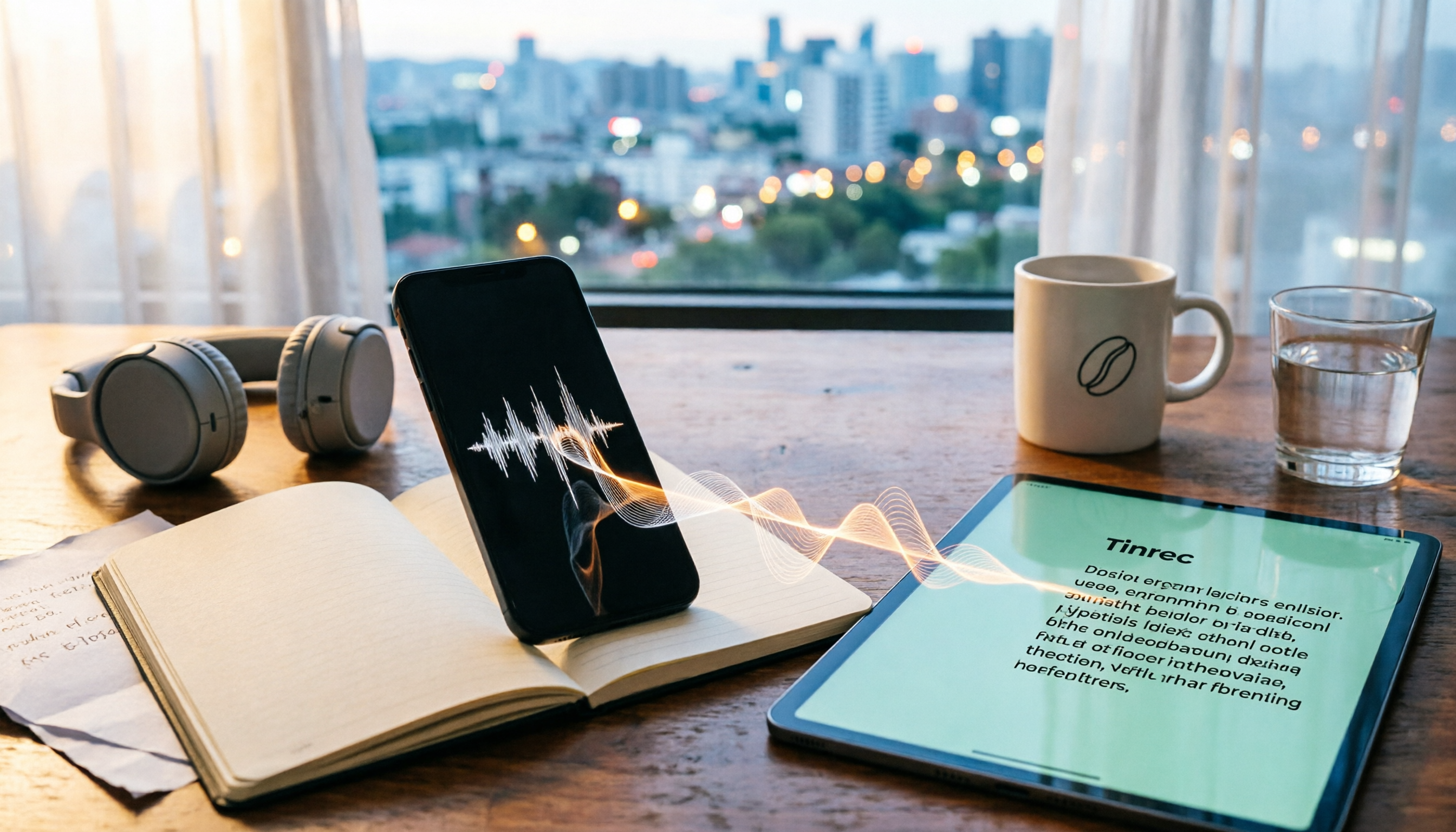
For a two-hour meeting, you have the recording file and the MP3 converted. Then what? You still have to listen from the beginning, type out a transcript sentence by sentence, and then organize who said what and what the action items are. This often takes longer than the meeting itself.
This article addresses that post-recording phase. First, we'll cover file formats, then how to choose a tool that can turn .m4a recordings into usable data.
Before Buying an iPhone Recording Organization Tool, Understand These 4 Key Points
1. Supported File Formats and Sources
You may need to organize not just iPhone .m4a files, but also MP3s, video files on your computer, or even a web video link. The more formats a tool supports, the less you need to convert beforehand. Tinrec supports importing audio and video files, and can also handle some web link content.
2. Chinese and Mixed Chinese-English Recognition Performance
Most transcription tools are designed for English meetings. If you record Chinese meetings or discussions with mixed Chinese and English, the recognition results vary greatly. Tinrec focuses on Chinese, Traditional Chinese, and multilingual meetings, and supports real-time translation and bilingual viewing.
3. What You Can Do After Transcription
A tool that only provides a transcript essentially throws the organization work back to you. Whether it offers summaries, chapters, action items, and the ability to ask questions about the recording content is where real time savings come from.
4. Whether to Keep Recordings and for How Long
Some tools don't save meeting audio files, keeping only text after recording. If you need to replay for verification, you must first confirm whether the tool retains the original recording. Tinrec supports saving audio and provides a team recycle bin mechanism.
Tinrec (Miao Ting Lu Yin) — Our Top Pick After Testing
Tinrec (Miao Ting Lu Yin) is an AI meeting notes and collaboration tool for individuals and teams, supporting web, desktop, and mobile. It doesn't just convert sound to text; it helps you organize a meeting into searchable, queryable, and further processable data.
In practice, it works like this:
During recording, you can start real-time recording and get a transcript as you record. For online meetings, the desktop version directly captures computer system audio, without needing to invite a meeting bot as a participant. This is quite thoughtful for those who don't want a bot appearing in the participant list. During recording, you can also get real-time translation, viewing original text, translation, or bilingual.
After recording, AI automatically generates summaries, chapters, and key points, breaking a long meeting into easily browsable sections. Action items are also organized—who is responsible for what and by when—much faster than manually going through the transcript yourself.
Even better is AI Q&A. You can directly ask it, "Who mentioned the budget in the last meeting?" It will provide answers based on semantic understanding, rather than dumping a bunch of keyword search results. From the same recording, you can also continue to generate reports, tables, or meeting minutes.
Stop organizing recordings by hand
Upload audio or video and automatically get a transcript, summary, and action items
For output, results can be exported to common file formats and brought into tools you already use like Notion, Google Docs, OneNote, Dropbox, without retyping.
Note that Tinrec's accuracy can be affected by recording quality, ambient noise, accents, and multiple people talking over each other. For important content, it's recommended to cross-check with the transcript timestamps and original recording.
Limitations: The free version provides basic quota to experience recording, importing, summaries, and transcription. If you have steady weekly needs, consider Pro; for short-term sprints, you can choose a weekly pass. Heavy users and teams can look at the team version—the team version is an independent collaboration space including members, roles, seats, shared quota, usage analytics, audit logs, and audio recycle bin.
Who it's for: If you often record Chinese meetings, want to use AI to find key points directly after recording, and don't want to be tied to specific hardware or operating systems, Tinrec is a worthwhile first stop to try.
Besides Tinrec, What Other Options Are There?
Otter.ai: A mature English business meeting assistant. Basic free plan offers 300 minutes per month; Pro annual billing is about USD 8.49/month. It has a strong mindshare for English meetings. If most of your recordings are in English, consider it. However, Tinrec emphasizes Chinese meeting experience more and also offers Agent post-processing to generate reports and tables from meeting content.
Notta: A multi-platform transcription and translation tool. Free version offers 120 minutes per month, with a single content limit of 3 minutes. Pro annual billing is about USD 8.17/month. It suits those who simply need transcription and subtitles. But Tinrec's desktop bot-free recording, team space, and AI Q&A are areas Notta doesn't cover.
PLAUD Note/NotePin: A representative of AI recording hardware. NotePin starts at USD 159 on the US official website, with membership billed separately. It suits those who like a portable physical device and need phone call recording. But this means you have to buy an extra device; Tinrec runs the full process via web, desktop, and mobile, and handles online meetings better.
Pitfall Guide: The 3 Most Common Mistakes When Organizing iPhone Recordings
Pitfall 1: Thinking converting to MP3 is the end. Converting .m4a to MP3 only solves the "playback" problem, not the "organization" problem. The real time-consuming part is turning content into transcripts, summaries, and action items. Conversion is just the first step.
Pitfall 2: Only looking at official accuracy claims. Many tools boast high accuracy, but that's usually measured in quiet environments. Real meetings have air conditioning noise, keyboard sounds, and multiple people talking over each other. It's recommended to test the free version with your own recordings, not just look at advertising numbers.
Pitfall 3: Using a transcription tool as a typewriter. If you only use it to turn recordings into text, you're only using part of its capabilities. With Tinrec's AI Q&A, you can directly ask "What was the conclusion of this meeting?" after recording, much faster than manually going through a 30-minute transcript.
Conclusion: Which One Should You Choose?
Simply put, iPhone recordings are .m4a files—that's a format issue; the hard part is how to turn the content into usable data after recording.
- Want to handle .m4a, MP3, video files, and need Chinese recognition → Tinrec (multi-format import, Chinese and multilingual focus)
- Want to use AI to find key points and ask questions directly after recording → Tinrec (AI Q&A and post-processing)
- Want to switch between phone and computer → Tinrec (web, desktop, mobile)
- Meeting data needs to be shared, retained, and handed over within a team → Tinrec team version (team space, seats, audit, recycle bin)
- Mainly record English meetings, limited budget → Otter.ai (free 300 minutes/month, mature English mindshare)
We suggest starting with Tinrec's free version, running a real .m4a recording you have on hand, and seeing if the transcript and summary are sufficient. If it feels good, then consider upgrading—no need to pay upfront.
References
- Record in Voice Memos on iPhone - Apple Support (Taiwan)
- [Phone Tips] How to upload/save iPhone Voice Memos recordings to a computer and convert to MP3? | Jyes Communication ~ Challenge the lowest phone market price
- Organize recordings in Voice Memos on iPhone - Apple Support (Taiwan)
- Export Voice Memos recordings to Files on iPhone - Apple Support (Taiwan)
- How to record iPhone calls? 5 iPhone call recording methods revealed!
Turn every recording into actionable outcomes
Get 60 free transcription minutes when you sign in. No credit card required.
Related Reading
You might also like

3 LINE Call Recording Methods Tested for 2026: How to Record on iPhone and Android, and How to Organize Recordings
LINE does not have a built-in call recording button, but iPhone users on iOS 26 can use the built-in "Local Capture," while Android users can use screen recording or Cube ACR, or use speakerphone with an external recording device. This article covers 3 tested methods, common mistakes, and legal reminders, and explains how to use Tinrec to turn call recordings into transcripts, summaries, to-dos, and searchable team data.
5 LINE Call Recording Methods Tested and Compared in 2026: How to Turn Recordings into Transcripts
LINE doesn't have a built-in call recording feature, but the real challenge isn't capturing the call—it's ending up with only your own voice or an audio file no one wants to listen to twice. This article reviews 5 common LINE call recording methods, tests the pitfalls of each, and explains how to use Tinrec to turn audio files into searchable, queryable transcripts and meeting notes. It also highlights legal considerations before recording.

Google Meet Recording Tools Compared: 4 Options for Automatic Transcripts in 2026
We start with how to download and install Google Meet on Android, iOS, desktop, and web, then compare Tinrec, Otter.ai, Granola, and Notta on post-meeting transcripts, summaries, action items, and team collaboration to help you find the most time-saving meeting notes setup.

How to Use Google Meet on TV in 2026: Chromecast Casting & Meeting Notes
How do you use Google Meet on TV? This guide clears up common misconceptions, explains why Android TV doesn't support meeting mode, how to cast with Chromecast and Google TV Streamer, and how to use Tinrec desktop to record Google Meet without a bot—generating transcripts, summaries, and action items.

Google Meet On-the-Go vs Tinrec: Which Is Better for Mobile Meetings in 2026?
Google Meet On-the-Go lets you join meetings while walking or commuting, but it only solves live participation—post-meeting organization still needs a separate solution. This article compares Google Meet On-the-Go and Tinrec for mobile meeting scenarios, focusing on post-meeting processing, cross-platform export, and team collaboration to help you decide which approach to use.

4 Ways to Record LINE Calls in 2026: Which One Actually Captures Both Sides?
LINE doesn't have a built-in call recording feature, but you can still capture calls using iOS 26 local capture, built-in Android recording, speakerphone with an external recorder, or third-party apps. This article tests 4 methods and explains how to use Tinrec to turn recordings into transcripts, summaries, and action items so your calls become searchable and useful.

4 Recording Archive Tools Tested: How to Save LINE Voice Messages Long-Term in 2026
LINE voice messages don't have a built-in download button, and saving them to your phone doesn't mean they're permanently stored. This article starts with common archiving mistakes, outlines 4 key points for choosing a recording archive tool, compares Tinrec, Otter.ai, Granola, and Notta, and includes a pitfalls guide and selection advice.

5 LINE Call Recording Methods Tested and Compared in 2026: iPhone, Android, or PC — Which Is Easiest?
Can you record LINE calls? This article covers 2026 methods including iPhone native capture, Android built-in call recording, screen recording, PC recording, and AI organization tools, and tests how Tinrec turns LINE call recordings into transcripts, summaries, and to-dos.

4 LINE Call Recording Methods Tested for 2026: Which Actually Works on iPhone, Android, or PC?
LINE still doesn't offer built-in call recording, so in 2026 you'll need to combine methods to save important calls. This hands-on guide covers current options for iPhone, Android, and PC, and compares the most time-consuming part—organizing recordings—including how Tinrec, Notta, Otter.ai, and PLAUD Note differ, so you can find a workflow that actually works.