
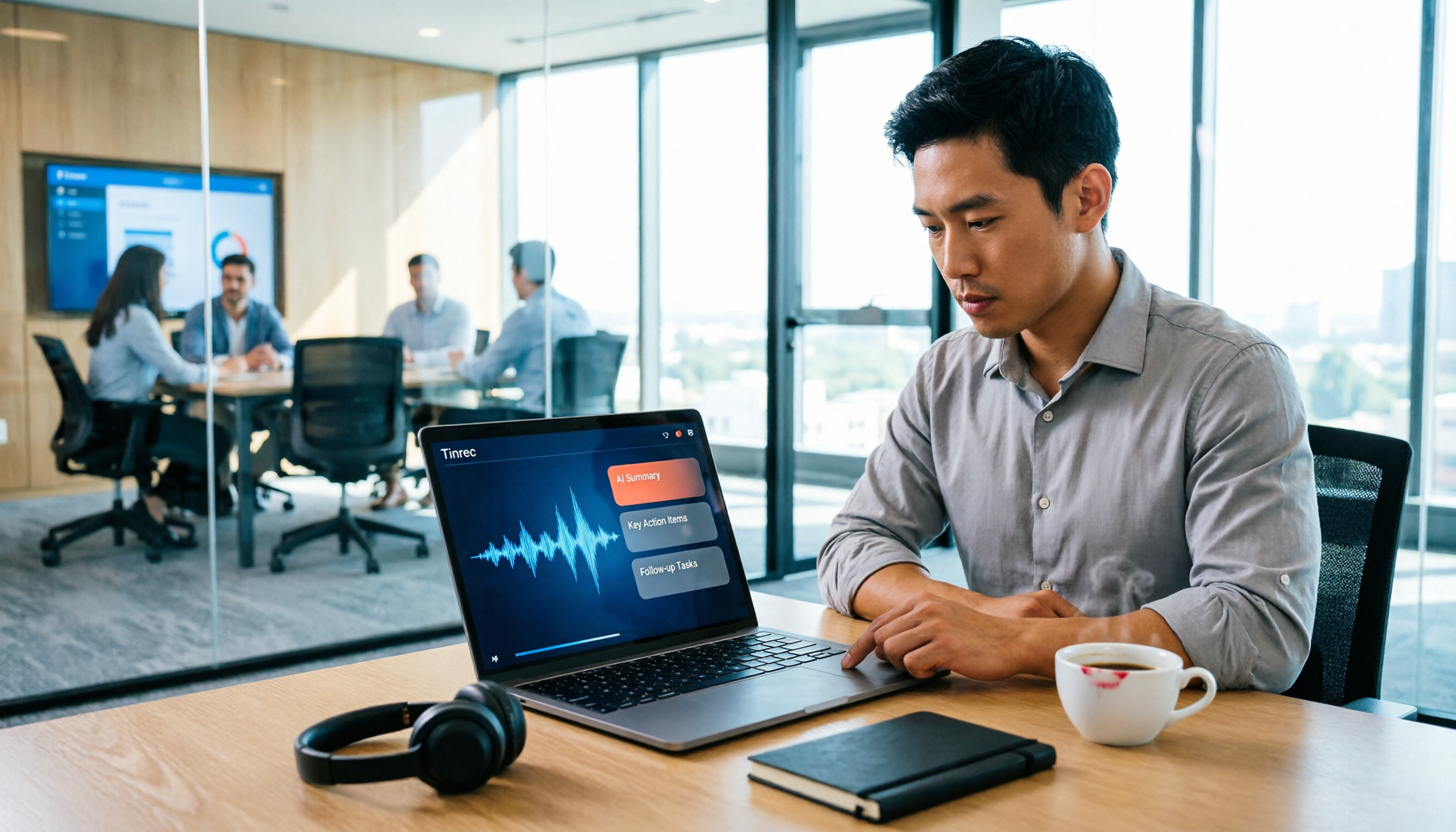
Turn recordings into transcripts and summaries in minutes
Upload audio or video for multilingual transcription, AI notes, and action items
Best Real-Time Transcription Tools in 2026: 5 Options Tested, This Free One Is Enough
After a meeting, your boss asks "Where are the meeting notes?" but you're still re-listening to a two-hour recording, typing out the transcript by hand, and worrying that this month's tool subscription fees will blow your budget again. This scenario is probably a shared pain for anyone who needs to organize meeting content. Real-time transcription tools have rapidly become popular in recent years, with options ranging from free versions to individual paid plans and team solutions, but how do you calculate which is actually cost-effective? This article skips vague definitions and takes you through features, pricing structures, real-world scenarios, and purchasing considerations all at once. The entire article uses Tinrec as the primary example because it covers real-time transcription, post-meeting organization, and team collaboration, turning "transcription costs" into "meeting data productivity."
What Can Real-Time Transcription Do for You?
Real-time transcription tools aren't just about turning sound into text. What they really solve is the problem of "how to use the data after the meeting ends." Here are four scenarios, using Tinrec as an example:
Scenario 1: Get transcripts and summaries immediately after a meeting Previously, after a two-hour meeting, you'd still need to spend another hour organizing notes. Tinrec supports real-time recording-to-text, so you can see the transcript while the meeting is in progress; after the meeting ends, AI generates summaries, chapters, and key points, making it clear who's responsible for what and what the deadlines are. This is especially noticeable for teams that meet more than three times a week—what you save isn't just typing time, but the cost of searching and tracking later.
Scenario 2: Online meetings without extra bots joining Tinrec's desktop version captures computer system audio to record online meetings, without needing to invite a meeting bot as a participant. It can handle meeting audio played on a computer from platforms like Zoom, Google Meet, Microsoft Teams, and Webex. For client meetings or internal decision-making meetings, having one less bot join means one less interruption and concern.
Scenario 3: Quickly organize interview and classroom recordings After an interview or class, you can upload the audio file to Tinrec, quickly convert it to a transcript, and then use AI summaries to extract key points and action items. If the content is cross-language, you can also use real-time translation to view it in the original language, translated version, or bilingual format.
Scenario 4: Team meeting data accumulation and handover The team version centralizes meeting recordings, transcripts, summaries, action items, and member management in a single team space. New members can view historical meeting data, and when members leave, they can hand over their team resources to other active members, preventing meeting knowledge from disappearing when people leave.
What Are the Core Capabilities of Real-Time Transcription Tools?
When choosing a tool, don't just look at "transcription minutes." The value of real-time transcription lies in whether it can continue to be used after transcription. Here are five core capabilities, explained using Tinrec's implementation:
1. Real-time recording-to-text: Transcribe while recording, not waiting until after
Tinrec supports real-time recording-to-text, suitable for offline meetings, interviews, and on-site recording. For those who need to confirm content synchronously, viewing the transcript while recording helps catch missed key points early, rather than re-listening after the meeting.
2. Bot-free online meeting recording: No extra participants
Tinrec's desktop version directly captures device system audio. Users initiate bot-free recording and real-time transcription through the desktop version, without adding a bot to the meeting. This is a smoother choice for teams that value meeting flow and privacy.
3. AI summaries, chapters, and action items: Turn long meetings into short ones
Tinrec doesn't just provide transcripts; it automatically generates summaries, chapters, key points, and action items. The worst part of long meetings is not finding the conclusion. With chapters and action items, you can jump directly to key sections and assign follow-up actions.
4. AI Q&A and multi-format export: Continue asking questions after transcription
Tinrec supports AI Q&A around meeting content, such as "Who mentioned the budget in the meeting?" or "What was the client's feedback?" It answers directly based on semantic understanding. Meeting results can also be exported to tools like Notion, Google Docs, OneNote, and Dropbox, or further generate reports, tables, and documents.
5. Team space and permission governance: Turn meeting data into team assets
Tinrec's team version provides an independent team space where meeting data belongs to the team. Administrators can set owners, admins, and regular members, assign, revoke, or transfer seats, and view team usage trends, member rankings, and audit logs. Even without a seat, members can still view, play, and read team data; only after obtaining a seat can they record, upload, edit, and import/export.
Practical Application Scenarios
Meeting notes: No more chasing recording files
Weekly meetings, review meetings, cross-department meetings—the most common situation is "no one remembers the conclusion after the meeting." Using Tinrec as an example, transcripts are generated in real-time during the meeting, and summaries and action items are automatically produced afterward. Managers can view historical meetings in the team space and track the progress of action items.
Stop organizing recordings by hand
Upload audio or video and automatically get a transcript, summary, and action items
Client interviews: Preserve the original context of needs and commitments
Sales or customer success teams visiting clients often need to record needs, objections, and commitments. Tinrec can transcribe in real-time and quickly find key client needs through AI Q&A after the meeting. Transcripts can also be exported to existing workflows for easy organization into proposals or follow-up emails.
Classes and lectures: Learning content can be searched and questioned
Students or researchers can upload course and lecture recordings to Tinrec to quickly obtain transcripts and summaries. When citations are needed, you can review the transcript timestamps for verification; when reviewing, you can also ask questions directly through AI Q&A without re-listening from the beginning.
Content creation and video subtitles: Accelerate post-production
Podcast and video creators need to turn interview content into articles or subtitles. Tinrec supports audio and video file transcription and multi-format export, bringing transcripts into editing or writing workflows. For mixed Chinese-English content, it can also be viewed bilingually, reducing translation and proofreading time.
5 Things to Note When Choosing a Real-Time Transcription Tool
1. Pricing structure and billing units: Don't just look at the monthly fee, look at "how benefits are calculated"
Real-time transcription tool costs typically fall into free versions, individual paid plans, and team solutions. Tinrec's individual version has a free version, weekly pass, Pro monthly, and Pro annual, suitable for different usage frequencies: for occasional recording organization, start with the free version; for short-term concentrated meetings or interviews, consider the weekly pass; for stable weekly use, Pro is more suitable; for long-term recording data accumulation, the annual pass is better. The team version is priced per paid seat, with monthly payment at USD 29.80/paid seat/month and annual payment at USD 199/paid seat/year, equivalent to about USD 16.58/month. Each paid seat provides 2,000 minutes of team shared import quota per month; under a valid team plan and valid seats, real-time recording is currently not deducted by minutes, while file and web imports consume team shared import minutes. Actual prices and promotions are subject to the official purchase page.
2. Real-time performance and latency: Can you view synchronously during meetings?
Some tools require uploading recordings before transcription, suitable for post-meeting organization; but if you need to confirm content synchronously during meetings, choose a tool with real-time transcription capability. Tinrec's real-time recording-to-text allows viewing while recording, especially useful for interviews and meeting notes.
3. Chinese and multilingual support: Test Taiwanese accents and mixed Chinese-English
Meetings in Taiwan often mix Chinese and English, and even include technical terms. Tinrec covers Chinese, Traditional Chinese, and multilingual meeting scenarios, and supports real-time translation and team hotwords. Actual performance is affected by recording quality, noise, accents, overlapping speakers, and technical terms. It's recommended to try it with your own recordings.
4. Post-meeting organization and secondary use: The transcript is not the end
After transcription, whether it can automatically generate summaries, chapters, and action items, whether you can ask questions around the content, and whether it can export to existing tools determines whether this cost is worth it. Tinrec provides AI summaries, chapters, action items, Q&A, and Agent post-processing after transcription, allowing meeting content to continue becoming reports, tables, and documents.
5. Team collaboration and governance: Distinguish permissions, seats, and usage
Team procurement most easily confuses "roles" and "seats." In Tinrec's team version, roles determine who can manage the team, members, audits, and team settings; seats determine whether members can record, upload, edit, import/export, and use team resources. Team resources belong to the team, not the individual uploader. The current team version is primarily team-level sharing, where all active members can read team data, but it is not a fine-grained file ACL system.
Frequently Asked Questions
Q1: How are real-time transcription tool costs generally calculated? There are three common pricing methods: free versions provide a fixed quota, individual paid plans are calculated monthly or annually, and team solutions are priced per seat. Using Tinrec as an example, the individual version has a free version, weekly pass, Pro monthly, and Pro annual; the team version is USD 29.80/paid seat/month for monthly payment and USD 199/paid seat/year for annual payment (about USD 16.58/month), with each paid seat providing 2,000 minutes of team shared import quota per month. Actual prices are subject to the official website purchase page.
Q2: Is Tinrec's free version enough? If you only occasionally organize a recording, the free version can serve as an entry point. The product provides a basic quota for users to experience recording, import, summaries, and transcription. If you have stable weekly meetings or interviews, consider the Pro monthly or annual; for team sharing needs, evaluate the team version seats.
Q3: What's the difference between Tinrec's team version and individual version? Individual version data is managed by the personal account. The team version provides an independent team space where meeting data belongs to the team, and adds capabilities such as members, roles, seats, shared benefits, usage analysis, audit logs, and audio recycle bin. The team version is not "multiple people sharing one personal account."
Q4: Can team members without seats view meeting data? Yes. Active members without seats can still view, play, and read team data; only after obtaining a seat can they perform resource usage operations such as recording, uploading, editing, and import/export.
Q5: Can AI transcription completely replace manual typing? It's not recommended to understand it that way. AI transcription can greatly reduce manual recording costs, but in situations with overlapping speakers, dialects, technical terms, or noisy environments, it may still miss or misunderstand details. For important content, it's recommended to combine transcript timestamps and recording playback for verification. Tinrec's value lies in connecting recording, organization, questioning, and team collaboration into one workflow, rather than claiming 100% accuracy.
Conclusion
The cost of real-time transcription tools should not be judged solely by "how much per minute." What you're really buying is the efficiency of post-meeting organization, searchable meeting data, and the way teams collaborate. Tinrec puts real-time transcription, AI summaries, action item extraction, AI Q&A, multi-format export, and team space into one workflow; individuals can start with the free version, and teams can evaluate the team version based on seats and shared quotas. If you're looking for a tool that can handle both real-time transcription and post-meeting collaboration, Tinrec is a choice worth trying first.
References
- 2026 Transcription Rate and Fee Overview: Are Free AI Transcription Tools Good? | Tasker Article Column
- Meeting Speech-to-Text and Transcription: Which AI Tool to Use? Free vs Paid Feature Comparison | Manager Today
- Yating Transcription: Online Speech-to-Text Service, Fee Introduction at a Glance! | Comprehensive AI Tool Introduction - Future Commerce
- No More Transcription Hassles! AI Transcription Helps You! Comparison and Review of 9 Major Transcription Tools
- 2026 Complete Inventory of Free Transcription Platforms: Review and Recommendation of 15 Free Speech-to-Text Tools
Turn every recording into actionable outcomes
Get 60 free transcription minutes when you sign in. No credit card required.
Related Reading
You might also like
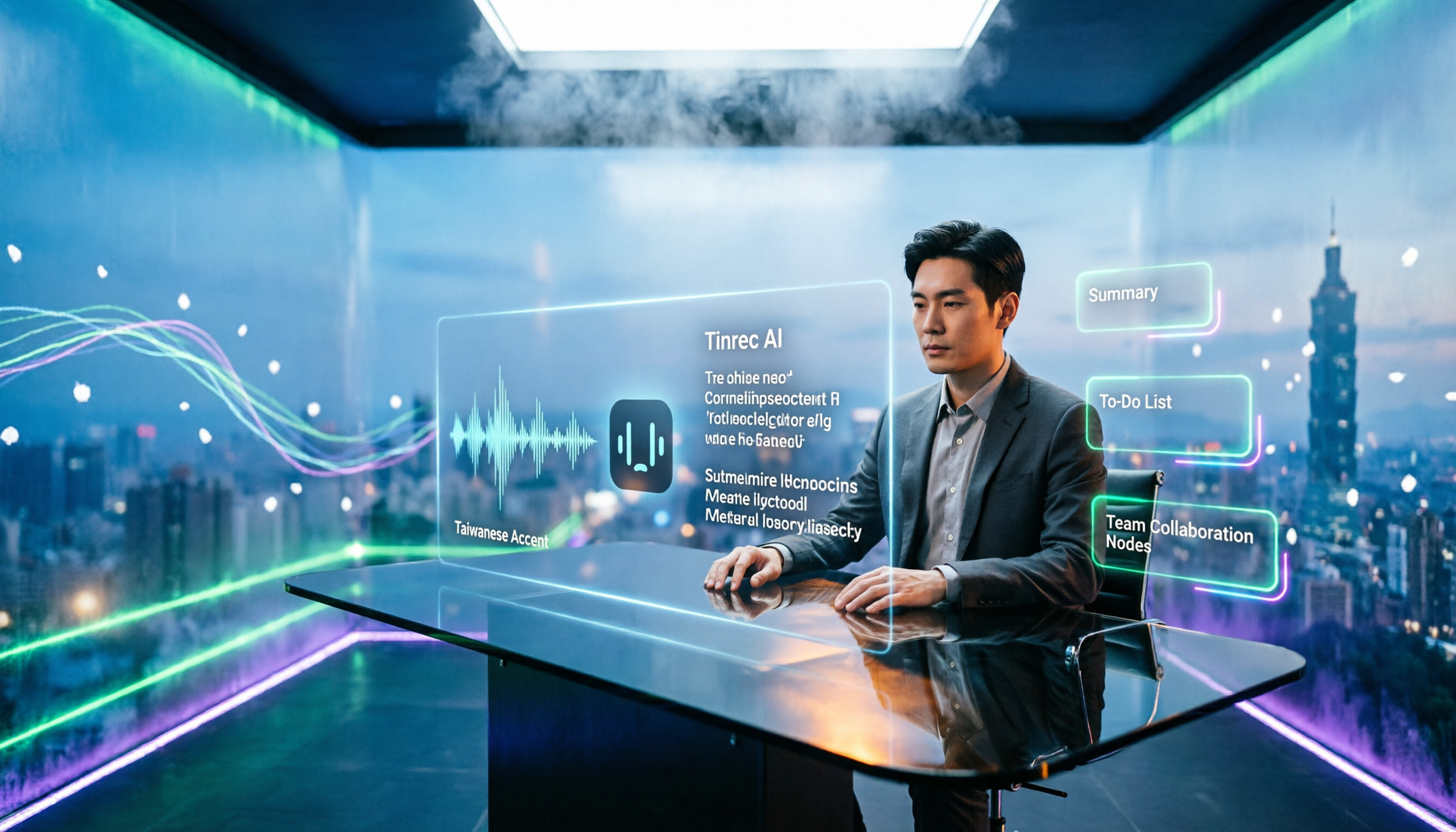
2026 Comparison of 2 Transcription Tools: What Is Yating Transcription? How Does It Differ from Tinrec?
Many people think transcription tools are all about who recognizes speech more accurately, but the real difference comes after recording. This article compares Yating Transcription and Tinrec across 5 dimensions: Taiwanese accent recognition, online meeting recording methods, post-meeting summaries and action items, pricing plans, and team collaboration, to help you decide which workflow suits you.

3 iPhone Voice Typing Methods Compared in 2026: Built-in Dictation, Tinrec, or Notta — Which Is Most Accurate?
How do you use voice typing on iPhone? This article compares three methods—built-in dictation, Tinrec, and Notta—covering setup steps, recognition accuracy, and post-meeting organization to help you find the best voice input method for your needs.

iPhone Frozen? 2026 Guide: Force Restart vs DFU Recovery Mode Compared
iPhone suddenly black screen and unresponsive? Should you force restart first or plug into a computer? This article compares force restart vs computer recovery mode/DFU across 5 dimensions—difficulty, data risk, time, and applicable symptoms—with button steps for each model and when to seek repair, helping you decide your next step in 5 minutes.

2026 AI Transcription Tools Comparison: Which Is Best for Chinese Meeting Minutes?
The real pain begins after the meeting—replaying recordings, extracting key points, and writing minutes often takes more time than the meeting itself. This article compares AI transcription tools like Tinrec, Otter.ai, Notta, and PLAUD, covering differences in Chinese and mixed Chinese-English recognition, online meeting audio capture, AI summary Q&A, and team data management. It also highlights key purchasing factors and common pitfalls to help you find the most time-saving option.

Can iPhone Be Used as a Level in 2026? Measure App vs Camera Level: 5-Dimension Comparison, Which to Use for Home Improvement and Photography?
Can iPhone be used as a level? Yes. This article tests the built-in Measure app level, the iOS 17 camera level, and the level measurement feature that may be hidden in the Compass app on older versions. It organizes 5 practical dimensions, step-by-step instructions, and pitfalls to help you quickly determine level when hanging pictures or composing photos.

5 Professional AI Tools Tested in 2026: Which Offers the Best Free Tier for Students?
During my freshman year, I juggled three AI tools at nearly $500 a month, but only one was actually opened daily. This article tests five common approaches from a student's perspective—from lecture recordings and group discussions to graduation project interviews—explaining how to calculate free tiers, which pitfalls to avoid, and why I ultimately consolidated my notes and meeting records into Tinrec.
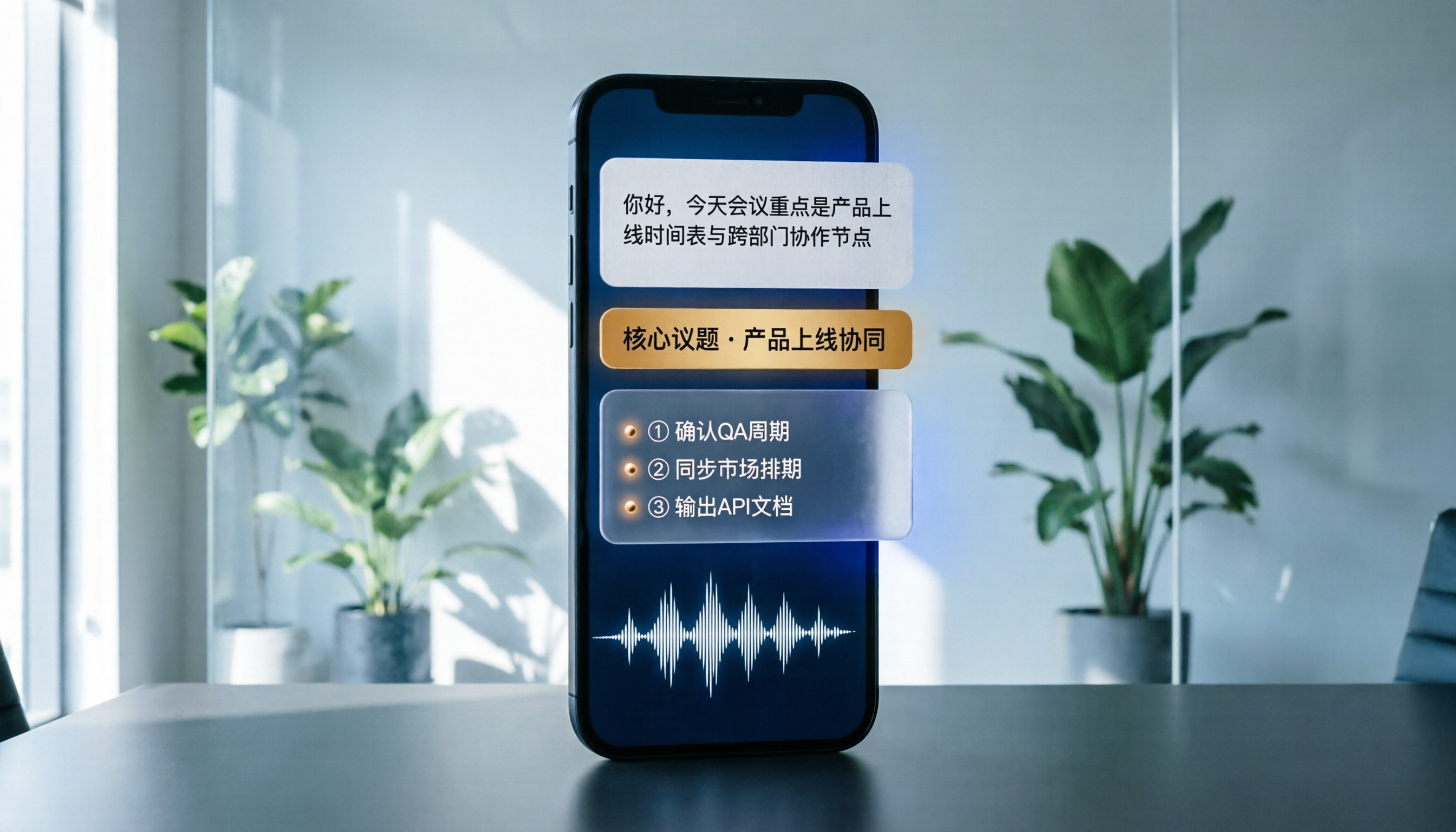
Best Phone Recording Apps in 2026: We Tested 5 — This One Makes Chinese Transcripts and Meeting Notes Easiest
Recording on your phone is easy; the hard part is what comes after. Based on real scenarios like meetings, interviews, and classes, this guide covers common iPhone recording methods, the 5 key factors to consider when choosing a recording tool, and uses Tinrec as an example to show how to turn a recording into a searchable transcript, summary, and to-do list.
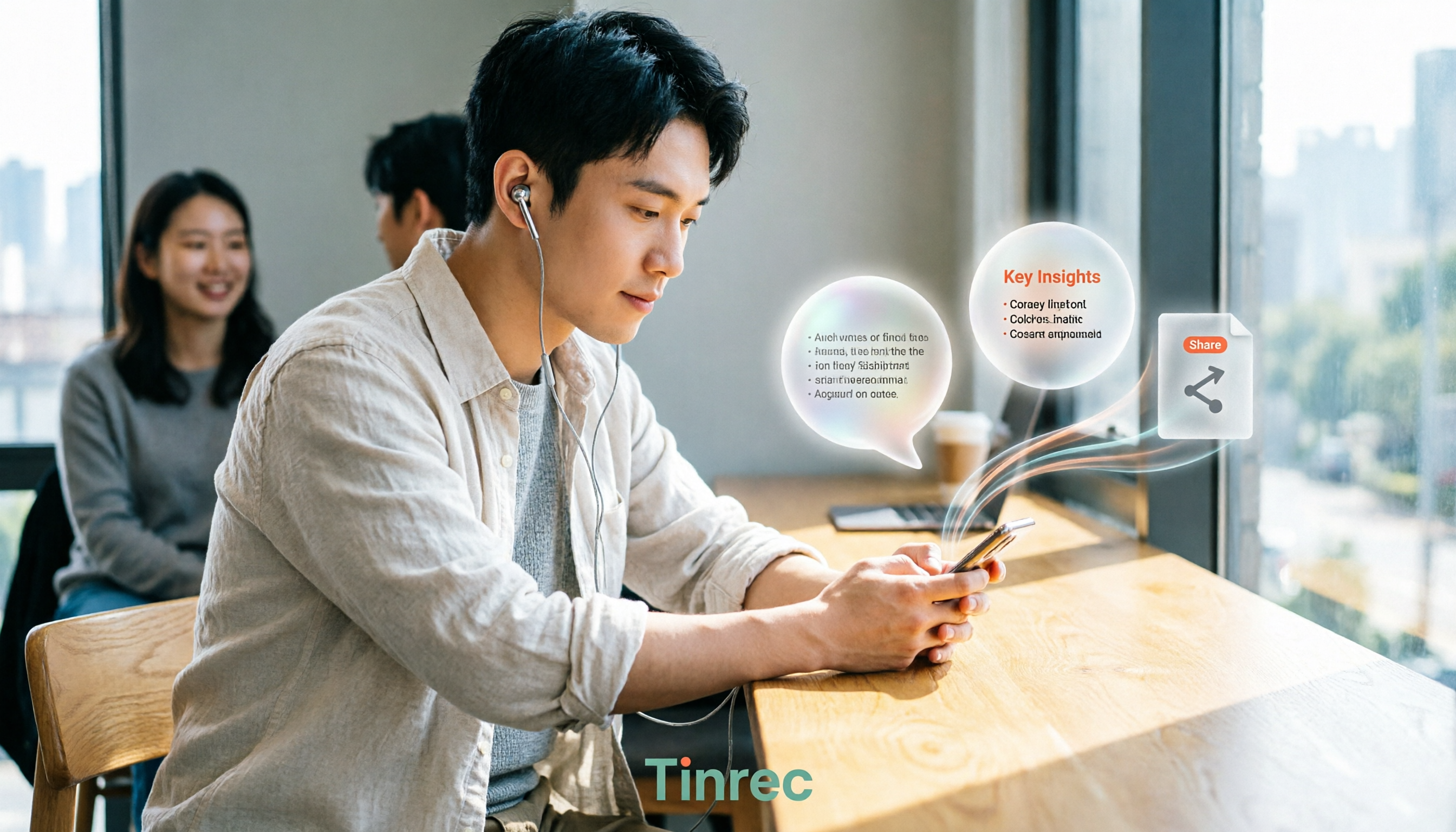
3 WeChat Voice Forwarding Alternatives Tested for 2026: How to Turn Voice Messages into Shareable Text
WeChat does not offer a voice forwarding feature, so received voice messages stay in the original chat. This article explains why this limitation exists and three common misconceptions, then uses Tinrec as an example to show how to turn voice into transcripts, summaries, and shareable documents, while comparing personal and team plans and offering buying advice.
2026 Live Transcription Tools Compared: Free Tiers and Per-Minute Costs
How do you do live transcription, and how much does it cost? This article compiles actual rates for human transcription in Taiwan (general conversation NT$15-25 per minute, multi-speaker or foreign language NT$40-70, rush jobs add 50-100%), and compares free tiers, plan limits, and live transcription tutorial steps for tools like Tinrec, Notta, Granola, and Otter.ai, helping you find the most cost-effective approach within your budget.