

Turn recordings into transcripts and summaries in minutes
Upload audio or video for multilingual transcription, AI notes, and action items
Last month I helped a research team organize interview data.
Eight interviews, each about 90 minutes. If I followed the old method—put on headphones, play, pause, type, rewind—each one would take four to six hours.
But the real headache wasn't the typing.
It was that "the audio hadn't even gotten to a place where I could process it." The interviews took place on Google Meet, so the audio was in the browser; another set was Zoom recordings provided by the client; and one was recorded by a colleague directly on a phone in the meeting room. Three sources, three formats, three ways to handle them.
If you've recently been searching for "how to extract text from video audio," you're probably running into the same thing: it's not that you can't type, it's that the audio is stuck in a meeting app, a video file, or a cloud link—and no one has paved the road before "becoming text."
So in this article I won't talk about specs. I want to make that road clear.
Before extracting video audio text, understand these 4 key points
1. How does the audio get into the tool?
This is the first hurdle everyone gets stuck on.
There are three common approaches: invite a meeting bot to join the meeting, use desktop software to capture your computer's system audio directly, or upload the recording afterward.
All three are used, but they differ a lot. When a bot joins a meeting, some participants may mind, and some company environments may not allow it. Uploading files afterward is the simplest, but you have to get the file first.
What I've come to prefer is the "desktop capture of system audio" route—the meeting goes on as usual, and you don't have to invite anyone in.
2. What do you actually get after transcription?
A transcript alone and "data you can directly work with" are two completely different things.
A 90-minute transcript is probably several thousand words. When you open it, you still have to read it from start to finish yourself to find "so what was the conclusion" and "who agreed to what."
So when I choose a tool, I always ask one question: after transcription, what else can it do for me?
3. What is your language context?
Chinese meetings, mixed Chinese-English technical discussions, and multilingual meetings across international teams—these three are completely different in difficulty.
There's also an easily overlooked detail: product codenames and technical terms that come up often in the team. If the tool doesn't recognize them, the transcript will be full of errors, and fixing them afterward is more tiring than retyping.
4. Where does this data end up?
If you're organizing an interview by yourself, this question doesn't matter.
But if this is a team's weekly routine meeting, storing data in a personal account is a problem: once the person leaves, the records disappear with them; when a new person joins, they can't see the past decision context.
That's why I started caring about "team spaces."
Tinrec—the one I kept using after testing
Tinrec is an AI meeting notes and collaboration tool for individuals and teams, available on web, desktop, and mobile.
After actually running it through several meetings, three things stood out most.
First, online meetings don't need a bot.
I keep the desktop version open, the meeting goes on as usual in Google Meet, and it directly captures the computer's system audio, generating a transcript while recording. Meeting audio played on a computer, such as Zoom, Microsoft Teams, and Webex, can also be handled this way.
The value here isn't just convenience—it's that no one will ask you "who is that account that joined the meeting?"
Second, after recording, it doesn't just give me a transcript.
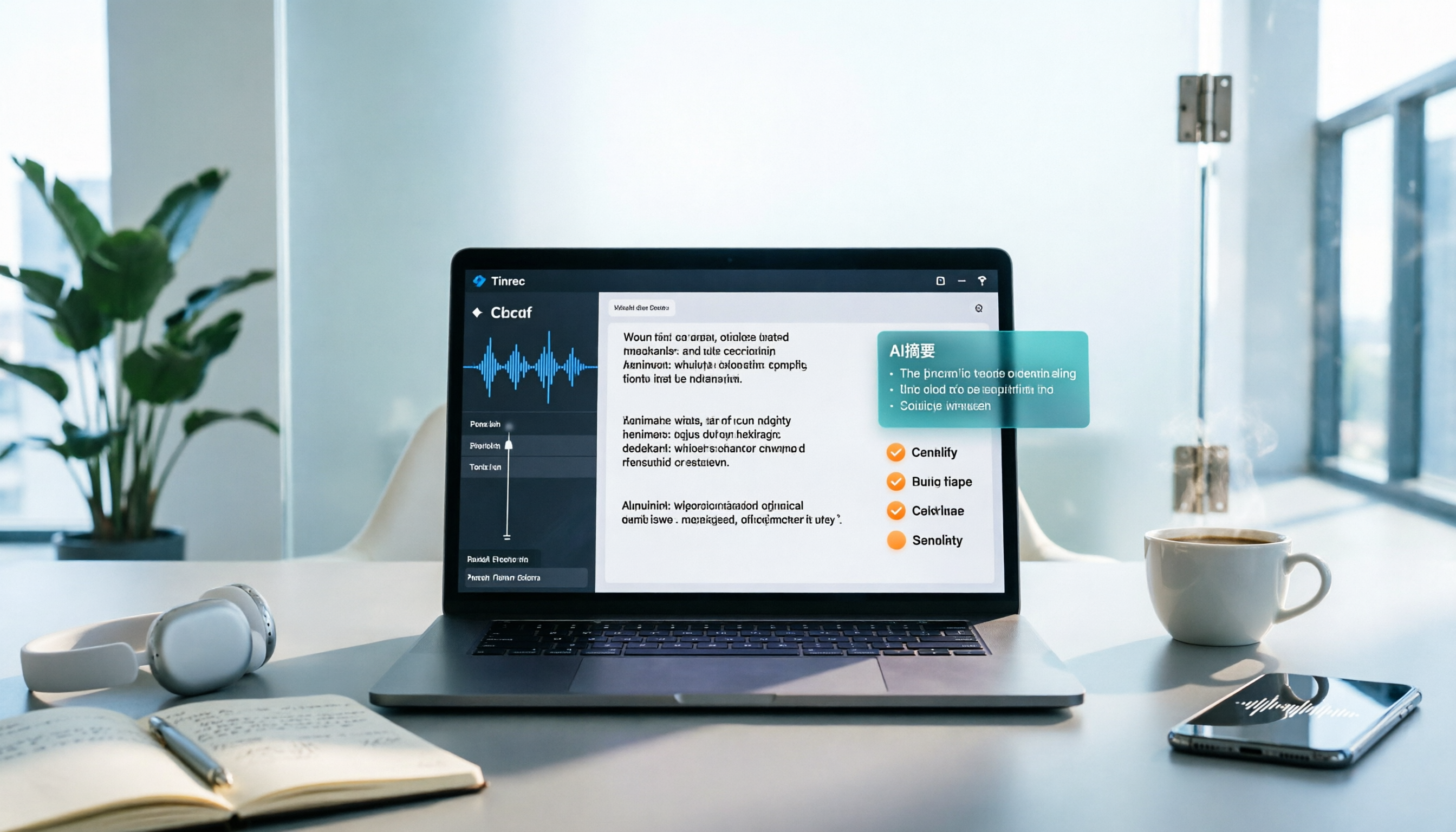
After the meeting ends, it produces a summary, chapters, key points, and action items. Who is responsible for what and what needs to be confirmed next time are listed directly.
The workflow is like this: start recording during the meeting, after the meeting first look at the summary to get the direction, and when you need details, go back to the transcript's timestamps. I used to read from start to finish; now it's "look at the skeleton first, then the meat."
Third, you can ask questions directly about the meeting content.
This is the part I find most practical and also most easily underestimated.
In the past, to find "who mentioned the budget last time," you had to use Ctrl+F to search keywords and guess which term the other person used at the time. Now I just throw the question at it, and it answers based on semantics.
My common way of asking goes like this (you can copy and modify it directly):
"Based on this meeting, please organize three things: 1. Items that were clearly decided 2. Each person's assigned action items and deadlines 3. Issues that were mentioned but not yet finalized. Please use bullet points and mark the corresponding timestamps."
You can also ask about several meetings from the same project together, for example: "Across these three meetings, is there any inconsistency in what was said about the launch timeline?"
In addition, it can export results to tools like Notion, Google Docs, OneNote, and Dropbox for further processing, and can generate reports, tables, and documents based on meeting content. For cross-language meetings, you can view the original text, translation, or bilingual content while recording.
Three main advantages I see:
Stop organizing recordings by hand
Upload audio or video and automatically get a transcript, summary, and action items
- Desktop captures system audio, so you don't need to invite a meeting bot, and the meeting flow is completely undisturbed.
- From transcript to summary, action items, Q&A, and export is an end-to-end flow, so you don't have to move data back and forth between multiple tools.
- The organizing experience for Chinese and mixed Chinese-English meetings is smooth, and teams can maintain their own commonly used terms.
Two limitations to know before use:
First, transcription quality is affected by recording conditions—background noise, accents, multiple people talking over each other, and technical terms can all cause differences in results. For important content, I still go back to verify the transcript timestamps and the original recording.
Second, quota rules differ by source. Real-time recording currently does not deduct by minutes under an active team plan, but file uploads and web link imports use shared quota. The free version can be used first to experience the flow, and heavy users can upgrade later.
Who it's for:
If your meetings are held online, you don't want to add a bot, you need Chinese or mixed Chinese-English organization, and you want to find key points directly through Q&A after recording—Tinrec will currently be the smoothest choice.
If you're leading a team:
The team version is not "multiple people sharing one personal account," but an independent team space. You can create multiple teams, invite members via link, distinguish owner/admin/regular member, and store meeting data centrally in the team.
There's a commonly confused concept to clarify here: roles determine who can manage the team, and seats determine who can record, upload, edit, and export. Active members without a seat can still view, play, and read team data, but cannot perform resource-usage operations.
On pricing, eligible teams get a first trial of 7 days, 1 free seat, and 300 minutes of team shared import quota; afterward, monthly billing is USD 29.80 per paid seat per month, and annual billing is USD 199 per paid seat per year (about USD 16.58 per month), with each paid seat providing 2,000 minutes of team shared import quota per month. Actual prices and promotions are subject to the official purchase page.
Besides Tinrec, what other options are there?
Notta: A multi-platform transcription tool that supports meeting notes, document import, translation, and team plans. The free version offers 120 minutes per month, with a maximum of 3 minutes per item; Pro annual billing is about USD 8.17/month, with 1,800 minutes per month. It overlaps a lot with Tinrec, but if what you want is "record online meetings on your computer without a bot" and then consolidate the data into a team space after the meeting, Tinrec is still more complete.
Granola: Also a bot-free AI meeting notes tool, with Basic free and Business at USD 14/user/month. It's great for English meetings, and its strength is "your handwritten notes plus AI enhancement." But it doesn't support uploading pre-recorded audio files and doesn't save meeting audio—if you need archiving or need to organize existing recording files, this is a hard limitation.
VEED.IO: An online video editing suite that can convert video audio to text, automatically generate subtitles and translate, then download as TXT. If you're already doing video editing, it's very useful. But its core is editing, not organizing meeting knowledge; after transcription, asking questions about the content, extracting action items, or putting it into a team database is not its scope.
Pitfall guide: 3 most common mistakes when extracting video audio text
Pitfall 1: Thinking "having a transcript" equals "usable."
A transcript is just raw material. If you have to dig conclusions out of thousands of words yourself every time, the time saved is very limited. When choosing a tool, include "what else after transcription" in your evaluation.
Pitfall 2: Only thinking about throwing a bot into the meeting room.
This is the most intuitive approach, but it's often the one most likely to cause trouble. Participants may ask who that account is, and some environments don't allow external tools to join. First confirm whether your meeting scenario can accept it, then decide which extraction method to use.
Pitfall 3: Only looking at the accuracy rate stated by the vendor.
Accuracy numbers vary with audio quality, accent, noise, and overlapping speech. Rather than looking at marketing, try it with one of your own hardest recordings.
One last note: recording and transcription involve personal data and regulations. Get consent when you should. No tool can do that for you.
Conclusion: Which one should you choose?
Let's turn the above context into a decision table:
- Need to capture audio from online meetings without letting a bot join → Tinrec (desktop captures system audio)
- After recording, want to ask AI directly to find key points and extract action items → Tinrec (can ask questions around meeting content)
- Chinese, mixed Chinese-English, or multilingual meetings, and need real-time translation → Tinrec
- Team needs to share meeting data, manage seats and usage → Tinrec team version
- Mainly doing video editing and subtitle output → VEED.IO
- Pure English meetings, and only need a set of notes → Granola (but it doesn't keep audio files)
Three benefits this method brings:
- No need to start organizing from scratch after the meeting; look at the summary first and then decide what to read.
- Finding information changes from "guessing keywords" to "asking questions directly."
- Meeting records change from personal files to data the team can search together.
Quick start checklist (six steps):
- Pick one of your own real meetings or your hardest recording.
- Use the desktop version to capture system audio, or upload an existing audio or video file.
- Confirm language settings, and turn on real-time translation if needed.
- After it ends, read the summary and chapters first; don't start with the transcript.
- Use a specific question to extract action items and decisions (you can refer to the question earlier).
- Export the results to where you usually work, such as Notion or Google Docs.
Tools will keep changing, but this order of "capture first, understand second, act last" is unlikely to change.
Use the free quota to test one of your own meetings first, and feel the difference of grasping the whole picture five minutes after the meeting. Test step by step, and you'll gradually master this method.
References
- Yating Transcript
- Speech-to-Text: AI speech input and transcription | Google Cloud
- Transcribe video to text - real-time, 99.9% accurate - VEED.IO
- Tested 4 best online speech-to-text tools, free and instant audio-to-transcript
- Video to text - free online AI audio/video transcription tool, unlimited and no registration | Video Transcriber AI
Turn every recording into actionable outcomes
Get 60 free transcription minutes when you sign in. No credit card required.
Related Reading
You might also like

2026 Free Real-Time Speech-to-Text for Classes: 2 Tools Compared
Can't keep up with note-taking in class? This guide compares the free plans of Tinrec and Yating Transcription, two real-time speech-to-text tools for classes, across 6 dimensions: live recording, post-class organization, AI Q&A, language support, export workflow, and team sharing. It also includes free and team plan quotas to help you decide which tool fits your class scenario.

Tinrec vs Otter.ai 2026: 5-Dimension Comparison — Which Is Better for Chinese Meeting Transcription?
How do you turn meeting recordings into usable text? This article tackles the common workplace pain point of transcription by comparing Tinrec and Otter.ai across five dimensions: Chinese transcription, meeting recording methods, post-meeting organization, AI Q&A, and team management. It also includes brief reviews of Notta and Granola, plus three common pitfalls when choosing a tool, helping you find the best recording-to-text solution for your needs.

How to Export Apple Voice Memos and Transcribe to Text in 2026: 5-Step Guide
How do you export iPhone Voice Memos recordings and turn them into text? This article first highlights common misconceptions like "seeing a transcript doesn't mean you have a text file," then walks you through 5 steps to export audio from Voice Memos, import it into Tinrec for transcription, and organize it into summaries, chapters, and action items. Finally, export to tools like Notion and Google Docs.

Tinrec vs Otter.ai 2026: 5-Dimension Comparison for Chinese Video-to-Text Scenarios
If you're looking for software to convert video to text, you're likely torn between Tinrec and Otter.ai. This article compares them across five dimensions: Chinese recognition, file transcription, meeting recording methods, post-meeting organization, and team governance. It also honestly lists the free tiers and paid prices of both to help you decide which one better suits your video and meeting scenarios.

2026 Guide: Summarize English Videos with Tinrec — Auto Summaries & Bilingual Transcripts
The most common mistake when organizing English videos is spending time transcribing instead of understanding. This article compares the actual workflows and problems of 4 common approaches, explains how Tinrec turns videos and audio into transcripts, AI summaries, chapters, and to-dos, and outlines 5 key criteria—bilingual comparison, AI Q&A, export, and team collaboration—to help you choose the right tool.
4 English Audio-to-Text Tools Tested and Compared in 2026: Which One Saves the Most Time on English Transcripts?
How do you choose an English audio-to-text tool? This article starts from practical decision points like mixed Chinese-English meetings, cross-language comparison, file import, and team data ownership, organizes 5 key purchasing criteria, and uses Tinrec as the main example for an in-depth breakdown, then briefly reviews the applicable scenarios and pricing of Otter.ai, TurboScribe, and PLAUD, and finally gives clear selection recommendations for different budgets and needs.
Best Speech-to-Text Apps in 2026: 6 Tools Tested + AI Summaries and Action Items
Tired of transcribing meeting recordings by hand? We reviewed 6 top speech-to-text apps for 2026—Tinrec, Notta, Otter.ai, TurboScribe, Granola, and Apple Notes—covering their positioning, key features, free and paid plans, and ideal users. Plus, scenario-based recommendations and 4 things to know before you start.

5 AI Meeting Tools Tested in 2026: From Meeting Notes to Action Items, Which One Really Saves Time?
Still replaying recordings after meetings? This guide skips feature lists and starts from real work scenarios to break down which part of your workflow AI tools should solve: from bot-free online meeting recording, live transcription, AI summaries and chapters, action item extraction, to AI Q&A, translation, export, and team knowledge retention. Plus 6 buying considerations and FAQs to help you turn meetings into searchable, collaborative, actionable data.

How to Generate Meeting Minutes in 2026: 5 Steps from Recording to AI Meeting Summary
Generating meeting minutes shouldn't be a tedious task of replaying recordings and typing along. This article starts with common misconceptions about minute generation, outlines 4 key points to consider before choosing a tool, then walks you through a 5-step process: recording → transcript → summary → action items and AI Q&A → export and archive. It also compares Tinrec, Otter.ai, Notta, and Granola to see who each suits best, with a pitfalls guide and selection advice.