

Turn recordings into transcripts and summaries in minutes
Upload audio or video for multilingual transcription, AI notes, and action items
4 Best Meeting Transcription Tools in 2026: From Free to Team Collaboration
The meeting is just the beginning—and you're usually the only one taking notes
Last Friday afternoon during a cross-departmental meeting, I missed a to-do item. Not on purpose—the meeting lasted 90 minutes, and I had to lead, answer questions, and jot down notes in between. In the last 15 minutes, everyone rushed to conclusions, and my notebook only had a few keywords I couldn't even decipher. The cost: I got called out by my boss during Monday's weekly report, and the team spent two extra days realigning on the same issue.
I manage a team of 10 and have about 15 meetings a week. What I used to dread wasn't the meetings themselves, but the aftermath: weekly meetings require organizing decisions, project meetings require sorting to-dos, one-on-ones require noting colleagues' needs, and cross-departmental coordination requires confirming who agreed to what. Handwritten notes are too slow, re-listening to recordings wastes time, and asking subordinates for help—they have their own work.
Even more troublesome are these scenarios: your boss asks, "What was the conclusion on that matter last time?" and you flip through notes for 3 minutes without finding it; you verbally assign a task to a subordinate, and two days later when you ask, they forgot because there was no record; cross-departmental communication's most time-consuming part isn't the communication itself, but the follow-up and confirmation afterward.
These problems can't be solved by "taking better notes." You don't need willpower; you need a tool that automatically turns meetings into searchable, trackable data.
Before choosing a meeting transcription tool, understand these 5 key points
1. How does it "enter" the meeting? Some tools use a meeting bot that joins your Zoom or Meet as an extra participant. This causes two problems in most companies: the other party feels uncomfortable seeing an extra name on the list, and you have to set it up in advance. Another approach is to capture system audio directly on your computer, so no one extra appears in the meeting. The latter is much more practical for those of us who often meet with external clients.
2. What does it give you after transcription? If it only provides a transcript, you still have to read through an hour of conversation yourself. What really saves time is automatic summaries, chapters, to-dos, and the ability to ask questions directly about the meeting content. This is where tools differ the most.
3. Does it keep the recording? Transcripts always have errors, especially with names, numbers, and proper nouns. Whether you can go back and listen to the original audio to verify determines whether you dare to use it as an official record.
4. Performance with Chinese and mixed Chinese-English. Meetings in Taiwan are rarely pure Chinese; they usually include sentences like "this feature needs to go live next week." The ability to handle mixed Chinese-English is more important than the official number of supported languages.
5. Is it a personal tool or a team tool? If you're just using it yourself, it doesn't matter; but if you want your team to search historical meetings and track to-dos together, whose account the data is under and whether it remains after a member leaves becomes a management issue.
Tinrec—the one our team kept after testing
In one sentence: Tinrec is an AI meeting notes and collaboration tool for individuals and teams, covering iOS, Android, desktop, and web. It doesn't just convert audio to text; it turns meetings into searchable, queryable, exportable data.
During the meeting: We mostly use the desktop version. It directly captures system audio to handle online meetings on Zoom, Google Meet, Microsoft Teams, and Webex without inviting any meeting bot. For in-person meetings, use real-time recording to get a live transcript; for past meetings or interview recordings, you can upload audio or video files. For cross-language meetings, you can enable real-time translation and view content in original, translated, or bilingual mode.
After the meeting: This is where it stands out from ordinary transcription tools. As soon as the meeting ends, AI summaries, chapters, and to-dos are generated—who is responsible for what and when it's due is immediately clear. Even more useful is AI Q&A: I directly ask it "Who was responsible for the budget matter in the last meeting?" and it doesn't give me a bunch of keyword search results but directly states the answer. Organized content can be exported to Notion, Google Docs, OneNote, Dropbox for further use, and can also generate reports, tables, or meeting minutes documents.
Our testing conditions and results: We tested with a 40-minute real department weekly meeting recording—laptop built-in microphone, air conditioning noise in the meeting room, 5 people taking turns speaking, with mixed Chinese-English product codes interspersed. The conclusion isn't "which number looks better" but "how much time do you need to fix." Tinrec's transcript required relatively few manual corrections; names and product codes were more error-prone at first, but after adding these terms to team hotwords, it became much more stable. Actual performance is still affected by recording quality, accents, noise, and multiple people talking over each other—I won't sugarcoat that.
Three reasons I think it's worth recommending:
Stop organizing recordings by hand
Upload audio or video and automatically get a transcript, summary, and action items
- No meeting bot: No unfamiliar participant appears in external meetings, which is a plus for client relationships.
- Meetings can be "reused": It doesn't end with getting a transcript; you can ask questions about the content, extract to-dos, and generate follow-up documents.
- Historical meetings become a database: After three months, you can actually look back and find "why we decided not to implement this solution."
Limitations to be clear about: It's not a service that automatically joins all meetings on your calendar; you have to open the desktop version and start recording yourself; the free version gives basic quota, and if you have a dozen meetings a week like me, you'll definitely need to upgrade; file imports consume quota, not unlimited.
If you lead a team, Tinrec's team version provides independent team spaces, where meeting data belongs to the team rather than individuals. You can create multiple team spaces, invite members via links, set owner/admin/member roles, and use "seats" to control who can record, upload, edit, and export. To be clear: members without seats can still view, play, and read team data, but cannot edit or upload. There are also team usage analytics, audit logs, audio recycle bin, and team hotwords. When a member leaves or loses their seat, resources can be transferred to other members, so data doesn't leave with the person. Paid seats provide 2,000 minutes of shared team import quota per month; under an active team plan and seat, real-time recording currently doesn't deduct minutes; team monthly is USD 29.80 per paid seat per month, annual is USD 199 per paid seat per year (about USD 16.58 per month). First-time eligible teams get a 7-day trial, 1 free seat, and 300 minutes of shared import quota. Prices and promotions are subject to the official purchase page.
Who it's for: Those whose meetings are mainly in Chinese or mixed Chinese-English, who don't want a bot joining the meeting, who want to use AI to find key points directly after recording, and who later want the whole team to share this data.
Besides Tinrec, what other options are there?
Otter.ai: A veteran choice for English business meetings. Free version has 300 minutes per month; Pro annual is about USD 8.49 per user per month, including 1,200 minutes of in-app recording and 10 file imports per month. If 90% of your meetings are in English, it's a mature solution. But our meetings mix Chinese with English product codes, and Tinrec is closer to our needs—especially after adding product codes to team hotwords, subsequent recognition became much more stable.
Notta: One of the competitors with the highest overlap with Tinrec. Free version has 120 minutes per month, max 3 minutes per session; Pro annual is about USD 8.17 per month, 1,800 minutes per month; Business annual is about USD 16.67 per seat per month, including unlimited transcription, role permissions, and usage reports. It's suitable for bulk file transcription and subtitle needs. Tinrec's difference is that the desktop version can record online meetings without a bot and keeps transcripts, summaries, and to-dos in the same team space for continued querying and use.
PLAUD Note/NotePin: A representative of AI recording hardware. NotePin official price is USD 159, Note Pro USD 189; Starter membership has 300 minutes per month, Pro annual is USD 99.99, 1,200 minutes per month. Its value is portability and ability to record phone calls. But you need to carry an extra device and pay for hardware; Tinrec can handle online meetings and existing audio files via phone, computer, or web, and team data can be centrally managed.
Pitfall guide: 4 most common mistakes when choosing a meeting transcription tool
Pitfall 1: Only looking at official accuracy claims. Many tools boast a high accuracy rate, but that's usually measured in a quiet environment. Real meeting rooms have air conditioning noise, keyboard sounds, and people talking over each other—that's where the gap appears. Test with your own real recording, don't just look at ads.
Pitfall 2: Thinking transcription is the end. If you only use such tools for "audio to text," you're actually using only one-third of their value. What really saves time is summaries, to-dos, and AI Q&A—asking "what was the conclusion" directly after the meeting is much faster than flipping through a 40-minute transcript yourself.
Pitfall 3: Ignoring whether recordings are kept. Some tools only give you text and don't keep the original audio. When you need to confirm "did he say the 15th or the 50th," you'll realize how important the original audio is.
Pitfall 4: The whole team sharing one personal account. This is common in small teams, but the risk is that all data is tied to one person's account, and it's troublesome if that person leaves. If meeting data is an asset to your team, use a solution with team spaces, roles, and seat design, so data belongs to the team.
Conclusion: Which one should you choose?
In one sentence: If you need real-time recording of Chinese meetings, bot-free online meeting recording, and the ability to query, extract to-dos, and share with your team afterward—Tinrec is the one we kept after testing.
- Meetings mainly in Chinese or mixed Chinese-English → Tinrec (supports real-time translation and bilingual view)
- Don't want a meeting bot joining Zoom/Meet/Teams/Webex → Tinrec (desktop captures system audio)
- Want to ask questions directly about meeting content and find key decisions after recording → Tinrec (AI Q&A, also exports to Notion, Google Docs, etc.)
- Need to use on phone, computer, and web → Tinrec (iOS, Android, desktop, web)
- Want a 10-person team to accumulate meeting data together and manage members and usage → Tinrec team version (team space + roles + seats + usage analytics + audit logs)
- Meetings almost entirely in English, just want to save money → Otter.ai (the only exception in this article)
My advice: Start with the free version for a few real meetings to test the waters. Focus on two things—how much time you spend fixing the transcript, and whether you actually use the AI summaries and to-dos. If it works, consider upgrading to Pro or going straight to the team version with your team. You don't need to buy the most expensive tool, but pick one you'll actually open and use.
References
- Meeting Ink - 2026 AI Meeting Notes Tool Review | 7 Speech-to-Text and Summary Speed Comparison | Meeting Ink - AI Meeting Notes Assistant Automatic Transcription and Summary
- No Time Limit! 3 Free AI Transcription Tools, Highly Recommended! AI Voice Notes Generate Meeting Records, Presentations, Mind Maps | 104 Workplace
- Must-See in 2026! 4 AI Audio-to-Text Tools Recommended: Meeting Notes, Podcast Transcription Artifact Review - Mobile01
- 5 Audio-to-Text Tools Recommended in 2026: AI Automatic Transcription and Meeting Minutes Review - Tinrec Blog
- Tested 4 Best "Speech-to-Text" Online Tools, Free Instant Audio-to-Transcript
Turn every recording into actionable outcomes
Get 60 free transcription minutes when you sign in. No credit card required.
Related Reading
You might also like

Tinrec vs Notta 2026: 5-Dimension Comparison for Chinese Meeting Transcription
How to choose an audio-to-text tool? This article addresses common pitfalls and reviews 6 practical solutions, including Tinrec, Notta, Otter.ai, Fireflies.ai, Granola, and a no-registration online tool. It compares them across 5 dimensions: meeting capture method, Chinese transcription, post-meeting organization, team collaboration, and pricing. All prices and free limitations are listed accurately to help you find the best fit for your meeting scenario.

2026 Video-to-Text Tools Compared: Which AI Transcription Saves the Most Time for Chinese Content?
How do you turn video audio into text? This article explores real-world scenarios to explain what pain points AI video transcription solves and what core capabilities to look for. It covers 5 key considerations when choosing a tool and compares Tinrec's personal and team plans. A FAQ section addresses common questions about long videos, accuracy, free quotas, and team permissions.

2026 Audio Extraction to MP3 Comparison: Tinrec One-Click Conversion with Transcript
Audio extraction to MP3 is just a means; what you really need is the content inside. This article uses real scenarios like meetings, client interviews, classes, and content creation to break down how Tinrec directly processes audio and video files, producing transcripts, AI summaries, and action items in one go, and organizes 5 key points to consider when buying and common questions to help you save time on repeated conversions and manual transcription.

5 Online Audio-to-Text Tools Tested and Compared for 2026: Which Free Tier and AI Summary Tool Is Most Practical?
There are many online audio-to-text tools, but most people make the wrong choice from the start. This article examines five key points: free tier limits, audio sources, Chinese recognition, post-meeting organization, and team data ownership. It compares Tinrec, Notta, TurboScribe, and Otter.ai, highlights four common pitfalls, and provides clear recommendations based on budget and use case.
3 AMR to MP3 Tools Tested and Compared in 2026: Which Is Easiest and Safest for Privacy?
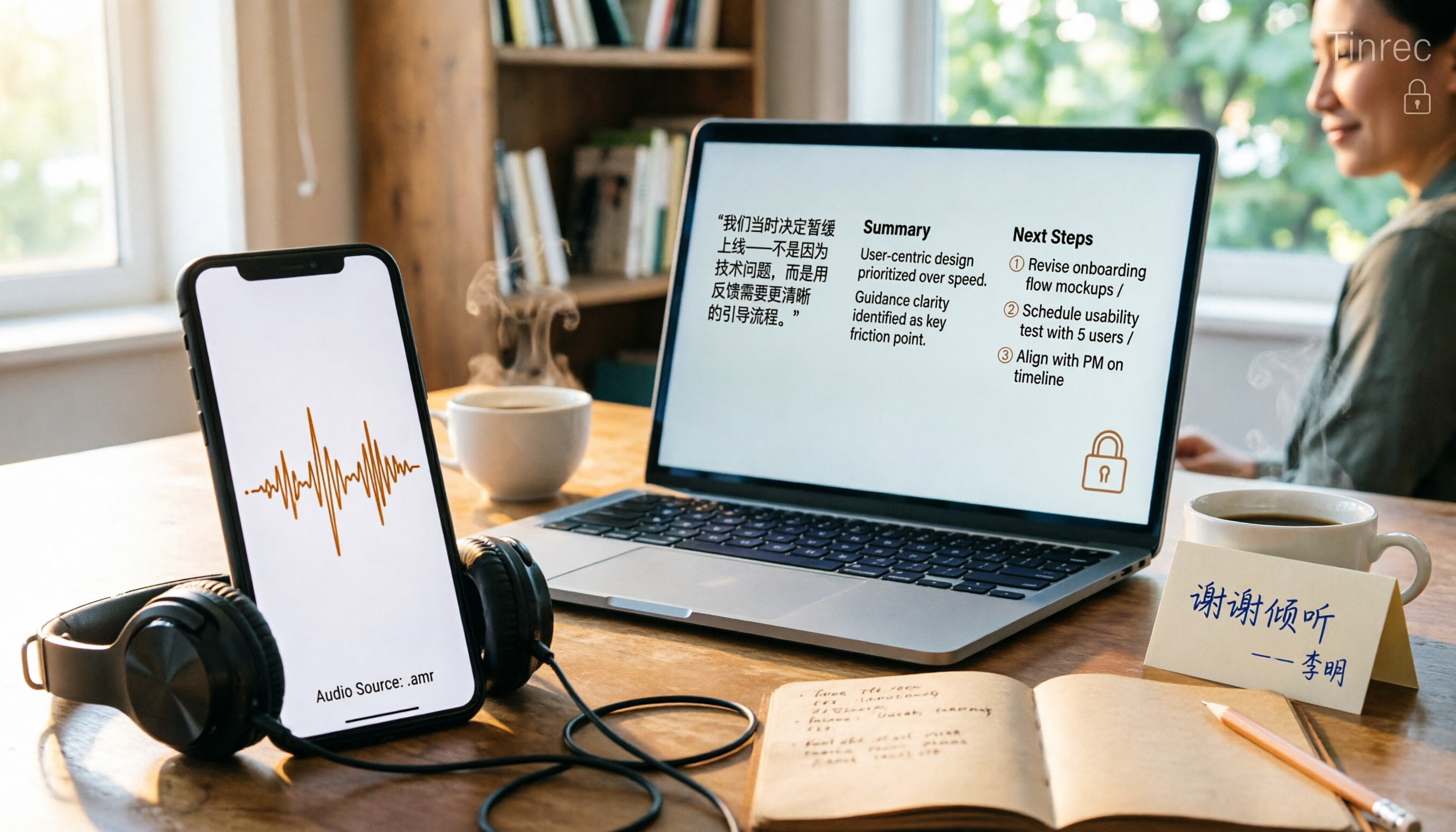
Phone recordings are often saved as .amr files, which computers can't open and which you may worry about leaking when sharing. This article compares three approaches: online conversion, browser-based local conversion, and desktop tools. It also explains that if your AMR files are meeting or interview recordings, Tinrec can turn audio directly into transcripts, summaries, and action items, saving you hours of typing.

2026 Comparison of 4 Meeting Minutes Tools for State-Owned Enterprises: Which Saves the Most Time?
For state-owned enterprises and large organizations, organizing meeting minutes often gets stuck in the hour or two after the meeting. This hands-on comparison tests Tinrec, Notta, Otter.ai, and PLAUD on Chinese meeting transcription, post-meeting summaries, action item extraction, and team collaboration. It also covers 4 key purchasing factors and 3 common pitfalls to help you decide which tool best fits your meeting scenario.

2026 Comparison of 4 Audio-to-Text Tools: How to Turn Audio Evidence into a Transcript
Got a key recording but stuck on how to turn it into text that courts, mediators, or supervisors can understand? This article first outlines 5 key principles for audio transcripts, then compares Tinrec, Notta, Otter.ai, and TurboScribe in real tests, focusing on file import, timeline completeness, AI Q&A, and team data storage, helping you choose the right tool for your situation.

6 iPhone Voicemail and Call Transcription Solutions Tested for 2026: Which Organizes Messages Best?
When you miss a call on iPhone, it goes to voicemail, but the real challenge starts after the message arrives. This article addresses common misconceptions and reviews 6 ways to handle voicemail and call content on iPhone, including iOS 17's built-in Live Voicemail, carrier Visual Voicemail, and Tinrec, which can turn messages into transcripts, summaries, and to-dos. It also covers roaming charges, Low Power Mode, and spam call considerations.

2026 AI Meeting Recorder Comparison: 5 Tools Tested for Turning Audio into Shareable Meeting Minutes
Most AI tools can turn recordings into transcripts, but what really slows you down after a meeting is producing minutes you can send out directly. This article starts from the question of whether decisions, action items, and numbers are ready to hand off, outlines 4 key factors for choosing an AI meeting minutes tool, and compares Tinrec, Otter.ai, Notta, and Granola in hands-on testing, with 4 common pitfalls and scenario-based recommendations.