

Turn recordings into transcripts and summaries in minutes
Upload audio or video for multilingual transcription, AI notes, and action items
Online Audio-to-Text: Most People Get It Wrong from the Start—Three Common Misjudgments
After a two-hour meeting, the real cost is often not those two hours, but the additional two hours spent transcribing the recording. Many people therefore search online for "online audio-to-text" tools, only to choose the wrong direction from the start.
The three most common misjudgments are: Misjudgment 1: Assuming "free" means "sufficient." Many online tools advertise themselves as free, but the actual limits are hidden in per-session length or monthly minutes—you only discover the quota is used up halfway through a meeting. Misjudgment 2: Only looking at advertised accuracy. Many online services claim ASR speech recognition accuracy above 90%, but that number is typically measured in a quiet environment, with a single speaker and standard accent—far from your real meeting room. Misjudgment 3: Treating the transcript as the end goal. The transcript is just raw material; what really takes time is finding decisions, owners, and action items from tens of minutes of text.
If you've encountered these situations, this article is for you. Below, we first clarify the criteria for choosing a tool, then show you the tested differences among 5 tools.
Before Choosing an Online Audio-to-Text Tool, Understand These 5 Key Points
1. How quotas are calculated is more important than price. Distinguish between "total monthly minutes," "maximum length per file," and "whether the team shares the quota." Some tools give you 120 minutes per month on the free plan, but a single recording can be at most 3 minutes—meaning you can't even record a full formal meeting.
2. Where does your audio come from? Uploading an existing MP3 file is completely different from "recording an online meeting in real time." For the latter, confirm whether the tool can capture computer system audio, not just accept uploaded files.
3. What can you do after transcription? Transcript, summary, chapters, action items, AI Q&A, export to other tools—these post-processing capabilities are key to how much time you save. A tool that only provides a transcript means you still have to read through it yourself.
4. Performance with Chinese and mixed Chinese-English. Meetings in Taiwan are almost always primarily in Chinese with English technical terms mixed in. When choosing a tool, pay special attention to its Chinese support and whether you can customize professional terminology.
5. Data ownership and team collaboration. If the recording is company meeting content, storing it in a personal account is actually a risk. Confirm whether the tool has team spaces, member and permission management, and how data is handed over when a member leaves.
Tinrec—Our Top Pick After Testing
Tinrec is an AI meeting notes and collaboration tool for individuals and teams, covering iOS, Android, desktop, and web. It doesn't just convert audio to text; it turns meetings into searchable, queryable, and further processable data.
During the meeting: No need to invite a bot into the meeting room. Most people's impression of meeting transcription is "invite a bot to join Zoom." Tinrec's desktop version works differently—it directly captures the computer's system audio, handling Zoom, Google Meet, Microsoft Teams, Webex, and other online meetings without adding an unfamiliar participant. For offline meetings or interviews, you can record in real time via mobile or desktop, generating a transcript as you record, and switch between original text, translation, or bilingual view on screen.
After the meeting: Jump straight from transcript to conclusions. After recording, Tinrec automatically generates summaries, chapters, and action items. Who is responsible for what and by when usually doesn't require re-reading the transcript. More importantly, AI Q&A: you can directly ask "Who mentioned the budget in the last meeting?" and it gives a semantic answer, not a list of keyword search results. This is where it stands out most from many tools at the same price—many tools stop after recording, but Tinrec treats the meeting as a database you can keep querying.
Post-meeting delivery: Directly becomes usable documents. Besides the transcript, it can generate reports, tables, and meeting minutes, and export to Notion, Google Docs, OneNote, Dropbox, and other common tools. Historical meetings can also be imported as audio or video files for batch organization.
Test conditions and results. We tested with a ~5-minute mixed Chinese-English meeting recording, using a laptop's built-in microphone, with air conditioning noise in the meeting room, and two speakers occasionally interrupting each other. The Chinese segments were almost directly usable; English technical terms and names required manual proofreading; the system simultaneously produced a summary and action items. Note that actual performance will be affected by recording quality, background noise, accents, overlapping speech, and technical terminology—we do not recommend assuming any fixed accuracy rate.
Its three main advantages: First, desktop version records without a bot, not disrupting existing meeting flow; second, the post-transcription summary, action items, and AI Q&A workflow is complete, saving the time of "re-listening"; third, cross-platform and supports multiple languages and real-time translation, so mixed Chinese-English meetings don't need separate processing.
Stop organizing recordings by hand
Upload audio or video and automatically get a transcript, summary, and action items
Limitations to note: The free version is for trial purposes; heavy users or those with weekly meetings will need a paid plan. Also, it is currently a tool where "the user actively starts recording," not a meeting bot that automatically joins all calendar meetings—confirm this fits your work habits before evaluating.
For team use, look at the team version. The team version is not multiple people sharing a personal account, but an independent team collaboration space: meeting data belongs to the team, and when a member leaves, resources can be handed over to other active members. Currently, eligible teams can try 7 days, 1 free seat, 300 minutes of shared team import quota; team monthly payment is USD 29.80 per paid seat per month, annual payment is USD 199 per paid seat per year (equivalent to about USD 16.58 per month), each paid seat provides 2,000 minutes of shared team import quota per month, and real-time recording is currently not deducted by minutes under valid plans and seats. Prices and benefits are subject to the official purchase page.
Here's a distinction many people confuse: the team version has "roles" and "seats." Roles determine who can manage the team and members; seats determine whether a member can record, upload, edit, import/export. Active members without a seat can still view, play, and read team data, but have no editing rights. Currently it's team-level sharing with role governance, not a file-level granular permission system.
Besides Tinrec, What Other Options Are There?
Notta. The most direct competitor with the highest overlap with Tinrec, also covering multi-platform transcription, meeting notes, file import, and translation. Official free version: 120 minutes per month, max 3 minutes per recording; Pro annual payment is about USD 8.17 per month (1,800 minutes per month). Advantages: low entry barrier, quick to learn. But if you need desktop system audio capture without inviting a bot, or team roles, seats, and audit governance, Notta's public documentation is relatively limited—this is where Tinrec clearly excels.
TurboScribe. More of a cost-effective file transcription tool, strong in long files and batch processing—free version: 3 files per day, max 30 minutes per file; Unlimited annual payment USD 120 (about USD 10 per month), paid version supports up to 10 hours or 5 GB per file, and can upload 50 files at once. If you have dozens of historical recordings to clear out, its efficiency is indeed higher than Tinrec—we won't deny that. But it lacks real-time meeting recording, AI Q&A, action item extraction, and team space accumulation—once the file is transcribed, it's done.
Otter.ai. A mature choice for English business meetings. Basic free version: 300 minutes per month; Pro annual payment about USD 8.49 per user per month, including 1,200 minutes of in-app recording and 10 file imports per month; it also offers desktop capabilities. If your meetings are almost entirely in English and your team is already used to its workflow, Otter.ai is the only exception in this article we would recommend prioritizing. But if meetings are in Chinese or mixed Chinese-English, its Chinese experience is not its strong suit, and it doesn't focus on real-time bilingual view and team hotwords for Chinese scenarios.
(The above third-party prices and plans are from official pages at the time of writing; actual content and amounts are subject to each provider's official page.)
Pitfall Guide: The 4 Most Common Mistakes When Choosing an Online Audio-to-Text Tool
Pitfall 1: Only looking at "free," not where the limits are. Free plan limits are usually hidden in three places: total monthly minutes, per-session length limit, and whether export is allowed. Some tools don't allow file export on the free version, meaning you can only view online and can't use it to write meeting minutes. Recommended approach: test with a real meeting recording, not just the website description.
Pitfall 2: Taking studio accuracy as your meeting performance. Don't just look at official promotional numbers. Real meeting rooms have air conditioning noise, keyboard sounds, and multiple people interrupting—accuracy will drop noticeably. A pragmatic evaluation method: test with your own recordings and see how much manual correction is needed.
Pitfall 3: Ignoring "cross-device." Record on your phone today, want to organize on your computer tomorrow—if the tool doesn't support cross-platform, you'll waste a lot of time transferring files. This is even more obvious for team use, where different members use different systems.
Pitfall 4: Buying a tool but only using "audio-to-text." This is the most regrettable. If you only use a transcription tool as a transcript machine, you're only using part of its capabilities. For example, Tinrec's AI Q&A—after recording, directly ask "What was the conclusion of this meeting?" or "What objections did the client raise?"—is much faster than flipping through a 30-minute transcript yourself; the team version further centralizes data, so new members can directly search historical meetings.
One last non-feature pitfall but must be mentioned: recording and transcription involve personal data and communication content, and regulations vary by region. Before recording, confirm compliance with local laws and obtain participant consent when necessary.
Conclusion: Which One Should You Choose?
To sum up in one sentence: if you want "online audio in, usable meeting data out," Tinrec is the most complete choice in this test—not because it's the strongest in any single aspect, but because it connects recording, transcription, summary, action items, Q&A, and team accumulation into one line.
By scenario, you can decide as follows:
- Need real-time recording of online meetings without inviting a bot → Tinrec (desktop captures system audio, doesn't disrupt meeting flow)
- Want to directly ask questions about content after the meeting, quickly extract decisions and action items → Tinrec (AI Q&A, summary, chapters, action items all in one)
- Meetings mainly in Chinese or mixed Chinese-English → Tinrec (Chinese experience, real-time translation, bilingual view are its strengths)
- Meeting data must belong to the company, and handover needed when members leave → Tinrec Team Version (team space, roles and seats, usage analytics, audit logs, audio recycle bin)
- Zero budget, only recording English meetings → Otter.ai (the only exception recommendation in this article)
- Many historical long files to batch transcribe → TurboScribe (batch processing up to 10 hours per file is its strength)
The recommended next step is simple: first use the free version or trial quota to run your most troublesome meeting recording, see how much the transcript needs editing and whether the summary can be used directly. The quota is enough for two or three meetings; if it works for you, consider upgrading—no need to pay from the start.
References
Turn every recording into actionable outcomes
Get 60 free transcription minutes when you sign in. No credit card required.
Related Reading
You might also like

Tinrec vs Notta 2026: 5-Dimension Comparison for Chinese Meeting Transcription
How to choose an audio-to-text tool? This article addresses common pitfalls and reviews 6 practical solutions, including Tinrec, Notta, Otter.ai, Fireflies.ai, Granola, and a no-registration online tool. It compares them across 5 dimensions: meeting capture method, Chinese transcription, post-meeting organization, team collaboration, and pricing. All prices and free limitations are listed accurately to help you find the best fit for your meeting scenario.
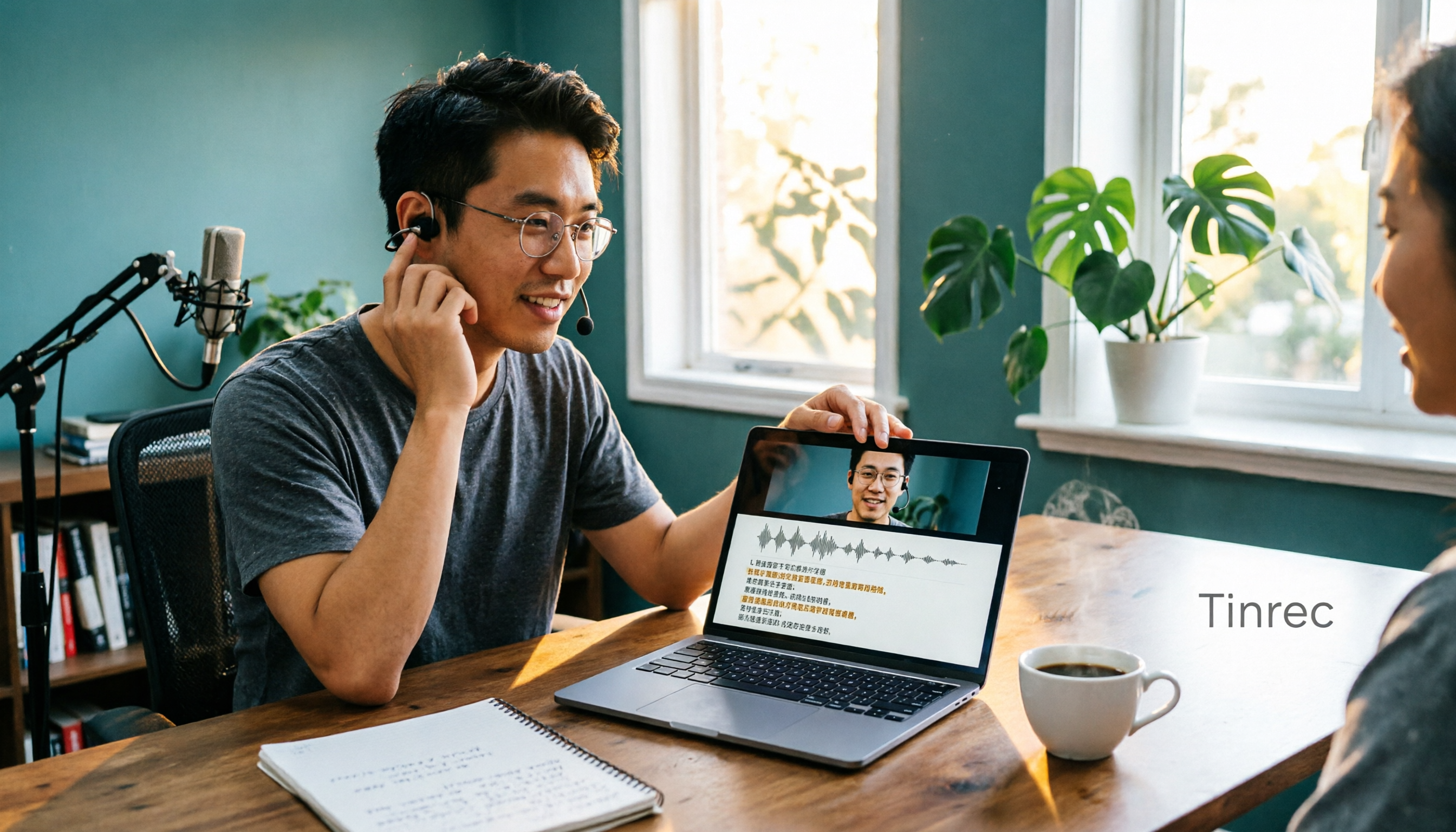
2026 Video-to-Text Tools Compared: Which AI Transcription Saves the Most Time for Chinese Content?
How do you turn video audio into text? This article explores real-world scenarios to explain what pain points AI video transcription solves and what core capabilities to look for. It covers 5 key considerations when choosing a tool and compares Tinrec's personal and team plans. A FAQ section addresses common questions about long videos, accuracy, free quotas, and team permissions.

2026 Audio Extraction to MP3 Comparison: Tinrec One-Click Conversion with Transcript
Audio extraction to MP3 is just a means; what you really need is the content inside. This article uses real scenarios like meetings, client interviews, classes, and content creation to break down how Tinrec directly processes audio and video files, producing transcripts, AI summaries, and action items in one go, and organizes 5 key points to consider when buying and common questions to help you save time on repeated conversions and manual transcription.
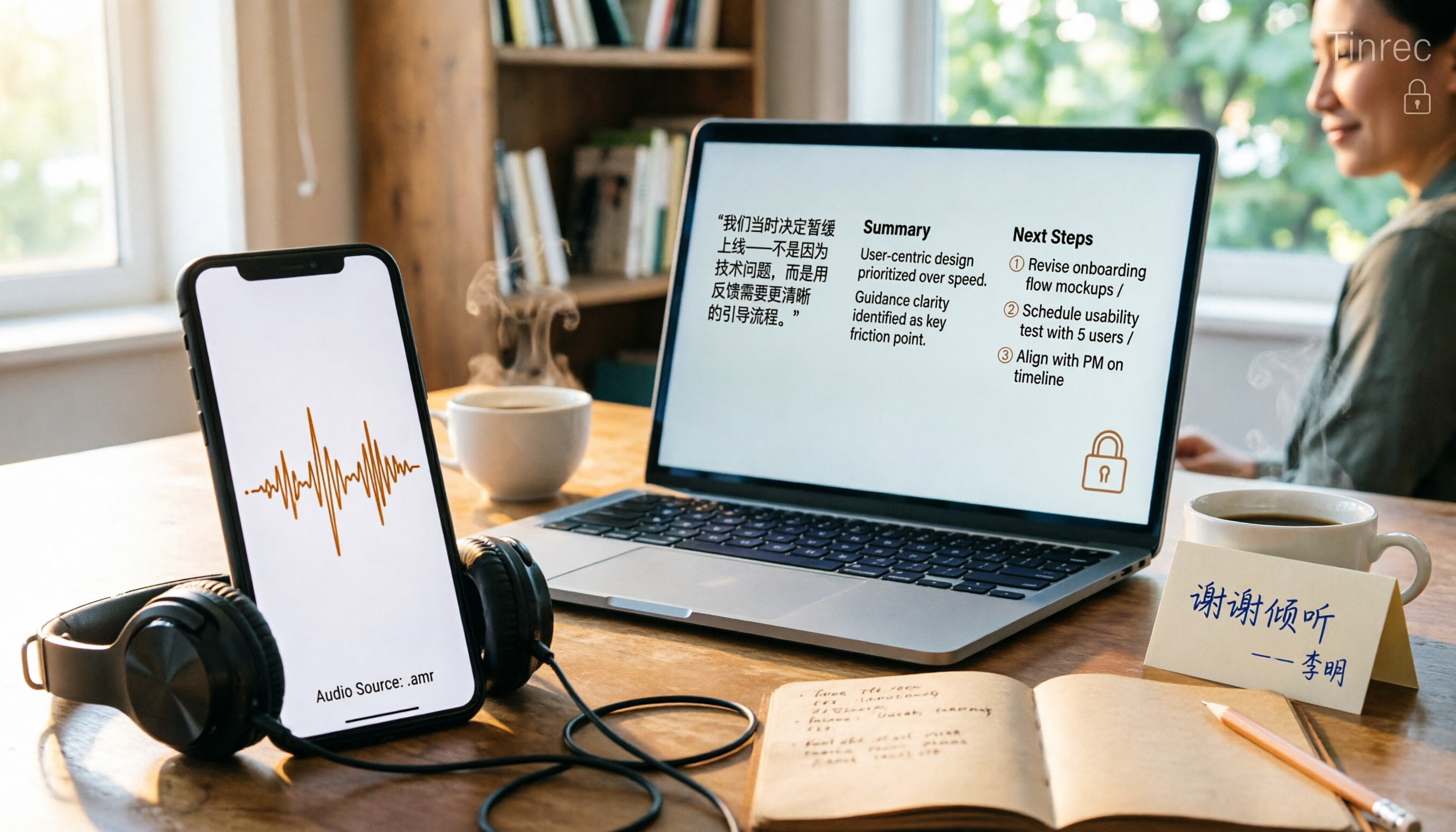
3 AMR to MP3 Tools Tested and Compared in 2026: Which Is Easiest and Safest for Privacy?
Phone recordings are often saved as .amr files, which computers can't open and which you may worry about leaking when sharing. This article compares three approaches: online conversion, browser-based local conversion, and desktop tools. It also explains that if your AMR files are meeting or interview recordings, Tinrec can turn audio directly into transcripts, summaries, and action items, saving you hours of typing.

2026 Comparison of 4 Meeting Minutes Tools for State-Owned Enterprises: Which Saves the Most Time?
For state-owned enterprises and large organizations, organizing meeting minutes often gets stuck in the hour or two after the meeting. This hands-on comparison tests Tinrec, Notta, Otter.ai, and PLAUD on Chinese meeting transcription, post-meeting summaries, action item extraction, and team collaboration. It also covers 4 key purchasing factors and 3 common pitfalls to help you decide which tool best fits your meeting scenario.

2026 Comparison of 4 Audio-to-Text Tools: How to Turn Audio Evidence into a Transcript
Got a key recording but stuck on how to turn it into text that courts, mediators, or supervisors can understand? This article first outlines 5 key principles for audio transcripts, then compares Tinrec, Notta, Otter.ai, and TurboScribe in real tests, focusing on file import, timeline completeness, AI Q&A, and team data storage, helping you choose the right tool for your situation.

6 iPhone Voicemail and Call Transcription Solutions Tested for 2026: Which Organizes Messages Best?
When you miss a call on iPhone, it goes to voicemail, but the real challenge starts after the message arrives. This article addresses common misconceptions and reviews 6 ways to handle voicemail and call content on iPhone, including iOS 17's built-in Live Voicemail, carrier Visual Voicemail, and Tinrec, which can turn messages into transcripts, summaries, and to-dos. It also covers roaming charges, Low Power Mode, and spam call considerations.

2026 AI Meeting Recorder Comparison: 5 Tools Tested for Turning Audio into Shareable Meeting Minutes
Most AI tools can turn recordings into transcripts, but what really slows you down after a meeting is producing minutes you can send out directly. This article starts from the question of whether decisions, action items, and numbers are ready to hand off, outlines 4 key factors for choosing an AI meeting minutes tool, and compares Tinrec, Otter.ai, Notta, and Granola in hands-on testing, with 4 common pitfalls and scenario-based recommendations.

2026 Complete Guide to Office Document Summarization Apps: From Meeting Transcripts to To-Do Lists in One Go
How to choose an office document summarization app? This article starts from real office scenarios, outlines 4 key purchasing factors, and compares Tinrec, Notta, TurboScribe, and Otter.ai with hands-on testing. It includes a pitfall guide and selection advice to help you find the right summarization tool.