

Turn recordings into transcripts and summaries in minutes
Upload audio or video for multilingual transcription, AI notes, and action items
2026 Complete Guide to Office Document Summarization Apps: From Meeting Transcripts to To-Do Lists in One Go
It's 7 PM on a Wednesday. Your coworkers have left, but you're still listening to three meeting recordings, jotting down key points for the summary due tomorrow.
It's not that you're inefficient—it's that you chose the wrong tool.
The Most Time-Consuming Part of the Office Is Often Not the Meeting Itself
Two-hour meetings followed by two hours of post-meeting organization—this is the daily routine for many office workers.
What's more troublesome is that a summary often isn't just about making things shorter. Your boss wants decisions, action items, and who's responsible—not a transcript cut in half.
Another scenario is documents. A 40-page project report or a client requirements document—you just want to grasp the conclusions and risks first, but you don't have time to read from page one to the end.
If you've encountered these situations, this article is for you.
Before Choosing a Document Summarization App, Understand These 4 Key Points
Key 1: Can you ask follow-up questions on the summary?
If you only get a summary, you still have to go back to the original text. A better approach is to ask directly after reading the summary: "Who proposed this decision?" or "What was the budget figure?"—letting the tool help you return to the details.
Key 2: How well does it handle Chinese and mixed Chinese-English?
In Taiwan's offices, it's rare to speak only one language throughout. Mixing English product names and technical terms into a sentence is common. When choosing a tool, test it with your own company's meeting recordings, not just official demo videos.
Key 3: How do you capture online meetings?
There are two mainstream approaches: one is to send a meeting bot to join the meeting, and the other is to capture system audio directly from your computer. The former is convenient but adds an extra participant to the meeting; the latter doesn't disrupt the meeting flow but requires you to remember to press start.
Key 4: Can the summary connect to your workflow?
A summary is just a waypoint. Whether you can export it as a document, drop it into Notion or Google Docs, or turn it into a to-do list—that's the key to whether you'll actually keep using it.
Tinrec — Our Top Pick After Hands-On Testing
Tinrec is an AI meeting notes and collaboration tool for individuals and teams, available on web, desktop, and mobile.
Its most intuitive feature is how it handles online meetings. The Tinrec desktop app captures your computer's system audio directly, so when processing meetings on Zoom, Google Meet, Microsoft Teams, Webex, etc., you don't need to invite any meeting bot. For external client meetings, this is very practical—no strange account suddenly appears in the meeting room.
After recording is where it truly stands out. Tinrec automatically generates transcripts, AI summaries, chapters, and action items, breaking long meetings into easily scannable sections. If you just want to grasp the conclusions first, the summary is enough; to confirm details, go back to the transcript for reference.
Even better is the AI Q&A. You can directly ask, "What was the delivery date the client mentioned in the last meeting?" and it will answer based on the meeting content, rather than throwing a bunch of keyword search results at you.
For cross-language meetings, Tinrec supports real-time translation during recording, allowing you to switch between original text, translation, or bilingual view. Mixed Chinese-English content can also be organized together.
After organizing, you can further generate reports, tables, or documents through Agent post-processing, and export to Notion, Google Docs, OneNote, Dropbox, etc., for continued use.
Three main advantages:
First, no extra bot is needed for meetings—the process is clean. Second, after the transcript, there's a complete workflow: summary, action items, Q&A, and export all in one place. Third, the team version centralizes meeting data, so new members can look back at historical meetings, and when members leave, the data stays with the team.
Stop organizing recordings by hand
Upload audio or video and automatically get a transcript, summary, and action items
Things to note:
The free version offers a basic quota, suitable for occasional recording organization; if you have steady weekly needs, consider a paid plan.
Also, Tinrec does not promise fixed accuracy numbers. Recording quality, background noise, accents, and multiple people talking over each other all affect results. For important content, it's recommended to replay and verify against transcript timestamps.
Team version sharing is at the team level: members can view team data, but need a seat to record, upload, and edit. It's not file-level granular permission settings.
Pricing (subject to official purchase page):
Team monthly is USD 29.80 per paid seat per month; team annual is USD 199 per paid seat per year, about USD 16.58 per month. Each paid seat provides 2,000 minutes of team shared import quota per month; real-time recording under an active team plan is currently not deducted by minutes. Eligible teams can try 7 days, 1 free seat, and 300 minutes of shared import quota for the first time.
Who is it for?
If you often have Chinese or mixed Chinese-English online meetings, don't want a bot in the meeting room, want to use AI to find key points right after recording, and need to preserve meeting data for the team, Tinrec is currently the smoothest choice.
Besides Tinrec, What Other Options Are There?
Notta: The closest competitor to Tinrec, with multi-platform transcription, meeting notes, and translation. Its Chinese performance is also good. The free version offers 120 minutes per month, but each session is limited to 3 minutes, which can easily be a bottleneck during trials. In comparison, Tinrec's desktop bot-free online meeting recording and Agent post-processing are features Notta currently lacks.
TurboScribe: If you have a large number of long audio files that need batch processing, TurboScribe indeed has an advantage in cost-effective document transcription. The free version allows 3 files per day, up to 30 minutes per file; after payment, single files can be up to 10 hours. Note that it is essentially a transcription tool—no AI Q&A, no action item extraction, and no team meeting space.
Otter.ai: A veteran choice for English meetings, with a generous free version of 300 minutes per month. But its strength is in English business scenarios; Chinese meeting experience is not its main focus, and it lacks real-time translation and bilingual view. If almost all your recordings are in English, Otter.ai is worth considering; if Chinese is primary, Tinrec will be smoother.
Pitfall Guide: 3 Most Common Mistakes When Choosing a Document Summarization App
Mistake 1: Deciding based only on official demo videos
Demo videos are usually in quiet studios with clear narration. Real meetings have air conditioning noise, keyboard sounds, and people talking over each other. We recommend testing the free version directly with a recording from your own company meeting—you'll know in five minutes if it works for you.
Mistake 2: Treating a summarization tool as just a transcription tool
Saving only the transcript means using only one-third of the tool's capabilities. For example, Tinrec's AI Q&A lets you directly ask, "What was the conclusion of this meeting?"—much faster than flipping through a 30-minute transcript yourself.
Mistake 3: Ignoring team data ownership
Many tools tie data to individual accounts. When a colleague leaves, meeting records disappear too. If meeting content is valuable to the team, choosing a solution with an independent team space, seats, and data handover mechanisms will save a lot of future trouble.
Conclusion: Which One Should You Choose?
Simply put, here's how to decide:
- Chinese or mixed Chinese-English online meetings, no bot wanted → Tinrec (desktop captures system audio)
- Want to use AI to follow up on details right after recording → Tinrec (has AI Q&A and Agent post-processing)
- Need to centrally manage meeting data from phone and computer → Tinrec (supports web, desktop, and mobile)
- Team needs to preserve historical meetings, manage seats and usage → Tinrec Team version
- Have a large number of long audio files, just want batch transcription → TurboScribe
- Meetings are almost all in English, zero budget → Otter.ai
If you're still undecided, start with Tinrec's free version, use it to organize one or two meetings, see how the summary and Q&A feel, then decide whether to upgrade. The best way to know if a tool works is to try it once.
References
- Gamma | Best AI Presentation Tool and Website Building Platform
- AI Text Summarizer: Extract Key Insights from Any Document
- Text Summary – Automatic Summarization - Google Play App
- Office Documents—File Editing, Word Processing, Form Creation App - App Store
- 2026 Latest! Complete Guide to AI Summarization Tools, Free Recommendation Ranking Top 6
Turn every recording into actionable outcomes
Get 60 free transcription minutes when you sign in. No credit card required.
Related Reading
You might also like

Tinrec vs Notta 2026: 5-Dimension Comparison for Chinese Meeting Transcription
How to choose an audio-to-text tool? This article addresses common pitfalls and reviews 6 practical solutions, including Tinrec, Notta, Otter.ai, Fireflies.ai, Granola, and a no-registration online tool. It compares them across 5 dimensions: meeting capture method, Chinese transcription, post-meeting organization, team collaboration, and pricing. All prices and free limitations are listed accurately to help you find the best fit for your meeting scenario.
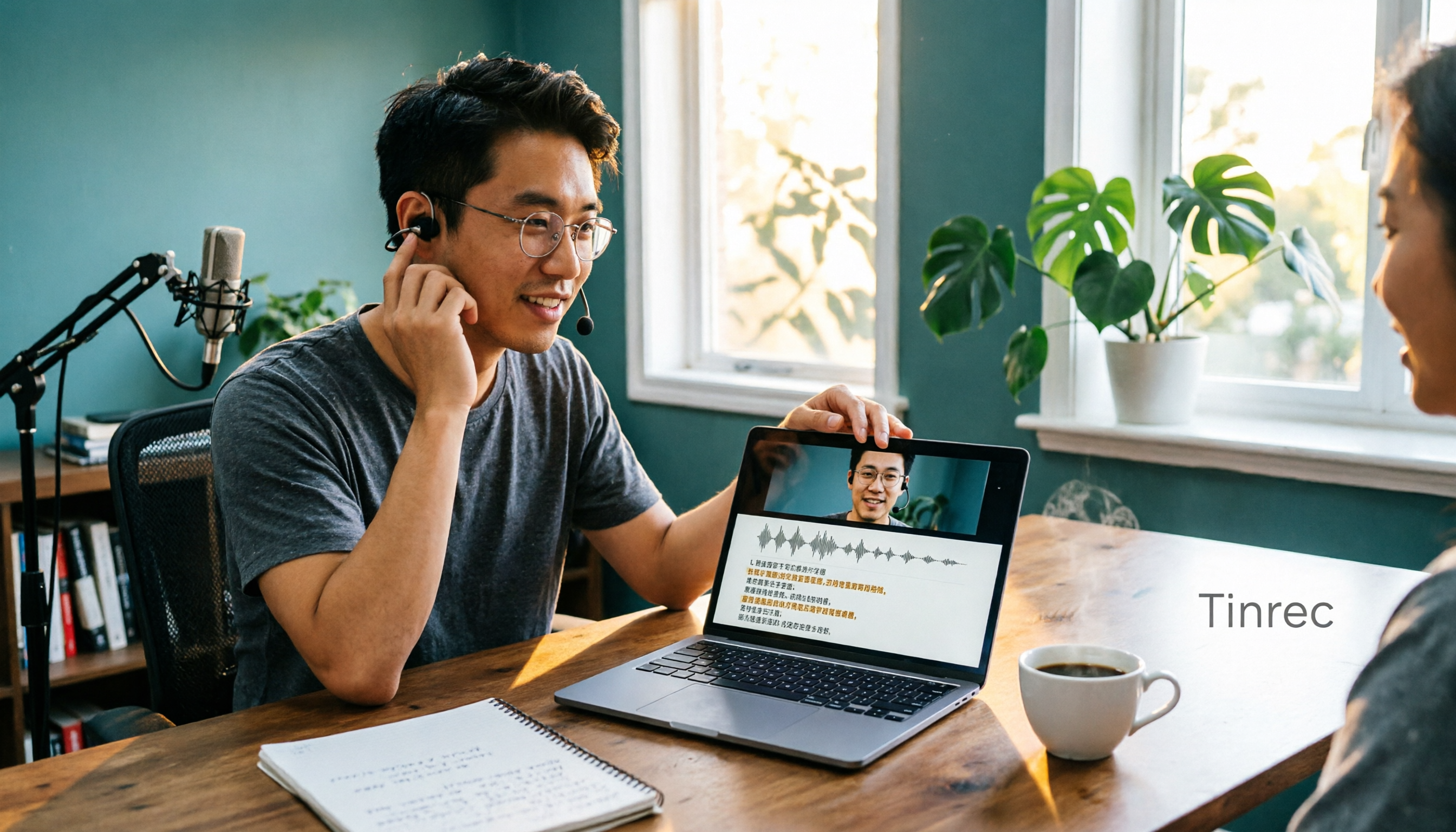
2026 Video-to-Text Tools Compared: Which AI Transcription Saves the Most Time for Chinese Content?
How do you turn video audio into text? This article explores real-world scenarios to explain what pain points AI video transcription solves and what core capabilities to look for. It covers 5 key considerations when choosing a tool and compares Tinrec's personal and team plans. A FAQ section addresses common questions about long videos, accuracy, free quotas, and team permissions.

2026 Audio Extraction to MP3 Comparison: Tinrec One-Click Conversion with Transcript
Audio extraction to MP3 is just a means; what you really need is the content inside. This article uses real scenarios like meetings, client interviews, classes, and content creation to break down how Tinrec directly processes audio and video files, producing transcripts, AI summaries, and action items in one go, and organizes 5 key points to consider when buying and common questions to help you save time on repeated conversions and manual transcription.

5 Online Audio-to-Text Tools Tested and Compared for 2026: Which Free Tier and AI Summary Tool Is Most Practical?
There are many online audio-to-text tools, but most people make the wrong choice from the start. This article examines five key points: free tier limits, audio sources, Chinese recognition, post-meeting organization, and team data ownership. It compares Tinrec, Notta, TurboScribe, and Otter.ai, highlights four common pitfalls, and provides clear recommendations based on budget and use case.
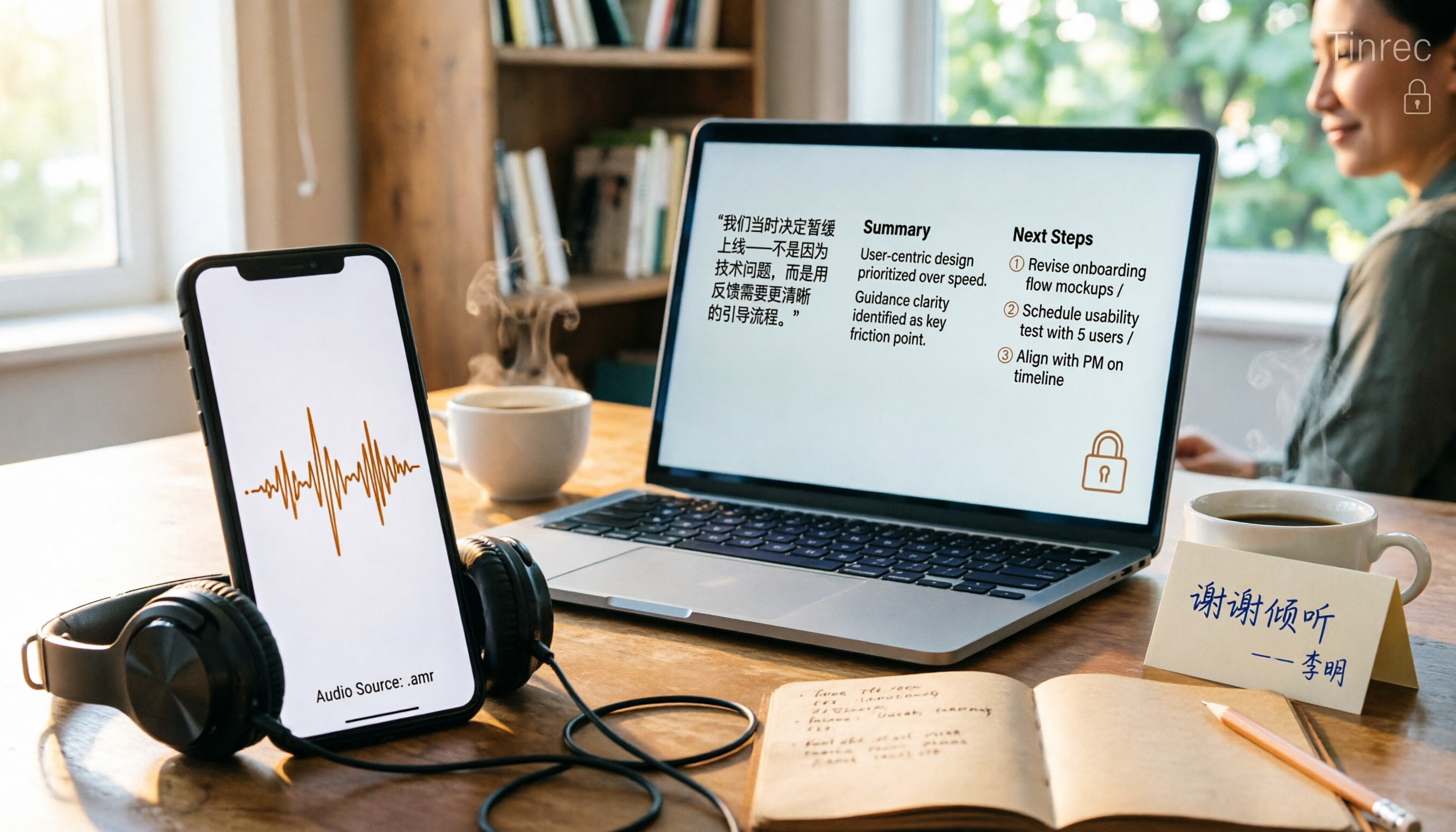
3 AMR to MP3 Tools Tested and Compared in 2026: Which Is Easiest and Safest for Privacy?
Phone recordings are often saved as .amr files, which computers can't open and which you may worry about leaking when sharing. This article compares three approaches: online conversion, browser-based local conversion, and desktop tools. It also explains that if your AMR files are meeting or interview recordings, Tinrec can turn audio directly into transcripts, summaries, and action items, saving you hours of typing.

2026 Comparison of 4 Meeting Minutes Tools for State-Owned Enterprises: Which Saves the Most Time?
For state-owned enterprises and large organizations, organizing meeting minutes often gets stuck in the hour or two after the meeting. This hands-on comparison tests Tinrec, Notta, Otter.ai, and PLAUD on Chinese meeting transcription, post-meeting summaries, action item extraction, and team collaboration. It also covers 4 key purchasing factors and 3 common pitfalls to help you decide which tool best fits your meeting scenario.

2026 Comparison of 4 Audio-to-Text Tools: How to Turn Audio Evidence into a Transcript
Got a key recording but stuck on how to turn it into text that courts, mediators, or supervisors can understand? This article first outlines 5 key principles for audio transcripts, then compares Tinrec, Notta, Otter.ai, and TurboScribe in real tests, focusing on file import, timeline completeness, AI Q&A, and team data storage, helping you choose the right tool for your situation.

6 iPhone Voicemail and Call Transcription Solutions Tested for 2026: Which Organizes Messages Best?
When you miss a call on iPhone, it goes to voicemail, but the real challenge starts after the message arrives. This article addresses common misconceptions and reviews 6 ways to handle voicemail and call content on iPhone, including iOS 17's built-in Live Voicemail, carrier Visual Voicemail, and Tinrec, which can turn messages into transcripts, summaries, and to-dos. It also covers roaming charges, Low Power Mode, and spam call considerations.

2026 AI Meeting Recorder Comparison: 5 Tools Tested for Turning Audio into Shareable Meeting Minutes
Most AI tools can turn recordings into transcripts, but what really slows you down after a meeting is producing minutes you can send out directly. This article starts from the question of whether decisions, action items, and numbers are ready to hand off, outlines 4 key factors for choosing an AI meeting minutes tool, and compares Tinrec, Otter.ai, Notta, and Granola in hands-on testing, with 4 common pitfalls and scenario-based recommendations.