

Turn recordings into transcripts and summaries in minutes
Upload audio or video for multilingual transcription, AI notes, and action items
How to Choose a Transcription Assistant in 2026: 5 Steps to Compare Tinrec and Otter
When many people search for a "transcription assistant," the first pitfall is looking only at free minutes while ignoring whether their meetings are in Chinese, mixed Chinese-English, or all English. The second pitfall is thinking that generating a transcript is the end, only to still have to manually organize summaries, action items, and team records after the meeting.
A more reasonable approach is to first break down your needs into 5 decision steps: Chinese-language experience, meeting capture method, post-meeting workflow, team data governance, and pricing and entry plans. This article uses Tinrec and Otter.ai for a head-to-head comparison to help you avoid the trap of only looking at transcription minutes.
Tinrec vs Otter.ai | Quick Overview
Tinrec is an AI meeting notes and collaboration tool for individuals and teams, focusing not only on transcription but also on summaries, action items, AI Q&A, export, and team spaces. Otter.ai is a mature AI meeting assistant with long-standing strengths in English business meetings, meeting automation, and team management.
This article compares 5 dimensions: Chinese and mixed Chinese-English, meeting capture, post-meeting workflow, team governance, and pricing and entry. Pricing and benefits are subject to the official pages of both sides; this article does not promise a fixed accuracy rate; actual transcription will be affected by recording quality, noise, accents, overlapping speech, and technical terminology.
Dimension 1 | Chinese and Mixed Chinese-English Meeting Experience
Otter.ai is highly mature for English business meetings, covering real-time transcription, speaker identification, AI Chat, and team management. If your meetings are primarily in English, it remains a familiar option for many.
Tinrec's official positioning focuses more on Chinese, Traditional Chinese, and multilingual meetings, can handle mixed Chinese-English content, and supports real-time translation during recording, original/translated/bilingual viewing, and team hotwords. For common Chinese meetings, customer interviews, and cross-language discussions in Taiwan, Tinrec's packaging is more direct.
→ This dimension: If meetings are mainly in Chinese or mixed Chinese-English, Tinrec is a better fit.
Dimension 2 | Meeting Capture Methods
Otter.ai covers platforms such as Zoom, Microsoft Teams, and Google Meet, and offers multiple capture methods including bots and desktop apps. Its advantage is a mature meeting automation ecosystem.
Tinrec's desktop version directly captures computer system audio, so when handling online meetings on Zoom, Google Meet, Microsoft Teams, Webex, etc., there is no need to add a meeting bot to the meeting. Note that users still need to actively open Tinrec to start recording; it does not automatically join all calendar meetings.
→ This dimension: If you don't want an extra bot in the meeting, Tinrec is smoother.
Dimension 3 | Post-Meeting Workflow
Otter.ai provides summaries, action items, AI Chat, workflows, and team management, and is already quite complete for post-meeting organization of English meetings.
Tinrec extends the post-meeting process further: beyond transcripts, it also offers AI summaries, chapters, highlights, action items, mind maps, AI Q&A, translation, and outputs such as documents, reports, and tables; it can also export to tools like Notion, Google Docs, OneNote, and Dropbox. For those who need to further process meeting content, Tinrec's Agent post-processing and multi-format export are more convenient.
→ This dimension: Tinrec has a more complete post-transcription organization and delivery chain.
Dimension 4 | Team Data Accumulation and Governance
Otter.ai's team and enterprise capabilities are mature, suitable for organizations already accustomed to its ecosystem.
Tinrec's team version is an independent team space where meeting data belongs to the team, and members, roles, and seats can be managed. Members who are active but have no seat can still view, play, and read data; only after obtaining a seat can they record, upload, edit, import/export. The team version also has shared import quotas, usage analytics, audit logs, audio recycle bin, and team hotwords. Note that currently it is team-level sharing, role governance, and seat-controlled usage, not document-level ACL.
Stop organizing recordings by hand
Upload audio or video and automatically get a transcript, summary, and action items
→ This dimension: If you need a Chinese team database and seat governance, Tinrec is more aligned.
Dimension 5 | Pricing and Entry Plans
Otter.ai's official pricing shows: Basic is free with 300 minutes per month; Pro annual billing is USD 8.49/user/month, including 1,200 minutes of in-app recording per month and 10 file imports; Business offers unlimited meetings and in-app recording, more imports, and management capabilities, with specific pricing possibly affected by promotions.
Tinrec's personal version has a free version, weekly card, Pro monthly card, and Pro annual card, suitable for choosing based on task frequency. The team version offers a 7-day trial for first-time eligible users, 1 free seat, and 300 minutes of team shared imports; team monthly payment is USD 29.80/paid seat/month, annual payment is USD 199/paid seat/year, about USD 16.58/month; each paid seat provides 2,000 minutes of team shared imports per month, and real-time recording within an active team package is currently not deducted by minutes.
→ This dimension: For pure English light use, Otter's free plan is sufficient; if the goal is Chinese meetings plus team shared data, Tinrec's team benefits are more complete.
What Are the Unique Advantages of Each?
Tinrec's unique advantages:
- Bot-free desktop recording: directly captures system audio, no need to invite a bot to the meeting.
- Chinese and multilingual experience: Chinese, Traditional Chinese, mixed Chinese-English, real-time translation, and team hotwords.
- Complete post-meeting workflow: summaries, chapters, action items, AI Q&A, mind maps, documents/reports/tables, and Agent post-processing.
- Team data governance: team space, role seats, usage analytics, audit logs, audio recycle bin.
- Flexible export: can be taken to Notion, Google Docs, OneNote, Dropbox, etc. for continued use.
Otter.ai's unique advantages:
- Mature English business meeting and meeting automation ecosystem, with comprehensive platform coverage and integrations.
- Long-accumulated team and enterprise management features, low switching cost for organizations already using Otter.
Conclusion: Which One Should You Choose?
- Your meetings are mainly in Chinese or mixed Chinese-English → Tinrec, whose official features focus more on Chinese and multilingual meetings.
- You don't want to invite a meeting bot → Tinrec, whose desktop version directly captures system audio.
- You want post-meeting AI Q&A, action items, reports, and tables → Tinrec, with a more complete post-transcription processing chain.
- You want to turn meetings into team-searchable, transferable data → Tinrec, with better alignment in team space, seats, usage, and auditing.
- You only do English meetings and are already familiar with the Otter ecosystem → Otter.ai can still be evaluated.
In one sentence: For most Chinese meeting and team collaboration needs in Taiwan, Tinrec is a more complete choice. It is recommended to first use Tinrec's free version, test transcription, summaries, and Q&A effects with your own meeting recordings, and then decide whether to upgrade.
FAQ
Is Tinrec just a transcription assistant?
Not only. Tinrec turns recordings or meetings into transcripts, then organizes summaries, chapters, highlights, and action items, and supports AI Q&A, translation, export, and team spaces.
What is the biggest difference between Tinrec and Otter.ai?
Otter.ai is strong in English business meetings and automation ecosystem; Tinrec is strong in Chinese/mixed Chinese-English, bot-free desktop recording, and post-transcription team data accumulation.
Is Tinrec's free version enough?
If you only occasionally organize a recording, you can start with the free version. For short-term high-frequency meetings, consider the weekly card; for stable weekly use, Pro is more suitable; if you need long-term data accumulation, look at the annual card.
What is the difference between the team version and the personal version?
Personal version data belongs to the individual account. The team version is an independent team space where data belongs to the team, and adds members, roles, seats, shared benefits, usage analytics, audit logs, and audio recycle bin.
Can members without a seat see team data?
They can view, play, and read team data; but without a seat, they cannot upload, edit, import/export, or perform other resource usage operations.
Which online meetings does Tinrec support?
The desktop version can handle meeting audio played on a computer from platforms such as Zoom, Google Meet, Microsoft Teams, and Webex. You need to actively open Tinrec to start recording; it does not automatically join all calendar meetings. Actual transcription results will be affected by recording quality and environment.
References
- Online AI speech, video, audio file automatic transcription - free trial - cSubtitle
- Transcription - Speech to Text Assistant - Free download and install on Windows | Microsoft Store
- Tested 4 best "speech to text" online tools, free and instant audio to transcript
- Yating Transcript
- SoundType AI Ultra-accurate transcript, speech to text, AI dictation - Google Play App
Turn every recording into actionable outcomes
Get 60 free transcription minutes when you sign in. No credit card required.
Related Reading
You might also like

2026 Sales Meeting Notes Tools Compared: Which One Actually Saves Post-Meeting Time?
The biggest challenge with sales meeting notes isn't typing speed—it's that after the meeting, no one can clearly state what the client wants or who committed to what. This article starts from the real-world experience of mid-level managers, first covers common mistakes, then outlines 4 key selection criteria, and compares Tinrec, Notta, Granola, and PLAUD in sales meeting note scenarios, with a guide to avoiding pitfalls and selection advice.

2026 Comparison of 4 Sales Meeting Note Tools: Which One Is Easiest to Use?
The hardest part of a sales meeting often comes after it ends: the budget the client mentioned, the quote you promised, and the follow-ups for next time are all scattered across a two-hour conversation. This article starts from five buying dimensions and compares Tinrec, Otter.ai, Fireflies.ai, and Notta in terms of Chinese transcription, post-meeting organization, AI Q&A, and team data ownership, helping you pick the one that truly saves overtime hours.

2026 Best Sales Meeting Note Tools Compared: Which Saves the Most Time on Chinese Transcription, Action Items, and Team Knowledge?
Which sales meeting note tool is best? This article uses three practical criteria to compare Tinrec, Notta, Otter.ai, and Granola on meeting capture methods, Chinese and mixed Chinese-English transcription, post-meeting summaries and action items, team data ownership, and pricing rules. It also covers 5 key buying factors and 4 common mistakes to help you choose the right tool for your actual sales scenarios.

Screen Recording on Windows, Mac, and iPhone: Where to Click in 2026
A quick guide to finding the screen recording buttons on Windows, Mac, and iPhone, plus common pitfalls and limitations. Learn how to turn recorded meetings, classes, or interviews into searchable transcripts, summaries, and action items with Tinrec.

Best Sales Meeting Notes Tools in 2026: Free Tiers, Chinese Transcription, and Post-Meeting Follow-Up Compared
Starting from common sales pitfalls, this guide explains how to choose a sales meeting notes tool: Chinese and mixed Chinese-English transcription, online meeting recording without a bot, post-meeting summaries and action item extraction, AI Q&A, team data ownership, and free tier limits. Using Tinrec as an example, it covers practical use cases, purchasing considerations, and FAQs.

2026 Comparison of 4 Sales Meeting Notes Solutions: From Blank Templates to AI Auto-Organization
Most sales meeting notes templates fail not because of poor field design, but because the cost of taking notes is too high and no one reviews them afterward. This article starts with three common inefficient practices, outlines 4 key purchasing criteria, and then compares Tinrec, Otter.ai, Notta, and Granola across meeting capture, post-meeting organization, search and follow-up, and team handover—helping you choose the one that will actually be opened and used.
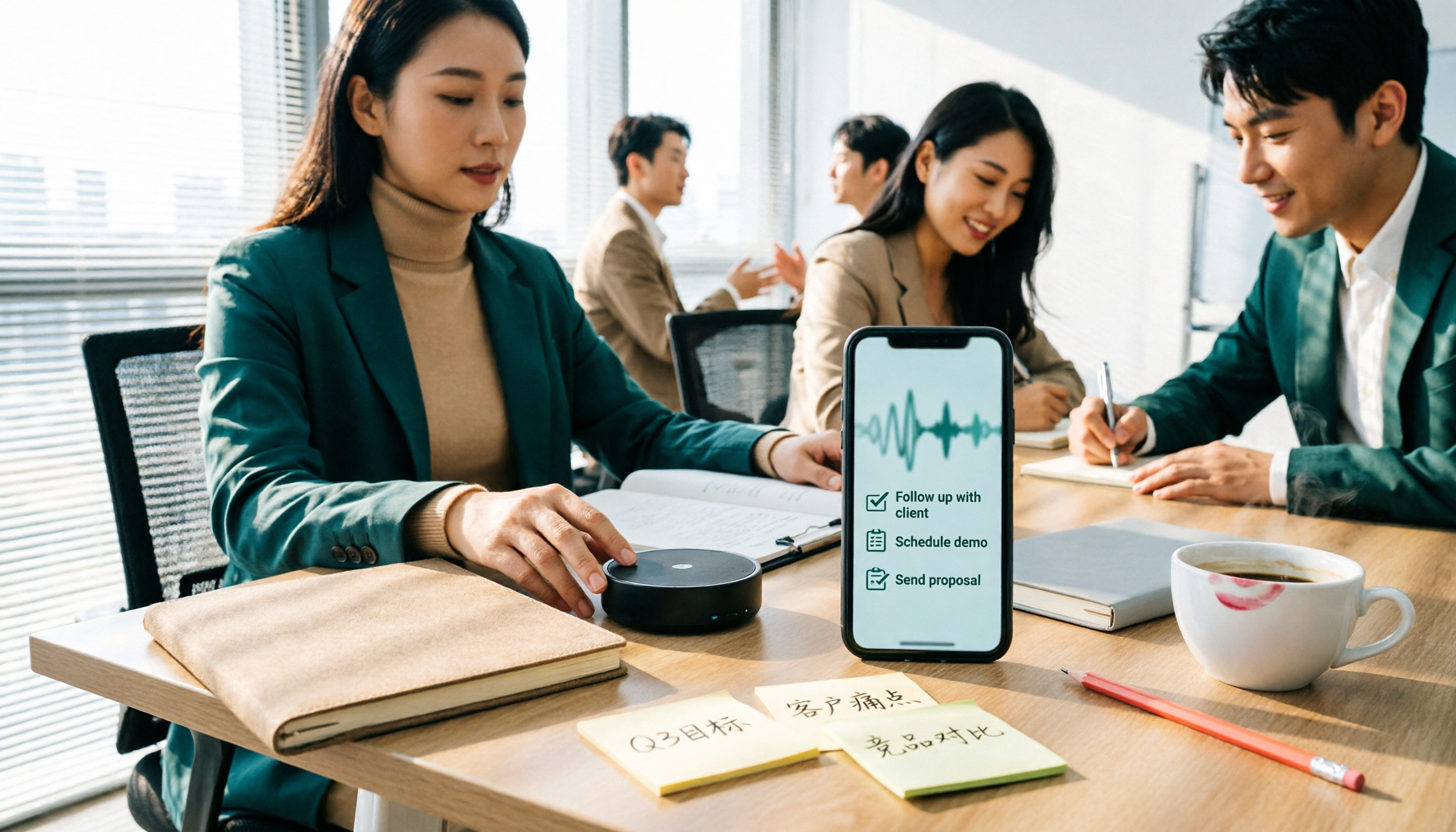
How to Choose a Sales Meeting Notes App in 2026: 5 Steps from Recording to Auto-Organized Action Items
Stop treating transcripts as meeting notes. This article reviews 4 apps that can handle sales meetings within their free tiers, explains the difference between long-term free plans and limited-time trials, single-recording length limits, and whether a desktop version is needed, with a comparison table and selection advice.

Tinrec vs Notta 2026: 5-Factor Comparison for Laptop Meeting Recording — Which Saves More Time?
Recording meetings on a laptop often means capturing only the microphone, dealing with background noise, and re-listening to create transcripts. This article compares Tinrec and Notta across five key factors, covering system audio recording, Chinese meeting transcription, AI summaries and action items, and team data management, with practical tips and selection advice.

3 Sales Meeting Note Tools Tested in 2026: How to Use Recording-to-Minutes to Save Time
How do you use sales meeting notes? This article walks through a complete workflow with Tinrec: from live recording, AI transcription, and proofreading to automatically generating summaries and action items, and using AI Q&A to uncover the customer's real concerns. It also compares the differences with Notta and Granola, and includes troubleshooting for common issues plus explanations of team plan permissions, seats, and pricing.