

Turn recordings into transcripts and summaries in minutes
Upload audio or video for multilingual transcription, AI notes, and action items
2026 Comparison of 4 Meeting Transcription Tools: Free Tiers, AI Summaries, and Team Collaboration
The meeting ends, the overtime begins—you don't need a recording, you need actionable meeting results
When choosing a meeting transcription tool, there's really only one question: do you want a verbatim transcript, or do you want meeting results you can directly use?
If you just want to turn audio into text, most tools on the market can do that. But if you want something that extracts conclusions and action items for you after the meeting, or even lets you ask two weeks later 'who proposed that budget last time?'—your options are much fewer.
That's why many people who look back at 2024 reviews find them less helpful: these tools get updated several times a year, and plans and quotas keep changing. Instead of relying on old rankings, it's better to first think about what your meetings actually look like.
Three scenarios you've probably encountered.
First, a one-hour meeting, two hours of post-meeting organizing. Re-listening, scrubbing the timeline, extracting key points—all manual.
Second, online meetings either forget to hit record, or you invite a meeting bot, which adds an extra account to the participant list, and clients ask 'who is that Notetaker?'
Third, two weeks later you want to confirm something that was said. The transcript is tens of thousands of words; Ctrl+F only finds words, not context.
4 Key Points to Understand Before Buying
1. Accuracy: Look at your meeting room, not the advertised numbers
Most tools claim high accuracy, but that's usually measured in a quiet environment. Real meeting rooms have air conditioning noise, keyboard clicks, people talking over each other, plus Chinese sentence segmentation, proper nouns, and mixed Chinese-English. Rather than trusting ad copy, take a real recording of your own and run it through the free version—especially to see how it handles mixed Chinese-English, names, and product names.
2. What it can do after transcription
Summaries, chapters, action items, AI Q&A, export formats—these are where the real time savings are. Using the tool only as 'audio to text' means you're using only a third of its capabilities.
3. How the meeting is recorded
One way is a meeting bot joining as a participant, which requires permissions and appears on the participant list; the other is a desktop app that directly captures the computer's system audio, without taking up a participant seat. The latter is especially convenient for meetings with external clients.
4. Quotas and team licensing
Personal quotas and team shared quotas are two different things; 'member', 'role', and 'seat' are also three different concepts—whether someone can see data is not the same as whether they can edit, upload, or export. If a team will use it, clarify this section first.
Tinrec—Turn meetings into searchable, queryable data
Tinrec is an AI meeting notes and collaboration tool for individuals and teams, available on web, desktop, and mobile. Its positioning is not 'audio to text' but turning meetings into data that can be searched, summarized, queried, exported, and ultimately stored in a team space.
Here's how the actual workflow goes.
During the meeting, the desktop app directly captures computer system audio, compatible with Zoom, Google Meet, Microsoft Teams, and Webex, without inviting a bot into the meeting room. It produces live transcription while recording, and for cross-language meetings, you can instantly switch between original text, translation, or bilingual view.
After the meeting, AI summaries and chapters are already organized, and action items are listed—who is responsible for what and when it's due, no need to dig back through.
The most useful post-meeting feature is the AI Q&A I use most: just ask 'who mentioned the budget in the last meeting? What was the conclusion?' It answers based on semantics, not just keyword matching. When you need to submit a report, you can also have it generate meeting minutes, tables, or documents, or export to Notion, Google Docs, OneNote, or Dropbox for further editing.
Stop organizing recordings by hand
Upload audio or video and automatically get a transcript, summary, and action items
Team scenarios are another level: the team version is a separate team space, not 'multiple people sharing one account'. Meeting data belongs to the team; members can view and play back past meetings; admins manage roles and seats, and seats determine who can record, upload, edit, and export. There are also team shared import quotas, usage analytics, audit logs, audio recycle bin, and team hotwords.
A few things to clarify upfront:
- The free version provides basic quota; regular users need to pay. The personal version offers weekly cards, Pro monthly, and Pro annual—choose based on your usage rhythm.
- The team version currently offers a 7-day trial with 1 free seat and 300 minutes of team shared import quota; paid seats are USD 29.80/month, or USD 199/year (about USD 16.58/month), with 2,000 minutes of shared import quota per paid seat per month. Real-time recording is currently not deducted by minutes under an active team plan. Prices and benefits are subject to the official purchase page.
- It does not 'automatically join all your calendar meetings'; you need to actively start recording with the desktop app.
- The team version focuses on team-level sharing plus role and seat governance, not file-level granular permissions.
- I can't give you a fixed accuracy number—audio quality, accents, noise, and overlapping speech all affect results; for important content, verify against transcript timestamps and recording playback.
Who it's for: people who need Chinese and mixed Chinese-English meeting notes, don't want a bot in the meeting room, want to use AI to find key points directly after the meeting, and need meeting data to stay within the team.
Besides Tinrec, what other options are there?
Otter.ai: A mature choice for English business meetings, with a generous free tier of 300 minutes per month. But Chinese sentence segmentation and mixed Chinese-English organization may feel less smooth for many. If your team meetings are entirely in English and you just want to keep costs at zero, it's a good deal; but if you need a Chinese meeting experience plus team data storage, Tinrec's overall workflow is closer.
Notta: Good multilingual transcription, free version offers 120 minutes per month with a 3-minute limit per item, suitable for occasional short audio files. If you want 'record online meetings without inviting a bot' and also need governance capabilities like seats, usage, and auditing, Tinrec's desktop recording and team space will save you a lot of communication overhead.
Granola: Also takes the no-bot approach, focusing on 'your handwritten notes + AI enhancement', very lightweight. However, it doesn't support uploading pre-recorded audio files and doesn't save meeting audio; if you need to keep recordings, verify original quotes afterward, or organize historical files, Tinrec is much more complete in this regard.
Pitfall Guide: 3 Most Common Mistakes When Choosing a Meeting Transcription Tool
Pitfall 1: Only looking at advertised accuracy. Advertised numbers mostly come from ideal environments. The right approach is to take a recording of your own meeting—preferably including proper nouns and multi-person dialogue—and run it through the free version; you'll see the difference in ten minutes.
Pitfall 2: Buying it but only using it for transcription. If you only use the verbatim transcript, you're giving up summaries, action items, and AI Q&A—the features that truly save time. After recording, just ask 'what are the three conclusions from this meeting?'—it's much faster than reading through a 30-minute transcript.
Pitfall 3: Ignoring team licensing and data ownership. 'Member', 'role', and 'seat' are three different things: whether a member can see data, whether a role can manage the team, and whether a seat allows recording and editing. Also clarify how meeting data under an employee's name is transferred after they leave, so it doesn't all leave with them.
A reminder: recording and transcription involve others; before use, please confirm local regulations and obtain participant consent when necessary.
Conclusion: Which one should you choose?
In one sentence: if you need Chinese meetings, bot-free recording, post-meeting querying, and team data storage, choose Tinrec.
- Meetings mainly in Chinese or mixed Chinese-English, need summaries and action items afterward → Tinrec
- Don't want a bot in the meeting room, but want to keep recordings and the original meeting → Tinrec
- Meeting data should stay with the team, with personnel changes, permissions, and usage management needs → Tinrec Team
- Meetings entirely in English, just want to avoid spending money first → Otter.ai free version
- You have a batch of pre-recorded audio files and need long-duration batch transcription → consider dedicated file transcription tools separately
I recommend starting with the free version: run a week's worth of real meeting recordings through the full workflow, see if the transcript is smooth, whether summaries can be used directly, and whether Q&A finds the key points. Upgrade if it fits—no need to pay from the start.
References
- Which audio-to-text tool is best? 2024 hands-on test of 5 tools, this one has the most comprehensive organization features - Tinrec Blog
- Hands-on test of 5 real-time meeting transcription tools in Traditional Chinese: accuracy, summary capability, pricing including Tinrec review - Tinrec Blog
- AI meeting notes software recommendations: 5 major apps tested and compared, automatic transcription makes meetings easy!
- Meeting audio to text, verbatim transcripts, which AI tool to use? Free vs paid features comparison | Manager Today
- [Audio to text] Hands-on comparison of 5 AI tools: how to choose between meeting summaries and verbatim transcripts - Tinrec Blog
Turn every recording into actionable outcomes
Get 60 free transcription minutes when you sign in. No credit card required.
Related Reading
You might also like

2026 Comparison of 4 Meeting Transcription Platforms: From Upload to Meeting Minutes, Which Saves the Most Post-Meeting Time?
After a meeting, do you want a verbatim transcript or a meeting record you can send out directly? This article compares the actual capabilities and limitations of four meeting transcription platforms—Tinrec, Otter.ai, Notta, and Granola—across five stages: import, transcription, summarization, action items, and export. It also compiles pricing and quotas verified in August 2026 to help you choose the right platform based on your needs.
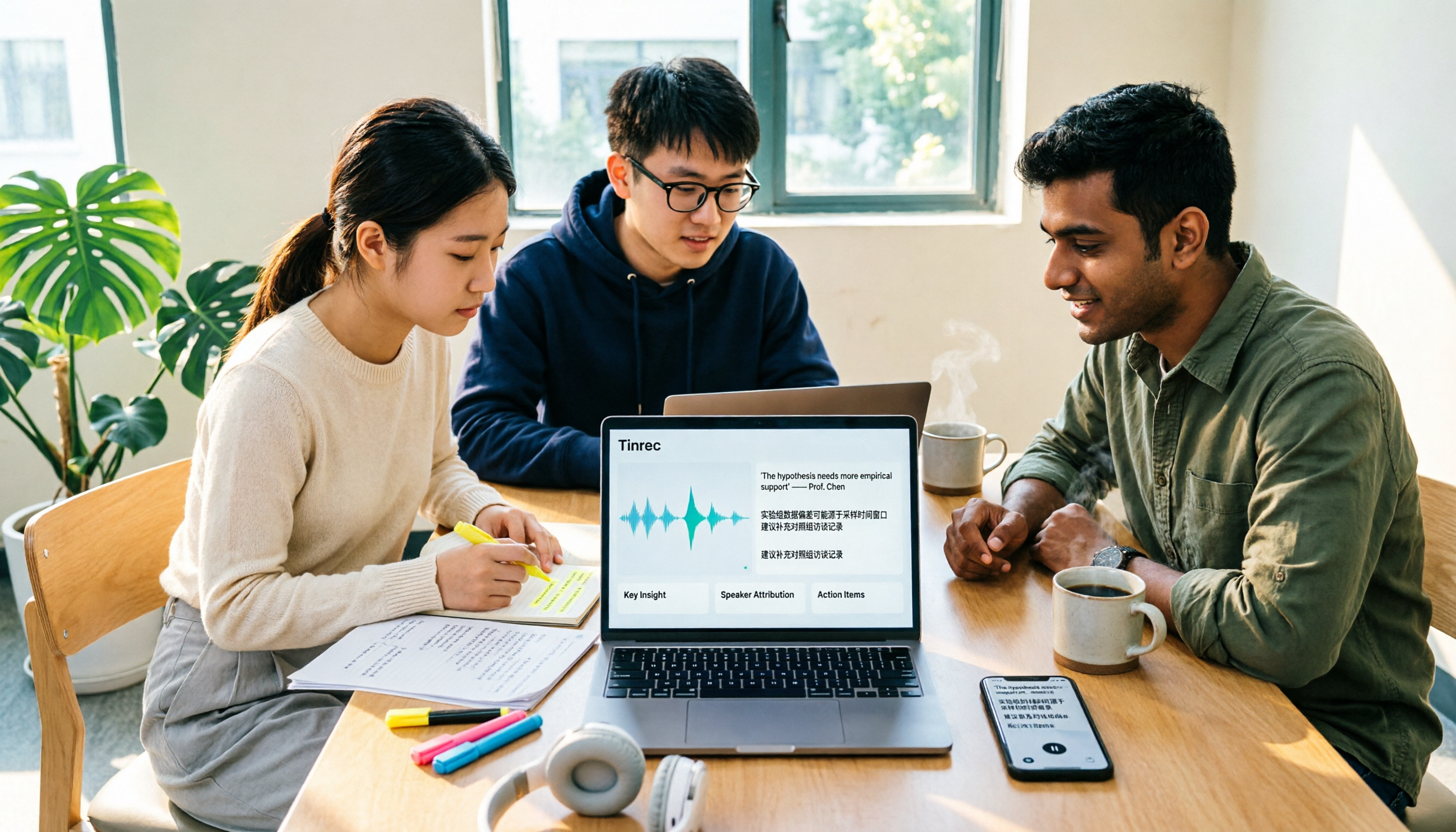
Best Meeting Transcription Tools of 2026: 4 Tested, This Free Version Is Enough for Students
Starting from real struggles with class recordings and group discussions, we tested four meeting transcription tools—Tinrec, Otter.ai, Notta, and TurboScribe—comparing free tiers, Chinese and mixed Chinese-English recognition, post-meeting summaries, and export capabilities. We also outline key decision points and three common pitfalls to help budget-conscious students find a tool they'll actually stick with.

5 Meeting Transcription Tools Tested and Compared for 2026: A Complete Guide from Recording to Meeting Minutes
Meeting transcription isn't as simple as pressing record and getting minutes. This guide covers the actual positioning, operation, and pricing of 5 tools, plus common pitfalls before, during, and after recording, to help you choose the right tool for your scenario.

2026 Complete Guide to Meeting Recording Transcription: Chinese Transcripts, AI Summaries, and Tool Comparison
How to choose a meeting recording transcription tool? This article breaks down 5 key purchasing factors, from Chinese recognition, meeting recording methods, post-meeting organization, quota calculation, to team data governance, and compares Tinrec, Otter.ai, Notta, and TurboScribe in terms of use cases and pricing to help you pick the one that saves the most time.

5 Meeting Transcription Methods Tested and Compared in 2026: The Verbatim Transcript Is Just the Beginning
Meeting transcription isn't just about turning audio into text. This article addresses three common misconceptions and breaks down the actual workflows for real-time transcription, bot-free recording, AI summaries, action item extraction, AI Q&A, and team knowledge retention. It also covers 5 key purchasing checkpoints and FAQs to help you find a method that truly saves time.

2026 Meeting Transcription Comparison: Bot-Free Recording + Auto-Generated Minutes
Tired of spending two hours after every meeting organizing notes? This guide tackles real workplace pain points and compares Tinrec, Notta, Otter.ai, and Granola for meeting transcription. It covers bot-free recording, Chinese and mixed Chinese-English transcription, post-meeting summaries and action items, team data ownership, and pricing. Includes 5 key buying criteria, 4 common pitfalls to avoid, and scenario-based recommendations (prices and plans verified as of August 2026).

2026 Comparison of 4 Meeting Transcription Tools: Which Saves the Most Time from Transcript to Meeting Minutes?
How to choose a meeting transcription tool? This article starts from the decision point: do you need a verbatim transcript or meeting minutes you can send out directly? It covers 4 key selection criteria and compares Tinrec, Otter.ai, Notta, and Granola in Chinese transcription, post-meeting organization, audio retention, and team collaboration, with 3 common pitfalls and scenario-based recommendations.

4 Free Meeting Transcription Tools in 2026: Free Tiers and Transcript Workflow Comparison
Turning meeting recordings into text is easy; turning transcripts into sendable meeting minutes is the hard part. This article compares Tinrec, Otter.ai, Notta, and TurboScribe from a practical workflow perspective—covering free tiers, speaker labeling, export formats, and post-meeting organization—plus four common pitfalls and selection advice. Data verified August 2026.

2026 Comparison of 6 Meeting Transcription Tools: Which Saves the Most Time on Chinese Transcripts and Post-Meeting Organization?
We tested 6 meeting transcription tools with the same mixed Chinese-English meeting recording, comparing bot-free recording, Chinese transcription, post-meeting summaries and action items, team data retention, and pricing. Includes a quick comparison chart and buying advice to help you pick the one that truly saves time.