
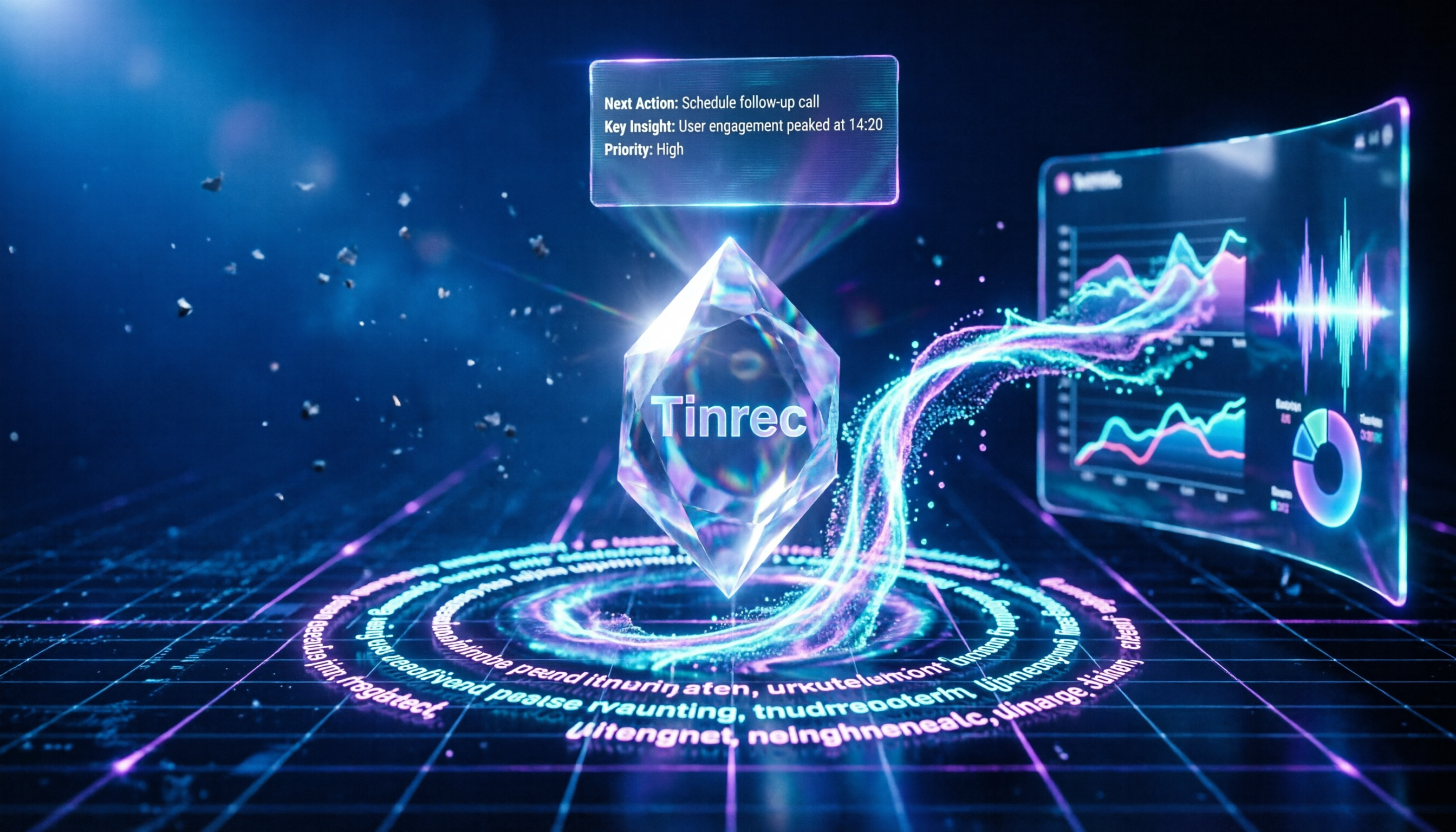
Turn recordings into transcripts and summaries in minutes
Upload audio or video for multilingual transcription, AI notes, and action items
Last semester, I took a seminar course where my group had to meet weekly on Google Meet, sharing screens to report progress. The worst part wasn't making slides—it was taking meeting notes afterward. The professor jumped between topics, and group discussions got chaotic. I'd try to type while listening, and my notes ended up so messy I couldn't even read them. Then I started using Tinrec, and I realized meeting notes could be this easy: while screen sharing on Google Meet, Tinrec records in the background, and within minutes after the meeting, it auto-generates a transcript, AI summary, and action items—no more scrambling.
What Can Tinrec Do for You?
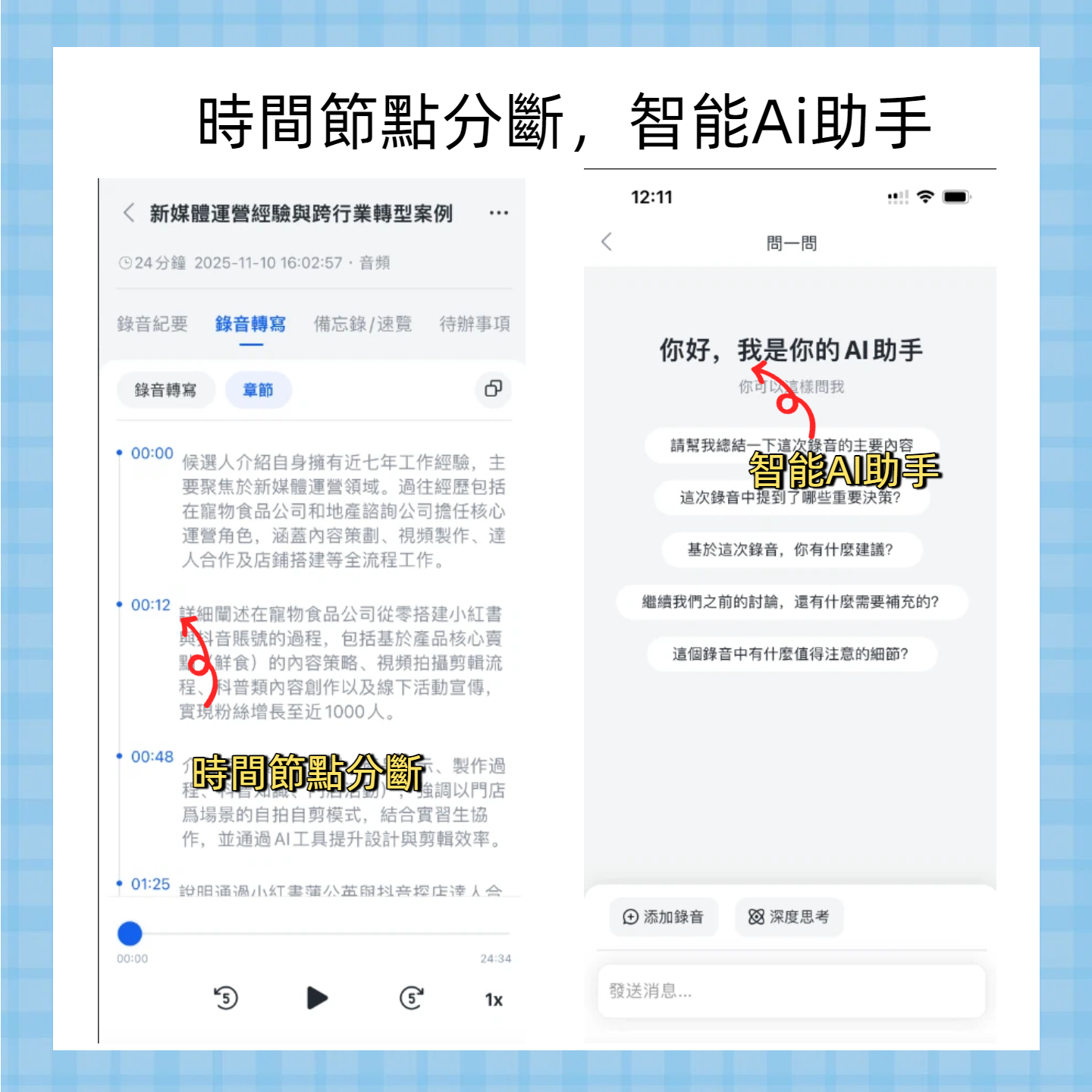
Before, after a two-hour Google Meet, I'd spend at least half an hour re-listening and typing transcripts. Now with Tinrec, it's a breeze. It's not just a recording tool—it turns meeting content into actionable material instantly.
Scenario 1: Meeting minutes in 5 minutes after a project meeting
Every time I screen share to report, while group members ask questions, Tinrec is already transcribing in real time. The moment the meeting ends, the AI summary pops up: meeting topic, conclusions, who's responsible for what, deadlines—all clear. I just drop the summary into the group chat, and everyone says, "Man, you're way too efficient."
Scenario 2: Convert online lectures into review notes
The worst part of remote learning is when professors screen share on Google Meet and flip through slides too fast. I use Tinrec to record the whole class, then later open the transcript and AI chapter breakdown. Before exams, I just search keywords to find key points—saves all that note-taking time.
Scenario 3: Internship interviews or client calls – quickly organize insights afterward
I had a series of online interviews where the interviewer shared a screen to give problems, and I worried about missing details while answering. So I started using Tinrec to record, then used the AI Q&A feature to ask, "What was that technical question about?" It instantly found the relevant segment, making follow-up emails super easy.
What Are Tinrec's Core Features?
Tinrec is completely different from the phone recording apps I've used before. It handles meetings like a smart assistant that organizes key points for you.
Real-time transcription
It transcribes while recording—not after. During a Google Meet, I can watch the live text to make sure I'm not missing anything. The delay is under a second, and accuracy is high, even for mixed Chinese-English technical terms.
AI summary
This feature saved me multiple times during finals. It doesn't just condense the transcript; it structures it: meeting topic, discussion conclusions, action items, all separated. Once after a two-hour project meeting, the summary even caught the extra tasks the professor assigned on the fly. I just pasted it into Notion as a to-do list.
AI Q&A
After transcription, you can ask Tinrec questions, like consulting a librarian. For example: "Who mentioned the budget cap in the meeting?" or "What was the client's feedback on point two?" It answers based on semantics, no need to scan the whole transcript.
Cross-device support
I use both iPhone and MacBook, and I can also log in via browser. Whether I'm using Google Meet on a computer or phone, Tinrec can record. No extra hardware needed—your phone is the recorder.
Stop organizing recordings by hand
Upload audio or video and automatically get a transcript, summary, and action items
Multiple output formats
Exported content can be saved as Word, TXT, PDF, or synced to Notion and Google Docs. I usually export each meeting's summary and action items to Notion's project database, keeping the entire semester's discussion traceable.
Real-World Use Cases
Group project discussions
Our department holds weekly Google Meet screen-sharing sessions. I typically use my MacBook and simultaneously use Tinrec's web version with "Computer Audio" to capture system audio and my microphone. Even during screen sharing, recording works perfectly. After the meeting, minutes are auto-generated. A two-hour meeting produces a summary within five minutes—no more late-night note catch-ups.
Online course review
I once took an online course where the professor screen shared code on Google Meet. I recorded with Tinrec, later exported the transcript, and used the chapter feature to split content by topic. Before exams, I searched keywords like "recursion" or "time complexity" to jump directly to relevant sections—much faster than scrubbing through video recordings.

Internship interview prep
Before interviews, I record mock interviews with seniors on Google Meet, then review them later. Tinrec's AI Q&A lets me find specific feedback on questions like "How to improve my self-introduction?" quickly, cutting note-taking time by half.
4 Key Points When Choosing a Meeting Minutes Tool
There are many voice-to-text tools on the market, but as a student on a budget, I set a few criteria, and Tinrec met almost all of them.
1. Accuracy: Don't just trust ads—test it
Some tools claim high accuracy but fail with Chinese-English mixed speech or background noise. In my tests recording Google Meet with a fan running, Tinrec's Chinese recognition was solid. Technical terms occasionally had errors, but context usually made them guessable.
2. AI features: Transcription is just the start—organization matters
If you only need a transcript, many free apps work. But Tinrec's AI summary, action item extraction, and Q&A are what really save me time. After a meeting, no need to re-listen—just read the summary to know the key points. Few other tools offer all three simultaneously.
3. Language support: Must handle Chinese well
Since our classes and meetings are mostly in Chinese, good Chinese support is crucial. Tinrec handles traditional Chinese well, even mixed with English technical terms. Unlike some foreign tools that only work well with English.
4. Cross-platform and pricing: Works on phone and computer, free tier is enough to start
Tinrec has iOS, Android, and web versions, so no matter what device you use for Google Meet, you can record. Pricing-wise, the free tier offers basic monthly transcription credits. When I tried it, I recorded three project meetings and still had credits left. For frequent meetings, the Pro monthly card costs under $6 (less than a meal out)—great value.
FAQ
Q: How do I use Tinrec to record during Google Meet screen sharing?
A: It's simple. If you're using a computer, open Tinrec's web version, click "Start Recording" and select "Computer Audio." It will capture both meeting audio and your microphone. Screen sharing video isn't recorded, but audio is clear. Mobile works too—just use speakerphone or conference mode.
Q: Is the free tier enough for one meeting?
A: Depends on length. Student project discussions usually last 1–2 hours; the free tier covers about 2–3 meetings. If you have multiple meetings weekly, consider a weekly card during finals—affordable and sufficient.
Q: Does Tinrec support Chinese? Is it accurate?
A: Yes, it supports traditional Chinese and handles mixed Chinese-English well. Accuracy drops if audio is poor or many people speak at once, but under normal conditions it's over 90%. I still recommend double-checking critical details.
Q: Is my recorded data secure? Will it leak?
A: Tinrec encrypts recordings and transcripts in the cloud, accessible only by your account. According to their privacy policy, they don't use your content to train models, so you can use it safely.
Summary
If you're like me—often using Google Meet for meetings, classes, and screen sharing, and struggling with meeting notes—you should really try Tinrec. It's not just a recorder; it's an AI assistant for meeting organization: real-time transcription, auto summary, action item tracking, and direct Q&A, all in one. The student plan is affordable, the free tier lets you experience it, and the Pro monthly card costs about the same as a boba tea. Since the semester started, I've recommended it to three classmates, and they all said, "Why didn't you tell me sooner?" Stop wasting time typing transcripts—give it a try. You'll be amazed how easy meeting notes can be.
Turn every recording into actionable outcomes
Get 60 free transcription minutes when you sign in. No credit card required.
Related Reading
You might also like

2026 In-Depth Comparison of 3 AI Transcription Tools: Essential for Saving Time in Google Meet Meetings
Tired of spending hours after Google Meet calls transcribing meeting minutes? This article tests three AI transcription tools that work with Google Meet, comparing Cantonese accuracy, AI Q&A features, and free tiers to help you find the best option. Tinrec stands out overall.

Best Google Meet Screen Sharing Meeting Notes Tools: 3 Tested in 2026, Top Pick for Traditional Chinese
Struggling with meeting notes after Google Meet screen sharing? We tested 3 voice-to-text tools on accuracy, Chinese support, AI features, and pricing to find the best solution for Traditional Chinese users.

2026 Side-by-Side Test of 2 Google Meet Recording Methods: Which Saves More Post-Meeting Effort?
This article compares Google Meet's built-in recording with AI tool Tinrec for meeting capture and post-meeting organization. It analyzes recording thresholds, Chinese subtitles, AI summaries, task extraction, and cross-platform sharing to determine which method saves you more time.

2026 Google Meet Recording: No Hardware License Needed + AI Auto Meeting Minutes
Worried about Google Meet hardware license costs? Actually, you can use Tinrec to record meetings directly on your computer, automatically generating transcripts, summaries, and action items—no hardware needed. This guide walks you through setup to save on licensing fees.
2026 Hands-On Comparison of 3 Google Meet Meeting Recording Methods: Which Is the Most Discreet and Efficient?
Worried about Google Meet detecting screen recording? This article tests three meeting recording methods—built-in recording, manual note-taking, and AI voice-to-text—and analyzes which is the most discreet and efficient, recommending Tinrec for secure meeting capture.
2026 Google Meet Built-in Transcription vs Tinrec: 5-Dimension Showdown – Which One Fits Your Meeting Notes?
Still debating whether to buy a Google Meet advanced subscription just for transcription? Pseric puts Google Meet's built-in transcription head-to-head with Tinrec, comparing accuracy, AI summaries, cross-platform support, multi-source compatibility, and pricing to help you find the best meeting notes solution.

2026 Comparison of 4 Google Meet Meeting Recording Tools: Can AI Notes Really Help You Leave on Time?
Tired of spending hours after Google Meet calls transcribing recordings and working overtime? We tested 4 AI recording tools and found that upgrading your webcam isn't the answer—choosing the right recording app is. Tinrec stands out with its AI conversation search and Cantonese accuracy. Want to know which tool saves the most time and lets you skip the late nights? Read on.
2026 Hands-on Review of 2 Google Meet Recording Tools: Who Can Make Perfect Meeting Notes After Muting Unwanted Speakers?
Google Meet hosts can mute participants, but what to do with the recording afterwards? This article puts two AI transcription tools—Tinrec and Otter.ai—to the test, comparing them across five dimensions: Chinese accuracy, input sources, AI features, pricing, and export options, to help you find the best choice for organizing Google Meet meetings.

2026 Head-to-Head Comparison of 3 Google Meet Breakout Room Recording Tools: Tinrec Makes Sure No Group Discussion Content Is Lost
Struggling to consolidate discussion content from Google Meet Breakout Rooms? This article tests 3 tools to turn group recordings and meeting content into searchable, summarizable actionable knowledge.