
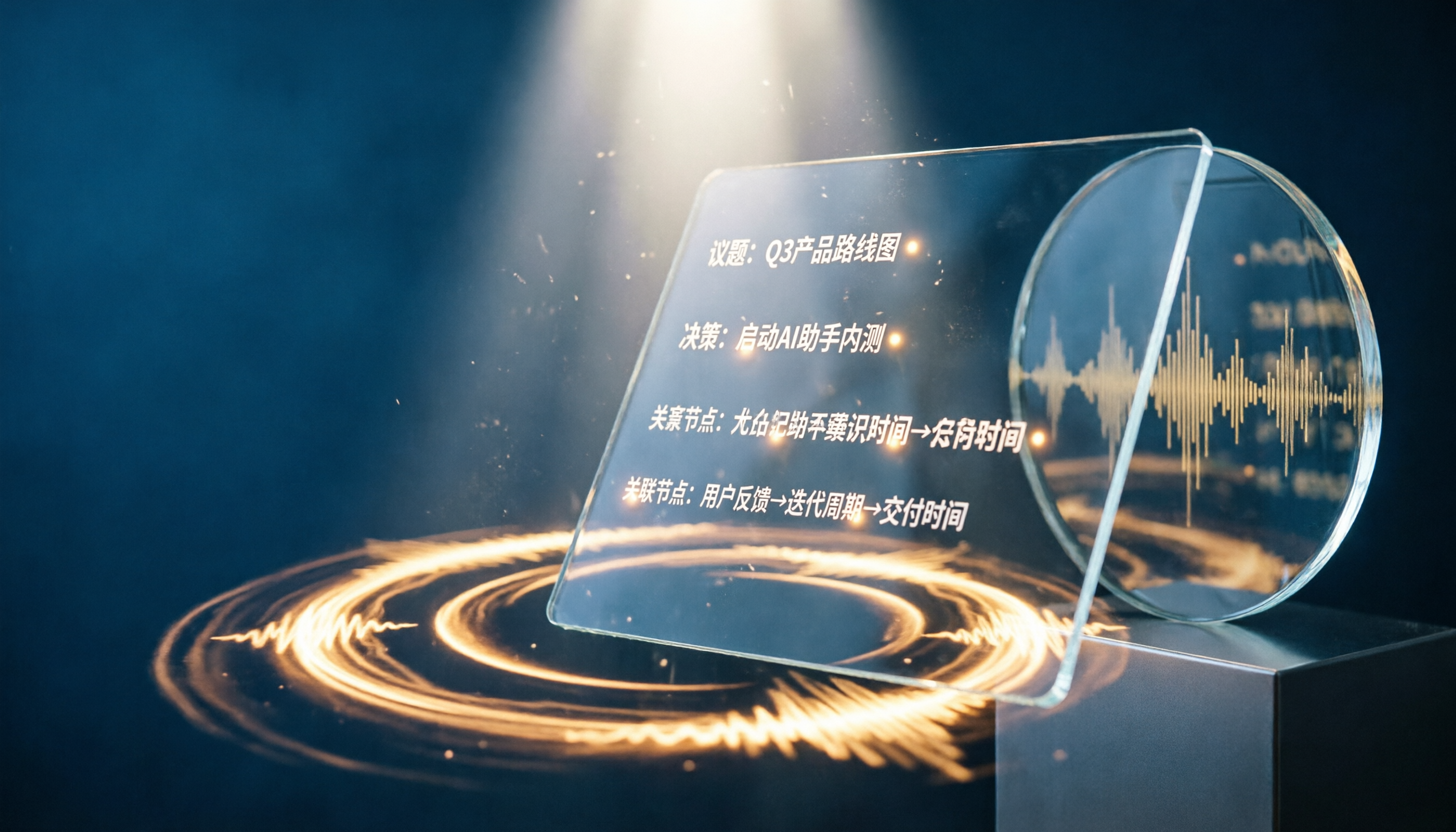
Turn recordings into transcripts and summaries in minutes
Upload audio or video for multilingual transcription, AI notes, and action items
I recently found myself dealing with a mess of online meeting recordings from the past six months. The problem? Google Meet's built-in transcription gives you a block of plain text after every meeting—no summary, no action items. When you need to revisit a decision, you end up scanning through the entire transcript.
So I started looking for a more complete solution.
I tried the platform's built-in transcription first, but in multi-person Chinese meetings, it often mixed up speakers. And once the meeting ended, the text record was stuck in that meeting—there was no way to combine it with my other study notes or interview recordings.
Then I switched to Tinrec. That's when I realized the key isn't just "turning speech into text"—it's what you can do with it afterward: organize, query, and export. That's when everything clicked.
This article compares Google Meet's built-in transcription and Tinrec from five dimensions, using real-world scenarios to help you decide which approach fits your meeting minutes needs.
What Should Meeting Minutes Do for You?
Many people think turning on transcription during a meeting means "I have a record," but the real issue is what happens after the meeting: Can you quickly find the budget figure discussed last week? Can you see who committed to what at a glance? Can you link the key points of this meeting to another meeting three months ago?
With just a transcript, that's hard to do.
Take Tinrec as an example. It doesn't just convert speech to text—it automatically generates a summary, chapters, and action items. After a two-hour project meeting, I don't need to listen from start to finish again. I open the summary to see conclusions, click on action items to track progress, and I can even ask Tinrec, "What did the client say about the second design version?" It will give me a specific answer based on the recording content.
(Screenshot: Tinrec meeting overview, with arrows pointing to AI summary, action items, and AI Q&A section)
That's what I think a meeting minutes tool should do: not just produce a text file, but output actionable information.
Core Capabilities of Meeting Minutes Tools
Before choosing a tool, think about what you need. Here are five key points that affect the actual experience, and I'll explain each using Tinrec's real operation.
Real-time transcript, but with speaker differentiation
Having text appear as you speak is a basic requirement. But the key is: in multi-person discussions, can it automatically identify who said what? Tinrec distinguishes between different participants in real time—not after the meeting. This makes it easier to follow the conversation while reading the live transcript.
(Screenshot: Live transcription interface, with arrow pointing to speaker labels)
AI summary, not just a condensation, but structured
Many tools' "summaries" just shorten the transcript, leaving you still unsure of the key points. Tinrec's summary organizes content into "meeting topic—discussion conclusions—action items—responsible person," making the summary itself a guide for action.
Ask questions about the recording, like searching your own database
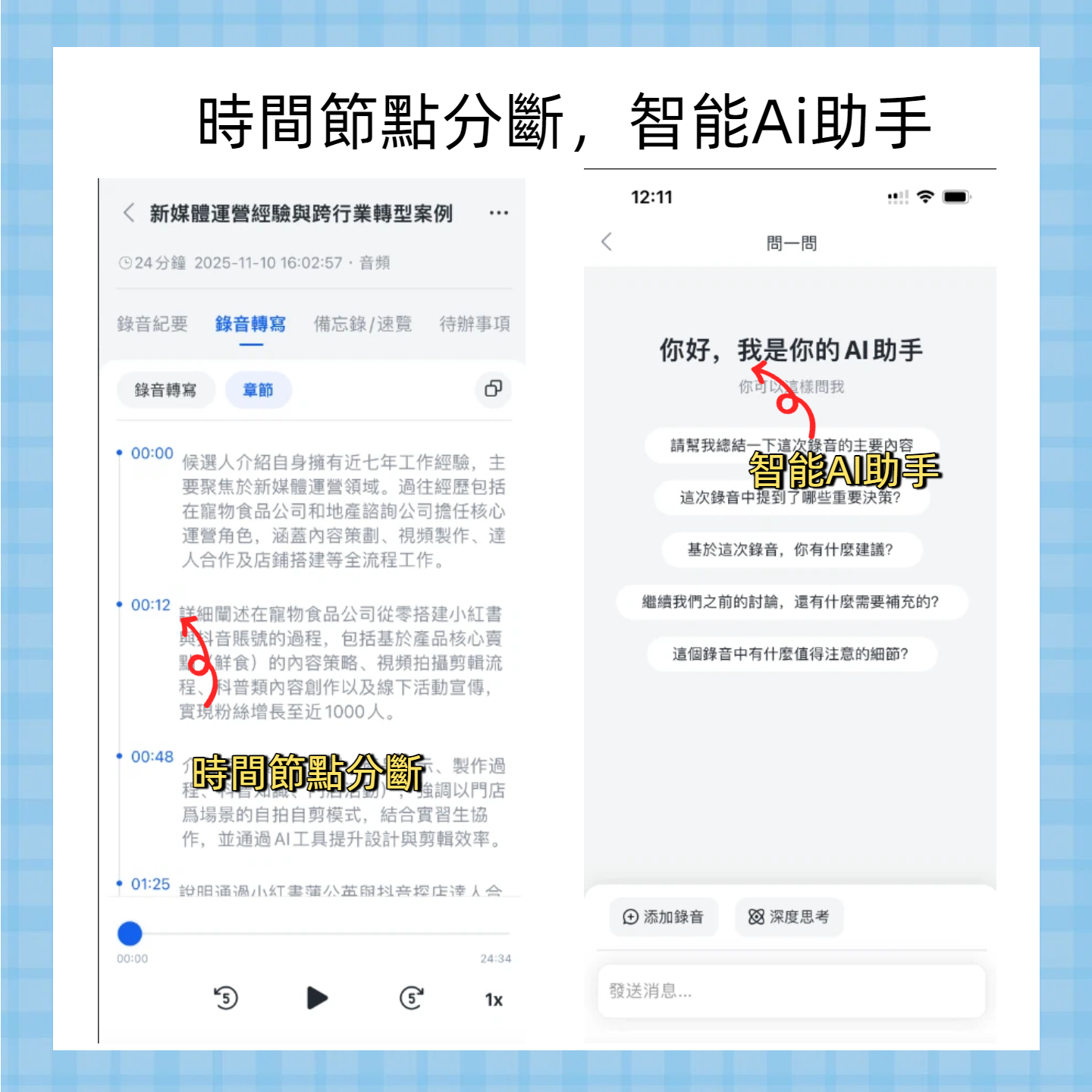
This is the feature I find most game-changing. Meeting records are no longer static files. You can ask Tinrec: "Who suggested delaying the launch in last week's meeting?" "What was the final decision on the budget?" It understands the context and gives you answers. This turns past meetings into a searchable knowledge base.
(Screenshot: AI Q&A interface, with arrow pointing to the question input and AI response)
Cross-meeting aggregation—connect decisions across meetings
A project might involve ten meetings, each with scattered discussions. Tinrec lets you group related meetings and query across them with AI. No need to manually go through ten transcripts. This is especially useful for long-term projects or client tracking.
Stop organizing recordings by hand
Upload audio or video and automatically get a transcript, summary, and action items
Export to tools you already use
Meeting minutes shouldn't be locked in a single platform. Tinrec supports export to Notion, Google Docs, and more. You can put summaries into project notes and sync action items to task management tools, keeping your workflow going.
Real-World Use Cases
Scenario 1: Weekly Project Status Meetings
Before, after each meeting I spent half an hour writing minutes and confirming action items. Now, I start recording with Tinrec, and by the time the meeting ends, the summary and action items are already generated. I just quickly review, tweak, and paste them into the team group. Follow-up done in five minutes.
Scenario 2: Client Requirement Interviews
When interviewing clients, I don't want to be distracted by note-taking. Tinrec records the entire conversation, the transcript helps me revisit details later, and the AI summary extracts key requirements. I then export these points into proposal documents, saving a ton of organization time.
Scenario 3: Cross-Timezone Team Communication
With team members scattered across time zones, not everyone can join meetings live. With Tinrec, absent members can quickly catch up via the summary and even ask questions about the recording, as if they attended. This reduces repetitive explanations.
Scenario 4: Personal Learning and Professional Development
I also use Tinrec to record online courses or lectures. After class, I ask the AI: "What specific examples were mentioned in this lecture?" "What exercises can I try right away?" It turns the entire audio course into an interactive notebook.
5 Things to Consider When Choosing a Meeting Minutes Tool
You might be deciding between Google Meet's built-in transcription and a third-party tool. Here are five practical aspects to consider.
1. Depth of post-transcription organization
Google Meet's transcription is plain text—no summary or action items. If you want structured records right after a meeting, a tool like Tinrec saves more effort.
2. Chinese accuracy and speaker differentiation
Multi-person Chinese meetings often have overlapping speech, filler words, and mixed languages. Built-in platform transcription can struggle with this. Tinrec is better tuned for Chinese and Traditional Chinese scenarios, with more reliable speaker labeling—important for later recall.
3. Searchability and reuse of past meetings
Google Meet's transcription is tied to the meeting link. Finding a discussion from three months ago is cumbersome. Tinrec centralizes recordings, letting you search with keywords or natural language queries across meetings, turning old data into usable knowledge.
4. Support for multiple input sources
Besides online meetings, you might have local audio files or online videos to process. Google Meet only handles its own meetings. Tinrec can upload audio files or paste YouTube links to organize them, making it more versatile.
(Screenshot: Interface for importing audio files or pasting online video links)
5. Long-term data accumulation and platform neutrality
If you switch video tools, your meeting records don't follow you. Tinrec is independent of meeting platforms, usable on phone and computer. Over time, your recordings and organized results stay under your control.
Frequently Asked Questions
Q: I already use Google Meet's built-in transcription. Do I still need Tinrec?
If you only need a rough dialogue record during the meeting, the built-in function is enough. But if you want summaries, action items, searchable past meetings, or need to organize course recordings, interviews, or other audio, Tinrec fills the gaps in organization and reuse.
Q: Can Tinrec directly record Google Meet meetings?
Yes. You can record the meeting audio using your computer or place a mobile device near the meeting to record. Tinrec supports various recording methods and is not limited to any specific video platform.
Q: Is the free plan sufficient?
Tinrec's free plan provides a basic monthly transcription quota, enough to try it on a few meetings or course recordings and experience the AI organization. If you have many meetings each week, consider the Pro plan.
Q: Are meeting contents private and secure?
Tinrec values user privacy. Recordings and transcriptions are under your control; deleted data is not retained. See the official website for detailed privacy policy.
Summary
Google Meet's built-in transcription makes meeting records easy, but it's more like an extension of live captions. If you need more than a text file—quick access to key points, tracking action items, cross-meeting queries, and centralizing various audio and video sources—an AI note-taking tool like Tinrec is a more complete solution.
If you often feel overwhelmed by meeting minutes, start with the Tinrec free plan and see how AI can help you organize. You'll find that post-meeting work can be this easy.
Quick Start Checklist: 5 Steps to Use Tinrec for Meeting Minutes
- Open Tinrec before the meeting and start recording.
- After the meeting, review the auto-generated summary and action items.
- Use AI Q&A to quickly confirm specific discussion details.
- Export the summary or action items to your notes or task tool.
- Periodically review past meetings using search or queries to find past decision context.
Try it step by step, and you'll gradually turn meeting minutes from a burden into an asset.
Turn every recording into actionable outcomes
Get 60 free transcription minutes when you sign in. No credit card required.
Related Reading
You might also like
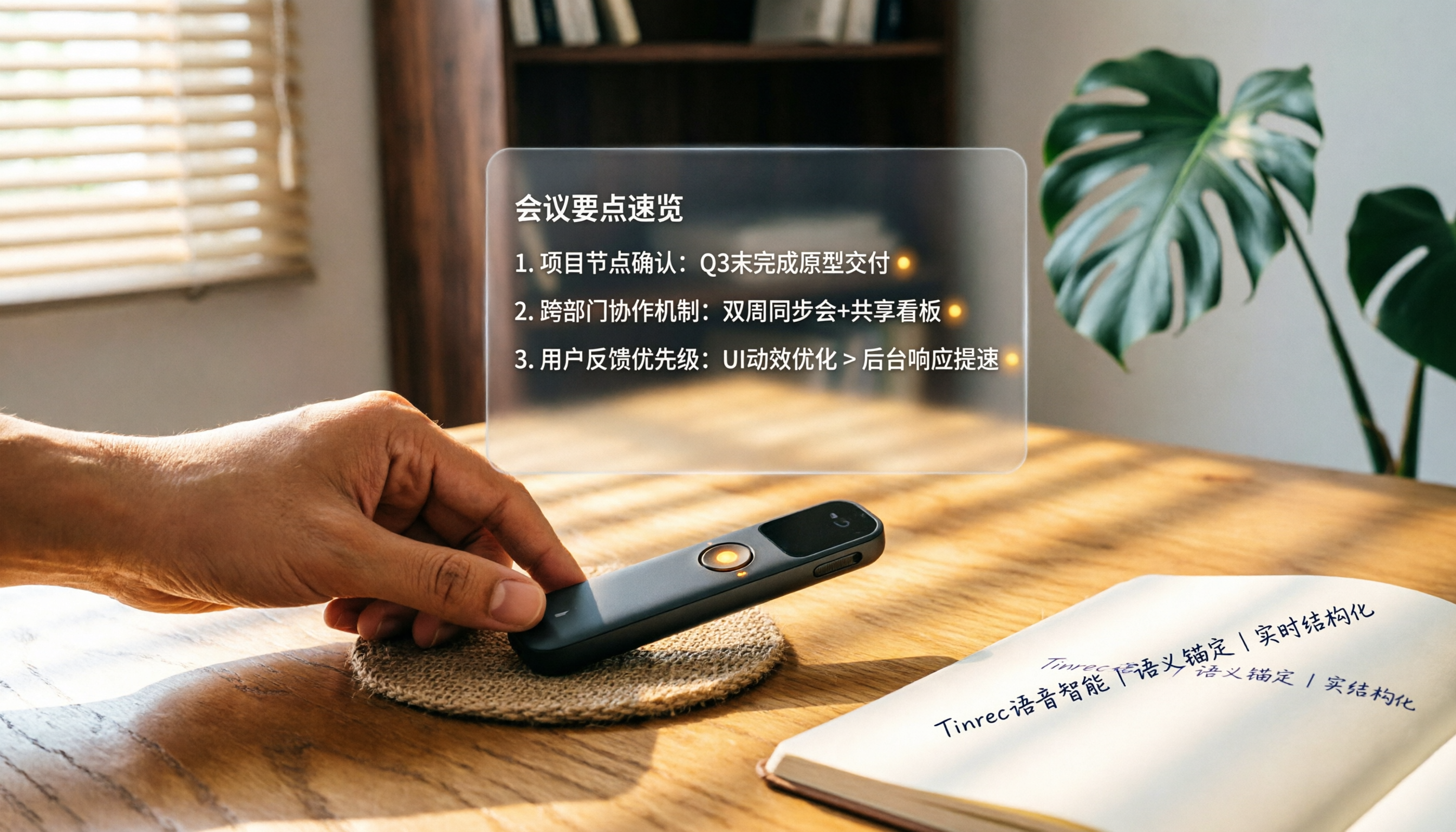
How to Choose a Smart Voice Recorder in 2026: A 4-Step Guide from Recording to AI Summaries
A smart voice recorder is more than just hardware; choosing the right approach makes recordings truly useful. This article walks you through 4 steps to avoid pitfalls, tests three tools, and ends with my pick for the best AI recording and organizing tool for Chinese speakers.
5 Best Speech-to-Text Tools in 2026: From Meetings to Learning, Organize Efficiently
I've compiled 5 AI speech-to-text tools I've tried over the past year, using Tinrec as an example to show you how to turn meeting, course, and interview recordings into usable text with a single workflow—no more piling up transcripts.

2026 Tested: 5 Recording Solutions Compared—Are Mobile Apps Really Better Than Voice Recorders?
Still debating whether to buy a voice recorder? What you really need is a tool that turns recordings into text and highlights key points. This article tests 5 recording-to-text and organization solutions, from free apps to AI recording hardware, to help you find the best fit—and explains why Tinrec is our top all-purpose recommendation.

2026 Long-Battery Voice Recorder Free Options: 5 Picks Reviewed
Running out of battery on your voice recorder during class is a nightmare? We tested 5 recording and AI organization tools, from free apps to paid plans, from a student's perspective to tell you which is best for long recordings, comparing battery life, audio quality, and AI features.

Tinrec vs Otter.ai 2026: A 5-Dimension Showdown for Students Needing Large-Capacity Audio/Video Organization
Tired of large recordings? A senior student tests Tinrec and Otter.ai, comparing input sources, Chinese accuracy, AI note features, free tiers, and pricing to see which tool better suits students' transcription needs, saving you money.

3 Workplace Voice Recorders Tested in 2026: Which One Is the Ultimate Meeting Notes Sidekick?
How should you choose a voice recorder for the workplace? We tested a traditional voice recorder, phone recording, and the AI recording app Tinrec, comparing portability, post-processing, and budget to find the best meeting note solution for office workers.

Voice Recorder vs. Phone Recording in 2026: How to Choose? 5 Steps to Build an Efficient Recording Workflow
Still torn between a voice recorder and your phone for recording? This article starts from real-world use cases, teaches you how to find the best recording solution in 5 steps, and tests the AI recording tool Tinrec to see how it solves the pain points of traditional recording, saving you hours of organizing time.

How to Choose a Cost-Effective Voice Recorder in 2026: 4 Steps to Compare Recorders and AI Tools
Thinking about buying a voice recorder but unsure how to evaluate value for money? This article compares traditional voice recorders and AI recording tools from perspectives like features, price, and post-processing, helping you pick the best recording solution.

2026 Test: AI Software vs. Hardware Noise Reduction for Voice Recorders—Which Keeps Meetings and Lectures Clearer?
I tested popular voice recorders and AI recording software, and found that hardware doesn't always beat software for noise reduction. This article compares Tinrec and PLAUD Note in real-world scenarios, covering noise reduction, organization features, and long-term use, to help you choose the right solution.