

Turn recordings into transcripts and summaries in minutes
Upload audio or video for multilingual transcription, AI notes, and action items
Tinrec vs Google Meet Transcription | Quick Overview
Many people use Google Meet for meetings; just enter the meeting ID and join. It’s convenient. But after the meeting, organizing recordings and transcriptions often takes more time than expected.
Google Meet itself offers live captions and recording, while Tinrec (formerly known as Miao Ting) is an AI audio and video organization tool specifically designed for meetings, lectures, and interviews. This article compares these two solutions from 5 dimensions that real users care about, helping you decide which one fits your workflow better.
Basic Comparison
- Tinrec: Available on iOS, Android, and web. Free plan includes basic transcription quotas; paid plans depend on frequency.
- Google Meet built-in transcription: Requires specific Google Workspace editions. Provides live captions and automatic transcript generation after recording (depending on version).
The following compares these 5 aspects: "Post-transcription processing," "Input source flexibility," "Chinese content accuracy," "Cross-platform integration," and "Pricing and ease of use."
Dimension 1 | What Can You Do After Transcription?
Google Meet's transcription feature mainly stops at converting speech to text. If you use a paid Workspace version, you get an automatically generated transcript after the meeting, but it's usually just plain text.
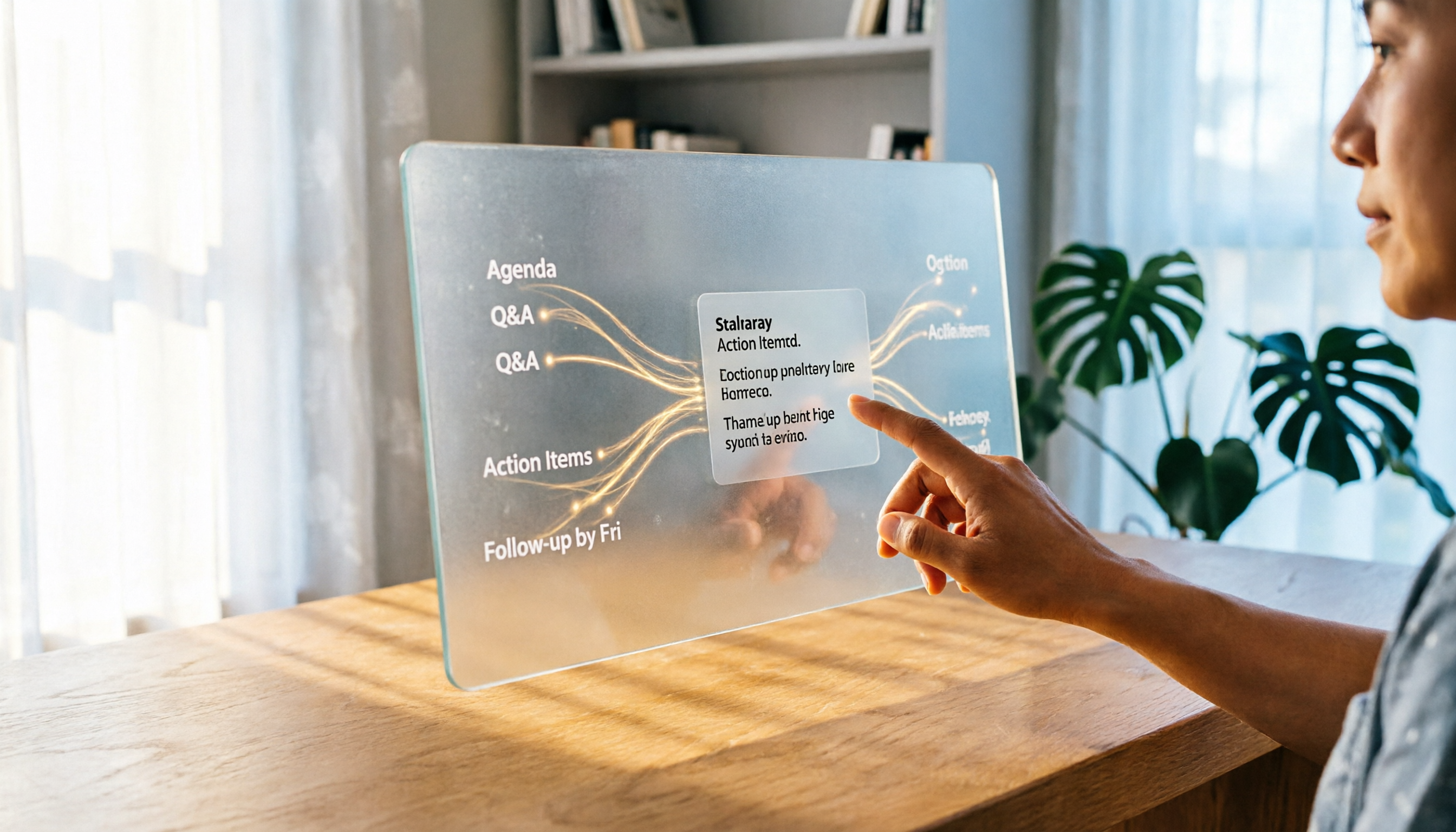
Tinrec treats transcription as a starting point. It can automatically generate AI summaries, chapter segmentation, to-do lists, and even allows you to ask questions about the recording (AI Q&A) to quickly extract key points. You can also export the organized data in various formats or have AI generate meeting reports and tables.
→ This dimension: Tinrec clearly wins (it doesn't just provide a transcript; it turns meeting content into usable, searchable data).
Dimension 2 | Does It Handle a Wide Range of Input Sources?
Google Meet only handles content recorded during an online meeting. It can't process in-person meetings, client interview recordings, or past lecture recordings.
Tinrec can record live meetings and also upload audio/video files from your phone, or paste links to web videos from YouTube, Bilibili, TikTok, etc., transcribing and summarizing them all. In short, Tinrec can digest any audio or video source and organize it uniformly.
→ This dimension: Tinrec is more flexible (supports not only online meetings but also local files and web videos).
Stop organizing recordings by hand
Upload audio or video and automatically get a transcript, summary, and action items
Dimension 3 | Which Handles Chinese Content Better?
Google Meet's live captions have high recognition accuracy for English, but support for Traditional Chinese is relatively basic. Especially with code-switching, proper nouns, or accented speech, the captions often need manual correction.
Tinrec's product design is specifically optimized for Chinese content. Whether it's a pure Chinese meeting, mixed Chinese-English discussion, or Taiwanese terms, the overall transcription usability is significantly higher. Of course, actual performance still depends on recording quality, but for Chinese users, Tinrec's experience is much better.
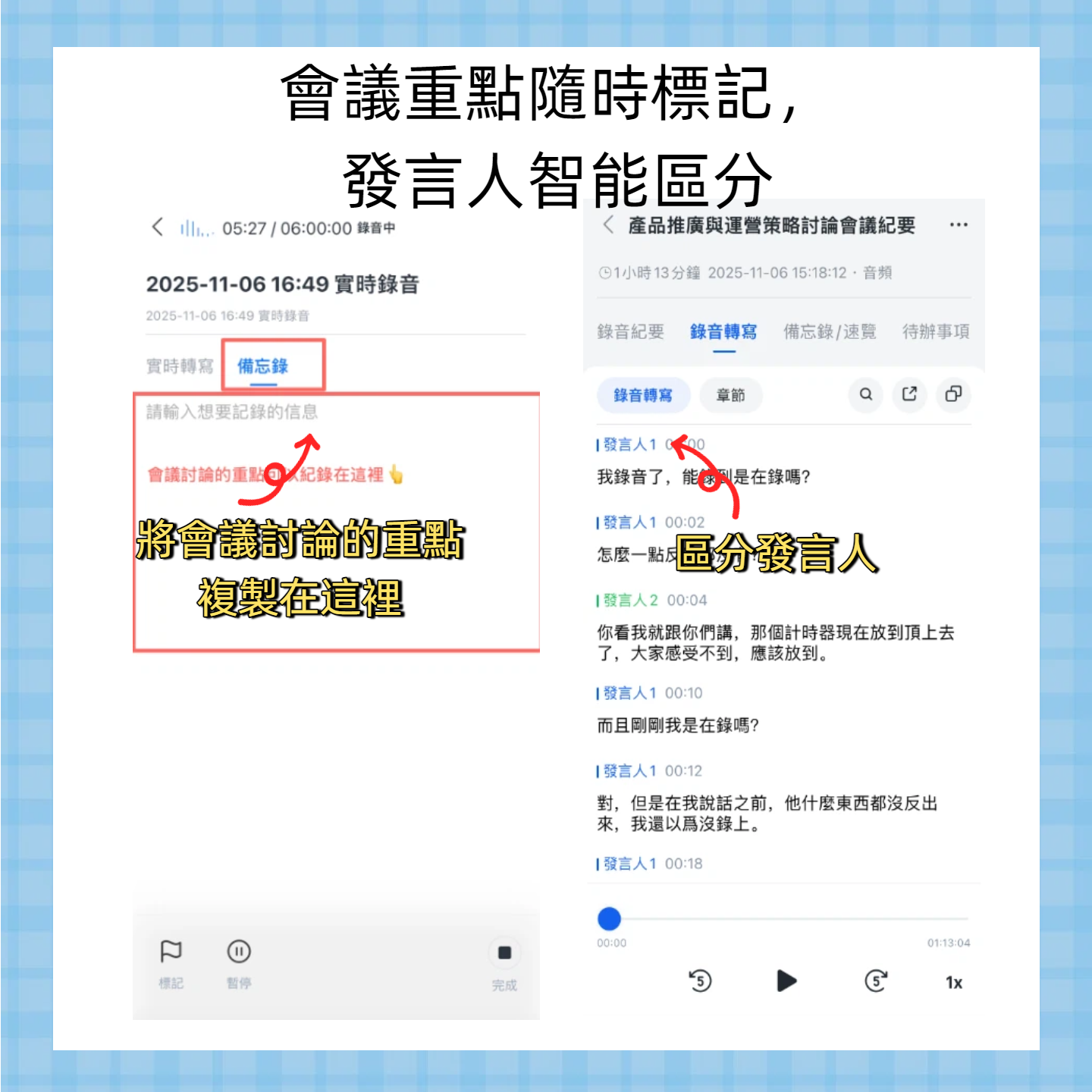
→ This dimension: Tinrec wins (its transcription and organization for Chinese scenarios are much closer to real needs).
Dimension 4 | Can Data Be Synced Across Devices?
Google Meet records are tied to your Google account and are usually only available as recordings and transcripts in Google Drive. Moving them to other note-taking or collaboration tools requires manual effort.
Tinrec itself offers iOS, Android, and web versions. Whether you record on your phone, take notes on a tablet, or continue organizing on your computer, content syncs across devices. Tinrec also supports exporting to tools like Notion, Google Docs, OneNote, etc., allowing your meeting data to flow into your usual workflow.
→ This dimension: Tinrec is more convenient (cross-device sync + multi-format export, ideal for long-term data accumulation).
Dimension 5 | Pricing and Getting Started
Google Meet's transcription is a built-in feature for those who already subscribe to a paid Workspace plan, so no extra cost. But free users have almost no usable transcription and note tools.
Tinrec offers a free plan with a monthly transcription quota, allowing you to try live recording, file transcription, and web video parsing. If you only need to organize meetings occasionally, the free plan is sufficient. For intensive meetings or courses, consider a weekly pass. For long-term use, the Pro monthly or yearly plan is affordable. No extra hardware needed; you can start right away on your phone or computer.
→ This dimension: Tie (Google Meet is zero-barrier for existing Workspace users; Tinrec is more cost-effective for those without Workspace or who need more features).
What Are the Unique Advantages of Each?
Tinrec's unique advantages
- Not just meetings: can organize lectures, interviews, podcasts, and web videos.
- Post-transcription provides summaries, chapters, to-dos, and AI Q&A, making data reusable.
- Cross-platform use allows records to accumulate into a personal knowledge base.
Google Meet built-in transcription's advantages
- Teams already using Google Workspace can enable captions directly in meetings with a seamless workflow.
- No need to install another app; sufficient for light note-taking needs.
Summary: Which Should You Choose?
- If you only need live captions during Google Meet and a quick glance at the transcript afterward → Google Meet's built-in feature is enough.
- If you want meeting recordings to automatically become summaries, to-dos, and be exportable to your favorite tools → Tinrec is a better fit.
- If your notes aren't limited to online meetings but also include lectures, interviews, and web videos → choose Tinrec without hesitation.
- If you are a Chinese user who cares about transcription accuracy and mixed-language handling → Tinrec's experience is far superior.
In a nutshell: If meetings for you are not just "listen and forget," but require turning content into actionable data, try Tinrec. It’s much more efficient than relying solely on Google Meet's built-in transcription.
Turn every recording into actionable outcomes
Get 60 free transcription minutes when you sign in. No credit card required.
Related Reading
You might also like
How to Save Chat Messages in Google Meet? 2026 Meeting Note Tools Recommendation, Tinrec Top Pick
When meeting on Google Meet, text messages are scattered everywhere, making it hard to organize later. This article tests 5 tools, teaches you how to fully record meeting content, Tinrec stands out for its AI summarization and Q&A features.

2026 Comparison of 2 Meeting Note Tools: After Replacing Facetime with Google Meet, Which One Handles Chinese Meetings Better?
After switching from Facetime to Google Meet for meetings, how can you efficiently take notes? This article compares Tinrec and Otter.ai in real tests, covering Chinese transcription, multi-source support, and AI summarization, to tell you which is better for Chinese users.

2026 Comparison of 3 Ways to Use Google Meet in China: Free Recording and Organization with Tinrec
When using Google Meet in China, unstable internet and messy meeting notes are common headaches. This article tests 3 solutions and shows you how to easily transcribe, summarize, and extract action items for free with Tinrec—no more manual work.

2026 4 Google Meet Recording to Text Tools Tested and Compared: Which Saves the Most Time?
Struggling to turn meeting recordings into text? We tested Tinrec, Plaud Note, Yating Transcript, and Otter.ai, comparing Cantonese accuracy, AI Q&A, cross-platform compatibility, and free tier limits to help you pick the most time-saving tool.

2026 Google Meet Recording Tools Comparison: 4 Tested, Best for Chinese Meeting Notes
Tired of manually summarizing Google Meet meetings? We tested 4 voice-to-text tools and recommend the best solution for Chinese speakers, plus buying tips and common pitfalls.

Free Google Meet Meeting Notes Tools 2026: A Look at 3 Options
Tired of spending hours transcribing Google Meet recordings? We tested 3 free AI meeting note tools, analyzing accuracy, AI summaries, cross-platform support, and language compatibility to help you find the best free solution that turns meeting recordings into searchable, actionable knowledge.

5 Google Meet Meeting Note Tools Tested in 2026: Which Free Plan Is Best?
Struggling to turn Google Meet recordings into text and summaries? This article tests 5 tools including Tinrec, Otter.ai, Fireflies.ai, comparing free plans, AI summaries, and Chinese support to help you find the perfect meeting note taker.

How to Record and Organize Google Meet Interviews in 2026: Tinrec Auto-Generates Transcripts, Summaries & Action Items
How to fully record and quickly organize Google Meet interviews? This article compares built-in transcription with Tinrec, testing 5 dimensions: real-time transcription, accuracy, post-meeting organization, cost, and cross-platform. Learn to save 80% of your note-taking time and never miss key points.

The Ultimate Guide to Google Meet Meeting Notes in 2026: Auto-Generate Summaries and Tasks with Tinrec
This guide teaches you how to use Tinrec to instantly transcribe Google Meet recordings, automatically generate summaries, to-do lists, and AI-powered Q&A, streamlining your workflow from invitation to post-meeting organization.