

Turn recordings into transcripts and summaries in minutes
Upload audio or video for multilingual transcription, AI notes, and action items
Every time I join an online meeting, my peripheral vision catches my own face, which is not only distracting but also makes me feel awkward when speaking.
Google Meet's hide self view feature does solve this pain point—just click a button, and your own video window disappears, instantly making the meeting experience much cleaner.
But what's even more exhausting is the post-meeting note-taking: a one-hour meeting can take two to three times longer to manually transcribe. If you rely solely on Google Meet's built-in transcription, you get live captions but no summary, no action items, and no way to search for key points afterward.
To help you find a more complete solution, I compared Google Meet's built-in transcription with Tinrec's instant recording in a real-world test. This article will break down 5 key dimensions to help you determine which one truly saves you post-meeting time.
Google Meet vs Tinrec: Quick Overview
Google Meet is a familiar online meeting tool. Its built-in live captions and transcription can record meeting conversations, but the functionality is limited to the meeting itself, leaving you with very little usable data afterward.
Tinrec, on the other hand, is an AI tool specifically designed for audio and video content. It handles not only meetings but also lectures, interviews, YouTube videos, and podcasts, converting them into text and automatically generating summaries, action items, and AI-powered Q&A.
| Comparison Item | Google Meet Built-in Transcription | Tinrec Instant Recording |
|---|---|---|
| Primary Role | Add-on feature of an online meeting platform | AI audio & video processing workspace |
| Input Sources | Google Meet meeting audio only | Live recording, audio/video files, web video links, meeting recordings |
| Chinese Content Support | Basic captions | Optimized for Chinese meetings, lectures, interviews; supports mixed Chinese/English |
| Free Plan | Unlimited (provided with meetings) | Monthly basic transcription quota; core features available for trial |
This article will dive deep into five dimensions: input source diversity, post-transcription organization, cross-platform support, AI-powered Q&A, and export flexibility.
Dimension 1: Input Source Diversity
Google Meet's transcription feature is tied to the meeting itself: you must be in a Google Meet session to use live captions. If you have a phone recording from an in-person meeting, an audio file from a class, a public YouTube video, or even a recording from Zoom or another platform, Google Meet simply cannot process it.
Tinrec, on the other hand, accepts any audio or video content. You can record directly, upload audio files from your phone, or even paste links to YouTube, TikTok, or Xiaohongshu videos, and it will automatically start transcribing. For anyone who needs to process diverse sources over time, this flexibility is crucial.
Winner: Tinrec clearly wins—Google Meet only handles its own meetings, while Tinrec covers virtually every audio/video scenario.
Dimension 2: Post-Transcription Organization
Google Meet provides live captions during the meeting and allows you to view the text transcript afterward, but it's just a flat conversation log. You have to manually sift through thousands of words to find discussion points, action items, or decisions—often more time-consuming than the meeting itself.
Stop organizing recordings by hand
Upload audio or video and automatically get a transcript, summary, and action items
Tinrec, however, positions transcription as just the starting point. It automatically generates key summaries, chapter segments, and extracts action items from the conversation. You can also select any part of the text and ask the AI to summarize or explain it. This transforms a recording from "knowing what was said" into "ready-to-use working material."
Winner: Tinrec dominates—it doesn't just turn speech into text; it organizes the content into actionable knowledge.
Dimension 3: Cross-Platform & Device Support
To use Google Meet transcription, you must be in a meeting on your computer or phone, and the functionality is limited by meeting status (once the meeting ends, captions stop and the text record may not be fully retained). If you want to record an interview on your phone and convert it to text, Google Meet can't help.
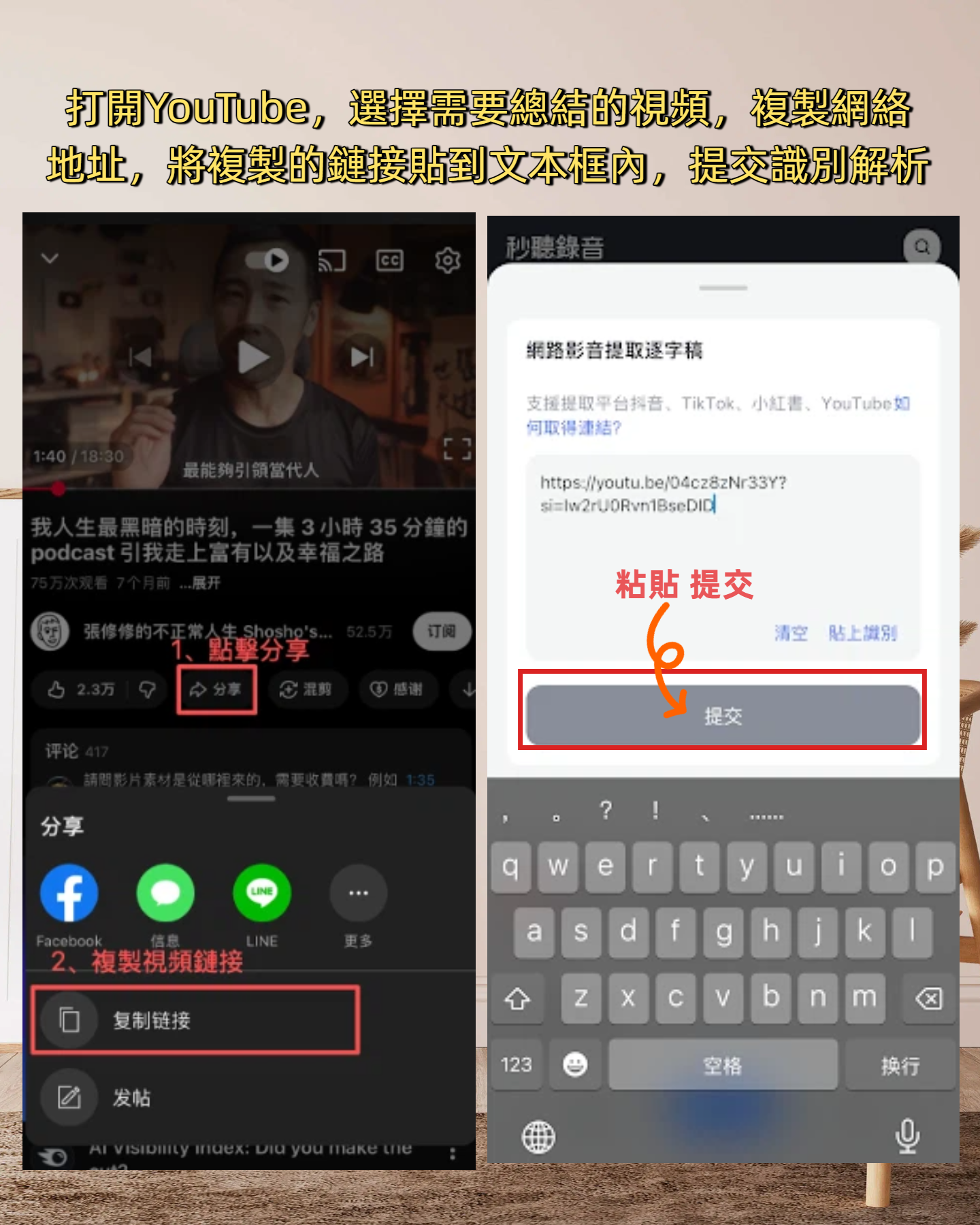
Tinrec offers iOS and Android apps as well as a full web version, so no matter where you are or what device you're using, you can independently record or import files. This means you can handle meeting recordings from your phone, downloaded videos on your computer, or even web links from your browser—all in one unified platform.
Winner: Tinrec wins—its cross-device and cross-scenario support makes it not just a meeting tool, but a portable audio/video processing hub.
Dimension 4: AI-Powered Q&A
Google Meet's transcription is just a static text document. If you want to find out "who mentioned the budget number in that meeting last month?", you have to manually keyword-search the entire text, and you still may not grasp the context.
Tinrec has a built-in AI Q&A feature: for any recording, you can ask questions like a friend—e.g., "What did the interviewee think about product pricing?" The AI answers based on the transcription content, even citing sources and timestamps. This is extremely useful for anyone who needs to revisit historical recordings.
Winner: Tinrec clearly wins—it turns recorded data from "too valuable to delete" into a searchable, queryable knowledge base.
Dimension 5: Data Export & Further Use
The transcript from Google Meet can be copied and pasted, but the formatting is plain. To turn it into a formal meeting minutes document, report, or executive summary, you have to manually format it yourself.
Tinrec supports multiple export formats including Word, PDF, and TXT, and can sync directly to Notion, Google Docs, OneNote, and other tools. Moreover, it can generate complete meeting minutes templates or tables in one click, saving you formatting effort.
Winner: Tinrec wins—it doesn't lock you into a closed system; instead, it feeds organized data into your existing workflow.
What Unique Advantages Does Each Have?
Tinrec's Unique Advantages
- Multi-source audio/video processing: Meetings, courses, interviews, web videos... all forms of recordings can be handled in one tool.
- Comprehensive AI post-processing: Summaries, chapters, action items, Q&A, export formats—making recording data truly usable.
- Enhanced support for Chinese content: The interface and transcription engine are optimized for Traditional Chinese environments, handling mixed Chinese/English and colloquial speech well.
- Free, low-barrier trial: No additional hardware needed; works on phone and computer. The free version lets you experience core transcription and summarization features.
Google Meet's Unique Advantages
- Zero installation, built-in: If you're a Google Meet user, the transcription feature is built in—no extra website or app needed.
- Live captions for accessibility: Provides real-time captions during meetings, helpful for hearing-impaired users or those who need reading assistance.
Summary: Who Should You Choose?
- If you only need to hide your own video during meetings and just want basic live captions → Google Meet's built-in feature is sufficient; no extra tools required.
- If you want automatic key takeaways and action items after meetings, classes, or interviews → Tinrec is a more efficient choice.
- If you need to process recordings from different platforms and formats → Tinrec's multi-source input will save you significant time.
- If you want to quickly query past recordings with AI → Google Meet lacks this feature; Tinrec lets you search content like a database.
One sentence summary: For most users who need meeting minutes, lecture notes, or interview transcripts, Tinrec is the more comprehensive solution. You can start with the free version and test the transcription and summarization quality with your own meeting recordings.
Turn every recording into actionable outcomes
Get 60 free transcription minutes when you sign in. No credit card required.
Related Reading
You might also like

2026 Google Meet vs Tinrec: A 4-Dimension Showdown – Which iPad Meeting Recorder Reigns Supreme?
Using Google Meet on iPad for meetings? Is the built-in transcription enough? This article compares accuracy, AI summarization, cross-platform support, and cost across 4 dimensions, showing why Tinrec is the better meeting recording solution.

2026 Guide to Google Meet Meeting Minutes: Turn Recordings into Text and Auto-Generate Summaries & Tasks with Tinrec
Tired of endless meetings and spending hours transcribing recordings? With Tinrec, automatically convert Google Meet recordings to text, get AI summaries and action items, and finish work 5 minutes after the meeting ends.

2026 4 Google Meet Recording & Note-Taking Tools Tested: Top Time-Saver for Mac Users
Running Google Meet meetings on your Mac? Here's how to turn discussions into meeting notes fast. In this post, I share my hands-on comparison of four tools and the time-saving solution I finally settled on, with a complete workflow.

How to Take Google Meet Meeting Minutes in 2026? 5 Steps from Recording to AI Summary
Tired of spending time organizing notes after Google Meet meetings? This article introduces a complete workflow using AI recording assistant Tinrec to transcribe Google Meet recordings into text, summaries, and action items, and compares other tools and hardware solutions to help you find the best meeting organization method.

2026 Hands-on Comparison of 5 Google Meet Meeting Recording Tools: Which AI Notes Really Save Time?
Meetings every day, but notes always miss the key points? This article tests 5 popular Google Meet meeting recording tools, from AI summaries and task extraction to multilingual transcription, helping you find the best workflow.

2026 Comparison of 4 Meeting Recording & Transcription Tools: Save Costs on HIPAA-Compliant Google Meet Meetings
How much does a HIPAA-compliant Google Meet plan cost? Looking to save on manual transcription costs for high-compliance meetings in healthcare and finance? This hands-on comparison of 4 recording and transcription tools shows why Tinrec is the top choice for balancing efficiency and budget.

2026 AI Meeting Recorder Tools Comparison: After Switching from Zoom to Google Meet, Which One Captures Meetings Best?
Still struggling with meeting notes after switching from Zoom to Google Meet? This article tests four AI transcription tools—Tinrec, Otter.ai, Fireflies.ai, and Notta—to help you find the best budget-friendly solution for Chinese meeting management.

2026 Comparison of 4 Google Meet Audio-to-Text Tools: Tinrec's AI Summary Saves the Most Time!
Struggling with Google Meet meeting notes? This article tests 4 audio-to-text tools for Google Meet, comparing transcription accuracy, AI summary quality, and post-meeting organization to help you choose the most time-saving solution. Tinrec excels in Chinese meeting scenarios, offering precise transcription and built-in AI conversation search, turning meeting notes into actionable knowledge.

Best Google Meet Recording-to-Text Tools? Tested 3 in 2026, Tinrec Most Practical
Tired of spending hours on meeting notes after Google Meet? I tested 3 recording-to-text tools for Google Meet, comparing transcription quality, note organization, and AI query capabilities. Find out which one works best for Chinese meetings, so you can get usable notes right after the meeting.