
Turn recordings into transcripts and summaries in minutes
Upload audio or video for multilingual transcription, AI notes, and action items
For many interviewers, graduate students, and workplace professionals who need to communicate with elders, finding a speech-to-text AI that accurately "supports Taiwanese Hokkien" has always been a pain point. Unlike Chinese and English, which have mature standardized writing systems, Taiwanese Hokkien (Southern Min) has long been a predominantly spoken language, resulting in scarce AI training data.
Although tech giants like Meta have invested significant resources in research, there's still a gap before reaching perfect commercial applications. This article explains the current technical bottlenecks of Hokkien speech recognition and compares 3 different types of solutions to help you clarify your needs:
- Understand the Technical Landscape: Why is Hokkien recognition harder than Chinese/English?
- Tool Comparison Table: Differences between research projects (Meta) vs. practical tools (Tinrec/Google).
- Practical Solution: What to do if you need to process multilingual recordings right now?
Quick Navigation Conclusions
- If you care about cutting-edge tech and real-time interpretation: Pay attention to Meta's Universal Speech Translator project (currently mostly experimental).
- If you need simple word/phrase translation: Try Google Translate (good for travel, limited for long sentences).
- If you need meeting recording organization, action item generation, and summaries: Choose Tinrec (Miao Ting Recorder) type of AI assistant with a complete workflow (supports 10 languages including Hokkien).
Why is Speech-to-Text for Taiwanese Hokkien So Difficult?
Before choosing a tool, it's necessary to understand why mature "Hokkien transcription" tools are rare. According to Meta AI researcher Peng-Jen Chen's development experience, there are two main challenges:
- Lack of Standardized Writing System (No Written Form): Among over 7,000 languages worldwide, more than 40% are purely spoken languages, and Hokkien is one of them. Traditional AI requires "speech + corresponding text" training, but Hokkien lacks a unified character standard, making it hard for models to converge.
- Data Collection Difficulties: To overcome this, the Meta team even used 30,000 hours of Taiwanese TV dramas as training material and used "Chinese" as an intermediate bridge. Even so, NTU EE Associate Professor Hung-yi Lee noted that current technology is still "experimental" and needs improvement in long-sentence translation and formal settings.
2026 Market-Leading Speech-to-Text AI Tools Comparison
Although perfection is still distant, the market offers tools with different positioning for various needs. Below is a comparison across three dimensions: "technical research," "basic translation," and "workflow efficiency":
| Dimension | Meta AI (Universal Speech Translator) | Google Translate / Voice Input | Tinrec (Miao Ting Recorder) |
|---|---|---|---|
| Core Positioning | Cutting-edge research project (not public app) | Basic daily word/phrase translation | Business meeting and interview recording assistant |
| Hokkien Support | Speech-to-Speech Translation (S2ST) | Basic ASR | Multilingual recognition engine |
| Real-time Transcription | Experimental demo stage | Supported, but long sentences prone to breaks | Real-time recording to text |
| Output Content | Focused on spoken translation (voice mainly) | Simple text translation | Transcript, AI summary, action items |
| File Processing | No direct file upload yet | No long audio support | Supports audio/video file import and parsing |
| Suitable Scenarios | Future metaverse socializing | Travel, simple directions | Meeting notes, lecture notes, interview organization |
Stop organizing recordings by hand
Upload audio or video and automatically get a transcript, summary, and action items
Analysis: Meta's strength lies in preserving tone and emotion (speech-to-speech), suitable for future real-time communication. Meanwhile, Tinrec focuses on "converting sound into productivity." Although Hokkien recognition is limited by overall tech limits and may not be as perfect as Chinese/English, it provides complete recording preservation and summary features in multilingual environments (10 languages including Chinese, English, Japanese, Korean, Hokkien, etc.), making it a more practical workplace choice.
Tinrec In-Depth Review: Complete Workflow from Recording to Action
For professionals or students, simply converting speech to text often isn't enough; the key is "how to organize" after conversion. Tinrec offers a more complete solution, especially in optimizing efficiency for long recordings.
1. Supports Multiple Language Recognition and Speaker Differentiation
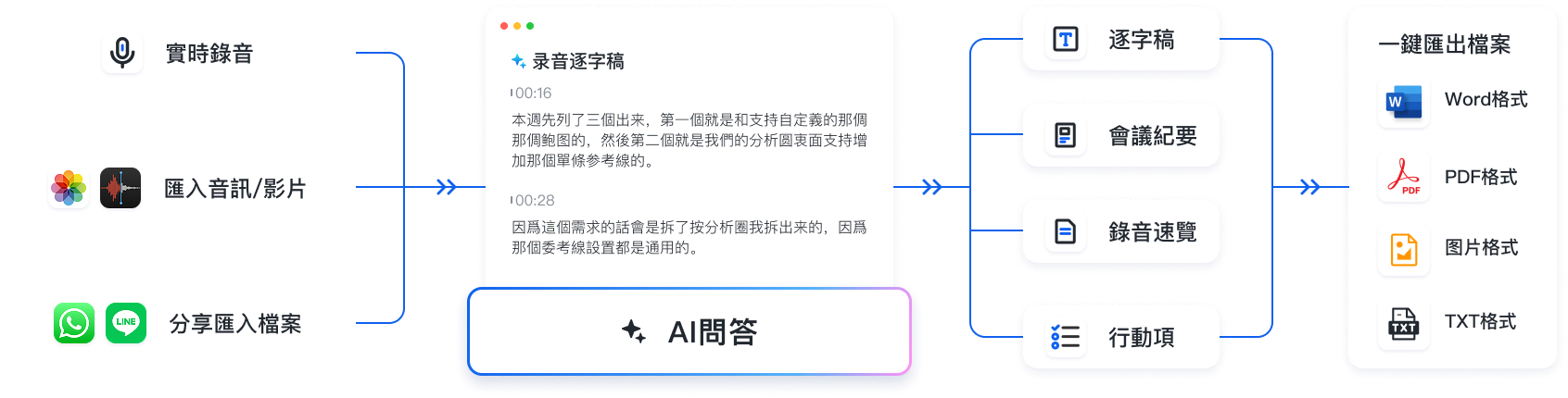
Tinrec automatically recognizes 10 languages including Chinese, English, Japanese, Korean, Hokkien, and Cantonese. In international meetings or multilingual interviews, it tries to differentiate speakers, turning messy recordings into structured dialogue text—solving the problem of "not knowing who said what" with traditional recorders.
2. More Than Just Transcripts: "Decision Summaries"
For a 1-hour interview recording, replaying takes 1 hour, reading the transcript takes 20 minutes, but reading Tinrec's AI meeting minutes may take only 3 minutes. It automatically extracts:
- Full Summary: Quickly grasp discussion points.
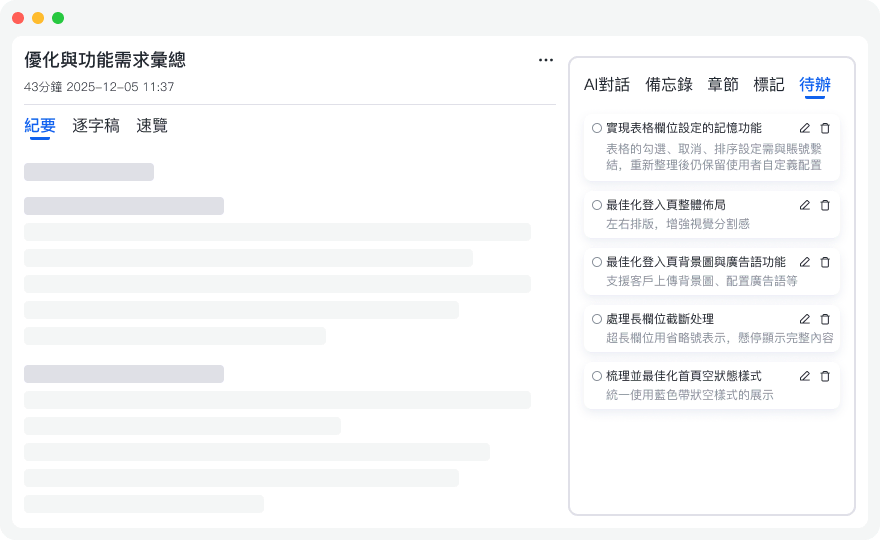
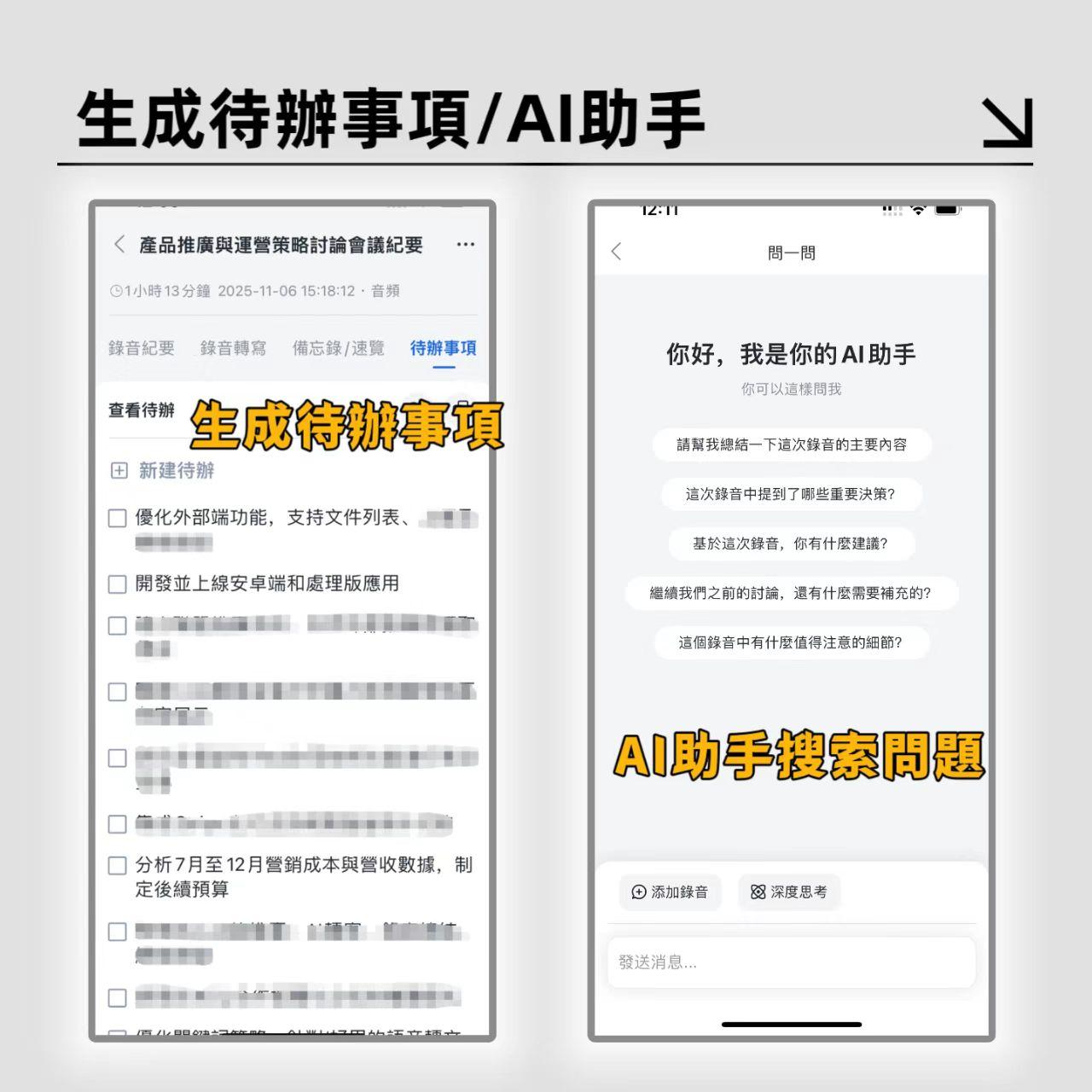
- Action Items: Directly list who should do what, avoiding post-meeting forgetfulness.
3. AI Dialogue Query: Find Answers by Asking
This is the biggest difference from traditional tools. If you're unsure about a detail in the recording (e.g., "What was the budget mentioned last time?"), you don't need to scrub the timeline; just type the question in Tinrec's AI dialogue box, and the system answers based on the recording content, greatly reducing information retrieval cost.
Practical Tutorial: 3 Steps to Turn Recordings into Actionable Text
Whether you use iPhone or Android, follow these steps to transform lengthy recordings into useful notes:
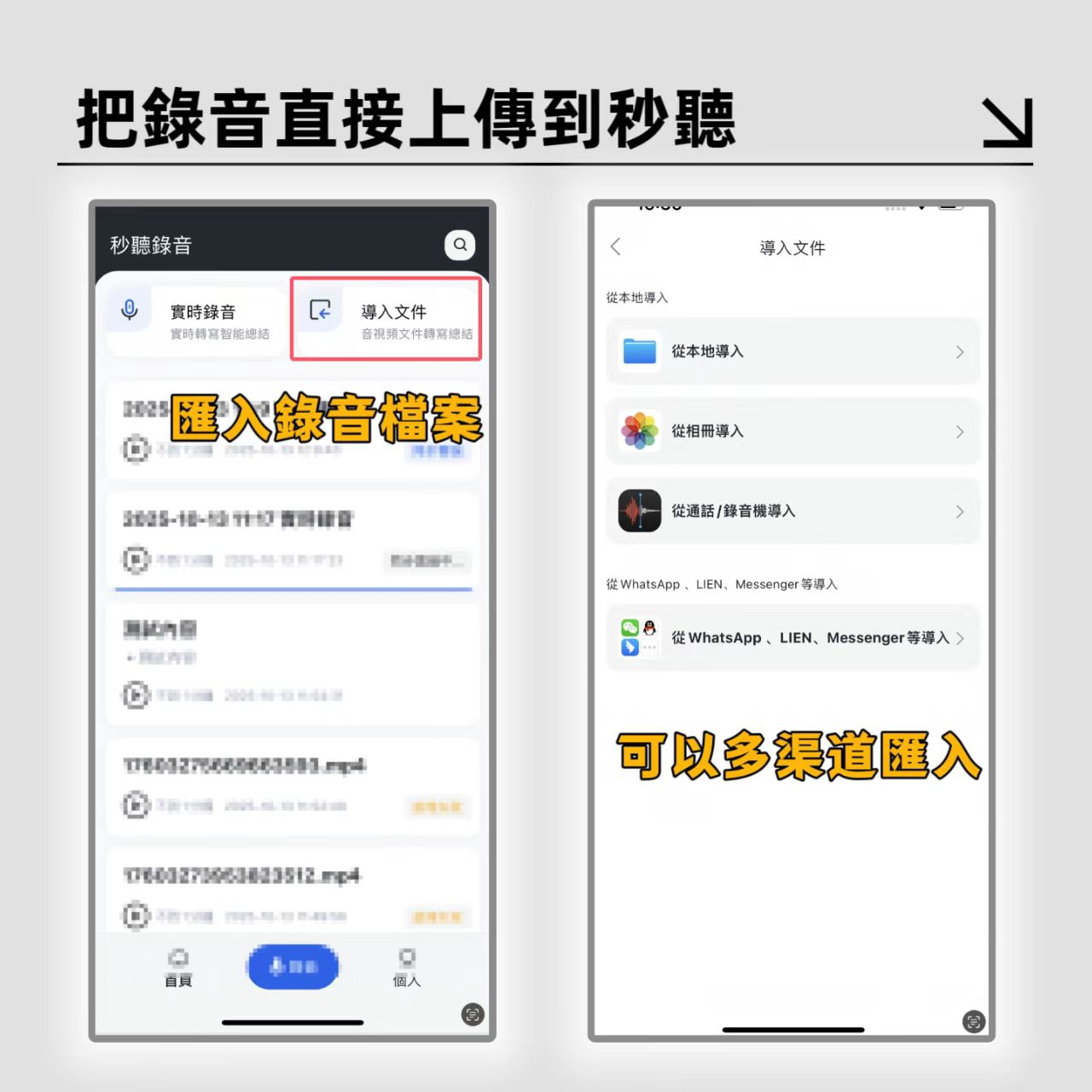
Step 1: Choose Recording or Import File
After entering Tinrec, choose the entry based on your situation:
- Live Meeting: Tap "Record to Text" and place your phone on the table to start recording.
- Existing File: If you have files from a recorder, use the "Audio File to Text" feature to upload.
- Online Learning: For YouTube videos or podcast links, paste them into "Podcast/Online Video to Text" for parsing.
Step 2: AI Auto-Transcription and Summarization
After recording ends, the system automatically processes the audio. You'll see the transcript generated in real time. Tinrec simultaneously analyzes content, automatically producing a "summary" and "chapter division" to help you quickly identify key points.
Step 3: Use AI Dialogue for Deep Organization
Once you have the text, if it's too long, use the AI Dialogue Query feature on the right:
- Command: "List all discussion points about 'marketing budget' in this recording."
- Command: "Summarize the three main conclusions of this meeting."
With this workflow, recordings that used to take hours can become shareable meeting notes in minutes.
Frequently Asked Questions (FAQ)
Q1: Is there a perfect Hokkien-to-text app available?
A: Honestly, there is no "perfect" commercial Hokkien-to-text tool yet. Even Meta's technology is still experimental, and due to the lack of standard characters, transcripts usually output "Hokkien-pronounced Chinese characters" or "directly translated Chinese." For formal use, manual proofreading is still recommended.
Q2: Why is the built-in recording-to-text on my iPhone not effective?
A: The iPhone's built-in Voice Memos app is optimized for short, single-speaker recordings and has limited ability to capture distant sound. Professional tools like Tinrec use algorithms to optimize background noise and are trained for long meeting scenarios, usually outperforming built-in features.
Q3: Does Tinrec have a free trial?
A: Yes. Tinrec offers a free version with up to 100 minutes of transcription per month, suitable for users with occasional meeting or interview needs.
Q4: Can I export the transcribed text for editing?
A: Yes. For easy post-processing, Tinrec supports exporting transcripts and summaries as TXT, Word, PDF, and other formats, making it convenient to copy into Notion or Word for further editing.
Q5: Can the AI handle mixed Chinese and English in recordings?
A: Tinrec has multilingual recognition capabilities. For common workplace conversations mixing Chinese and English (e.g., "What's the deadline for this project?"), it usually achieves decent accuracy, but keep the recording environment quiet and clear.
Q6: What is "speech-to-speech" and how is it different from "speech-to-text"?
A: Meta's new technology is "speech-to-speech" (S2ST), which directly translates spoken language into another spoken language without going through text, suitable for oral communication. The common "speech-to-text" (S2T) produces a transcript, suitable for notes and archiving. Choose according to your goal: communication or recording.
Turn every recording into actionable outcomes
Get 60 free transcription minutes when you sign in. No credit card required.
Related Reading
You might also like

Google Speech-to-Text vs AI Studio vs Notta vs Tinrec: 2026 Comparison — Is Free Enough?
Is Google's free audio-to-text good enough? We compare Google AI Studio, Google Cloud Speech-to-Text, Notta, and Tinrec across recognition methods, meeting recording, post-meeting organization, team collaboration, and pricing to help you decide which fits your use case and when to upgrade from free.

5 Voice Generators Tested in 2026: Which One Actually Saves Time on Voice Organization?
Voice generators fall into two categories: 'generating voice' and 'organizing voice.' Choosing the wrong type wastes time. This article tests 5 tools, covering Chinese meeting transcripts, bot-free online meeting recording, AI Q&A, and team knowledge retention. It outlines 4 key buying factors and 3 common pitfalls, and explains Tinrec's actual performance and limitations in Chinese meetings and post-meeting organization workflows.

Tinrec vs Otter.ai 2026: 5-Dimension Comparison for Chinese Video Summarization
Recorded hours of video but no one watches? This article breaks down 5 key factors for choosing a video summarization tool from a mid-level manager's perspective, comparing Tinrec and Otter.ai, with pricing and limitations of Notta and TurboScribe, to help you find the best workflow for Chinese meetings, training, and interview videos.
5 Best iPhone Recording Apps in 2026: From Free Recording to AI Meeting Notes
How do you choose the best iPhone recording app in 2026? This guide walks you through real-world use cases, core capabilities, and key buying factors, using Tinrec as an example to show how recordings can become searchable, collaborative, and actionable meeting data.

3 Audio Format to MP3 Conversion Methods Compared in 2026: After Conversion, Who Can Save You Cleanup Time?
Converting audio formats to MP3 is easy; the hard part is organizing after conversion. This article starts from the decision point of 'do you need conversion or organization?' explains MP3's role in the workflow, and uses Tinrec as an example to demonstrate how to turn meeting, interview, and lecture recordings into searchable, summarizable, and queryable transcripts and action items, while comparing the differences and pricing between personal and team versions.
How to Summarize Knowledge Videos in 2026: 5 Steps from Transcript to AI Highlights
Saving more knowledge videos than you can ever watch? This article compares Tinrec and Felo AI across 5 dimensions—input sources, transcript traceability, post-meeting output, AI follow-up questions, and team knowledge retention—plus a 5-step workflow to help you decide which tool fits your learning and work scenarios.

How to Use AI Transcription Generators in 2026: A Complete 5-Step Tutorial
This guide covers AI transcription generators, starting with 4 key factors to consider when choosing one, then demonstrating a complete 5-step workflow from recording to post-meeting output. It compares the positioning of Tinrec, Notta, Otter.ai, and Granola, and includes common pitfalls to avoid and team plan benefits to help you find the right transcription tool for your meeting style.

2026 Comparison of 4 Multi-Speaker Meeting Transcription Tools: Which Can Identify Speakers and Summarize Key Points?
The pain point of multi-speaker meetings isn't just hearing clearly—it's identifying who said what and then organizing it. This article breaks down speaker identification limits, real-time vs. offline differences, post-meeting organization, and team data ownership from a methodological perspective. It tests and compares Tinrec, Otter.ai, Granola, and Notta, providing a selection order and onboarding checklist you can follow directly.
5 Best Speech-to-Text Tools in 2026: Free Transcription Compared
We tested 5 speech-to-text tools in 2026, comparing Chinese recognition, audio retention, post-meeting organization, and team collaboration. Plus buying tips and pitfalls to help you find the best transcription solution.