

Turn recordings into transcripts and summaries in minutes
Upload audio or video for multilingual transcription, AI notes, and action items
2026 Meeting Recording Tools: Bot-Free Recording + AI Action Item Management
When choosing a meeting recording tool, most people look at the price first. But I suggest you ask yourself one question first: Are you willing to let a "meeting bot" join every online meeting as a participant?
This question will directly affect all your subsequent choices. I lead a 10-person team at a tech company and have about 15 meetings a week—weekly meetings, project progress meetings, one-on-ones, cross-department coordination. What used to be most annoying wasn't the meetings themselves, but the aftermath. Because every meeting has a bunch of decisions and action items, my work only begins after the meeting ends.
Three situations are even more troublesome: when my boss asks "What was the conclusion on that thing last time?" I flip through notes for 3 minutes and still can't find it; when I ask a subordinate about something I assigned two days later, they say they forgot; after cross-department communication, just tracking and confirming takes another half day. The root of all these problems is the same—meeting content wasn't properly captured, nor turned into a searchable, trackable format.
So this article won't talk marketing fluff. I'll lay out the tools my team has actually used, starting from "what problem do you need to solve?" to help you judge which one suits you.
Before Choosing a Meeting Recording Tool, Understand These 4 Key Points
1. How does it "get into" your meeting? This is the first dividing line. One type is a meeting bot that joins your Zoom, Meet, Teams with a separate account. The advantage is automation, but the downside is an extra stranger on the list, which can be awkward in client meetings. The other type is desktop software that directly captures the computer's system audio without adding any participant. If you often meet with external clients, this factor weighs more than price.
2. Do you get a transcript, or data you can act on? A transcript is just raw material. What really saves time is the summary, chapters, key points, and action items automatically generated after the meeting—who does what and by when. If the tool only gives you a wall of text, you still have to reread it yourself.
3. Can it handle Chinese and mixed Chinese-English meetings? Meetings in Taiwan rarely use a single language throughout. Product terms in English, discussion in Chinese, clients speaking half Chinese half English—this is common. When choosing a tool, don't just look at how many languages it supports; look at how well it organizes mixed Chinese-English content, and whether you can maintain your own professional terminology.
4. After recording, who holds the data? With personal accounts over time, meeting data gets scattered across everyone's phones and cloud drives, and when people leave, the data goes with them. If this matters to you, check whether the tool has team spaces, member and usage management, and how data is handed over when members leave.
Tinrec—The One I Kept After Testing
In one sentence: Tinrec is an AI meeting notes and collaboration tool for individuals and teams, covering iOS, Android, and web, with a desktop version that can directly capture computer system audio.
Record online meetings without a meeting bot. Now when I have Zoom, Google Meet, Microsoft Teams, or Webex meetings, I just open Tinrec desktop and start recording. It captures the sound played by the computer, so no bot appears on the participant list, and clients won't ask "Who is that account?" To be clear, this is not "automatically join all meetings on your calendar"—you actively start the recording.
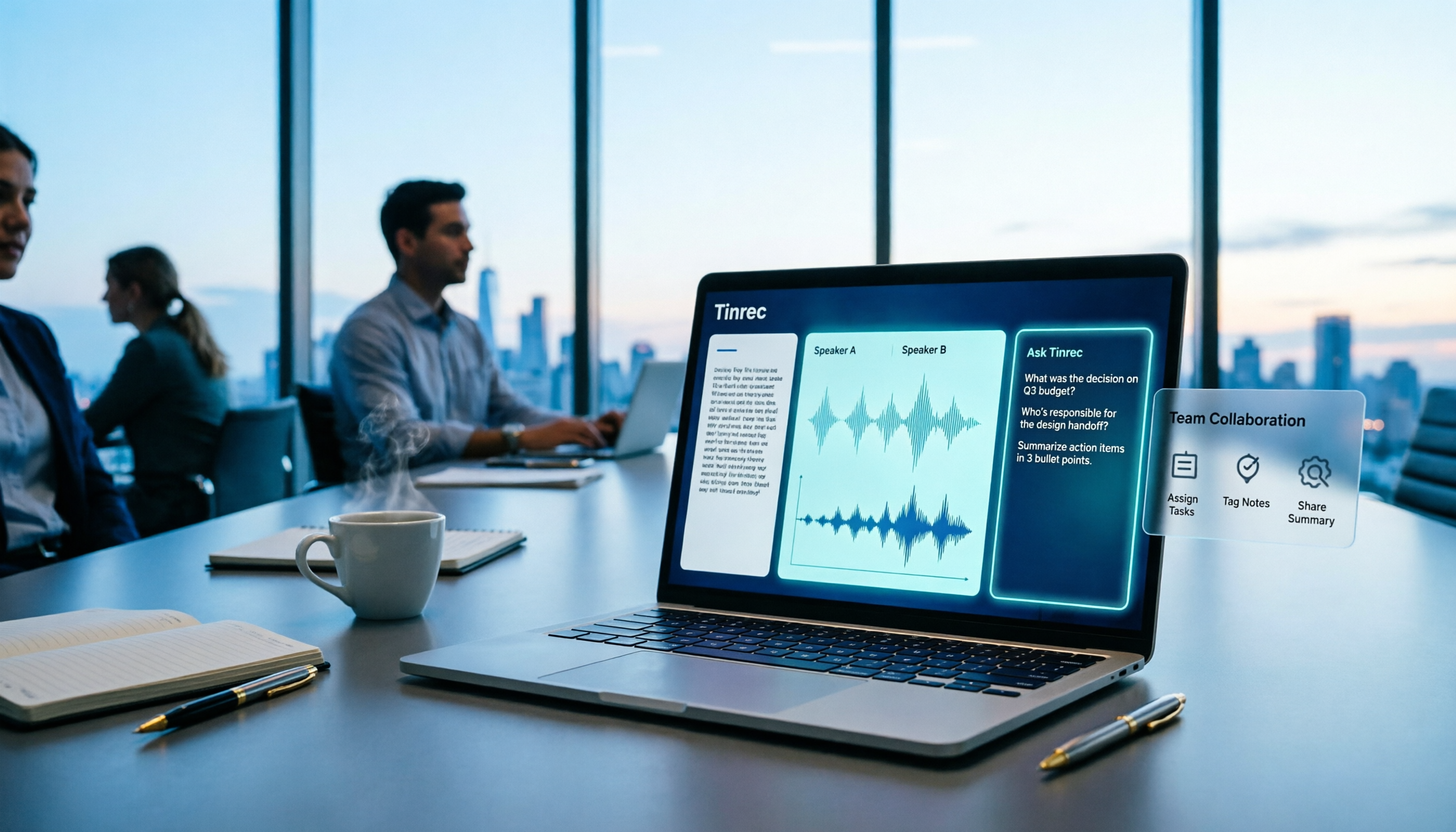
When the meeting ends, the data is already organized. It generates a transcript while recording, and after the meeting automatically produces a summary, chapters, key points, and action items. My own routine: after a weekly meeting, I first cut out the action items section and paste it directly into the team's tracking list; when reporting to my boss, the summary and chapters are enough, no need to replay a 40-minute recording.
After recording, you can ask it questions directly. This is the main reason I kept it. Previously, to find "who mentioned the budget in the last meeting," I had to Ctrl+F through the transcript keyword by keyword. Tinrec lets you ask follow-up questions via AI Q&A, and it answers based on the meeting content. It can also generate reports, tables, and documents, and export to tools I already use like Notion, Google Docs, OneNote, and Dropbox. The same meeting data can be continuously queried and processed—this is where I feel the biggest difference.
It handles Chinese meetings, cross-language meetings, and historical recordings. It supports Chinese, Traditional Chinese, and multilingual meetings. During recording, you can switch between original text, translation, or bilingual view. The team plan also allows maintaining hot words, adding internal product codes and proper nouns, which improves recognition of professional terms.
Stop organizing recordings by hand
Upload audio or video and automatically get a transcript, summary, and action items
The team plan solves the "data ownership" problem. It's not just adding a few people to my personal account, but an independent team space. Members can view, play, and read the team's historical meeting data, and new colleagues taking over a project can directly review past meeting records. On the management side, you can set owners, admins, and regular members, and decide via seats who can record, upload, edit, and export. There are also usage analytics, audit logs, and an audio recycle bin. Currently, the team monthly plan is USD 29.80 per paid seat per month, annual plan USD 199 per paid seat per year (about USD 16.58 per month). Each paid seat includes 2,000 minutes of team shared import quota per month; eligible teams get a 7-day first trial with 1 free seat and 300 minutes of shared import quota; real-time recording under an active team plan currently does not deduct minutes. Prices, currencies, and promotions are subject to the official purchase page.
Three reasons I think you should buy: First, you can record online meetings without a bot, avoiding awkwardness in external meetings. Second, the transcript followed by summary, action items, Q&A, and export is a complete workflow, not a half-finished product. Third, the team plan's roles, seats, usage, and audit turn meeting data into a department asset, not someone's private file.
Honest limitations: The free plan's quota is good for trying it out. If you have meetings every day like me, you'll need a paid plan. Also, transcription accuracy is affected by recording quality, ambient noise, accents, overlapping speakers, and professional terminology. I won't guarantee a fixed number—for important decisions, I still go back to check the transcript timestamps and recording. One more thing to be clear about: the team plan currently focuses on team-level sharing, and all active members can read team data. It is not a file-level granular permission system; members without a seat can view and listen, but cannot upload, edit, or export.
Who it's for: People who often have Chinese or mixed Chinese-English meetings, don't want a bot in the meeting, need summaries and action items after the meeting, and want meeting data to stay with the team. If you mainly record pure English meetings, the next section has a more cost-effective option.
Besides Tinrec, What Other Options Are There?
Otter.ai: A mature AI meeting assistant with a strong mind for English business meetings, and a generous free plan of 300 minutes per month. If your meetings are almost all in English, it's a more direct choice than Tinrec. But its handling of Chinese and mixed Chinese-English content is not its strong suit, and its flexibility for post-meeting multi-format processing and team data accumulation is relatively limited.
Granola: Also takes the bot-free route, relying on desktop system audio plus user handwritten notes to generate content. Lightweight and easy to use. But it does not retain meeting audio files, nor does it support uploading existing pre-recorded audio files. Tinrec retains audio files and can import historical meeting files—when you need to check the original audio or dig up an interview from three years ago, the difference shows.
PLAUD Note/NotePin: Representatives of the hardware approach. Physical recording cards are suitable for on-the-go recording, phone calls, and long standby. But the cost is carrying an extra device and an extra hardware expense. Tinrec requires no additional equipment; web, desktop, and mobile all work, and online meetings, historical files, and team spaces are all in one system.
Pitfall Guide: 4 Most Common Mistakes When Choosing a Meeting Recording Tool
Pitfall 1: Only looking at official accuracy numbers. That number is usually measured in a quiet environment, single language, no noise. Real meeting rooms have air conditioning, keyboard sounds, and people talking over each other. The simple approach: test with a recording of your own real meeting, don't just look at ads.
Pitfall 2: Thinking a transcript is enough. A transcript is raw material, not a finished product. If you get a wall of text, you still have to spend time rereading. When choosing a tool, look directly at its "post-meeting output": does it have summaries, chapters, action items, can you ask questions about the content, can it export to your existing workflow.
Pitfall 3: Ignoring whether audio files are retained. Some tools only keep text, not audio. When you encounter "Did they really say that?" and have no original audio to check, it's painful. By the way, whether you can import old recordings is also key—if historical data can't get in, you can only handle new meetings forever.
Pitfall 4: Treating the team plan as "multiple people sharing one account." What you should really ask: Who owns the data, how is data handed over when members leave, who has management rights, who has usage rights. Roles (who can manage) and seats (who can use) are two different things. Ask clearly before buying, don't wait until the purchase order is done to find out it's not what you imagined.
Finally, a compliance reminder: Please follow local regulations for recording and transcription, and obtain participant consent when necessary.
Summary: Which One Should You Choose?
My advice is to choose by scenario, not just by price:
- Often have Chinese or mixed Chinese-English meetings, and don't want a bot in the meeting → Tinrec (desktop directly captures system audio)
- Need summaries and action items immediately after the meeting, and want to ask follow-up questions about meeting content → Tinrec (AI Q&A and action item extraction are its most practical parts)
- Need to use on mobile, computer, and web, and also import old recordings → Tinrec (multi-platform plus file import, retains audio)
- Need to turn meeting data into a department asset, manage members, seats, and usage → Tinrec team plan
- Meetings are almost all English, budget is tight → Otter.ai (the few exceptions in this article)
If you're still on the fence, my approach is to start with the free version, use it to record two or three real meetings, and the next day see if its summaries and action items can be directly used to assign tasks. If it works, consider upgrading; if not, you've only lost the time of two meetings.
References
- No time limit! 3 free AI transcription tools, highly recommended! AI voice notes generate meeting records, presentations, mind maps | 104 Workplace Power
- AI meeting notes software recommendations: 5 major apps tested and compared, automatic transcription makes meetings super easy!
- Meeting recording - PChome 24h Shopping
- Meeting Ink - 2026 AI meeting notes tool test | 7 voice-to-text and summary speed comparison | Meeting Ink - AI meeting notes assistant automatic transcription summary meeting minutes
- Meeting Ink - Transcript AI Meeting Summary Voice to Text App - App Store
Turn every recording into actionable outcomes
Get 60 free transcription minutes when you sign in. No credit card required.
Related Reading
You might also like

2026 Top 5 Real-Time AI Meeting Notes Compared: Tinrec vs Notta vs Plaud — Which One Should You Choose?
The real pain point of meeting notes isn't whether they can be transcribed, but how to use them after transcription. This article starts with common misconceptions, outlines the positioning of 5 highly discussed real-time AI meeting note tools, and focuses on the differences between Tinrec, Notta, and Plaud. It compares meeting capture methods, post-meeting outputs, audio retention, team governance, and pricing plans to help you decide which one fits your meeting scenario.

2026 AI Meeting Notes Guide: Tinrec's Bot-Free Recording & Auto-Generated To-Dos
How do you choose an AI meeting notes tool? This article examines Chinese recognition, recording methods, post-meeting organization, and team data ownership, comparing Tinrec, Notta, Otter.ai, and Granola, plus four common pitfalls to help you find a solution that truly saves time after meetings.

5 Best Meeting Notes Apps of 2026: Which Free Version Is Actually Enough?
Still spending an hour after every meeting writing up notes? This comparison puts five common meeting notes app approaches side by side—covering Chinese recognition, how meetings are captured, post-meeting organization, team permissions, and pricing—and explains how Tinrec handles recording, transcription, summaries, action items, and AI Q&A within its free tier.

Tinrec vs Otter.ai: Which AI Transcription Tool Is Right for You in 2026?
Choosing an AI transcription tool isn't just about speed—it's about language support, meeting capture methods, post-meeting organization, and team data governance. This comparison of Tinrec and Otter.ai breaks down key dimensions to help you decide which tool fits your meeting needs.

What Is Real-Time Transcription in 2026: Definition, 4 Key Factors, and Tool Comparison
What is real-time transcription and how does it differ from transcribing recordings? This article explains the definition and how it works in plain language, outlines 4 key factors to consider, and compares Google Live Transcribe, Yating, Notta, and Tinrec in Chinese meetings, post-meeting organization, and team collaboration, with scenario-based recommendations.

4 Meeting Transcription Tools Tested: Which AI Saves the Most Time on Chinese Transcripts and Summaries?
After a meeting, do you spend another two hours organizing the audio recording? This article compares four meeting transcription tools—Tinrec, Notta, Otter.ai, and Granola—on Chinese transcription, AI summaries and action items, bot-free recording, team collaboration, and pricing to help you find the most time-saving solution.

3 iPhone Audio-to-Text Apps Tested in 2026: How Long Can You Record and Which Saves the Most Time After Meetings?
How long can an iPhone actually record? This article first breaks down the storage, battery, and file interruption risks of the built-in Voice Memos app, then compares 3 audio-to-text tools from a student's perspective—covering free quotas, single-recording limits, post-meeting organization, and AI Q&A capabilities—to help you decide whether the built-in recorder is enough or if you need an AI recording assistant that delivers key points right after recording.
Google Live Transcribe vs Tinrec in 2026: 5-Dimension Comparison — Which Is Better for Meeting Notes?
Google Live Transcribe & Sound Notifications is an Android accessibility tool known for being free, providing real-time transcripts, and sending environmental sound alerts. Tinrec focuses on meeting notes and team collaboration. This article compares them across 5 dimensions—transcription and organization, online meeting recording, AI Q&A, audio file import, and team management—to help you decide which one to use for meeting notes.

3 iPhone Call Recording Solutions Compared: iOS 18 Built-in vs Tinrec in 2026
iPhone call recording finally has a built-in solution with iOS 18, but regional restrictions, legal issues, and post-call organization are the real pain points. This article compares 3 solutions: iOS 18 built-in call recording, Tinrec, and PLAUD Note with Otter.ai, helping you understand how to record calls and quickly turn them into transcripts, summaries, and action items.