

Turn recordings into transcripts and summaries in minutes
Upload audio or video for multilingual transcription, AI notes, and action items
5 Best Meeting Notes Apps of 2026: Which Free Version Is Actually Enough?
It's 2 p.m. on a Wednesday, and you just walked out of a 90-minute cross-departmental meeting. There's a recording sitting on your phone, but you already know what's coming: you'll probably spend another hour tonight listening to the whole thing just to produce the meeting notes.
What's worse, you remember someone mentioned a budget adjustment during the meeting, but you can't for the life of you recall who said it or which line item they were talking about.
Meeting notes apps exist for exactly this scenario. This article compares five common approaches on the market—built-in platform transcription, AI assistants that join meetings as a bot, bot-free desktop recording tools, AI recording hardware, and pure transcription tools—and tests them against real needs like regular meetings, interviews, and classes to see which one saves the most time for the average office worker.
Here's the bottom line upfront. If you're dealing with Chinese-language meetings, need to turn them into action items afterward, and don't want to buy extra hardware, Tinrec is the most well-balanced option among these approaches.
What Can a Meeting Notes App Do for You?
Scenario 1: The Meeting Ends and Your Notes Are Already There
A two-hour meeting used to mean another hour of cleanup afterward. Today's tools can generate the transcript, summary, conclusions, and action items the moment the meeting ends.
Take Tinrec, for example. After recording, you open the note and find the meeting topic, key discussion points, who's responsible for what, and deadlines—all already organized into sections. Your job is to review, not to start from scratch.
Scenario 2: No Extra "Attendee" Needed for Online Meetings
Anyone who's used a meeting bot knows that awkward moment: an unfamiliar account shows up on the participant list, and you have to explain to the client what it is.
Tinrec's desktop app captures your computer's system audio directly. It works with Zoom, Google Meet, Microsoft Teams, Webex, and other online meetings—no bot needs to be added to the meeting.
Scenario 3: Those Recordings You Never Have Time to Listen To
Interviews, lectures, client calls—you accumulate a pile of audio files but never have time to listen, and eventually you forget what you even said.
Tinrec supports uploading audio and video files for transcription. Once transcribed, it can generate summaries, chapters, and key points—no need to re-listen to the whole thing.
Scenario 4: Meetings Become a Searchable Database
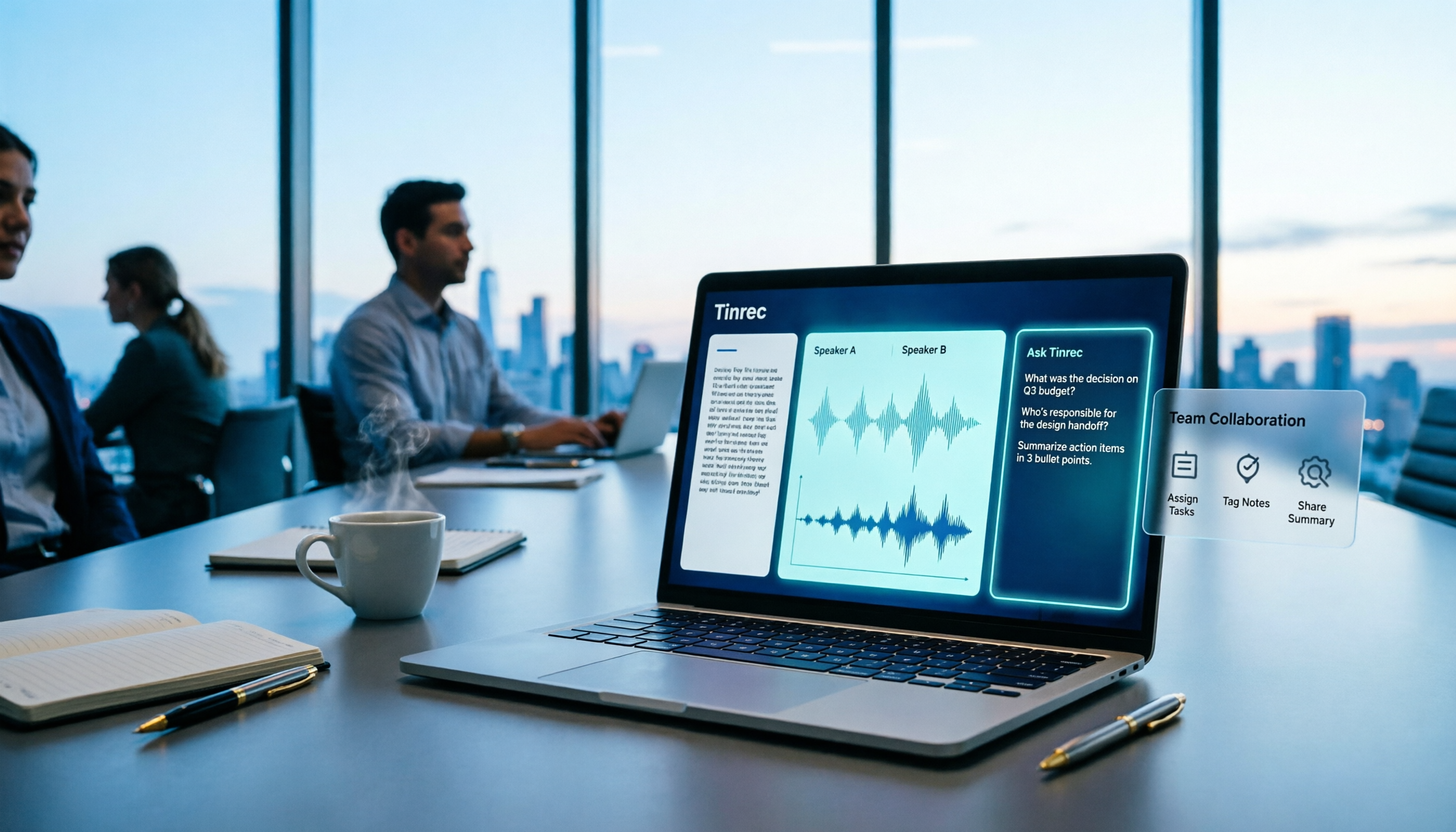
After transcription, Tinrec supports AI Q&A based on the meeting content. You can ask things like "What concerns did the client raise in this meeting?" and it will answer based on the content.
For anyone who needs to look back at past meetings, this is far more effective than hitting Ctrl+F in a transcript to find keywords.
What Are the Core Capabilities of a Meeting Notes App?
Capability 1: Real-Time Transcription
Transcribe as you record—not after the fact. During the meeting, you can follow along with the text to make sure nothing important is missed. This is especially useful for in-person meetings and interviews.
Tinrec's real-time recording-to-text feature builds this into the workflow, so meeting content starts taking shape right away.
Capability 2: Bot-Free Online Meeting Recording
Tinrec's desktop app records online meetings by capturing your device's system audio, so no extra participant is added.
One thing to note: this doesn't mean it "automatically joins every meeting on your calendar." You still need to actively open Tinrec and start recording.
Capability 3: AI Summaries and Chapters
AI summaries aren't just condensing a transcript into a paragraph—they're structured organization. Tinrec breaks long meetings into chapters and key points, so you can grasp a one-hour meeting in two or three minutes.
Capability 4: Action Item Extraction and Post-Meeting Outputs
A transcript doesn't turn itself into a report. Tinrec can extract action items from the discussion and use Agent post-processing to generate meeting minutes, reports, tables, and documents—ready to submit or archive directly.
Capability 5: AI Q&A and Multi-Format Export
Meeting data is only valuable if it can be used further. Tinrec supports exporting results to Notion, Google Docs, OneNote, Dropbox, and other tools, fitting into your existing workflow.
Capability 6: Team Spaces and Governance
The team plan provides an independent team space where meeting data belongs to the team, and new members can access historical data.
On the admin side, there are roles, seats, usage analytics, audit logs, and an audio recycle bin. Simply put, roles determine who can manage the team, and seats determine whether a member can record, upload, edit, and export.
Real-World Use Cases
Project Weekly Meetings and Cross-Departmental Meetings
Regular weekly project meetings are where "we talked about this last time and forgot" happens most often. Record the entire discussion with Tinrec, organize the action items and owners afterward, and look back at historical data before the next meeting—so the decision trail stays intact.
Client Interviews and Sales Meetings
Client needs, concerns, and commitments are often scattered throughout the conversation. Tinrec can transcribe the entire conversation and organize key points, so when you're writing a proposal or follow-up email afterward, you can pull material directly from the meeting notes.
Stop organizing recordings by hand
Upload audio or video and automatically get a transcript, summary, and action items
Classes, Lectures, and Professional Development
Not being able to take notes fast enough during class is a common experience. Record with your phone and upload to Tinrec, and AI will organize it into a summary, course highlights, and action items—no need to re-listen to two hours when reviewing.
Media Interviews and Content Creation
Interview audio files are usually long and fragmented. Tinrec's transcripts are searchable and queryable. When you need to find a specific quote while writing, it's much faster than dragging back and forth on a timeline.
Teams That Need to Preserve Knowledge
If meeting data only lives on individual phones and in chat rooms, it disappears the moment someone leaves. The team plan centralizes meeting storage in a team space. When members change, the resources they were responsible for can be handed over to other active members—data doesn't leave with the individual.
5 Things to Watch Out for When Choosing a Meeting Notes App
1. Chinese and Technical Term Recognition
Don't just go by official marketing claims—test it with your own recording. Chinese meetings often mix Chinese and English, industry jargon, and product codes, and the recognition experience varies widely.
Tinrec covers Chinese, Traditional Chinese, and multilingual meeting scenarios, and offers a team hotword feature that lets teams maintain commonly used terms to improve recognition of specialized vocabulary. Also keep in mind that actual performance is affected by recording quality, background noise, accents, and overlapping speakers—no tool should promise a fixed accuracy rate.
2. How the Meeting Is Captured
This is the most easily overlooked point. Some tools send a bot into the meeting, some rely on hardware recording, and some use desktop system audio.
Tinrec takes the bot-free desktop approach, and also supports real-time recording, audio/video upload, and mobile recording—making it friendlier for those who don't want to buy extra equipment.
3. What You Can Do After Transcription
A transcript is just the first step—whether it can help you organize is the key. When choosing a tool, look at whether it offers summaries, chapters, action items, AI Q&A, translation, and export.
Tinrec's completeness in this area is its main advantage: after transcription, you can ask questions directly, generate reports and tables, and export to your existing tools.
4. Will the Recording Be Kept, and Can You Go Back to Verify?
Some tools only keep text and not audio, which makes it a hassle when you want to confirm tone or context afterward.
Tinrec keeps recordings, and the team plan additionally provides an audio recycle bin. Accidentally deleted audio files can be restored before permanent cleanup, with a current retention period of 30 days.
5. How Permissions and Pricing Work
For Teams-type tools, you need to distinguish between roles and seats. Tinrec's team plan is primarily team-level sharing: all active members can view, play, and read team data, but a seat is required to record, upload, edit, and export. Currently, file-level granular permission settings are not supported—make sure you understand this upfront.
On pricing, Tinrec's personal plan offers a free version, weekly pass, Pro monthly, and Pro annual—choose based on your usage frequency. The team plan's first eligible trial is 7 days, 1 free seat, and 300 minutes of team shared import quota; paid plans are USD 29.80 per paid seat per month, or USD 199 per paid seat per year (about USD 16.58 per month), with each paid seat providing 2,000 minutes of team shared import quota per month. Under an active team plan and seat, real-time recording currently does not deduct minutes; file and web imports use the team shared quota. Prices and promotions are subject to the official purchase page.
Frequently Asked Questions
Is the free version of a meeting notes app enough?
It depends on how many meetings you have per month. Tinrec's free version provides a basic quota that lets you try recording, importing, summaries, and transcription—enough for occasionally organizing a meeting recording. If you have consistent weekly needs, a weekly pass or Pro plan would be more practical.
Do I need to add a bot to the meeting to use Tinrec?
No. Tinrec's desktop app captures your computer's system audio directly to record online meetings, so no extra participant appears. You need to open Tinrec yourself to start recording—it's not currently a mode that automatically joins all calendar meetings.
What accuracy rate can it achieve?
It's not recommended to judge by a single number. Transcription quality depends heavily on the recording environment—microphone distance, background noise, and multiple people speaking at once all affect results. A more practical approach is to verify important content against transcript timestamps and recording playback.
What's the difference between the team plan and the personal plan?
Personal plan data is managed under an individual account. The team plan provides an independent team space where meeting data belongs to the team, plus member invitations, role and seat management, shared benefits, usage analytics, audit logs, and an audio recycle bin—suitable for departments or project teams that need centralized management of meeting assets.
Can members without a seat still see the data?
Yes. Active members without a seat can still view, play, and read team data—they just can't perform uploads, edits, imports, or exports. When they need to contribute, you can assign them a seat.
What should I pay attention to before recording?
Recording and transcription involve personal data and local regulations. Before a meeting, it's best to inform participants and get consent, especially for client meetings and international meetings. For this part, follow the regulations of your industry and region.
Conclusion
A meeting notes app isn't meant to replace your judgment—it's meant to take over the most time-consuming work: re-listening to recordings and typing transcripts by hand.
If your meetings are primarily in Chinese, often on Zoom or Teams, and you don't want an extra bot account in the meeting, Tinrec's combination of bot-free desktop recording plus post-meeting summaries, action items, and AI Q&A gets you closer to "ready to use the moment the meeting ends" than a pure transcription tool.
To see if it's right for you, start with the free version and try it on a real meeting. The best way to know if it saves you time is to test it with your own recording.
References
- AI 會議記錄軟體推薦:5 大 App 實測評比,自動轉文字讓你開會超輕鬆!
- 最近蠻多人問我,有沒有什麼 AI 工具可以做會議記錄? 他們現在還是手工打字,常常沒法一心二用,又蠻浪費時間。 我一律回答 —— SeaMeet 為什麼推薦?幫大家整理重點: -綁 Google Meet,線上會議同步轉逐字稿,又有即時摘要,超方便。 -不用特別重新整理,會議結束後,直接發信給所有會議參與者。 -操作簡單到爆,完全沒玩過 AI 工具的中老年人,我 10 分鐘就教會他們。 -實體會議
- 不限時間!3個免費AI逐字稿工具,好用推薦!AI語音筆記生成會議記錄、簡報、心智圖|104職場力
- r/ProductivityApps on Reddit: 有人知道有沒有免費或便宜的app可以幫你做會議記錄嗎?
- AI會議記錄 - Google Play 應用程式
Turn every recording into actionable outcomes
Get 60 free transcription minutes when you sign in. No credit card required.
Related Reading
You might also like

2026 Top 5 Real-Time AI Meeting Notes Compared: Tinrec vs Notta vs Plaud — Which One Should You Choose?
The real pain point of meeting notes isn't whether they can be transcribed, but how to use them after transcription. This article starts with common misconceptions, outlines the positioning of 5 highly discussed real-time AI meeting note tools, and focuses on the differences between Tinrec, Notta, and Plaud. It compares meeting capture methods, post-meeting outputs, audio retention, team governance, and pricing plans to help you decide which one fits your meeting scenario.

2026 AI Meeting Notes Guide: Tinrec's Bot-Free Recording & Auto-Generated To-Dos
How do you choose an AI meeting notes tool? This article examines Chinese recognition, recording methods, post-meeting organization, and team data ownership, comparing Tinrec, Notta, Otter.ai, and Granola, plus four common pitfalls to help you find a solution that truly saves time after meetings.

2026 Meeting Recording Tools: Bot-Free Recording + AI Action Item Management
A mid-level manager who attends 15 meetings a week shares hands-on insights: starting from the decision point of whether to let a meeting bot join, this article breaks down 4 key factors for choosing a meeting recording tool, and explains the real-world experience, limitations, and use cases of Tinrec's desktop bot-free recording, AI summary and action items, Q&A, and team plan roles and seat management.

Tinrec vs Otter.ai: Which AI Transcription Tool Is Right for You in 2026?
Choosing an AI transcription tool isn't just about speed—it's about language support, meeting capture methods, post-meeting organization, and team data governance. This comparison of Tinrec and Otter.ai breaks down key dimensions to help you decide which tool fits your meeting needs.

What Is Real-Time Transcription in 2026: Definition, 4 Key Factors, and Tool Comparison
What is real-time transcription and how does it differ from transcribing recordings? This article explains the definition and how it works in plain language, outlines 4 key factors to consider, and compares Google Live Transcribe, Yating, Notta, and Tinrec in Chinese meetings, post-meeting organization, and team collaboration, with scenario-based recommendations.

4 Meeting Transcription Tools Tested: Which AI Saves the Most Time on Chinese Transcripts and Summaries?
After a meeting, do you spend another two hours organizing the audio recording? This article compares four meeting transcription tools—Tinrec, Notta, Otter.ai, and Granola—on Chinese transcription, AI summaries and action items, bot-free recording, team collaboration, and pricing to help you find the most time-saving solution.

3 iPhone Audio-to-Text Apps Tested in 2026: How Long Can You Record and Which Saves the Most Time After Meetings?
How long can an iPhone actually record? This article first breaks down the storage, battery, and file interruption risks of the built-in Voice Memos app, then compares 3 audio-to-text tools from a student's perspective—covering free quotas, single-recording limits, post-meeting organization, and AI Q&A capabilities—to help you decide whether the built-in recorder is enough or if you need an AI recording assistant that delivers key points right after recording.
Google Live Transcribe vs Tinrec in 2026: 5-Dimension Comparison — Which Is Better for Meeting Notes?
Google Live Transcribe & Sound Notifications is an Android accessibility tool known for being free, providing real-time transcripts, and sending environmental sound alerts. Tinrec focuses on meeting notes and team collaboration. This article compares them across 5 dimensions—transcription and organization, online meeting recording, AI Q&A, audio file import, and team management—to help you decide which one to use for meeting notes.

3 iPhone Call Recording Solutions Compared: iOS 18 Built-in vs Tinrec in 2026
iPhone call recording finally has a built-in solution with iOS 18, but regional restrictions, legal issues, and post-call organization are the real pain points. This article compares 3 solutions: iOS 18 built-in call recording, Tinrec, and PLAUD Note with Otter.ai, helping you understand how to record calls and quickly turn them into transcripts, summaries, and action items.