

Turn recordings into transcripts and summaries in minutes
Upload audio or video for multilingual transcription, AI notes, and action items
Many people think that simply installing an AI tool that supports real-time transcription will solve all their meeting note problems.
After using a few, you'll find that the real pitfall isn't whether it can transcribe, but what happens after transcription—a 60-minute meeting can produce 20 to 30 pages of transcript, and you still have to read through it all to find that one key conclusion.
Another common misconception is separating recording and organizing into two different tools. First record with your phone, then upload to a transcription service at home, and finally manually paste into your note-taking app. Each step seems efficient, but in reality, it's all redundant work.
A more reasonable approach is to choose a tool that can string together real-time transcription → summary → to-dos → export into one seamless flow, and it should cover the meeting formats you actually encounter: online meetings, in-person meetings, and those audio files that have been sitting on your hard drive for ages.
Why are people looking for alternatives to Plaud and Notta?
Plaud is a representative of AI recording hardware; users buy a portable recording device suitable for phone calls, in-person interviews, and long on-site recordings.
Notta is a general-purpose transcription tool, strong in multilingual recognition, file upload, subtitles, and translation. Many people start with it just to turn a recording into text.
Neither type of tool is inherently problematic; people usually start looking for alternatives when their needs grow.
At first, you just wanted a transcript. Later, you wanted a summary. Then, you wanted to see to-dos as soon as the meeting ended. Finally, you realized it's best if the whole team can access and continue from these things. When needs reach this stage, tools that only solve a single part become insufficient.
If you've encountered similar situations, Tinrec is worth checking out.
Tinrec vs Notta: What's the difference in core experience?
How meeting audio is captured
Whether a meeting can be fully recorded depends on how the tool captures audio. Tinrec's desktop version directly captures your computer's system audio, so for Zoom, Google Meet, Microsoft Teams, Webex, and other online meetings, you don't need to invite a meeting bot. Notta offers different paths such as a meeting bot, desktop app, and file upload. For participants, having one less bot in the list makes the meeting flow simpler.
What you get after transcription
Transcription is just the starting point. Tinrec generates summaries, chapters, key points, and to-dos after transcription, and you can continue AI Q&A on the meeting content, even produce reports, tables, and documents. Notta's strengths lean towards subtitles, translation, and summaries. The difference here is: do you want a block of text, or do you want data you can directly work from?
Whether audio files are retained
Tinrec retains audio files, so you can later cross-check the transcript and timestamps. This is especially important in decision-making meetings or client commitments—text recognition can make mistakes, and going back to the original audio is fastest. When choosing a tool, this is worth confirming upfront, because not every tool retains meeting audio.
Team collaboration and governance
Tinrec's team plan provides an independent team space where meeting data belongs to the team, and you can manage member roles, seats, usage, and audit logs. When a member leaves or is removed, resources can be transferred to other active members. Notta's Business plan also offers role permissions and usage reports. The difference is that Tinrec keeps recording, transcript, to-dos, and export all within the same team space.
Chinese and cross-language meetings
Tinrec focuses on Chinese meetings, mixed Chinese-English content, and multilingual transcription. It can translate in real-time during recording and display in original, translated, or bilingual format. Teams can also maintain their own professional glossary. Actual performance is affected by recording quality, accents, background noise, and overlapping speakers, so it's best to test with your own recordings.
Tinrec's core features at a glance
Real-time recording to text: Press record, and text appears synchronously. By the time the meeting ends, the transcript is already formed. Works for offline meetings, interviews, and impromptu discussions.
Bot-free online meeting recording: The desktop version captures system audio, so no bot needed for Zoom, Google Meet, Teams, or Webex. Note that this requires you to actively open Tinrec to start recording; it does not automatically join every meeting on your calendar.
AI summary, chapters, and to-dos: Long meetings are broken into easily browsable sections, and action items are organized into a to-do list. When you look back for "who is responsible for what," you don't have to re-listen.
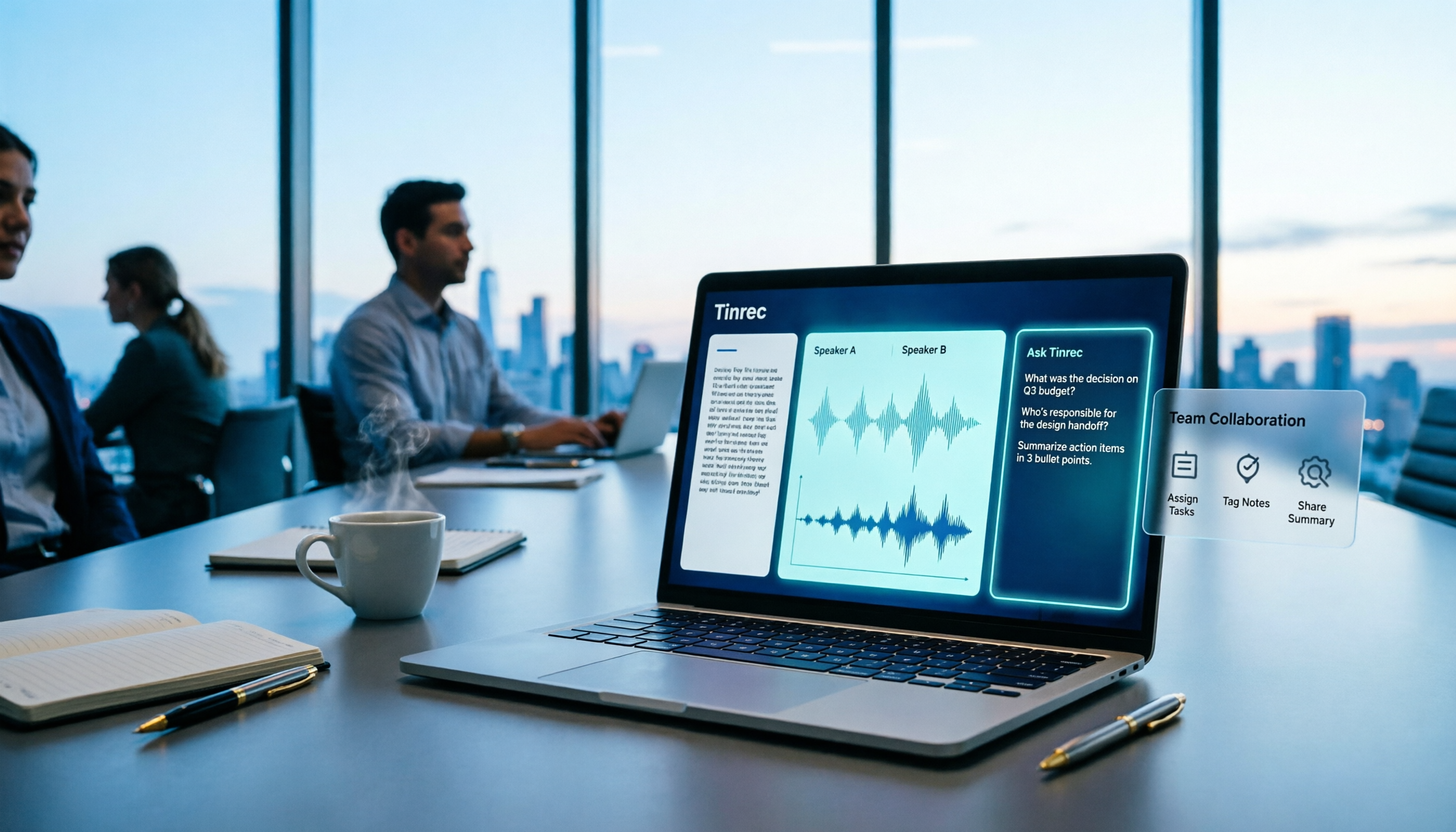
AI Q&A: This is my most-used feature. Just ask "What was the conclusion of this meeting?" or "When will the budget be confirmed?" and the tool provides answers based on semantic understanding, without manually scanning the entire transcript.
Stop organizing recordings by hand
Upload audio or video and automatically get a transcript, summary, and action items
Team space and governance: Meeting data is stored centrally. Admins can manage roles, seats, sharing permissions, usage, and audits. Accidentally deleted audio can be recovered from the recycle bin.
Real-world use cases
Weekly project meetings: Regular weekly meetings are perfect for real-time transcription. You can follow along with the text during the meeting to ensure no key points are missed, and after the meeting, directly view the summary and to-dos—much easier than taking notes afterward.
Client interviews and requirement confirmation: Client requirements, objections, and commitments are all captured in the transcript. Later, when you need to compile a proposal or reply email, you can simply extract key points via AI Q&A and export to your existing workflow.
Cross-language meetings: With foreign clients or cross-regional teams, real-time translation and bilingual viewing help everyone stay on the same page. After the meeting, compile the bilingual content into a shared version to reduce back-and-forth confirmations.
Classes and personal notes: Whether it's a class, lecture, or your own random thoughts, once transcribed, you can search, ask questions, and reuse. Over time, it becomes your own small database.
Points to consider when choosing a real-time AI meeting notes tool
Does the input source cover your real scenarios? First list the meeting formats you encounter in a week—online, offline, phone, existing audio files are all different. Tinrec supports real-time recording, computer meeting recording, audio and video files, mobile recording, and some web link imports.
Are the post-meeting outputs sufficient? Transcript is just the basics; summaries, chapters, to-dos, Q&A, and multi-format export are what you'll actually use daily. Tinrec can also export results to Notion, Google Docs, OneNote, Dropbox, etc., for further processing.
Can audio files be retained? Keeping audio gives you a chance to cross-check later. Tinrec retains recordings, and the team side has a recycle bin mechanism. Accidentally deleted audio can be restored before permanent cleanup; the current retention period is 30 days.
Distinguish between "roles" and "seats": Roles determine who can manage the team and view usage and audits; seats determine whether a member can record, upload, edit, and export. In Tinrec's team plan, members without a seat can still view, play, and read team data, but cannot perform resource usage operations.
Quotas and billing: The personal plan has a free version, weekly pass, Pro monthly, and Pro annual. Choose based on your usage frequency. The team plan is currently USD 29.80 per paid seat per month, or USD 199 per paid seat per year (about USD 16.58 per month). Each paid seat provides 2,000 minutes of team shared import quota per month. Eligible teams can try 7 days, 1 free seat, and 300 minutes of shared import quota. Real-time recording is currently not deducted by minutes under an active team plan and active seat. Prices, currencies, and promotions are subject to the official purchase page.
Conclusion: Is Tinrec worth a try?
If you want meeting data that's "ready to use right after recording," rather than a transcript you have to read through yourself, Tinrec's combination is closer to that need: the desktop version records online meetings without a bot, automatically generates summaries, chapters, and to-dos after the meeting, and you can use AI Q&A to extract key points, then export to your usual tools.
Individual users can start with the free version, which provides basic quota sufficient to experience recording, file import, summary, and transcription. For short-term intensive meetings or interviews, a weekly pass is enough. For regular weekly use, Pro is smoother.
For teams, it depends on whether data needs to be retained. When meeting content becomes a shared team asset, governance capabilities like member roles, seats, usage, and audits become more important than mere transcription minutes. We recommend running a test with your own meeting recordings—that's more direct than any review.
FAQ
Is Tinrec's free version enough?
The free version provides basic quota to experience recording, file import, summary, and transcription. If you only occasionally organize a recording, the free version is best to try first; for short-term concentrated meetings or interviews, consider a weekly pass; for steady weekly needs, Pro is more suitable.
Do I need to add a meeting bot to the meeting?
No. Tinrec's desktop version directly captures computer system audio, so no extra bot is needed for Zoom, Google Meet, Teams, or Webex. However, note that this is not "automatically joining all meetings on your calendar"; you start recording by opening Tinrec yourself.
Which meeting platforms are supported?
It can handle meeting audio played on your computer from Zoom, Google Meet, Microsoft Teams, Webex, etc. This means it can technically process meeting audio from these platforms, but does not imply official partnerships with them.
What accuracy can I expect?
Tinrec does not recommend promising a fixed accuracy rate. Actual performance is affected by recording quality, background noise, accents, overlapping speakers, and technical terminology. For important content, cross-check with transcript timestamps and audio playback.
What's the difference between the team and personal plans?
Personal plan data is managed by the individual account; the team plan is an independent team space where meeting data belongs to the team, plus additional features like member roles, seat management, sharing permissions, usage analytics, audit logs, and audio recycle bin.
Can accidentally deleted team audio be recovered?
After audio enters the team recycle bin, it can be restored before permanent cleanup begins; the current retention period is 30 days. To-dos are not covered by the recycle bin.
References
- AI Meeting Notes Software Recommendations: 5 Major Apps Tested and Compared, Automatic Transcription Makes Meetings Super Easy!
- Meeting Ink - 2026 AI Meeting Notes Tool Test | 7 Speech-to-Text and Summary Speed Comparison | Meeting Ink - AI Meeting Notes Assistant Automatic Transcription and Summary
- AI Meeting Notes - Google Play App
- AI Meeting Notes - Intelligent Meeting Notes and Summaries | MaiAgent
- Still Taking Meeting Notes by Hand? These 3 AI Tools Save Time and Effort (The Third is Free and Fastest)::I'm Chi
Turn every recording into actionable outcomes
Get 60 free transcription minutes when you sign in. No credit card required.
Related Reading
You might also like

2026 AI Meeting Notes Guide: Tinrec's Bot-Free Recording & Auto-Generated To-Dos
How do you choose an AI meeting notes tool? This article examines Chinese recognition, recording methods, post-meeting organization, and team data ownership, comparing Tinrec, Notta, Otter.ai, and Granola, plus four common pitfalls to help you find a solution that truly saves time after meetings.

5 Best Meeting Notes Apps of 2026: Which Free Version Is Actually Enough?
Still spending an hour after every meeting writing up notes? This comparison puts five common meeting notes app approaches side by side—covering Chinese recognition, how meetings are captured, post-meeting organization, team permissions, and pricing—and explains how Tinrec handles recording, transcription, summaries, action items, and AI Q&A within its free tier.

2026 Meeting Recording Tools: Bot-Free Recording + AI Action Item Management
A mid-level manager who attends 15 meetings a week shares hands-on insights: starting from the decision point of whether to let a meeting bot join, this article breaks down 4 key factors for choosing a meeting recording tool, and explains the real-world experience, limitations, and use cases of Tinrec's desktop bot-free recording, AI summary and action items, Q&A, and team plan roles and seat management.

Tinrec vs Otter.ai: Which AI Transcription Tool Is Right for You in 2026?
Choosing an AI transcription tool isn't just about speed—it's about language support, meeting capture methods, post-meeting organization, and team data governance. This comparison of Tinrec and Otter.ai breaks down key dimensions to help you decide which tool fits your meeting needs.

What Is Real-Time Transcription in 2026: Definition, 4 Key Factors, and Tool Comparison
What is real-time transcription and how does it differ from transcribing recordings? This article explains the definition and how it works in plain language, outlines 4 key factors to consider, and compares Google Live Transcribe, Yating, Notta, and Tinrec in Chinese meetings, post-meeting organization, and team collaboration, with scenario-based recommendations.

4 Meeting Transcription Tools Tested: Which AI Saves the Most Time on Chinese Transcripts and Summaries?
After a meeting, do you spend another two hours organizing the audio recording? This article compares four meeting transcription tools—Tinrec, Notta, Otter.ai, and Granola—on Chinese transcription, AI summaries and action items, bot-free recording, team collaboration, and pricing to help you find the most time-saving solution.

3 iPhone Audio-to-Text Apps Tested in 2026: How Long Can You Record and Which Saves the Most Time After Meetings?
How long can an iPhone actually record? This article first breaks down the storage, battery, and file interruption risks of the built-in Voice Memos app, then compares 3 audio-to-text tools from a student's perspective—covering free quotas, single-recording limits, post-meeting organization, and AI Q&A capabilities—to help you decide whether the built-in recorder is enough or if you need an AI recording assistant that delivers key points right after recording.
Google Live Transcribe vs Tinrec in 2026: 5-Dimension Comparison — Which Is Better for Meeting Notes?
Google Live Transcribe & Sound Notifications is an Android accessibility tool known for being free, providing real-time transcripts, and sending environmental sound alerts. Tinrec focuses on meeting notes and team collaboration. This article compares them across 5 dimensions—transcription and organization, online meeting recording, AI Q&A, audio file import, and team management—to help you decide which one to use for meeting notes.

3 iPhone Call Recording Solutions Compared: iOS 18 Built-in vs Tinrec in 2026
iPhone call recording finally has a built-in solution with iOS 18, but regional restrictions, legal issues, and post-call organization are the real pain points. This article compares 3 solutions: iOS 18 built-in call recording, Tinrec, and PLAUD Note with Otter.ai, helping you understand how to record calls and quickly turn them into transcripts, summaries, and action items.