

Turn recordings into transcripts and summaries in minutes
Upload audio or video for multilingual transcription, AI notes, and action items
Why Do Client Visit Commitment Lists Always Get Missed?
You spend two hours visiting a client and verbally agree to three follow-up items. Back at the office, those three items end up on a sticky note, in your phone's notes app, and in a chat thread.
Two weeks later, the client asks, "When will I get that revised quote you mentioned?" That's when you realize you missed one of them.
What's worse, these commitments usually don't appear in formal contracts—they're scattered throughout the conversation: "I'll send you samples next week," "I'll check with engineering about this spec," "I'll try to negotiate the price." Without a list, there's no tracking, and it's hard to build trust for the next interaction.
If you've been in this situation, this article is for you.
Before Choosing a Visit Recording Tool, Understand These 4 Key Points
1. Does it capture transcripts or commitments? Most transcription tools just convert audio to text. But after a visit, you don't need a 40-minute transcript—you need to know "what did I promise the client." When evaluating tools, first check if it can automatically extract action items and key points.
2. What visit scenarios does it support? Client visits aren't limited to meeting rooms. They can be in-person meetings, phone calls, or remote meetings on Zoom or Teams. If a tool only handles uploaded files, it won't cover your actual workflow.
3. Can you ask questions afterward? Three days after a visit, you want to confirm "was the client more concerned about price or delivery time?" If you have to manually Ctrl+F for keywords, you'll waste a lot of time. Tools with AI Q&A can give you answers directly.
4. Can the team take over? If a salesperson goes on leave, resigns, or transfers, can the visit commitment list be handed off to a colleague for follow-up? This depends on whether the data is stored in a personal account or a team workspace.
Tinrec—Our Top Choice After Testing
Tinrec is an AI meeting notes and collaboration tool for individuals and teams, available on iOS, Android, and web; the desktop version can handle online meetings on Zoom, Google Meet, Microsoft Teams, Webex, and more.
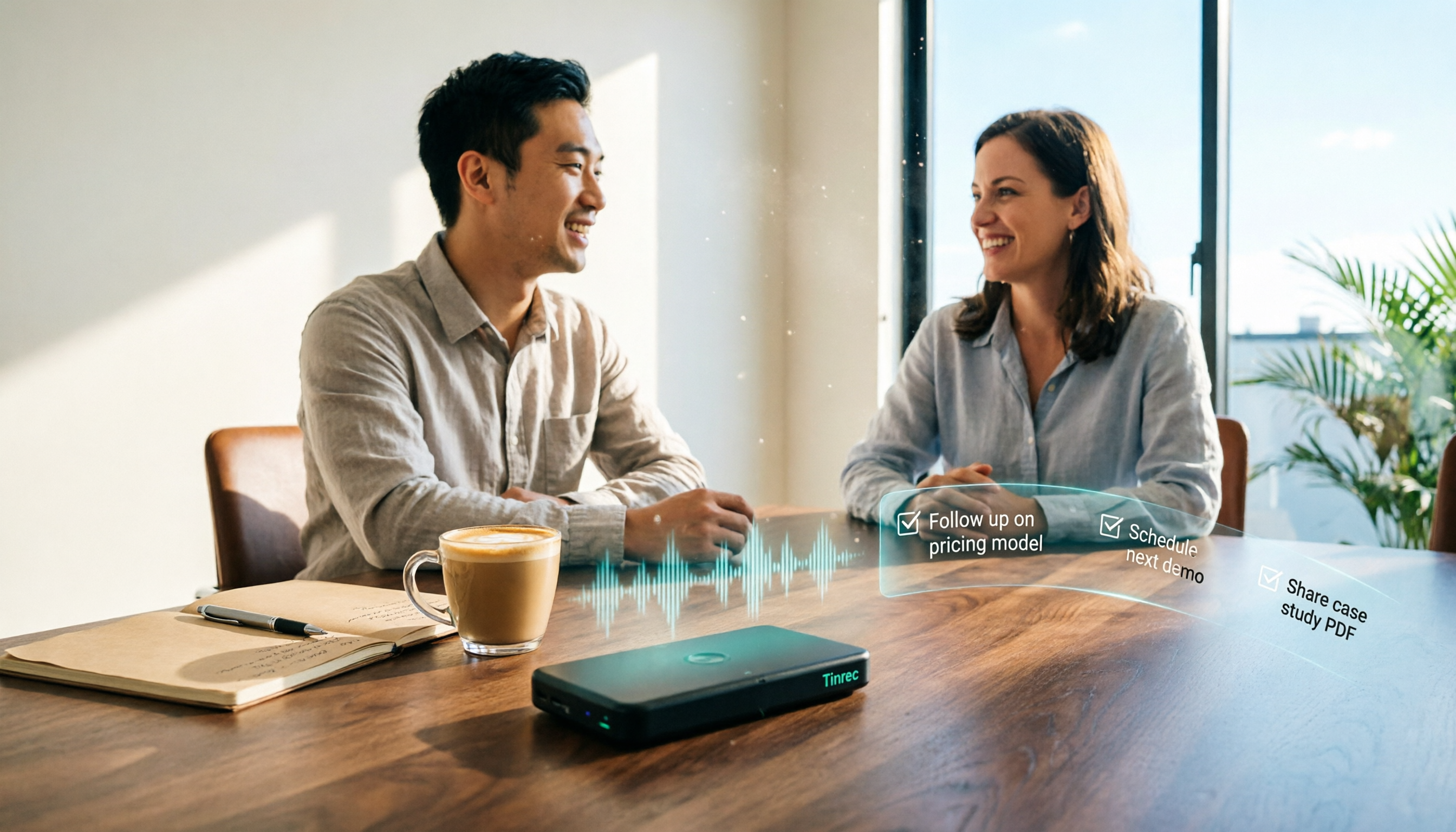
Turn verbal commitments into action items Open Tinrec for live recording during client visits, and it generates a transcript in real time. Afterward, AI automatically creates summaries, chapters, and action items—the client's "send sample quote by next Wednesday" and "check specs with engineering" are organized into concrete actions, so you don't have to replay the entire recording. For salespeople visiting two or three clients a day, this difference is immediate.
Ask follow-up questions after recording This is the biggest difference from typical transcription tools. After recording, you can directly ask Tinrec: "What concerns did the client have about delivery time?" It will provide answers based on semantic understanding, rather than dumping a list of keyword search results. The same visit data can also generate reports, tables, or meeting minutes.
Team workspace keeps commitments from leaving with people The team version is a separate collaboration space, not a shared account. Visit recordings, transcripts, and action items are stored in the team, so new members can review historical data; managers can assign seats, view usage trends, and access audit logs. When a member leaves or loses their seat, their team resources can be handed over to others.
Stop organizing recordings by hand
Upload audio or video and automatically get a transcript, summary, and action items
Things to note The free version offers basic quota, suitable for occasional transcription of one or two recordings. If you have weekly visits, consider the Pro plan; the team version is priced per seat: USD 29.80 per paid seat per month, or USD 199 per paid seat per year (about USD 16.58 per month). Each paid seat includes 2,000 minutes of shared team import quota per month; live recording under an active seat is currently not deducted by minutes. Actual prices and promotions are subject to the official purchase page.
Also, transcription quality can be affected by recording quality, background noise, accents, and multiple people talking over each other. For important commitments, it's recommended to cross-check with recording playback; don't treat it as a 100% error-free replacement.
Who is it for If you visit clients weekly, need a checkable commitment list after visits, and want colleagues to take over follow-up actions—Tinrec is currently the closest fit for this workflow.
Besides Tinrec, What Other Options Are There?
Notta: A multi-platform transcription tool covering meeting notes, file import, and translation, with the highest overlap with Tinrec. Free version: 120 minutes per month, max 3 minutes per file; Pro annual plan is about USD 8.17 per month. It leans toward "turning audio into text"; visit commitment lists, AI follow-up questions, and team data retention are not its focus. If you only need simple file transcription, consider it; but for post-visit action tracking, Tinrec's Q&A and team workspace are more direct.
Otter.ai: A mature choice for English business meetings. Free version: 300 minutes per month; Pro annual plan is about USD 8.49 per user per month. Its strength is English meeting automation; the experience with Chinese and mixed Chinese-English content is not as good as Tinrec, and organizing visit commitments and handoffs are not its focus. If almost all your recordings are English meetings, Otter is still a cost-effective option.
PLAUD Note / NotePin: AI recording hardware. NotePin costs USD 159, Note Pro USD 189; Starter membership includes 300 minutes per month. Portable hardware recording is convenient, but you need to carry an extra device, and online meetings and historical file organization still require the app. Tinrec requires no hardware purchase and works on phone, computer, and web, and can handle online meetings directly.
Pitfall Guide: The 3 Most Common Mistakes in Managing Visit Commitments
Pitfall 1: Recording without organizing. Recording a bunch of files without turning them into a list is as good as not recording. Extract action items the same day as the visit, and confirm ownership and deadlines while the memory is fresh.
Pitfall 2: Keeping commitments on personal devices. If the commitment list only exists in your phone's notes, colleagues can't see it and managers can't track it. Once you go on leave or resign, those commitments disappear. A shared team workspace is far more reliable than personal notes.
Pitfall 3: Thinking a transcript is enough. A transcript is raw material, not a finished product. If you only use the tool as "audio-to-text," you're using only a third of its capabilities. With Tinrec, you can directly ask "What objections did the client raise during this visit?"—much faster than manually scanning a 30-minute transcript.
Summary: Which One Should You Choose?
Turn verbal visit commitments into a trackable list → Tinrec (automatic action item extraction) Want to ask AI directly after a visit "What was the client concerned about?" → Tinrec (AI Q&A) Don't want an extra bot joining online meetings → Tinrec (desktop version records without a bot) Team needs to share visit records and hand off when members leave → Tinrec team version (workspace, seats, usage, audit) Only record English meetings, budget-first → Otter.ai
We recommend trying Tinrec's free version for one or two visit workflows first, to see if the action item list it extracts matches your work habits. If it works well, then consider upgrading—no need to pay from the start.
References
Turn every recording into actionable outcomes
Get 60 free transcription minutes when you sign in. No credit card required.
Related Reading
You might also like

2026 Comparison of 5 Sales Meeting Action Item Tools: Which One Actually Tracks To-Dos to Closing?
After a sales meeting, promises get lost in recordings? This article compares 5 common tools based on hands-on testing, covering action item extraction, bot-free meeting recording, Chinese and mixed Chinese-English recognition, team data handover, and seat management. It also demonstrates a complete workflow with Tinrec, including quotas, pricing, and considerations for personal and team plans.

2026 Comparison of 3 Sales Call Follow-Up Tools: Which One Can Actually Turn Calls into Send-Ready Emails?
Still spending time re-listening to recordings to write follow-up emails after sales calls? This article starts with the efficiency traps salespeople commonly fall into, explains how AI meeting note tools turn calls into transcripts, summaries, and action items, and uses Tinrec as an example to cover features, real-world use cases, buying considerations, and FAQs, including differences between personal and team plans and pricing details.

Which Client Visit Recording Tool Is Best? 2026 Hands-On Test of 2 Options—This One Auto-Generates Transcripts and To-Dos
Poor client visit records usually aren't due to an ugly template—it's because the process was wrong from the start. This article examines three common pitfalls and compares the on-site recording, record output, Chinese recognition, team storage, and long-term cost of the portable AI recording hardware PLAUD Note versus the AI meeting notes tool Tinrec. It also provides template field suggestions you can apply directly, helping you decide whether you need a better template, process, or tool.

How to Record Sales Meetings in 2026 with Tinrec: Bot-Free Recording + AI Action Item Extraction
Tired of missing details in sales meeting notes? This guide covers common mistakes, shares 4 key factors for choosing a sales meeting note-taking tool, and tests Tinrec's bot-free recording, AI action item extraction, and team collaboration features to help you turn every client conversation into trackable sales actions.
How to Create Client Follow-Up Reports in 2026: Tinrec Auto Summaries + Action Item Extraction
After a client meeting, notes often get lost. This tutorial shows you how to use Tinrec to turn client call recordings into transcripts, summaries, action items, and ready-to-send follow-up reports. It also covers 4 key factors to consider when choosing a tool, compares Otter.ai, Granola, and Notta, and includes a pitfalls guide and scenario-based recommendations.

3 AI Meeting Notes Tools Tested: Which Can Turn Minutes into a PRD?
After a meeting, you have the transcript—but the PRD still starts from scratch. This article focuses on whether meeting minutes can evolve into a spec document, comparing Tinrec, Granola, Otter.ai, and Notta on Chinese meetings, material import, post-meeting processing, and team knowledge retention. Includes a copy-paste PRD prompt.

2026 Comparison of 3 Meeting Notes to PRD Tools: Which One Can Generate a Requirements Document Draft?
Converting meeting notes to a PRD often gets stuck because spoken content is hard to structure. This article outlines 5 practical steps and compares Tinrec, Otter.ai, and Granola across 4 dimensions—Chinese meeting note organization, post-meeting output, recording retention, and team collaboration—to help you choose the right approach.
4 Sales Call Summarization Tools Compared for 2026: How to Choose for Chinese Calls and Follow-Ups
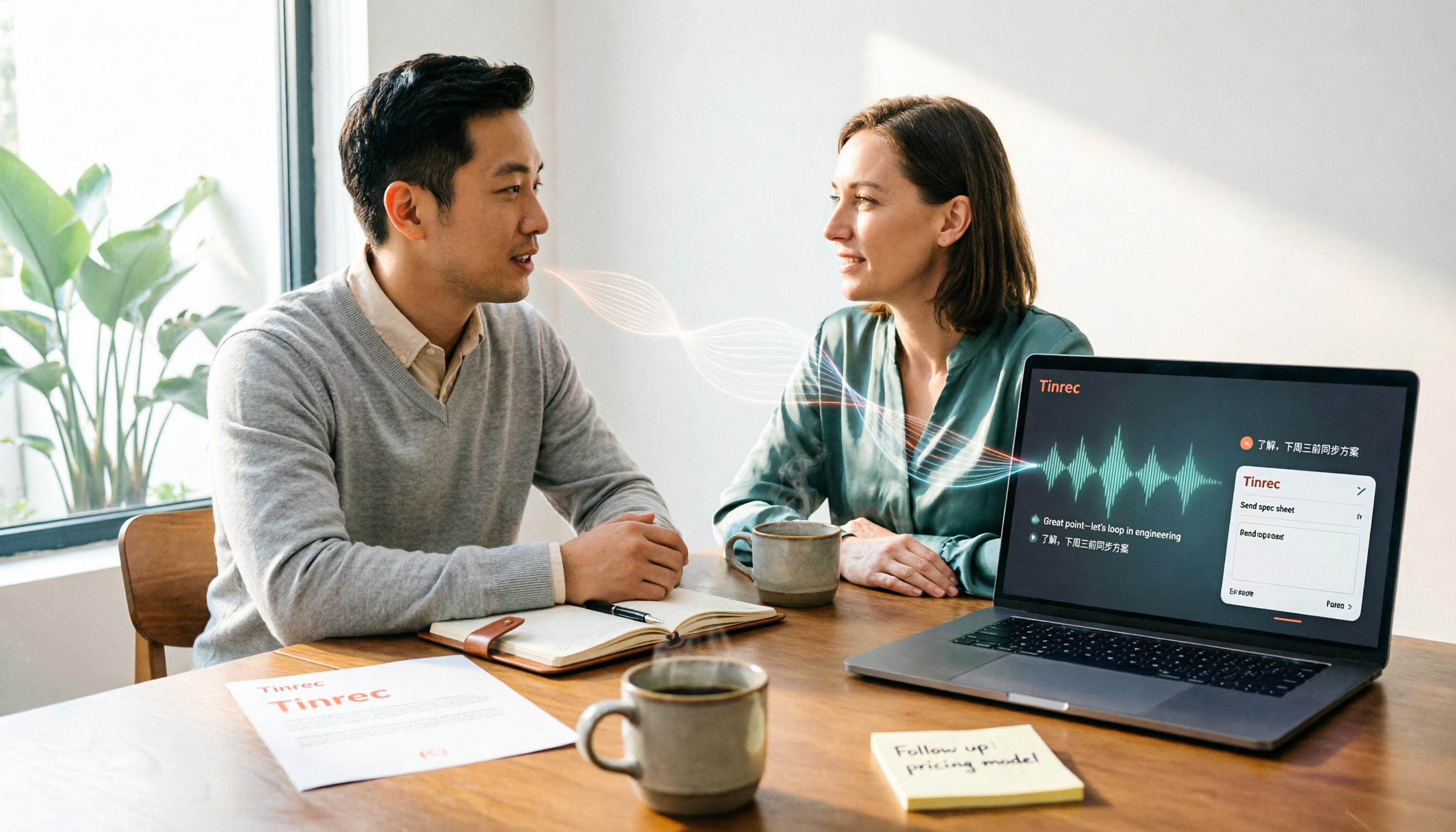
The most time-consuming part of a sales call is often not the conversation itself, but the post-call organization. This comparison evaluates Tinrec, Otter.ai, Fireflies.ai, and Notta across four dimensions: Chinese and mixed Chinese-English recognition, summary granularity, export workflows, and team collaboration. It also outlines 5 key questions to ask before purchasing and 4 common pitfalls to avoid.

Tinrec vs Otter.ai 2026: 5-Dimension Comparison for Turning Product Review Meetings into PRDs
Struggling to write a PRD after your product review meeting? This article compares Tinrec and Otter.ai across 5 dimensions—Chinese meeting recognition, bot-free recording, post-meeting output to PRD, team knowledge retention, and cross-device input—to explain why Chinese product teams find Tinrec more efficient for turning review meeting decisions directly into PRDs.