
Turn recordings into transcripts and summaries in minutes
Upload audio or video for multilingual transcription, AI notes, and action items
2026 Vocologia Courses Compared: How to Choose Online Training and Organize Post-Course Recordings
Most people who see "vocologia 2026" first check the start date, then look at tuition, and then enroll.
That is the most common and most costly mistake.
Continuing education in vocology is not about buying a certificate; it is about turning anatomy and physiology, dysphonia assessment, neuroscience, and voice training into the clinical or rehearsal-room judgment you use every day. Course format, language of instruction, certification backing, and whether post-course materials are retained are often far more important than early-bird pricing.
Another inefficient approach: after the course, recordings sit on your phone, notes are scattered in three places, and six months later you cannot find that one segment for review.
This article starts with these pitfalls, organizes three Vocologia courses worth considering in 2026, and then discusses how to retain the content after the course.
3 Most Common Pitfalls When Searching vocologia 2026
Pitfall 1: Looking only at the start date, not the format. In 2026, mixed synchronous and asynchronous formats are common. Nuova Artec offers synchronous online classes plus two in-person sessions; afonoaudiologicas offers monthly synchronous classes with asynchronous courses, running from November 2025 to July 2026. Once synchronous classes conflict with your work or clinic hours, the cost of making up missed sessions is high.
Pitfall 2: Treating the registration fee as the total cost. The Nuova Artec page in Rome states clearly: registration €200, plus €2,000 (including VAT), payable in 4 installments, with the final installment due by July 30, 2026. Tuition is only one part; materials, certification, travel, and leave costs should all be factored in.
Pitfall 3: Retaining nothing after the course. The biggest loss in online continuing education is not tuition, but the unorganized second-round knowledge. When the instructor talks about "narrative approaches" or "voice and drug interactions," you nod along in the moment, but three months later you only remember "something was mentioned."
Of these three pitfalls, the first two can be avoided by research; the third requires a tool.
4 Things to Understand Before Choosing a 2026 Vocologia Course
1. Synchronous, asynchronous, or blended? The value of synchronous classes lies in real-time questions and live discussion; the value of asynchronous classes lies in your own schedule. For blended courses, check carefully: are synchronous sessions recorded for replay, and will the virtual classroom remain open indefinitely?
2. Who backs the certification? The Vocology Center's international certification program awards a "Certificación Internacional en Vocología Aplicada" upon completion, with a clinical or artistic track depending on your path, and the page mentions university backing. A backed certificate is easier to explain when seeking employment or contracts across borders.
3. Can you handle the language of instruction? These three courses are taught in Italian and Spanish respectively. The language barrier is not just "being able to understand"; it is whether you can grasp the details of professional terminology in the moment.
4. Can post-course materials be reused? This is the point most easily overlooked by readers in Taiwan and most regretted afterward. afonoaudiologicas emphasizes "indefinite access to the virtual classroom and course recordings," while Nuova Artec provides a dedicated library on the Tinkific platform. But even if the platform is open, you still need to organize notes and transcripts yourself; otherwise, the material merely "exists" rather than being "usable."
Summary of 3 Vocologia Courses in 2026
Nuova Artec | Scuola di Vocologia Clinica 2026 (Italy)
Starts January 30, 2026, with class times 9:00–13:00 and 14:00–17:00.
The format is synchronous distance learning (FAD) in an interactive virtual classroom, plus 2 in-person sessions (RES), with Telegram support and tutoring. The course uses GoToMeeting and has a dedicated library on Tinkific.
Cost is €200 registration plus €2,000 (including VAT), payable in 4 installments, due by July 30, 2026. The page also mentions benefits for recent graduates; check directly with the school for details.
Who it suits: those aiming for a clinical path, able to accept Italian instruction, and willing to travel for in-person sessions.
Vocology Center | Certificación Internacional en Vocología Aplicada (Colombia)
Starts January 24, 2026; free informational interviews can be booked before the start date.
Upon completion, you receive an international certification marked as clinical or artistic depending on your track. The course is positioned as advanced education for voice professionals, and the page mentions university backing.
Who it suits: those who want a directional international certificate, are comfortable in a Spanish-speaking environment, and want to confirm through an interview whether to pursue a clinical or artistic track.
afonoaudiologicas | Vocología Básica y Avanzada (2025/11–2026/7)
From November 2025 to July 2026, with one synchronous class per month plus asynchronous courses, totaling over 40 hours.
Includes supplementary materials, indefinite access to the virtual classroom, special classes by guest lecturers, workshops and mini-courses, and a community that continuously shares the latest voice evidence.
The target audience is broad: speech-language pathologists, voice therapists, singers, singing teachers, voice coaches, and professional voice users in speaking and singing.
Who it suits: those with limited budget and time who want to build a foundation first and then advance. The course starts in late 2025, so those joining in 2026 should confirm whether they can catch up.
Also Noteworthy: SAV Argentine Society of Voice 2026 Events
If your budget does not yet cover a full course, society events are a good way to test the waters. In 2026, they plan a Childhood Dysphonia Day, a public speaking workshop (on voice and professional image), a Vocology Researcher Day, and a series of events for World Voice Day 2026.
Stop organizing recordings by hand
Upload audio or video and automatically get a transcript, summary, and action items
Single-day events have high information density and are easier to fit into your existing work rhythm.
Tinrec — Our Top Choice for Organizing Course Recordings After Testing
Let us be clear about its positioning: Tinrec is not a course platform; it is an AI meeting notes and collaboration tool for individuals and teams.
But for "retaining content after class," it is the tool I currently use most often.
Why Use It for Course Recording Instead of a Meeting Bot
Many online courses do not use Zoom or Meet but platforms like GoToMeeting, where meeting bots cannot enter.
Tinrec's desktop version captures the computer's system audio directly, without inviting any bot to join the meeting. When you play the course on your computer, it generates a transcript in sync. Supported platforms include Zoom, Google Meet, Microsoft Teams, and Webex.
Note that this is not "automatically joining all meetings"—you need to open Tinrec and start recording yourself.
Three Features I Actually Use
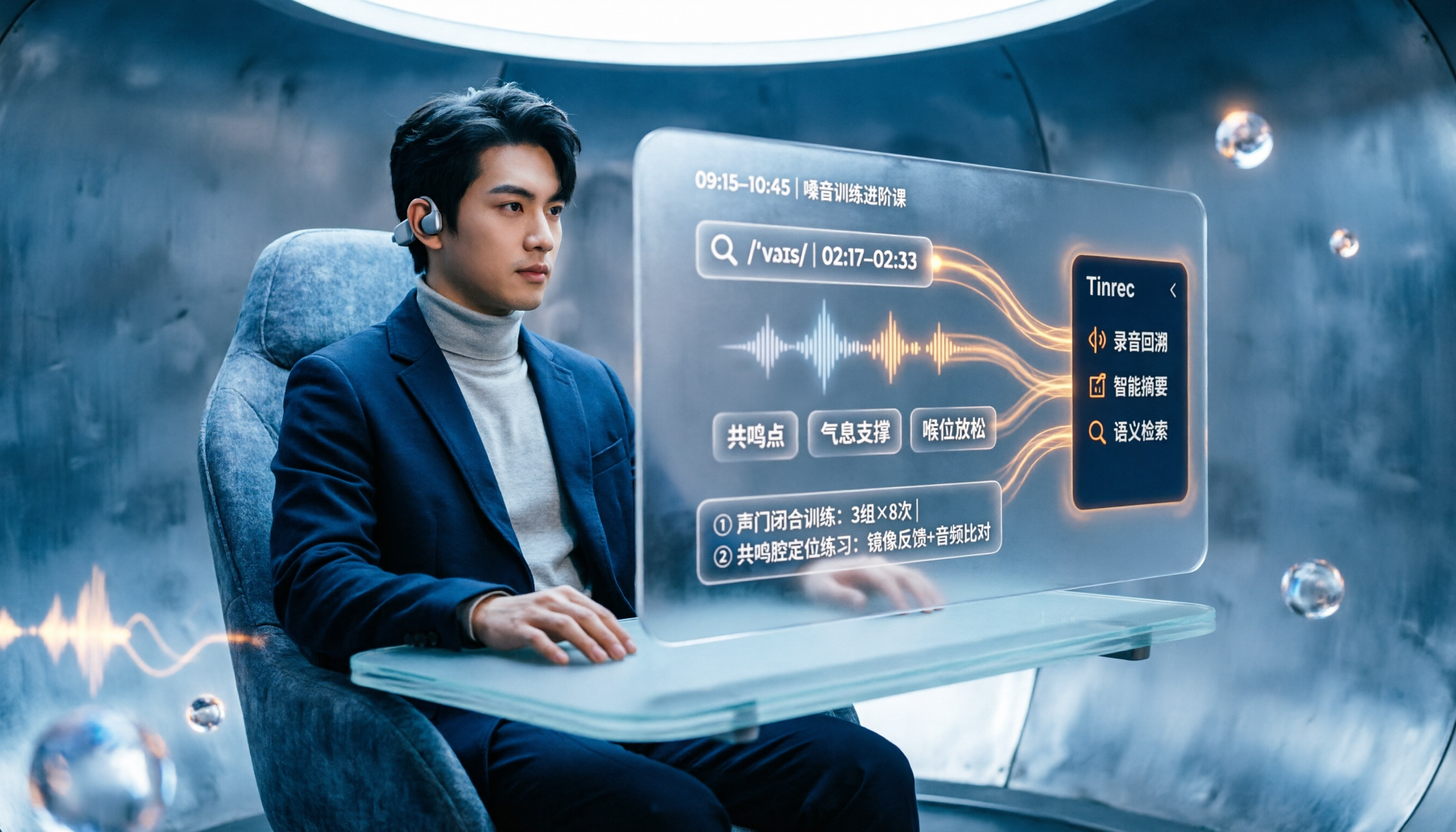
Live transcript during class, with real-time translation. When the course is in Italian or Spanish, real-time translation lets me view the original and the translation or bilingual comparison side by side. This is especially useful for terminology-dense courses; if you miss a sentence, you do not need to replay the whole segment.
Automatic summary, chapters, and to-dos after class. The biggest fear with a two-hour class is that key points are scattered. Tinrec breaks long content into chapters, extracts key points, and organizes "literature to look up" and "vocal exercises to practice" into to-dos.
AI Q&A to find that segment again. This is where I save the most time. You do not need to Ctrl+F in a 90-minute transcript guessing keywords; just ask "which chapter covers the instructor's discussion of dysphonia classification," and it answers based on semantics and takes you back to the corresponding location. Most transcription tools at the same price point do not yet have this capability.
Audio Files, Export, and Team Use
Besides online courses, I also upload interview or lecture recordings directly for transcription. Organized results can be exported to Notion, Google Docs, OneNote, Dropbox, and other tools, then written into my own notes.
If your clinic, teaching office, or studio shares continuing education resources, the team version is another level: independent team spaces, member and role management, seat allocation, usage analytics, audit logs, and a 30-day retention audio recycle bin. Team terminology can be maintained through "team hotwords," which is practically helpful for terminology-dense fields like vocology.
Team pricing is USD 29.80 per paid seat per month, or USD 199 per paid seat per year (about USD 16.58 per month) with annual billing; eligible teams get a 7-day trial, 1 free seat, and 300 minutes of shared team import quota on first signup. Paid seats provide 2,000 minutes of shared team import quota per month; real-time recording is currently not deducted by minutes under an active plan and active seat.
Honest Limitations
I will not tell you its accuracy is 98% or 99%; the official documentation does not promise a fixed number. Actual performance is affected by audio quality, background noise, accents, overlapping speakers, and professional terminology.
The free version is a basic quota, suitable for trying out; document and web imports consume shared team quota and are not unlimited. For important content, verify against recording playback and transcript timestamps.
Also, before recording, confirm local regulations and obtain consent from instructors and participants when necessary.
Who It Suits
If you plan to enroll in any online Vocologia course this year, habitually review thoroughly after class, or need to study in a multilingual environment—Tinrec is the tool I would try first.
Besides Tinrec, What Other Options Are There?
Notta The most direct competitor with the highest overlap with Tinrec, offering multi-platform transcription, file import, translation, and team plans. Free version: 120 minutes per month, 3 minutes per session; Pro annual billing about USD 8.17 per month, 1,800 minutes per month; Business annual billing about USD 16.67 per seat per month. Its file transcription is stable, but it lacks Tinrec's desktop bot-free online meeting recording and Agent post-processing workflow.
Granola Also a bot-free AI meeting notes tool; Basic is free, Business is USD 14 per user per month, Enterprise is USD 35. It is great for people who take notes while listening, but it does not support uploading pre-recorded audio files and does not save meeting audio. If you need to archive lecture recordings and re-listen for verification, Tinrec is more suitable.
Otter.ai A veteran choice for English business meetings; Basic is free with 300 minutes per month, Pro annual billing about USD 8.49 per user per month, including 1,200 minutes per month and 10 file imports. If your course is entirely in English, it is a cost-effective option; but for Chinese and multilingual courses, as well as team data retention and export workflows, Tinrec is closer to the habits of users in Taiwan.
Pitfall Guide: 4 Most Common Mistakes When Preparing for 2026 Continuing Education
Mistake 1: Buying a synchronous course as if it were asynchronous. Before enrolling, confirm what the class times convert to in Taiwan time. Morning classes in Europe may be evening or late night in Taiwan; sustaining that schedule for seven months makes it easy to give up midway.
Mistake 2: Comparing only tuition, not total cost. List registration fee, installment deadlines, materials, certification fees, and travel/accommodation for in-person sessions before comparing. A split like €200 plus €2,000 looks lower, but the sum is what you actually pay.
Mistake 3: Ignoring the language barrier. Professional courses in Italian and Spanish test whether you can grasp concepts at normal speaking speed. If your language skills are still beginner level, choose courses with asynchronous materials that you can review repeatedly.
Mistake 4: Not organizing after class. Using the tool only as "audio-to-text" means using only one-third of its value. For example, Tinrec's AI Q&A—asking directly after class "what assessment methods were mentioned in this lecture" is much faster than manually flipping through a 90-minute transcript.
Conclusion: How Should You Choose?
In one sentence: choose the right course format first, then choose the right post-course organization method; decide these two things separately.
Want a clinical path, can accept Italian, willing to attend in person → Nuova Artec's clinical vocology course. Want a directional international certification, Spanish-language track → Vocology Center's applied vocology certification. Limited budget, want to build a foundation first, need asynchronous flexibility → afonoaudiologicas' basic and advanced courses. Not yet decided whether to commit to a full course → Start with SAV 2026 single-day events and workshops. Course recording, transcripts, summaries, and post-course Q&A → Tinrec, the one we use most often after testing.
I suggest starting with the free version to run through the workflow once: record a lecture, see whether the transcript, chapters, and summary actually help your review habits, then consider upgrading. There is no rush to buy an annual plan; in continuing education, being able to keep using it matters more than buying a lot at the start.
References
Turn every recording into actionable outcomes
Get 60 free transcription minutes when you sign in. No credit card required.
Related Reading
You might also like

2026 Voice-to-Text Tools Tested: How to Use Notta and Which Free Version Is Enough
How do you use Notta? This hands-on guide walks through Notta's five steps—sign-up, recording, transcription, AI summary, and export—and honestly lays out the free plan's 120 minutes per month and 3-minute per-recording limits, plus paid pricing. It also compares Tinrec, Otter.ai, and TurboScribe on how they capture meetings, organize notes afterward, and retain team knowledge, with buying tips and three common pitfalls to help you pick the tool that truly saves time.

2026 AI Meeting Recorder Comparison: What Is Notta and Which Tool Should You Choose?
Many people search for "what is Notta" but the real question is whether the tool fits their needs. This article breaks down the company background, market focus, and free plan pitfalls, then compares four tools hands-on to help you decide between Notta, Otter.ai, Granola, and Tinrec.

Notta Pricing in 2026: Breaking Down 3 Plans, Which Is Worth It, and How to Choose Alternatives
How does Notta charge? This article breaks down the actual pricing logic of Notta's Free, Pro, and Business plans in 2026, including the 120 minutes per month and 3-minute per-segment limits, annual upfront billing, and per-seat pricing differences. It also covers 5 key points to check before buying, 4 common mistakes, and a comparison of alternatives from the perspective of 'ready to use right after the meeting.'

2026 AI Transcription Showdown: Vocol.ai vs. 4 Alternatives — Which Is Worth It?
Is Vocol.ai really better? This decision-focused review tests Vocol.ai, Yating Transcription, Good Tape, TurboScribe, and Tinrec, comparing generation speed, language support, post-meeting organization, and team collaboration, with selection advice and usage notes.

Vocol Latest Version vs Tinrec (2026): No-Bot Transcription + AI To-Do Summaries
Is the latest Vocol enough? This guide compares Vocol.ai and Tinrec across 5 dimensions: meeting capture, post-meeting output, multilingual transcription, team governance, and plan quotas. We also highlight 3 common pitfalls when choosing a meeting notes tool, so you can pick the right one within your budget.

Tinrec vs Vocol.ai in 2026: A 5-Dimension Comparison for Chinese Meeting Notes
Most people compare voice tools by looking only at free minutes and accuracy rates, but overlook how meetings are recorded and whether post-meeting data is usable. This article uses five dimensions—meeting capture, Chinese language processing, post-meeting outputs, export workflows, and team governance—to compare Tinrec and Vocol.ai, and summarizes common pitfalls and selection advice for choosing AI meeting tools.

2026 Tinrec vs Vocol.ai: Bot-Free Recording & Chinese Meeting Notes Comparison
In 2026, how should you choose between Tinrec and Vocol.ai? This article compares them across four dimensions: meeting capture, post-meeting organization, team governance, and data handover. It includes a quick feature overview table and clear recommendations to help Hong Kong office workers and team leads make a fast decision.

2026 Free AI Meeting Notes Options: Vocol Comparison Table and 5 Buying Tips
Still can't pick a tool after reading several Vocol comparison tables? This article doesn't repeat feature lists; instead, it breaks down 5 dimensions that truly affect daily efficiency: recording method, language translation, post-meeting output, team permissions, and pricing logic. Using Tinrec as an example, it explains how bot-free recording, real-time translation, AI Q&A, and team spaces can actually save office workers time on post-meeting organization.

2026 AI Meeting Transcription Tools Compared: Is the Latest Vocol Worth It?
Tired of endless meeting notes? This hands-on guide covers 4 key factors for choosing an AI meeting recorder and compares Tinrec, the latest Vocol, Otter.ai, and Notta—plus pitfalls to avoid and pricing—so you can find the right fit for your workflow.