

Turn recordings into transcripts and summaries in minutes
Upload audio or video for multilingual transcription, AI notes, and action items
Last month, after a two-hour review meeting at a client's office, I thought I'd generate the transcript on the high-speed rail ride back and have the minutes ready by evening. But when I opened Otter's free version, the Chinese transcription was full of English letters mixed in, the client's company name was completely wrong, and none of the attendees' names matched. The problem wasn't the tool itself—I had the wrong focus from the start: whether a free trial works isn't about the minutes, it's about which kind of Chinese it recognizes.
Why confirm "Chinese support" before discussing free trials?
Meetings in Taiwan rarely involve "pure Chinese." A weekly meeting might sound like this: "We finished the retro after sprint last week, all blockers are resolved, next we need to sync with PM on the roadmap." If a tool only recognizes standard Chinese, such sentences get chopped up messily.
More realistically, most tools' free quotas are for "testing," not for "production." Things you can't test in the free version—Traditional Chinese terminology, Taiwanese accents, colleagues' English names, product codes—won't automatically improve after paying. So the list below is ordered by "whether it's actually usable for Chinese meetings," with prices and quotas all according to current official announcements. You decide which one is worth your time to try.
Tinrec—Chinese meeting transcription plus post-meeting organization, most complete
One-sentence positioning: turn meetings into searchable, collaborative, actionable team data.
Currently my team's main tool. First reason: its desktop version directly captures computer system audio, recording Zoom, Google Meet, Microsoft Teams, and Webex without inviting a meeting bot into the meeting room list—this is especially important for client meetings; you don't want the other party to see a Notetaker in the attendee field.
Second reason: Chinese. It covers Chinese, Traditional Chinese, and mixed Chinese-English content. During recording, you can switch between original text, translation, or bilingual view. The team can also maintain "hotwords" to feed in product codes, client names, and internal terminology, greatly improving professional term recognition. Actual results still depend on recording quality, accents, and multiple people talking over each other; no tool can guarantee 100%.
Third reason: the "post-meeting" part I care most about. It automatically generates summaries, chapters, to-dos, and mind maps, allows follow-up questions around meeting content, and can use Agent post-processing to generate reports, tables, and documents, then export to Notion, Google Docs, OneNote, Dropbox. Previously I spent forty minutes organizing after a meeting; now I open the summary and edit for fifteen minutes.
Plans and pricing: Individuals can start with a free version; there are also weekly cards, Pro monthly, and Pro annual (actual prices per official website). Team version: first-time eligible users get a 7-day trial, 1 free seat, 300 minutes of team shared import; monthly USD 29.80 per paid seat per month, annual USD 199 per paid seat per year (about USD 16.58/month), each paid seat provides 2,000 minutes of team shared import per month; real-time recording under active team plans and active seats is currently not deducted by minutes.
Who it's for: Those whose meetings are mainly in Chinese or mixed Chinese-English, who need to deliver minutes and to-dos after meetings, and who need data to reside in the team rather than on personal hard drives.
Otter.ai—Veteran for English meetings, Chinese is currently Simplified
Otter was founded in 2016 by former Google engineers, exploded in popularity during the remote meeting wave in 2020 due to Zoom integration, and now has over 15 million users. It's synonymous with AI meeting transcription in the English world. It covers Zoom, Teams, Meet, live transcription, speaker identification, AI Chat, and team management—its maturity is unquestionable.
But back to the keyword: Chinese. The official language list currently lists Chinese (Simplified), not Traditional Chinese. The official "recognizes Chinese accent" means it understands English with a Chinese accent, not that it supports Chinese itself—these two things are often confused. So Taiwanese users can test it, but shouldn't assume Traditional Chinese terminology, Taiwanese accents, English abbreviations, and names will all be correct.
Free quota: Basic includes 300 minutes of transcription per month, 3 lifetime file imports, and access to Zoom/Teams/Meet, AI Chat, live transcription, speaker identification, and mobile app. Pro annual works out to USD 8.49 per user per month, including 1,200 minutes of in-app recording per month and 10 file imports; Business offers unlimited meetings and in-app recording. Prices subject to Otter's official pricing page.
Who it's for: Those whose meetings are 80% English, or who occasionally want to transcribe Chinese meetings into drafts and edit themselves.
Stop organizing recordings by hand
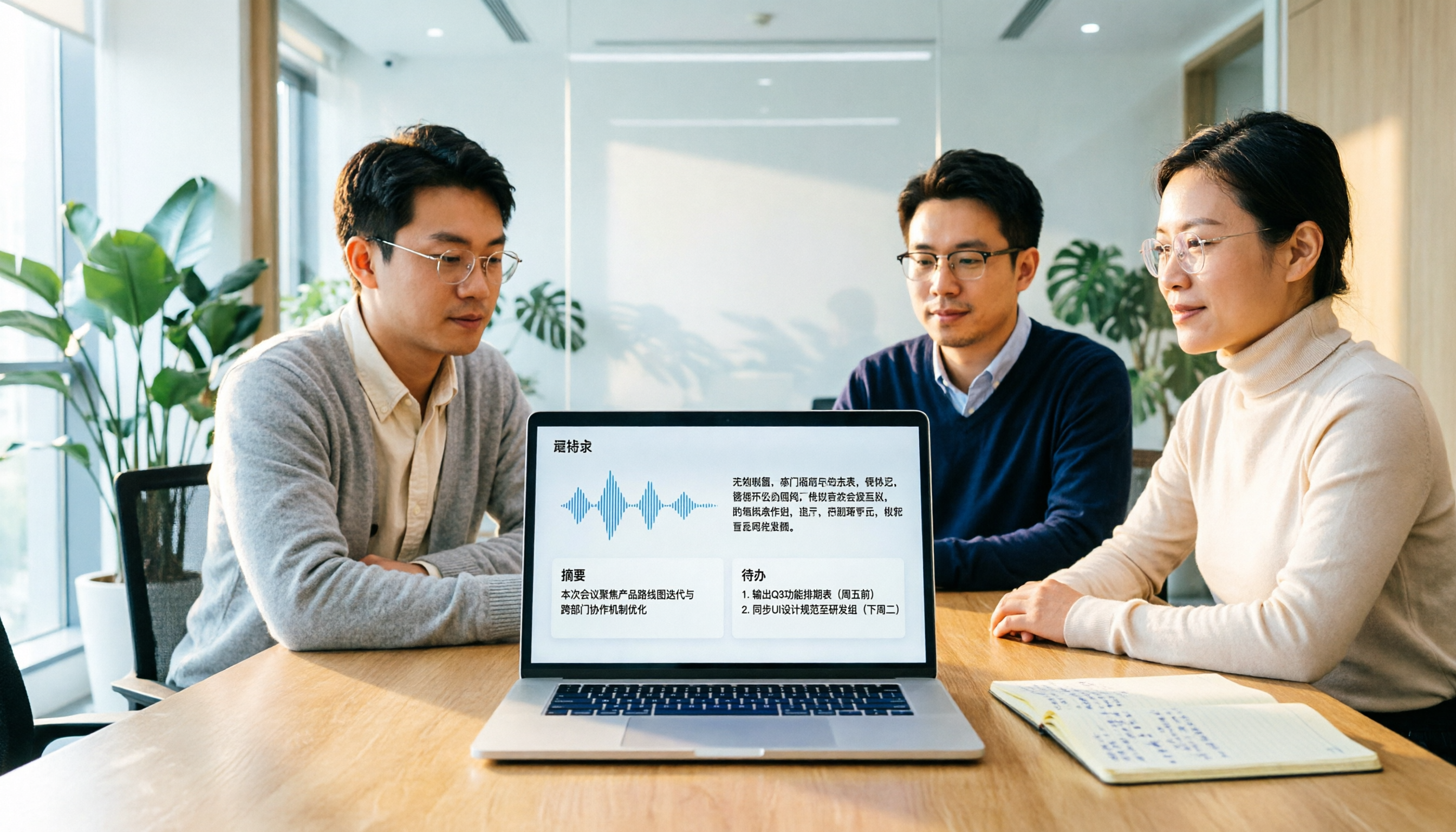
Upload audio or video and automatically get a transcript, summary, and action items
Notta—Multilingual transcription, Chinese is one of its strengths
Notta overlaps significantly with Tinrec, both offering multi-platform transcription, meeting notes, file import, translation, and team plans. Chinese support is a relatively confident area for it.
Official quotas: Free includes 120 minutes per month, max 3 minutes per single content; Pro annual works out to USD 8.17/month, 1,800 minutes per month; Business annual works out to USD 16.67 per seat per month, including unlimited transcription, role permissions, and usage reports. Subject to Notta's official pricing page.
Who it's for: Those who frequently handle cross-language files and whose main workflow is "upload recording to transcribe."
TurboScribe—Cost-effective choice for long files and batch transcription
If you have piles of interview files and course recordings rather than one live meeting after another, a file-based tool like TurboScribe is more cost-effective.
Official quotas: Free includes 3 files per day, max 30 minutes per file; Unlimited annual is USD 120 (about USD 10/month), paid version supports up to 10 hours or 5 GB per file, can upload 50 files at once, supports subtitles and translation. Subject to TurboScribe's official pricing page.
Who it's for: Those who need to process large batches of existing audio files and don't need AI Q&A or team governance.
Granola—Bot-free meeting notes, but audio files aren't retained
Granola takes a similar approach to Tinrec's desktop version: real-time transcription via device system audio and microphone, no bot sent into the meeting, combined with your own handwritten notes to generate more targeted content.
Official pricing: Basic free, Business USD 14 per user per month, Enterprise USD 35 per user per month. Note that it supports transcript viewing, copying, and searching, but does not support uploading pre-recorded audio files and does not save meeting audio files. Subject to Granola's official pricing page.
Who it's for: Those who only handle live meetings, strongly prefer no extra bot in the meeting, and don't need to retain recordings.
PLAUD Note/NotePin—Hardware approach, suitable for field workers
PLAUD sells devices. NotePin USD 159, Note Pro USD 189, membership Starter 300 minutes per month, Pro USD 99.99/year (1,200 minutes per month), Unlimited USD 239.99/year, subject to official page.
Who it's for: Those who frequently visit client sites, need phone call recording or on-the-go notes, and are willing to carry an extra device for convenience.
With so many options, how should you choose?
• Meetings mainly in Chinese (especially Traditional Chinese), need to deliver minutes and to-dos after → Tinrec, this is its core design scenario
• Meetings mix Chinese and English, with lots of internal terminology → Tinrec, feed proper nouns into team hotwords first
• Don't want a bot appearing in the attendee list → Tinrec desktop (retains recordings and file import) or Granola (doesn't retain audio)
• Meetings almost entirely in English, team already using Otter → Otter, no need to switch
• 50 interview audio files sitting in your drawer to process at once → TurboScribe or Notta
• Frequently in the field, need physical recording device → PLAUD
• Zero budget, only transcribe one or two meetings a month → Otter Basic's 300 minutes or Tinrec free version are enough to verify
4 things to know before using Otter's Chinese free trial
1. Simplified is not Traditional. The official list shows Chinese (Simplified). Before subscribing, take a real meeting recording of your own (10 minutes is enough) and test names, company names, product codes, and simplified/traditional transcription. Don't just look at the feature list.
2. 300 minutes is roughly 5 one-hour meetings. And existing audio or video only has 3 lifetime import credits. It's suitable for testing one or two short meetings, not as a long-term audio file upload solution. If you have a dozen meetings a week, look directly at paid plans' per-seat minutes for a more realistic comparison.
3. Mixed Chinese-English is the biggest variable. A third-party review tested 5 different types of meetings, with Traditional Chinese averaging about 82% and mixed Chinese-English about 76%—this is a single reviewer's result, not official numbers, but the message is clear: one or two out of ten sentences need correction. Always manually verify the original text and recording before delivering to clients.
4. Test in the right order. Pick an "unimportant but complex" meeting to test (multiple people, accents, proper nouns), run the same 10-minute audio file through two or three tools simultaneously—more reliable than reading ten feature comparison articles. This is also why I recommend starting with free versions or short-term plans: first confirm it recognizes your Chinese, then discuss whether to pay.
One final reminder: recording and transcription involve attendees' rights. Notify as required by local regulations and obtain consent where necessary—no tool can save you from this.
Conclusion
The purpose of a free trial isn't to save money; it's to confirm "it recognizes your Chinese." Otter is a mature, good tool, but in Taiwan's meeting scenarios with Traditional Chinese and mixed Chinese-English, you need to test before deciding. If you're like me—a dozen meetings a week, still need to deliver minutes and track to-dos after—Tinrec currently connects transcription, Q&A, to-dos, and team data retention most completely. Find a real meeting recording, run it through both, and the answer will be clearer than any review article.
References
- 2026 Otter.ai Review: Complete Chinese Tutorial, Features, Costs, User Experience | Meeting Notes, Automatic Transcription Helper - RosyArts
- Which Otter Chinese Translation is Best? 2026 Test of 4 Options, Cambridge Dictionary Most Complete - Tinrec Blog
- Does Otter.ai Support Chinese? Simplified Chinese Limitations, Free 300 Minutes and Tutorial | Mason AI Lab
- Is Otter.ai Good for Chinese? 2026 In-Depth Review for Taiwanese Users (with Alternatives)
- Otter.ai Tutorial | How to Get Started with Otter.ai
Turn every recording into actionable outcomes
Get 60 free transcription minutes when you sign in. No credit card required.
Related Reading
You might also like
Otter Chinese in 2026: Which Solution Works Best? A Side-by-Side Comparison of 3 Options and Why Tinrec Is Better for Chinese Meetings
When people search for 'Otter Chinese,' there are actually two different needs: looking up the English word, or finding a Chinese alternative to Otter.ai. This article first clarifies how to look up 'otter' (the animal) most comprehensively, then compares Tinrec and Otter.ai across five dimensions: Chinese recognition, meeting capture methods, post-meeting output, team data ownership, and quota pricing, to help you choose the right tool for Chinese meeting notes.

2026 Comparison of 2 Chinese Meeting Transcription Tools: Why Tinrec Is Better Suited for Chinese Than Otter.ai
Otter.ai is mature for English meeting transcription, but Chinese transcription has always been a pain point. This article uses the perspective of a team lead in Taiwan to compare Otter.ai and Tinrec in Chinese transcription, bot-free recording, post-meeting organization, and team collaboration, helping you decide which is better for Chinese meetings.

Otter in Chinese: What It Means and Whether Otter.ai Supports Chinese Meetings (2026 Guide)
What does 'otter' mean in Chinese? There are two layers: the literal translation of the English word 'otter' and whether Otter.ai, an AI meeting tool, can handle Chinese. This article clarifies the literal meaning and official language support, then explains why 'supports Chinese' doesn't mean it understands your Chinese meetings. Using Tinrec as an example, it breaks down the complete workflow from recording and transcription to summaries, action items, and team knowledge retention.

Tinrec vs Otter.ai 2026: 5-Dimension Comparison for Chinese Meeting Scenarios
People searching for 'which otter Chinese is good' are either looking for the Chinese translation of the word 'otter' or asking about Otter.ai's Chinese capabilities. This article separates these two intents, then compares Tinrec and Otter.ai across five dimensions: Chinese and mixed Chinese-English transcription, online meeting capture methods, post-meeting outputs, team governance, and pricing/quotas. It concludes with clear recommendations based on usage scenarios.

2024 Comparison of 3 Otter Chinese Alternatives: Which Saves More Time for Chinese Meeting Notes?
If you're searching for Otter Chinese, what you really need to determine is whether Otter.ai is sufficient for Chinese meetings. This article compares Tinrec, Otter.ai, and Notta from four perspectives: Chinese transcription, bot-free recording, post-meeting organization, and team collaboration, to help you choose the right tool for Chinese meeting notes.

Otter Chinese Alternatives in 2026: 3 Tools Tested, Tinrec Best for Chinese Meetings
Otter.ai has limited Chinese support. This article addresses two search intents behind 'which Otter Chinese is best' and compares Tinrec, Notta, and TurboScribe in Chinese meeting transcription, post-meeting organization, and team collaboration to help you choose the right tool.

4 Chinese Subtitle Tools Worth Trying in 2026: Alternatives for Otter Users
Otter officially supports only English, Spanish, and French—no Chinese interface and no Chinese subtitles. Based on real-world use, this article explains Otter's Chinese limitations and compares Tinrec, Otter, Notta, and TurboScribe on Chinese transcripts, mixed Chinese-English speech, post-meeting organization, and team collaboration to help you choose a truly usable Chinese subtitle solution.

Tinrec vs Otter.ai 2026: 5-Dimension Comparison for Chinese Meeting Notes
Can Otter.ai handle Chinese? This article compares Tinrec and Otter.ai across 5 practical dimensions: Chinese and Traditional Chinese recognition, online meeting recording methods, post-meeting outputs, team collaboration governance, and pricing quotas, helping teams decide which is better suited for their meeting scenarios.

Otter in Chinese: 2026 Guide to 6 Chinese Books and Transcription Tools
People searching for "Otter Chinese" have two needs: finding a meeting transcription tool that understands Chinese, or looking up the Chinese meaning of otter or related Chinese books. This article covers 6 practical options, including Tinrec, Otter.ai, Notta, TurboScribe, plus free dictionary and book-finding resources, with pricing and buying advice.