

Turn recordings into transcripts and summaries in minutes
Upload audio or video for multilingual transcription, AI notes, and action items
Many people searching for "Otter Chinese" are really asking: "Can this tool actually understand Chinese?"
Another common misconception is thinking that buying a Chinese book will solve the problem of a tool not understanding Chinese. In reality, a tool's Chinese support level and what books are available in bookstores are two completely different things.
Let's break down the needs first, and the options become clear.
Why do you need to distinguish between the two needs for "Otter Chinese"?
The first is the tool route: you want a speech-to-text tool that can handle Chinese meetings and interviews. Otter is just the first name you've heard.
The second is the lookup route: you just want to know the Chinese meaning of the word otter, how to write its plural, how to use it in a sentence, or you want to find a related Chinese book.
The answers for these two routes are completely different. Below are 6 options you can keep in your pocket: the first 4 are tools, and the last 2 are resources for looking up words and finding books.
Option 1 | Tinrec – The most complete AI assistant for Chinese meeting notes
In a nutshell: turn meeting recordings into team data that is searchable, queryable, and actionable.
The first highlight is bot-free recording. The desktop version directly captures computer system audio, so when handling online meetings on Zoom, Google Meet, Microsoft Teams, or Webex, you don't need to pull a bot into the meeting room. For Chinese users, this is more practical than anything.
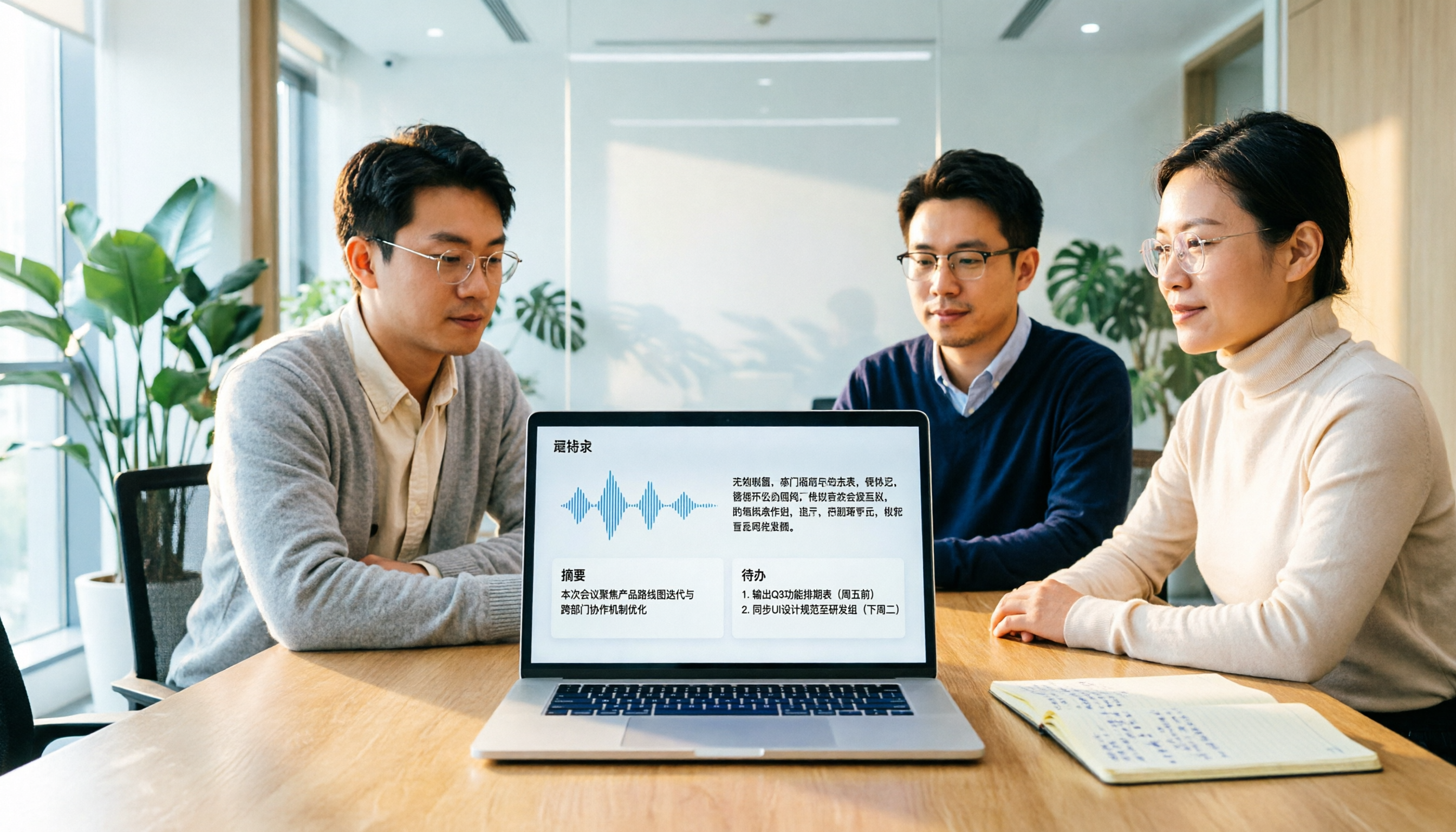
The second highlight is the post-transcription workflow. It automatically generates summaries, chapters, and action items, and can also do AI Q&A around the meeting content—questions like "What concerns did the client mention last week?" can be asked directly without re-listening to a two-hour recording. It also supports generating reports, tables, and documents, and exporting to tools like Notion, Google Docs, OneNote, and Dropbox.
The third highlight is multilingual support and real-time translation. It can handle Chinese, mixed Chinese-English, and multilingual meetings, and during recording you can switch between original text, translation, or bilingual view. The team version also lets you add frequently used terms to a hotword list, reducing the chance of mishearing technical terms.
The fourth highlight is team knowledge retention. The team version provides an independent space where data belongs to the team; when a member leaves or loses a seat, resources can be handed over and won't disappear with the individual account. It also includes member and seat management, usage analytics, audit logs, and an audio recycle bin.
Plans and pricing: The personal version has a free plan, weekly pass, Pro monthly, and Pro annual, choose based on usage frequency. The team version offers a 7-day trial for first-time eligible users, 1 free seat, and 300 minutes of shared import quota; monthly payment is USD 29.80 per paid seat per month, annual payment is USD 199 per paid seat per year (about USD 16.58 per month), each paid seat gets 2,000 minutes of shared import quota per month, and real-time recording under an active seat is currently not deducted by minutes.
Who it's for: People who need Chinese meeting notes, don't want a bot joining meetings, and want post-meeting data to stay with the team for continued use.
Option 2 | Otter.ai – The veteran choice for English meeting notes
In a nutshell: A veteran AI meeting notes tool, with English transcription as its signature strength.
Its strengths are in English business meetings, speaker identification, AI Chat, and workflow integrations, and its maturity is indeed high. Note that Chinese support is relatively limited; if 90% of your meetings are in Chinese, the experience will be quite different from English scenarios.
Pricing: Basic is free, 300 minutes per month; Pro annual is about USD 8.49 per user per month, including 1,200 minutes of in-app recording per month and 10 file imports; Business offers unlimited meetings and in-app recording plus more management capabilities, actual pricing subject to the official page.
Who it's for: People who frequently have English meetings and interviews, and whose teams are already used to an English interface.
Option 3 | Notta – Multilingual transcription and translation
A multilingual transcription tool positioned similarly to Tinrec, covering multi-platform use, meeting notes, file import, and translation.
It supports a wide range of languages, and the subtitle and translation workflow is smooth. The free version offers 120 minutes per month with a 3-minute limit per item, suitable for trying it out; Pro annual is about USD 8.17 per month, 1,800 minutes per month; Business annual is about USD 16.67 per seat per month, including unlimited transcription, role permissions, and usage reports.
Who it's for: People who mainly need file transcription and translation, with less need for real-time meeting notes.
Stop organizing recordings by hand
Upload audio or video and automatically get a transcript, summary, and action items
Option 4 | TurboScribe – Long files and batch transcription
If you have a pile of interview audio files rather than one meeting after another, this option is worth a look.
It focuses on long files, batch uploads, subtitles, and translation. The free version allows 3 files per day with a 30-minute limit per file; Unlimited annual is USD 120 (about USD 10 per month), paid version supports files up to 10 hours or 5 GB, and up to 50 files at once.
Who it's for: Researchers, podcast producers, and anyone who needs to process a large number of long audio files at once.
Option 5 | Cambridge Dictionary Online – The most complete for looking up the Chinese meaning of otter (free)
Back to the most basic need: if you just want to know what otter means, an online dictionary is faster than any tool.
The three most common pitfalls here: ignoring part of speech (otter is a countable noun, plural can be otters), only memorizing the Chinese translation without looking at example sentences, and confusing sea otter with the general otter. Cambridge Dictionary has complete example sentences and pronunciation data, and also offers a Traditional Chinese interface, friendly to Taiwanese readers.
Who it's for: People looking up words, checking example sentences, and confirming usage. Free.
Option 6 | Kingstone, Books.com.tw – Channels for finding Otter-related Chinese books
Honestly, Chinese books specifically about Otter are not common. Most people look for books on topics like "meeting notes," "AI tool applications," and "English learning" in Chinese bookstores.
Kingstone's recommended books section organizes selections and book fair information by topic; Books.com.tw's foreign language section can find original English books, but note that foreign books are mostly special orders, usually taking 14–20 business days, and overseas special imports can take 1–2 months, so it's recommended to order separately from other items. For bulk corporate purchases, both have corporate procurement channels to inquire about.
Who it's for: People who want to build background knowledge through reading, or need to buy original English books.
With so many options, how should you choose?
• Want the most complete Chinese meeting workflow (transcription + summary + action items + AI Q&A) → Tinrec
• Don't want a meeting bot joining online meetings → Tinrec desktop version
• Need Chinese, mixed Chinese-English, and real-time translation → Tinrec
• Team needs to share meeting data, manage seats and usage → Tinrec team version
• 90% of meetings are in English, and the team is used to an English interface → Otter.ai
• Mainly handle file transcription and subtitle translation → Notta
• Need to process many long audio files at once → TurboScribe
• Just looking up the Chinese meaning of otter → Cambridge Dictionary Online (free)
• Want to read books first to build concepts, or buy original English books → Kingstone, Books.com.tw
4 things to know before using these tools
Chinese transcription does not have a fixed accuracy rate. Recording quality, noise, accents, multiple people speaking at once, and technical terms all affect results. For important content, it's recommended to cross-check with the transcript timestamps and recording playback.
"Supports Chinese" and "works well in Chinese" are two different things. When choosing a tool, directly test it with a real Chinese meeting recording—that's more accurate than looking at spec sheets.
Free quotas are usually enough for trying out, not for work. First check the monthly minutes and per-item limits, then decide whether to upgrade.
Confirm consent and regulations before recording. Obtaining consent from participants in accordance with local regulations and company policies is a basic step when using recording tools.
Conclusion
Otter is a classic choice for English meeting notes, but if your meetings are mainly in Chinese, "Chinese support" is the dimension you should really compare.
Considering Chinese meetings, bot-free recording, and post-meeting team knowledge retention, Tinrec currently connects the workflow more completely. You can start with the free version for a real meeting, then decide whether to upgrade.
FAQ
Q1: Does Otter support Chinese?
A: Otter.ai's main strength is English meeting transcription, and Chinese support is relatively limited. If your meetings are mainly in Chinese, it's recommended to test with a real Chinese recording, or consider a tool focused on the Chinese experience.
Q2: Is the free version enough?
A: For occasionally organizing a recording, the free version is usually enough. But if you have meetings every week, the free quota will run out quickly, and then a weekly or monthly pass is more cost-effective. Tinrec offers a free version, weekly pass, Pro monthly, and Pro annual.
Q3: Does Tinrec require a bot to join meetings?
A: No. The desktop version directly captures computer system audio for online meetings on Zoom, Google Meet, Microsoft Teams, Webex, etc.; but the user must actively start recording—it does not automatically join all calendar meetings.
Q4: What's the difference between "roles" and "seats" in the team version?
A: Roles determine who can manage the team, members, and audits; seats determine whether a member can record, upload, edit, import, and export. Active members without a seat can still view, play, and read team data, but cannot perform resource usage operations.
Q5: If a team member leaves, will meeting data be taken away?
A: No. Team resources belong to the team. When a member exits, is removed, or loses a seat, the resources they are responsible for need to be handed over to other active members.
Q6: Can 100% accuracy be guaranteed?
A: It's not recommended to expect that. Tools can greatly reduce the time spent on manual note-taking and organizing, but important decisions and numbers should still be verified against the transcript and recording.
References
Turn every recording into actionable outcomes
Get 60 free transcription minutes when you sign in. No credit card required.
Related Reading
You might also like
Otter Chinese in 2026: Which Solution Works Best? A Side-by-Side Comparison of 3 Options and Why Tinrec Is Better for Chinese Meetings
When people search for 'Otter Chinese,' there are actually two different needs: looking up the English word, or finding a Chinese alternative to Otter.ai. This article first clarifies how to look up 'otter' (the animal) most comprehensively, then compares Tinrec and Otter.ai across five dimensions: Chinese recognition, meeting capture methods, post-meeting output, team data ownership, and quota pricing, to help you choose the right tool for Chinese meeting notes.

2026 Comparison of 2 Chinese Meeting Transcription Tools: Why Tinrec Is Better Suited for Chinese Than Otter.ai
Otter.ai is mature for English meeting transcription, but Chinese transcription has always been a pain point. This article uses the perspective of a team lead in Taiwan to compare Otter.ai and Tinrec in Chinese transcription, bot-free recording, post-meeting organization, and team collaboration, helping you decide which is better for Chinese meetings.

Otter in Chinese: What It Means and Whether Otter.ai Supports Chinese Meetings (2026 Guide)
What does 'otter' mean in Chinese? There are two layers: the literal translation of the English word 'otter' and whether Otter.ai, an AI meeting tool, can handle Chinese. This article clarifies the literal meaning and official language support, then explains why 'supports Chinese' doesn't mean it understands your Chinese meetings. Using Tinrec as an example, it breaks down the complete workflow from recording and transcription to summaries, action items, and team knowledge retention.

Tinrec vs Otter.ai 2026: 5-Dimension Comparison for Chinese Meeting Scenarios
People searching for 'which otter Chinese is good' are either looking for the Chinese translation of the word 'otter' or asking about Otter.ai's Chinese capabilities. This article separates these two intents, then compares Tinrec and Otter.ai across five dimensions: Chinese and mixed Chinese-English transcription, online meeting capture methods, post-meeting outputs, team governance, and pricing/quotas. It concludes with clear recommendations based on usage scenarios.

2024 Comparison of 3 Otter Chinese Alternatives: Which Saves More Time for Chinese Meeting Notes?
If you're searching for Otter Chinese, what you really need to determine is whether Otter.ai is sufficient for Chinese meetings. This article compares Tinrec, Otter.ai, and Notta from four perspectives: Chinese transcription, bot-free recording, post-meeting organization, and team collaboration, to help you choose the right tool for Chinese meeting notes.

Otter Chinese Alternatives in 2026: 3 Tools Tested, Tinrec Best for Chinese Meetings
Otter.ai has limited Chinese support. This article addresses two search intents behind 'which Otter Chinese is best' and compares Tinrec, Notta, and TurboScribe in Chinese meeting transcription, post-meeting organization, and team collaboration to help you choose the right tool.

4 Chinese Subtitle Tools Worth Trying in 2026: Alternatives for Otter Users
Otter officially supports only English, Spanish, and French—no Chinese interface and no Chinese subtitles. Based on real-world use, this article explains Otter's Chinese limitations and compares Tinrec, Otter, Notta, and TurboScribe on Chinese transcripts, mixed Chinese-English speech, post-meeting organization, and team collaboration to help you choose a truly usable Chinese subtitle solution.

Tinrec vs Otter.ai 2026: 5-Dimension Comparison for Chinese Meeting Notes
Can Otter.ai handle Chinese? This article compares Tinrec and Otter.ai across 5 practical dimensions: Chinese and Traditional Chinese recognition, online meeting recording methods, post-meeting outputs, team collaboration governance, and pricing quotas, helping teams decide which is better suited for their meeting scenarios.

Otter.ai Chinese Free Trial Guide 2026: 6 AI Meeting Tools Tested and Recommended
Can Otter.ai really handle Chinese, and what are the free trial limitations? Based on real meeting scenarios for mid-level managers, this article breaks down Otter's Simplified Chinese support status, the Basic free 300 minutes and 3 lifetime import credits, and compares the Chinese performance, pricing, and use cases of 6 tools including Tinrec, Notta, TurboScribe, Granola, and PLAUD—so you can test with a real meeting before paying for a subscription.