

Turn recordings into transcripts and summaries in minutes
Upload audio or video for multilingual transcription, AI notes, and action items
3 Google Meet Call Recording Tools Compared for 2026: From Audio to Transcripts
"The meeting ended. Now what?"
It's 3 PM on a Wednesday, and you just closed a 40-minute Google Meet call. The moment you close the window, the three conclusions you reached, the two action items, and the budget cap the client casually mentioned—all that's left is a vague impression in your head.
You open your notebook to jot down a few lines, only to realize you only remember "something about the budget."
This isn't a memory problem; it's a tool problem. Google Meet does a great job of getting people connected for meetings, but when it comes to post-call organization, it basically hands the work right back to you.
This article starts from that pain point, laying out three common ways to document Google Meet calls and comparing them to see which one actually saves you time.
What Is Google Meet? A One-Minute Primer
Google Meet is Google's video calling and online meeting service, part of the Google Workspace ecosystem.
It has a low barrier to entry: on a computer, you can join from any modern browser without installing software; on a phone or tablet, you can use the Google Meet app; if your internet is unstable, you can dial in using the phone number in the meeting invite for audio-only participation.
The free version has some basic limits: group calls max out at 60 minutes and 100 participants; one-on-one and mobile calls have no time limit. Live captions, noise cancellation, in-call chat, screen sharing, and other features are fully available only with certain Google Workspace or other paid plans.
Simply put, Google Meet solves the "meeting" itself. The real struggle for most office workers happens after the meeting ends.
Three Ways to Document Calls After They End: What's the Difference?
First: Type while you listen. It's the most intuitive, and the most distracting. You look down to take notes during the call, and when you look up, the other person has moved on to the next slide. And handwriting can never keep up with speech—the sentences you miss are often the key points.
Second: Use the platform's built-in transcription. Some Google Workspace plans offer meeting transcription and smart notes, but it depends on the plan level—free versions usually don't get it. And the recorded content mostly stays within the platform; turning it into the format you want still takes extra work.
Third: Use a desktop tool to capture audio in sync and generate transcripts while you meet. This is the approach Tinrec takes. It doesn't join the meeting or disturb anyone; instead, it converts call audio from your computer into text and simultaneously generates summaries and action items.
All three methods "leave a record," but the real difference is whether that record can be used directly. Below, using Tinrec as an example, we'll explain what the third approach can actually achieve.
Turning Google Meet Calls into Usable Data: What Can It Do for You?
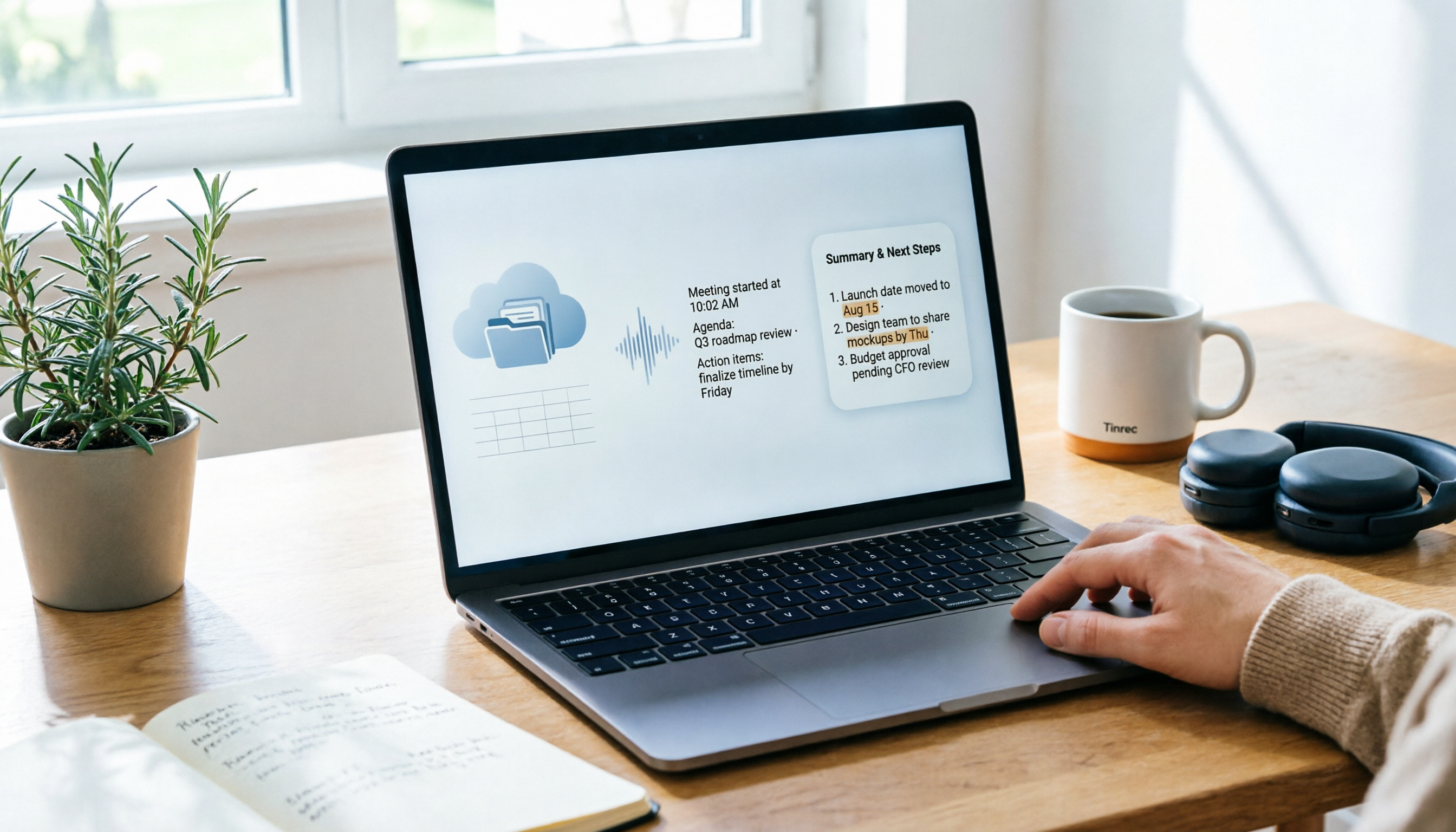
Scenario 1: The call ends, and the transcript is already ready Tinrec's desktop version captures your computer's system audio and converts it to text in real time during the call. You don't have to type distractedly during the meeting, and you don't have to re-listen to a 40-minute audio file afterward. The moment the meeting ends, the transcript is already there in full.
Scenario 2: Don't read from the beginning—check the summary and action items first Transcripts are long, but you don't necessarily need to read every word. Tinrec automatically generates summaries, chapters, and key points, and organizes action items that emerge during discussion into a to-do list—who's responsible for what and when it's due, clearly separated.
Scenario 3: Two weeks later, you can't remember what the client said This is the real pain point for many. During the meeting, you think you'll remember, but two weeks later when you're writing a proposal, you realize you've forgotten all the details. Tinrec's AI Q&A lets you ask questions directly about the meeting content: "What was the budget cap the client mentioned?" "Which feature were they concerned about?" No need to re-listen or search randomly with keywords.
Scenario 4: Your team shouldn't rely on just you to remember that meeting If you work as a team, Tinrec's team version stores meeting data centrally in a team space. New members can look back at past meetings, and when members leave, the data doesn't go with them.
What Are Tinrec's Core Capabilities?
Bot-free recording of online meetings Most meeting recording tools send a "meeting bot" to join as a participant. Tinrec's desktop version doesn't need to do that—it directly captures the system audio playing on your computer. It works for calls on Zoom, Google Meet, Microsoft Teams, Webex, and similar platforms in browsers or desktop apps. No stranger suddenly appears in the meeting, and you don't have to explain it to the host.
Real-time transcription and live translation Live transcription is a basic feature. For cross-language meetings, you can switch between original text, translation, or bilingual view during recording, so you don't discover afterward that you missed an entire section.
AI summaries, chapters, and action items Tinrec doesn't just compress the transcript into a paragraph; it structures the information: meeting topics, conclusions, and action items are listed separately. Long meetings are automatically divided into chapters, so you can jump around instead of reading from minute one.
Stop organizing recordings by hand
Upload audio or video and automatically get a transcript, summary, and action items
AI Q&A After transcription, you can ask questions directly about the meeting content, and it will answer based on semantic understanding. You can ask about a single meeting or across multiple past meetings—especially useful for finding old decisions.
Multi-format export and Agent post-processing Organized content can be exported to Notion, Google Docs, OneNote, Dropbox, and other tools for further processing, or you can use the Agent to generate meeting minutes, reports, or tables—ready to deliver.
Team spaces and governance The team version offers independent spaces, member invitation links, role distinctions (Owner/Admin/Member), and seat management, plus usage analytics, audit logs, audio recycle bin, and team hotwords.
Four Practical Use Cases
Client needs interviews The biggest fear during interviews is having to listen and take notes at the same time, with your eyes constantly drifting down. Use Tinrec's desktop version to record the entire call, and you can focus on looking at the other person. Afterward, pull requirements, objections, and commitments directly from the summary, then export as an interview record to share with your team.
Weekly stand-ups and project meetings The point of weekly meetings is often not the discussion itself, but "who promised what last week." Tinrec's action item extraction pulls out action items scattered throughout the conversation, so decisions and owners no longer rely on each participant's memory.
Cross-language meetings When meeting with overseas teams or clients, real-time translation plus bilingual view means you don't have to wait for a translated transcript. Afterward, you can also use the bilingual transcript to confirm you didn't misunderstand anything.
Courses, lectures, and internal training Online course content is often denser than meetings. Use Tinrec to import existing audio files or record directly, then use AI Q&A to review specific sections—much faster than replaying the entire video.
6 Things to Consider When Choosing a Google Meet Call Documentation Method
1. Will it disrupt the meeting itself? Some tools must join as a bot, which seems unnecessary for external client meetings. Tinrec uses desktop system audio capture, so no extra participants appear in the meeting.
2. Is the recording kept? This is often overlooked. Some tools only provide transcripts and don't keep audio files, so you can't check the tone or context of a specific sentence afterward. Tinrec keeps the recording, and the transcript can be linked back to timestamps.
3. What can you do after transcription? A tool that only gives you a transcript is essentially handing the organization work right back to you. Tinrec's value is in the second half: summaries, chapters, action items, Q&A, export, and document generation.
4. Actual performance with Chinese and multilingual meetings Mixing Chinese and English is very common in meetings in Taiwan. Tinrec covers Chinese and multilingual scenarios and provides team hotwords for maintaining technical terms. Note that actual performance is affected by recording quality, background noise, accents, and overlapping speakers; for important content, it's best to cross-check against the original text.
5. Team collaboration and permission design If you need team sharing, look carefully at the difference between roles and seats. In Tinrec's team version, roles determine who can manage members and view audits; seats determine whether a member can record, upload, edit, and export; members without seats can still view, play, and read team data.
6. Is pricing and quota transparent? Tinrec's free version offers a basic quota to try recording, importing, summaries, and transcription. The team version is USD 29.80 per paid seat per month, or USD 199 per paid seat per year (about USD 16.58 per month), with each paid seat providing 2,000 minutes of shared team import quota per month; eligible teams can try 7 days free with 1 free seat and 300 minutes of shared import quota. Actual prices and billing amounts are subject to the official purchase page.
Frequently Asked Questions
What is Google Meet? How is it different from other video conferencing software? Google Meet is Google's video calling service. The biggest difference is that you don't need to install software—you can join from a browser on a computer, use the app on a phone, or dial in by phone. The free version limits group calls to 60 minutes and 100 participants.
Does the free version of Google Meet have meeting transcription? Usually not, or only for specific plans. Advanced features like transcription, smart notes, and noise cancellation are mostly tied to Google Workspace or other paid plans. If you only need it occasionally, an external tool like Tinrec is simpler.
Do I need to add a bot to the Google Meet call when using Tinrec? No. Tinrec's desktop version directly captures your computer's system audio, so no extra participants appear in the meeting. Note, however, that this is not an "auto-join all calendar meetings" mode—you need to actively open Tinrec to start recording.
Does Tinrec support Chinese? How accurate is it? It supports Chinese and multilingual meetings, and offers real-time translation and bilingual view. As for accuracy, it is affected by recording quality, noise, accents, multiple people speaking at once, and technical terms. It's recommended to use it in a quiet environment with a good microphone, and cross-check important content against the recording.
Is the free version enough? If you only need to organize an occasional call, the free version's basic quota is enough to try recording, importing, summaries, and transcription. If you have regular weekly meetings, upgrading is more cost-effective.
What's the difference between the team version and the personal version? In the personal version, data belongs to your personal account; the team version is an independent team space with member invitations, role and seat management, shared import quota, usage analytics, audit logs, and an audio recycle bin. Team data belongs to the team, and when a member leaves, it is transferred to other active members—it won't be taken away.
Conclusion
Google Meet makes "having a meeting" almost effortless, but the gap after the meeting ends has always been up to users to fill.
If you have more than three meetings a week, the cost of manually documenting them is significant. Take Tinrec as an example: the desktop version records calls without disturbing anyone, and afterward gives you transcripts, summaries, and action items, with the ability to ask follow-up questions and export—that's the complete workflow for turning calls into usable data.
If you're not sure if it's right for you, start with the free version and test it with a real meeting—that will be clearer than reading ten introductory articles.
References
- Google Meet: Online Web and Video Conferencing Calls | Google Workspace
- Make Meet calls with Google Meet - Android phone & tablet - Google Meet Help
- Google Meet: A guide to Google's video-conferencing service, how to join calls, record, and blur backgrounds
- Google Meet: Online Video Meetings and Calls | Google Workspace
- Make Meet calls with Google Meet - Computer - Google Meet Help
Turn every recording into actionable outcomes
Get 60 free transcription minutes when you sign in. No credit card required.
Related Reading
You might also like

Where to Find Google Meet on Android in 2026: 5-Step Guide
Can't find Google Meet on your Android phone? This guide walks you through 5 steps to locate Google Meet, join meetings quickly from Gmail and Calendar, and after the meeting use Tinrec to turn speech into transcripts, summaries, and action items.

Google Meet Chat Location in 2026: 3 Steps to Find It on Desktop and Mobile
Can't find the Google Meet chat during a meeting? This practical guide walks you through the chat locations on desktop, mobile, and after the meeting, plus fixes for when the icon disappears and how to keep the discussion for later.

Google Meet Link Guide 2026: Find Your Link and Auto-Organize Meeting Notes
Can't find a Google Meet link? It's usually not missing—you're just looking in the wrong place. This guide shows you how to quickly locate meeting links from three entry points: Calendar, Gmail, and meet.google.com. It also explains how, once you've found the link, you can use Tinrec to automatically turn meeting content into transcripts, summaries, and action items.

Google Meet Recording Guide 2026: Where to Find Recordings, Why They're Missing, and How to Organize Meeting Notes
Can't find your Google Meet recording after a meeting? This guide explains where recordings are saved by default and why you might not find them, then shows how Tinrec can turn meeting audio into transcripts, summaries, and action items—no more digging through Drive.
Where Are Google Meet Recordings Stored in 2026? 5-Step Guide
Can't find your Google Meet recording after the meeting? The problem usually isn't whether you recorded it—it's that you're looking in the wrong place. This 5-step guide explains whose cloud the recording is saved to, how to quickly retrieve it from Drive and Calendar, how to download a backup, and finally how to turn the recording into a searchable transcript and meeting notes.

What Is Google Meet in 2026: Core Features Explained + How to Organize Meeting Notes
Google Meet is Google's video conferencing service, formerly Hangouts Meet, merged with Duo in 2022. This article explains from a mid-level manager's practical perspective what Google Meet is, who uses it, free vs. paid differences, privacy rules, and demonstrates how to use Tinrec to turn Meet meeting content into transcripts, summaries, and action items, so you don't have to rely on memory after the meeting.

Google Meet vs Tinrec in 2026: 5-Dimension Comparison — Which Is More Cost-Effective for Meetings?
Google Meet pricing actually has three answers: free at $0, Workspace paid plans starting around US$6.30 to US$7, and the hidden cost of upgrading to Standard for recording and AI notes. This article walks you through 5 steps to convert monthly fees into annual per-person expenses, using the Tinrec team plan as a second reference point to help you clearly explain why you chose a particular plan in meetings.

3 Google Meet Note-Taking Tools Tested for 2026: How to Record Online Classes and Group Discussions Most Efficiently
What is Google Meet used for? Starting from real student scenarios, this article first clarifies Google Meet's purpose and what it doesn't solve, then tests and compares 3 note-taking tools, summarizing key buying factors, pitfalls to avoid, and budget-friendly recommendations for students.

Google Meet vs Tinrec: 2 Meeting Note Methods Compared (2026)
Google Meet is Google's video conferencing service launched in 2017. You can hold meetings in a browser, and free accounts generally support 100 participants for 60 minutes. This article first explains what Google Meet is, then compares its built-in transcription with Tinrec across five dimensions: recording method, post-meeting output, input sources, team data management, and cost, to help you decide which meeting note method suits you better.