

Turn recordings into transcripts and summaries in minutes
Upload audio or video for multilingual transcription, AI notes, and action items
2026 Audio-to-Text Tools Compared: Which Free Tier and Post-Meeting Workflow Actually Saves You Time?
The Most Common Mistake: Treating "Audio-to-Text" as the Finish Line
Most people pick these tools intuitively: check how many free minutes you get, then the price, and finally choose the one with the most minutes.
That approach often backfires. Because you actually get a transcript—then what?
I have a fixed habit when testing these tools: deliberately run an imperfect recording through them. Online meetings, air conditioning noise, two or three people talking over each other, mixed Chinese and English. The results usually fall into two categories.
One is "text but unusable"—no punctuation, no paragraphs, everyone mixed together, and you still have to re-listen to the whole thing. The other is "ready to edit"—paragraphs, timestamps, and key points already highlighted.
The difference isn't transcription speed—it's who helps you finish the stretch after transcription.
So besides comparing free tiers, this article also looks at three things: whether the output is directly usable, whether there are post-meeting summaries and action items, and whether team data is easy to manage when shared. These are the real factors that determine whether you'll keep using a tool.
4 Key Points to Understand Before Choosing an Audio-to-Text Tool
First, the "math" of free tiers varies a lot. Some give you a few minutes per month, some limit single-session length, and some limit the number of files per day. The same "free" label can mean 3 minutes per month versus 120 minutes per month—completely different things. Look at what your files look like first, then check the limits.
Second, where does your audio come from? One type is "existing files"—MP3s recorded on your phone, MP4s downloaded from video conferences. The other is "meetings that haven't happened yet"—you want to transcribe while the meeting is ongoing. These are almost two different product categories, and many tools that advertise free transcription only handle the former.
Third, is there post-processing after transcription? A transcript alone just swaps "time spent listening and typing" for "time spent reading a long document." If there's automatic paragraphing, summarization, chapters, and action items, you actually save time. This difference is especially obvious in long meetings.
Fourth, where does the data ultimately live? Personal accounts are easy to use, but once two or more people are involved, problems arise: whose account holds the meeting notes? Can you still find the data after a colleague leaves? This is why I later started paying special attention to team spaces and seat design.
Tinrec (秒聽錄音)—The One I Kept Using After Testing
Tinrec is an AI meeting notes and collaboration tool for individuals and teams, available on iOS, Android, desktop, and web. It doesn't just convert audio to text—it turns meetings into searchable, summarizable, queryable, and exportable data.
During the meeting: no bot to invite.
This is what sets it apart from most AI meeting tools. Tinrec's desktop app captures your computer's system audio directly, so for online meetings on Zoom, Google Meet, Microsoft Teams, or Webex, you don't need an extra meeting bot to join as a participant.
My test conditions: a roughly 12-minute discussion with mixed Chinese and English, transcribed live using the desktop app. The transcript appeared on screen, and I could switch to translation or bilingual view when I needed to compare with the original. The practical feeling was—you don't have to remind yourself to "remember to hit record" before the meeting ends, because you already did at the start.
Note that this is "you actively open Tinrec and start recording," not automatically joining all meetings on your calendar. Think of it as a smarter recording console, not an assistant that joins meetings on its own.
After the meeting: this is where it pulls ahead.
After the meeting ends, Tinrec automatically generates summaries, chapters, and key points, and organizes action items from the discussion into to-dos. This is especially noticeable in meetings over 40 minutes, because you don't need to read from minute one.
Even better is AI Q&A. The entire meeting content becomes a queryable database—for example, you can ask "who mentioned the budget in the last meeting?" or "who is responsible for this requirement?" and it answers based on the meeting content, rather than dumping a list of keyword search results.
If you need to deliver documents, it can also use Agent post-processing to generate reports, tables, and meeting notes, or export to Notion, Google Docs, OneNote, or Dropbox for further editing. Simply put, it connects the most tedious part of the workflow from "listening and typing" to "delivering something."
Team use: data isn't locked in someone's account.
This is something I think is under-discussed but most important for companies. Tinrec's team plan is a separate team space, not multiple people sharing a personal account.
Teams have two concepts: "roles" and "seats." Roles determine who can manage members, audit, and team settings; seats determine whether members can record, upload, edit, and export. Members without a seat can still view, play, and read team data, but cannot upload, edit, or export.
Stop organizing recordings by hand
Upload audio or video and automatically get a transcript, summary, and action items
Meeting data belongs to the team. When a member leaves, is removed, or loses their seat, their resources can be transferred to other members—they don't disappear with the person. Admins can also see team usage trends, member rankings, import details, and audit logs; accidentally deleted audio can be recovered from the recycle bin (currently retained for 30 days).
Plans and limitations, stated honestly.
The personal plan includes Free, Weekly Pass, Pro Monthly, and Pro Annual. I don't recommend comparing prices first—choose by task: for occasional transcription, start with the free plan; for intensive interviews or courses in a short period, the weekly pass is better; for steady weekly meetings, go Pro; for long-term accumulation of recording data, the annual plan is more cost-effective. Actual limits and prices are subject to the official plan page.
For the team plan, the current details are: eligible teams can try free for 7 days with 1 free seat and 300 minutes of shared team import quota. Monthly is USD 29.80 per paid seat per month; annual is USD 199 per paid seat per year (about USD 16.58 per month), with each paid seat providing 2,000 minutes of shared team import quota per month. Real-time recording under an active team plan and active seat currently does not deduct minutes; file and web imports consume shared team quota.
Limitations to note: the team plan currently focuses on team-level sharing—all active members can read team data, and it's not fine-grained file-level permissions. If you need "different visibility for each document," you'll need to evaluate that separately. Also, transcription accuracy is affected by recording quality, accents, noise, and overlapping speech; for important content, it's best to replay and verify with timestamps.
Who is it for? People who frequently hold online meetings, need Chinese and mixed Chinese-English transcripts, want summaries and action items right after meetings, and whose teams need a shared meeting database.
Besides Tinrec, What Are the Alternatives?
Notta: a similarly positioned multilingual transcription tool. Supports multi-platform transcription, meeting notes, file import, and translation, and has a team plan. The official free plan offers 120 minutes per month with a 3-minute limit per session; Pro annual is about USD 8.17 per month (1,800 minutes per month), prices subject to the official page. The two overlap heavily; the difference is in the post-meeting part: Tinrec uses desktop bot-free recording for online meetings and connects summaries, action items, AI Q&A, and team spaces together. If your main need is cheap file transcription, Notta is sufficient.
Granola: bot-free AI meeting notes. Also uses desktop system audio and combines user handwritten notes to generate content, with a lightweight interface. But note that it doesn't support uploading existing audio files and doesn't save meeting audio. If you have a pile of MP3s and M4As waiting to be organized, it won't help. Tinrec also requires no bot, but supports file import, retains recordings, and can produce Chinese transcripts and bilingual comparison. Business is USD 14 per user per month (per official page).
TurboScribe: a cost-effective choice for file transcription. Long files and batch processing are its strengths; the paid plan supports up to 10 hours or 5 GB per file and up to 50 files at once, while the free plan allows 3 files per day (30 minutes per file). If you need to clear out dozens of historical recordings at once, it's more suitable. But real-time meetings, post-meeting summaries, action items, and team collaboration are not its focus—that's exactly where Tinrec stands.
Pitfall Guide: 4 Most Common Mistakes When Choosing an Audio-to-Text Tool
Pitfall 1: Only looking at free minutes. More minutes doesn't mean better. Some have hard limits on single-session length (3 minutes, 30 minutes), some limit files per day. First confirm how long your files are and how many you need to process at once, then compare limits.
Pitfall 2: Assuming a transcript equals meeting notes. A 60-minute transcript with no paragraphs or punctuation can take longer to read than to listen to. The real difference is in post-processing: summaries, chapters, action items, and whether you can query. This is why I recommend actually testing with a piece of your own recording—official demo audio is usually too clean.
Pitfall 3: Ignoring cross-device and handover. Recording on your phone today, organizing on your computer tomorrow—if the tool doesn't support cross-platform, it'll be painful. Even more troublesome is teams: data stored in personal accounts leaves when the person leaves. When choosing, ask "who ultimately owns this data"—that's more practical than anything.
Pitfall 4: Forgetting the legality of recording itself. Recording and transcription involve personal data, and local regulations may require consent from participants. No matter how convenient the tool is, this step can't be skipped.
Conclusion: Which One Should You Choose?
If you remember one thing: Don't choose a tool by "how many free minutes"—choose by "how much time you'll spend after the meeting."
The practical breakdown is roughly like this:
- Need transcripts for Chinese and mixed Chinese-English meetings → Tinrec (multilingual and real-time translation, bilingual comparison is handy)
- Don't want to invite meeting bots anymore → Tinrec (desktop captures system audio)
- Want to find key points via Q&A right after recording, need summaries and action items → Tinrec (AI Q&A and Agent post-processing)
- Team needs to share meeting data, with personnel changes → Tinrec team plan (spaces, roles, seats, usage, and audit)
- Just need to cheaply convert lots of old files to text → TurboScribe (stronger for long files and batches)
- Only need basic multilingual transcription, budget-first → Notta (lower entry price)
- Only use desktop meetings, don't need to keep audio → Granola (lightweight note-taking experience)
My recommendation: don't pay first. Run a piece of your own real recording through Tinrec's free plan—ideally a meeting with noise and people talking over each other—and see if the output is directly editable. If it is, that means the tool saves you not just listening and typing time, but also the most dreaded post-meeting organizing time.
References
- Online AI speech, video, and audio file auto-transcription - free trial - cSubtitle
- Audio to text | Free online audio file to transcript | Proactor AI
- Online speech-to-text AI, free MP3 or audio file to text transcript - MyEdit
- AI speech-to-text | Free and easy online speech-to-text tool
- MP3 to text - Automatically transcribe MP3 online - VEED.io
Turn every recording into actionable outcomes
Get 60 free transcription minutes when you sign in. No credit card required.
Related Reading
You might also like

3 WhatsApp Voice-to-Text Tools Tested: Which Handles Cantonese Best in 2026?
A practical comparison of three common ways to transcribe WhatsApp Cantonese voice messages, covering language support, privacy, post-meeting organization, and team collaboration to help you choose the right tool and workflow.

4 Free Recording Summary Tools for 2026: Free Tiers and Meeting Notes Comparison
How to choose a recording summary tool without getting burned? This article rounds up 4 recording summary tools with free trials in 2026, comparing free quotas, per-file limits, Chinese summaries, and post-meeting follow-up Q&A, and explains which scenarios each suits—meeting notes, class notes, and team collaboration—so you pick the right tool and work less overtime.

2026 Comparison of 4 Meeting Summary Generators: Which Free Tier Is Actually Enough?
A free version doesn't mean you can use it for free. This article compares the free offerings of Tinrec, Notta, Otter.ai, and TurboScribe—breaking down the three different ways limits are counted (minutes, files, and per-session caps), explaining what each can and can't do, and noting the date the data was verified—so you know which one is truly usable before you pay.
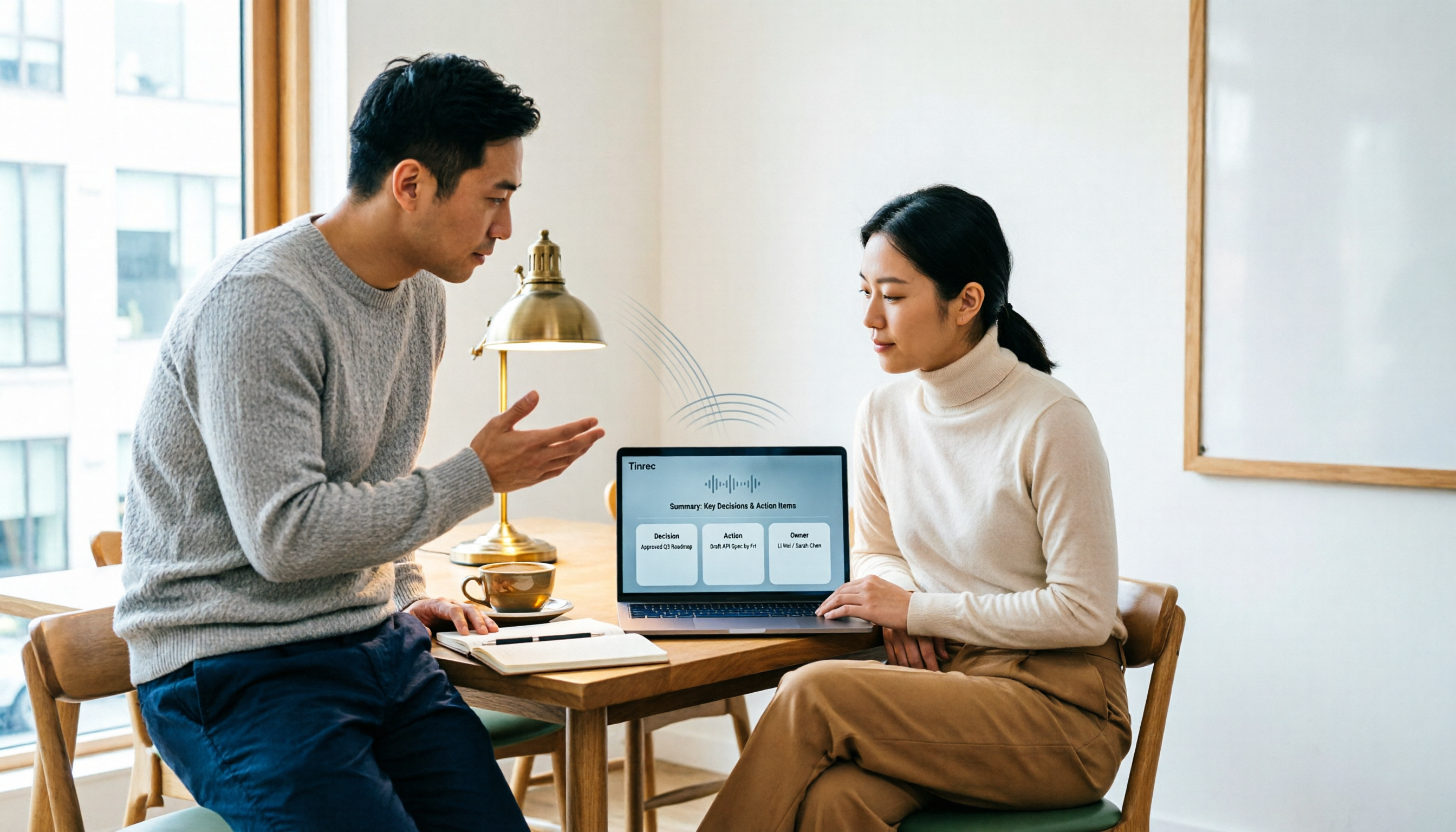
2026 AI Note Taker Comparison: 5 Tools Tested — Transcripts Aren't Meeting Notes, Which One Actually Saves You Time?
Most people think AI note takers just turn audio into text, but you still end up with a massive transcript to review yourself. This guide covers buying criteria, hands-on testing, and pitfalls, comparing Tinrec, Notta, Otter.ai, Granola, and more to help you find the one that truly saves you organizing time.

The Complete Guide to Cantonese Audio Transcription in 2026: From AI Transcripts to Team Collaboration
A roundup of key considerations for choosing a Cantonese speech-to-text AI in 2026, covering Cantonese recognition, mixed Chinese-English, spoken vs. written language, post-meeting summaries, action items, and team knowledge retention. Features hands-on testing with Tinrec as the primary example, compares use cases and limitations of Otter.ai, Notta, and PLAUD, and includes a pitfalls guide and selection advice.

4 Audio-to-Text Tools Tested and Compared in 2026: Which AI Meeting Notes Actually Save Time?
We tested 4 audio-to-text tools with the same mixed Chinese-English meeting recording, comparing meeting audio capture methods, whether audio files are retained, post-meeting summaries and AI Q&A, Chinese recognition experience, team quotas and permission governance, and compiled 4 common purchasing pitfalls to help you choose a solution that truly saves time within budget.
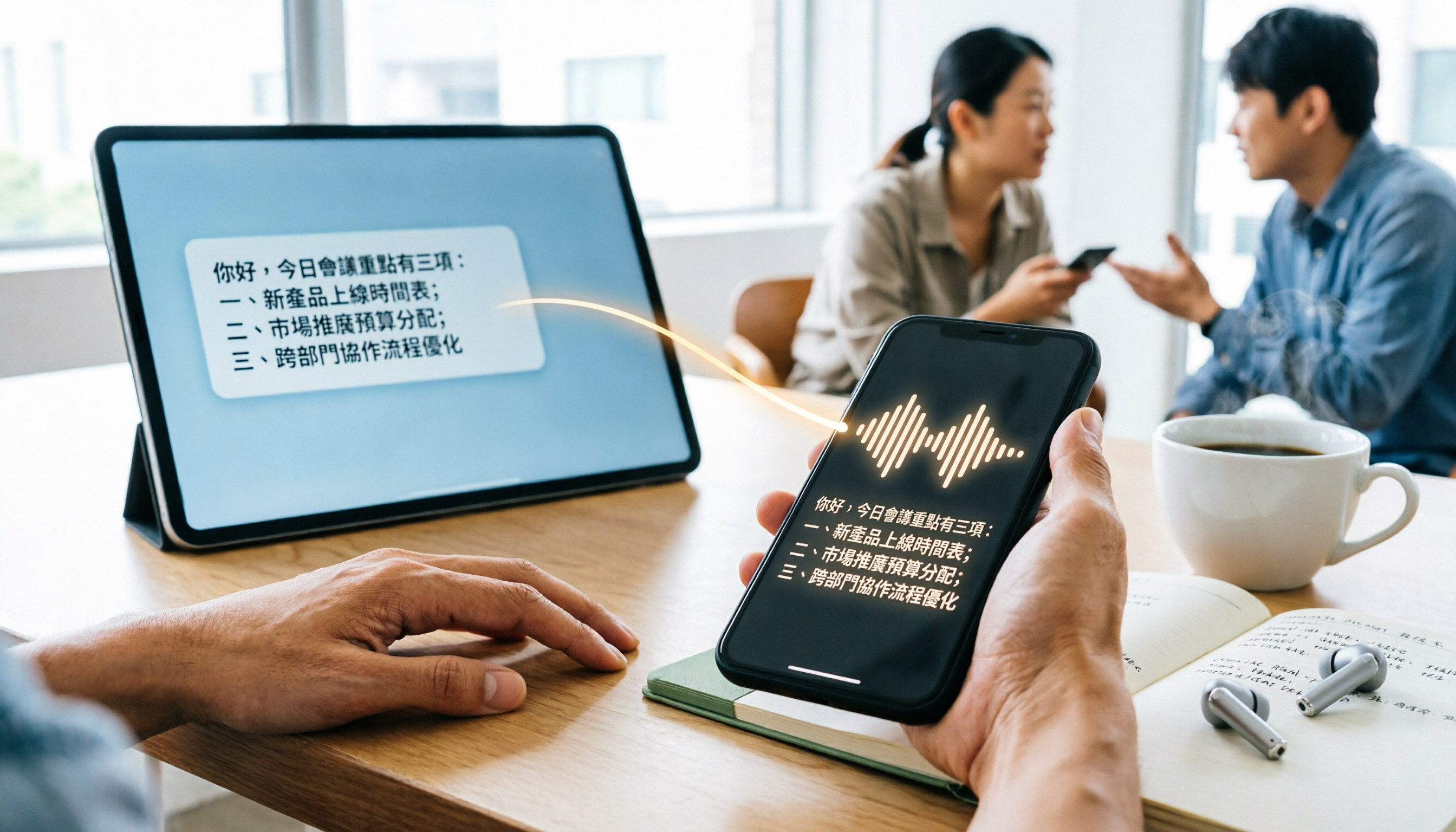
WhatsApp Cantonese Voice to Text in 2026: Official Transcription vs. iOS Shortcut vs. Tinrec
WhatsApp's official voice-to-text feature is rolling out gradually, but Cantonese support and language settings often confuse users. This article compares WhatsApp's official transcription, the iOS Shortcut cantonese.ai, and Tinrec, covering text capture, post-meeting organization, team collaboration, cross-platform support, and pricing to help you choose the right approach.

The Complete 2026 Guide to Transcribing Cantonese Audio on iPhone: From Built-in Dictation to AI Transcripts
Many people think speaking into the iPhone keyboard microphone is the same as recording-to-text, but meeting recordings still need to be replayed. This article covers three common methods for transcribing Cantonese audio on iPhone: iOS built-in Voice Memos, local Whisper tools, and the Tinrec post-meeting workflow. It also helps you choose the right tool with selection criteria, pitfalls to avoid, and scenario-based recommendations.
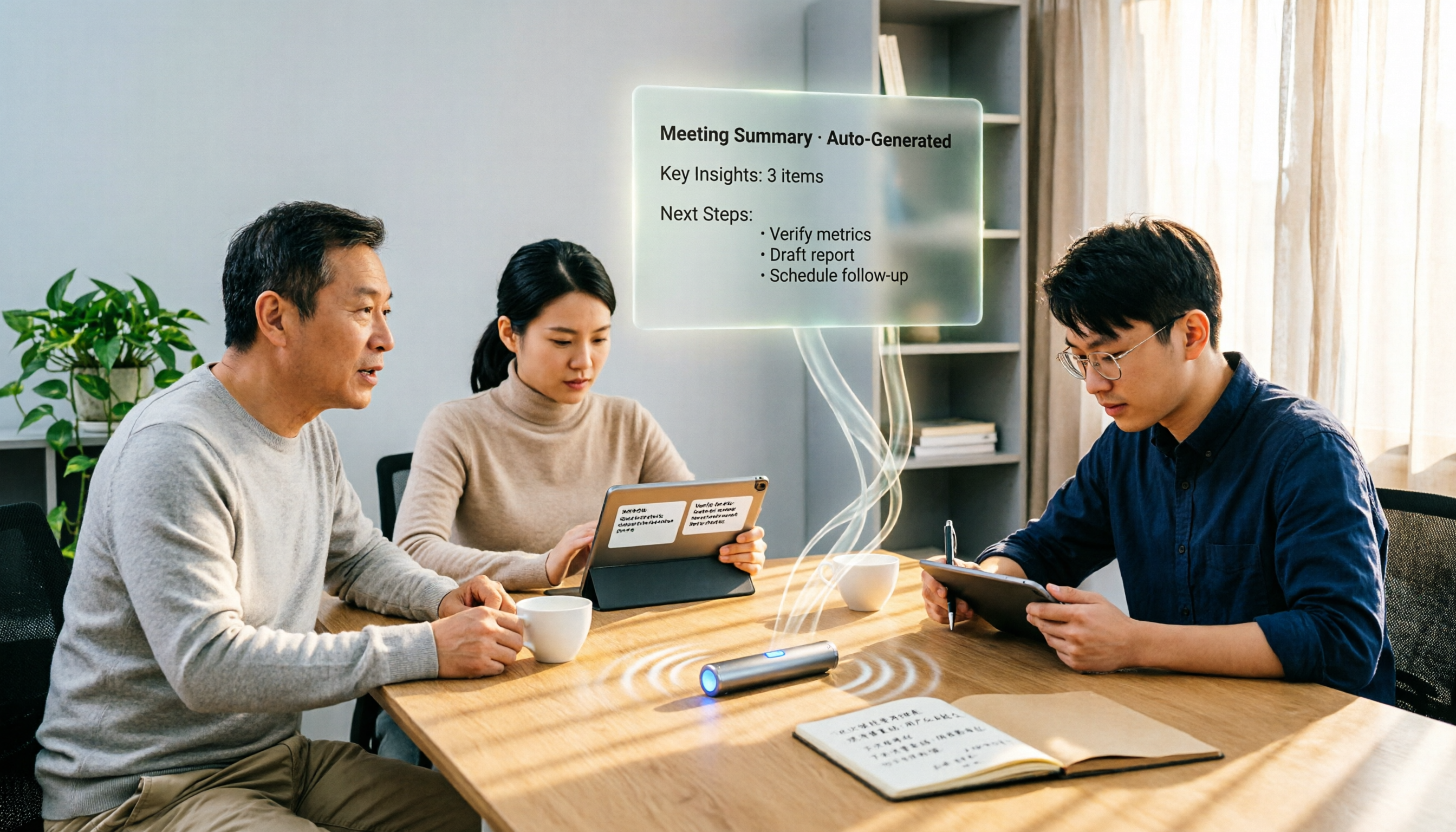
4 Free Cantonese Speech-to-Text Options in 2026: Free Tiers and Post-Meeting Cleanup Compared
Looking for free Cantonese speech-to-text but hitting limits like only 15 minutes free, paid exports, or manual post-meeting cleanup? This article rounds up 4 options in 2026, comparing free conditions, Cantonese recognition, and post-meeting summary/to-do capabilities, and explains when Tinrec's free and team plans fit. This is not a hands-on test; data verified as of August 18, 2026.