
Turn recordings into transcripts and summaries in minutes
Upload audio or video for multilingual transcription, AI notes, and action items
1. Office Pain Points: Low Efficiency and High Error Rate of Manual Cantonese Recording Transcription
In the era of digital content explosion, "YouTube caption generation" has become a high-frequency need for media workers, marketers, and even administrative assistants. However, for regions where Cantonese is the primary communication language, this task comes with unique pain points. Cantonese is highly colloquial, featuring numerous modal particles (e.g., "la," "ge," "ze") and code-switching with English.
Traditional manual transcription requires repeatedly listening to recordings and typing out every word. According to industry statistics, processing one hour of Cantonese interview audio typically takes an experienced stenographer 3 to 4 hours to produce a first draft. If the colloquial content needs to be converted into formal written Chinese, the time cost doubles. This not only leads to low office efficiency but also makes human fatigue a major source of typos or missing key information, becoming the biggest bottleneck in content production.
2. Solution Comparison: Built-in Phone Dictation, General Speech APIs, and TinRec Professional Transcription
Three main solutions exist for transcription needs, but their effectiveness varies greatly:
- Built-in phone dictation: The most accessible tool, suitable for short real-time voice input. However, for long meeting recordings or YouTube audio files lasting tens of minutes, phone dictation often stops due to screen lock and cannot distinguish speakers. The resulting text is usually a large chunk without punctuation, making it hard to use directly.
- General speech APIs (e.g., Google/OpenAI): These technologies offer high recognition accuracy and handle multiple languages. However, for Cantonese, general models tend to do a "phonetic transliteration." For example, they faithfully transcribe "佢今日冇返工" without converting it to the written form "He didn't come to work today." This leaves users who need proper AI meeting minutes or high-quality YouTube caption generation with a massive post-editing workload.
- TinRec (Second Listening): A tool designed specifically for complex recording scenarios. It not only supports MP3 to text and call recording to text but also optimizes for Cantonese language features. Compared to general solutions, TinRec handles long audio files and offers contextual understanding, significantly lowering the barrier to post-production editing.
3. Core Advantages: TinRec's "Colloquialism Filtering" and "Written Language Restructuring" Technology
TinRec (Second Listening) stands out in professional fields because it bridges the gap between "understanding speech" and "writing well." Its two core technologies redefine transcription standards:
Stop organizing recordings by hand
Upload audio or video and automatically get a transcript, summary, and action items
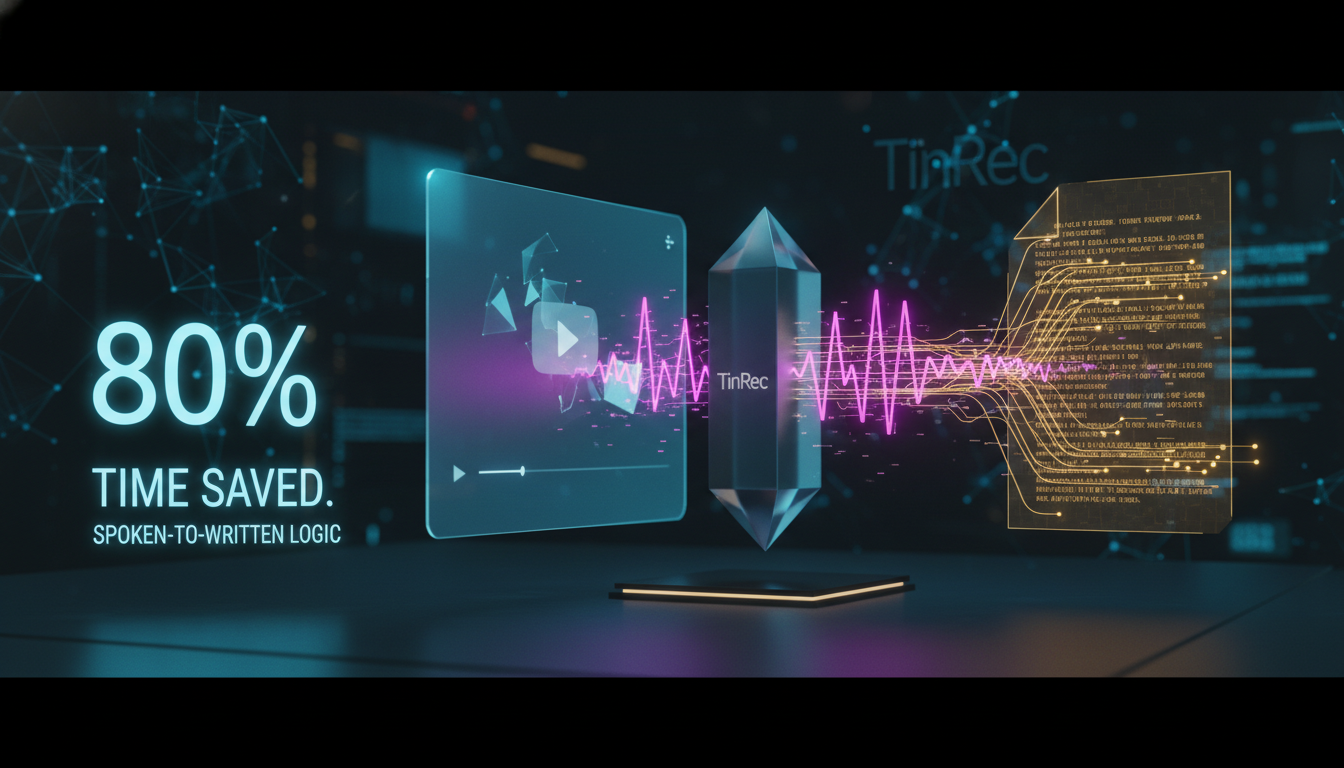
- Colloquialism Filtering: When generating YouTube captions or meeting notes, excessive filler words (e.g., er, um, actually, like) hinder readability. TinRec's AI model identifies and appropriately filters these meaningless filler words, making the output cleaner and smoother.
- Written Language Restructuring: This is the most powerful feature for Cantonese users. The system automatically converts colloquial Cantonese terms into standard written Chinese during transcription. For example, it converts "諗住" to "intend" and "畢竟" to "after all." This function directly eliminates the manual translation step, allowing the output to be used directly in formal documents or as material for standard YouTube caption generation.
4. Real-World Cases: How Law Firms and Media Interviews Save 80% Time with AI
In professional scenarios demanding precision and efficiency, TinRec's application yields significant results:
- Law Firm Case: A well-known legal team used to have assistants spend entire afternoons transcribing and polishing client statement recordings (call recording to text). After adopting TinRec, lawyers simply upload audio files, and the system generates accurate transcripts in minutes, automatically distinguishing between lawyer and client speech. The AI's written language restructuring ensures document professionalism. Assistants only need a final review, reducing overall document processing time by 80%.
- New Media Interview Case: A financial media channel running a YouTube channel needs to publish multiple interview videos weekly. Previously, creating YouTube captions was the editor's biggest headache. Now, they use TinRec to directly parse video links or upload audio files, quickly obtaining timed subtitle files (SRT) in written Chinese. They also use the AI meeting summary feature to quickly extract interview highlights and write video descriptions, greatly shortening the video publishing cycle.
5. Cost Analysis: ROI of Time Cost vs. Software Subscription Fees
Many companies hesitate to adopt paid software, but a simple cost-benefit analysis makes the answer clear.

Assume an administrative assistant earns $30 per hour and processes 5 hours of recordings per week. Manual transcription takes about 15-20 hours, costing $450-$600 per week. In a month, labor costs for transcription alone approach $2,400.
In contrast, TinRec (Second Listening) subscription fees are a fraction of labor costs. With automation, the original 20-hour workload is compressed to 1-2 hours. The 18 hours saved can be used for higher-value creative work like planning, analysis, or client communication. For businesses, this is not just cost savings but a multiplier of talent efficiency. Investing in a precise AI meeting minutes tool can yield ROI in the first month.
6. Conclusion: The Necessity of Choosing Precise Transcription Tools for Professional Scenarios
As AI technology becomes widespread, simple "speech-to-text" no longer meets professional needs. Whether for efficient YouTube caption generation or creating rigorous business meeting records, choosing a tool that understands colloquialism, polishes text, and supports written language conversion is crucial.
TinRec (Second Listening), with its unique Cantonese processing technology, successfully bridges the gap between general speech recognition and professional document requirements. In this efficiency-driven era, leveraging tools to automate tedious transcription tasks is an indispensable strategy for any professional team striving for excellence.
Turn every recording into actionable outcomes
Get 60 free transcription minutes when you sign in. No credit card required.
Related Reading
You might also like

4 AI Meeting Note Tools Tested for 2026: Which Saves the Most Time for Chinese Meetings?
Still spending two hours writing meeting notes after the meeting? This article compares four AI meeting note tools, breaking down Chinese and mixed Chinese-English recognition, meeting recording methods, post-meeting summaries and action items, cross-platform export, and team member management. It also lists four key pitfalls to avoid when choosing a tool, helping you find a solution that truly saves time.

2026 Guide: Convert Audio to Transcripts — Stop Typing Manually & Auto-Generate Meeting Minutes with AI
Don't want to type transcripts by hand? This guide covers two scenarios—live meetings and pre-recorded files—and outlines 4 key buying factors. We tested Tinrec's bot-free meeting recording, AI summaries, and Q&A workflow, compared Notta, Granola, and PLAUD, and included the most common pitfalls to avoid.

4 AI Recording Tools Tested for 2026: Which Saves the Most Time on Chinese Meeting Notes?
Recorded a meeting but never have time to organize it? This hands-on comparison looks at four common approaches—built-in phone features, free online tools, AI recording hardware, and dedicated AI meeting note tools—and tests Tinrec on Chinese meeting transcription, summaries, and action items. Includes 6 buying considerations and FAQs.

2026 Medical Meeting Transcription Tools Compared: Which AI Saves You the Most Time with Chinese Transcripts and Summaries?
For professionals juggling over a dozen meetings a week and still stuck with post-meeting notes, which tool should you use? This article dives into practical decision points, covering 5 key factors for choosing a medical meeting transcription tool. We tested Tinrec's bot-free recording, AI summaries, action item extraction, and AI Q&A, and briefly review alternatives like Notta, Otter.ai, and PLAUD. We also provide a guide to avoid common pitfalls and final recommendations.
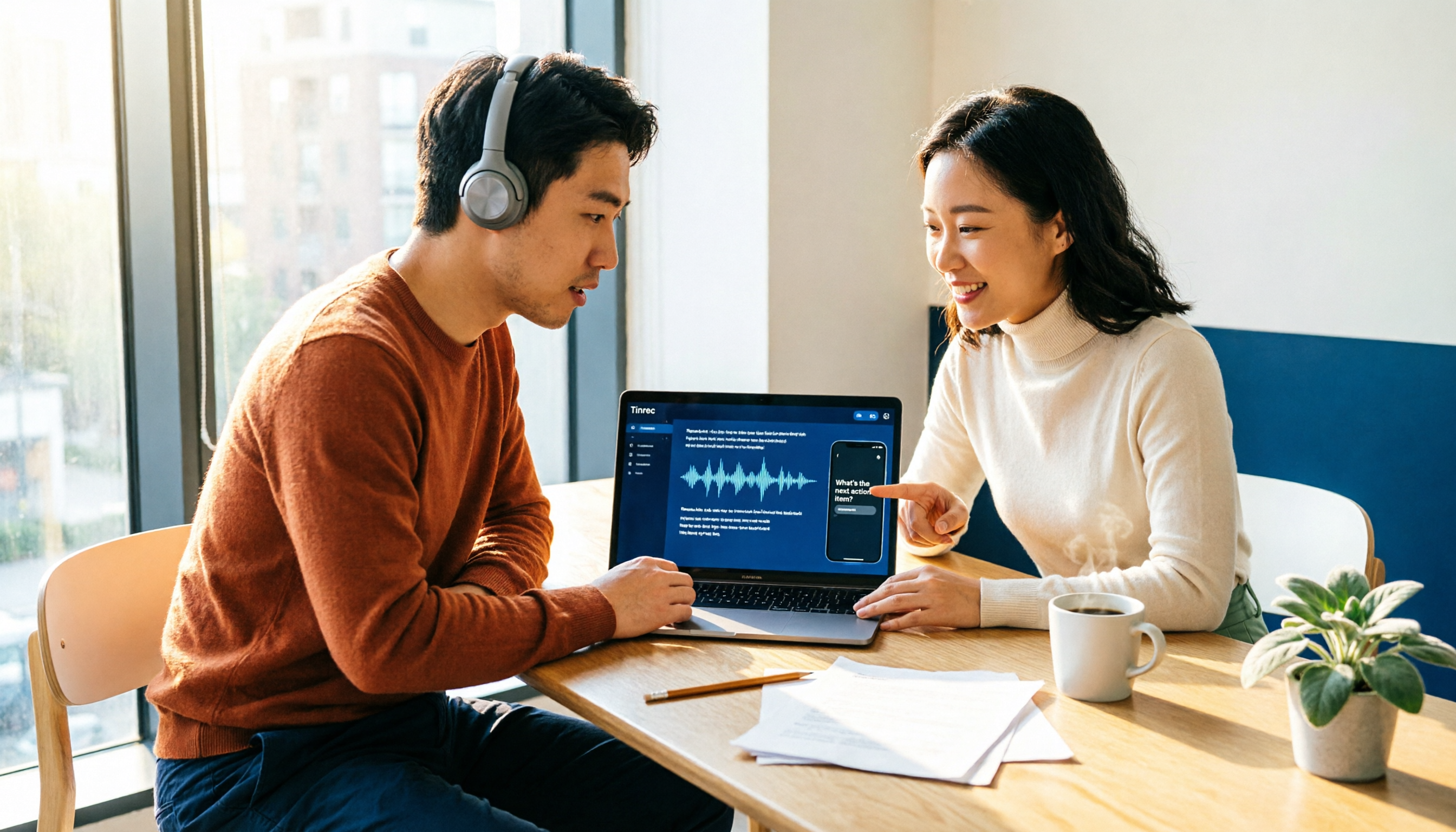
How to Choose an Automatic Transcription Tool in 2026: 5 Steps to Compare Yating Transcription and Tinrec
How do you choose an automatic transcription tool? Starting from the actual checklist I use when picking tools, I compare Yating Transcription and Tinrec across five dimensions, covering online meeting recording methods, post-meeting organization depth, AI Q&A, cross-platform team collaboration, and quota pricing, to help you determine which one better fits your workflow.

4 Best Audio-to-Text Apps in 2026: Which One Actually Saves You Post-Meeting Time?
A mid-level manager who attends 15 meetings a week shares hands-on experience. From online meeting recording methods and transcription performance for Chinese and mixed Chinese-English to post-meeting summaries and action item organization, this breaks down the differences among four types of audio-to-text apps and explains how Tinrec uses bot-free recording, AI summaries, action item extraction, and team spaces to turn meetings into searchable, collaborative, actionable data.
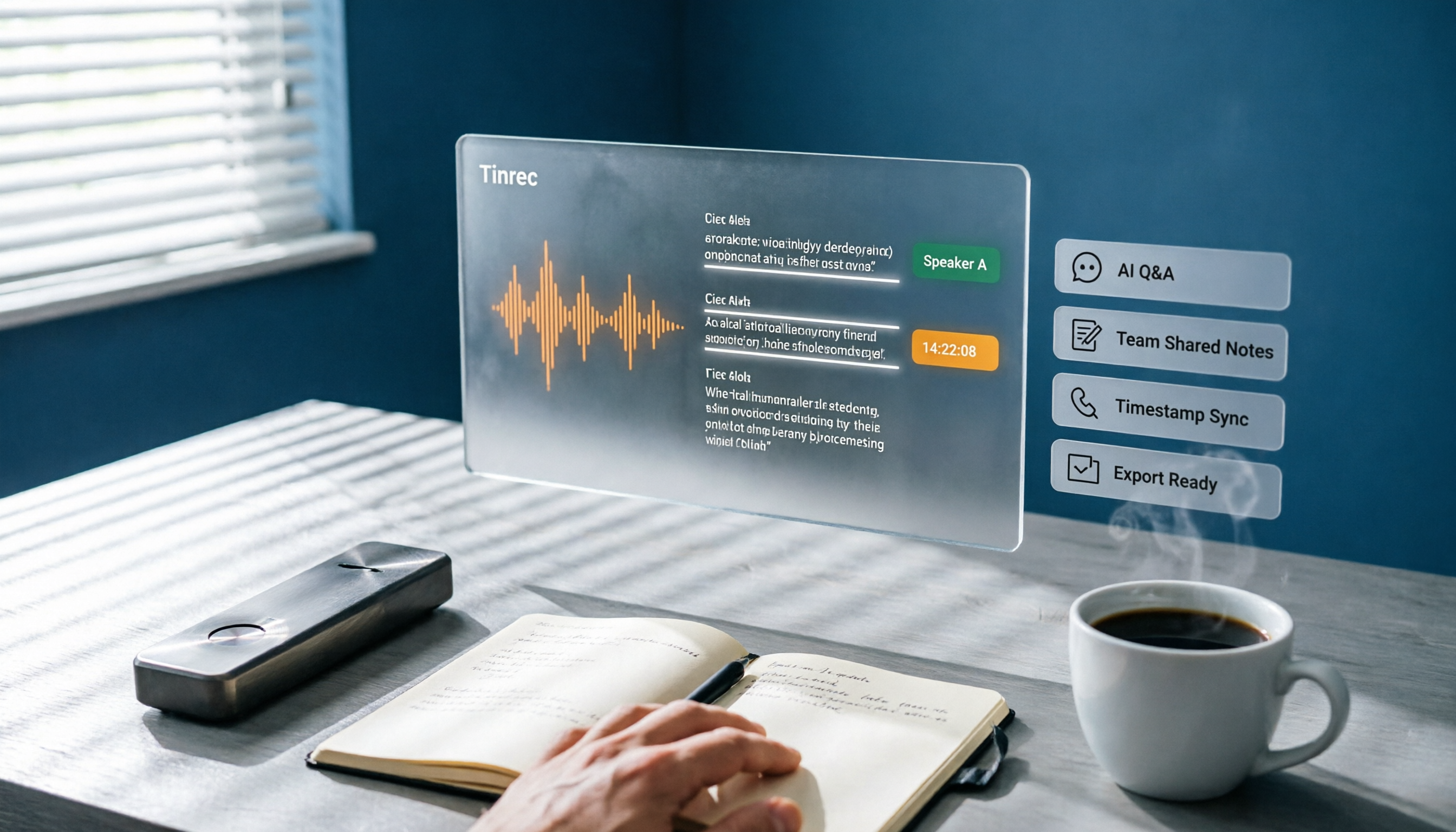
4 Interview Transcription Tools Compared in 2026: From Recording to Citable Text
After an interview, organizing the transcript often feels more exhausting than the interview itself. This article starts from 'recording to citable text' and compares 4 interview transcription tools, covering speaker labeling, AI Q&A, audio retention, and team sharing, plus common pitfalls and selection advice.

Tinrec vs Notta 2026: 5-Dimension Comparison for Chinese Meeting Transcription Tools
Starting from the decision focus of 'Do you want transcription, or usable meeting data?', this article compares Tinrec and Notta across 5 dimensions, covering selection criteria, a full breakdown of Tinrec, other options, and pitfalls to avoid, helping Chinese meeting users make a quick choice.

5 Transcription Tools Tested and Compared in 2026: Transcription Takes Too Long—Which One Actually Saves Time?
Transcription takes too long, and the problem is often not typing speed but the "listen, type, re-read" workflow. This article tests 5 transcription and AI meeting note tools, covering how to judge accuracy, post-meeting organization, audio retention and export, free quotas, and team seat licensing. It provides criteria you can follow directly and analyzes Tinrec's actual performance in bot-free recording, AI Q&A, and team knowledge retention.