
Turn recordings into transcripts and summaries in minutes
Upload audio or video for multilingual transcription, AI notes, and action items
In the digital age, speech-to-text technology has become key to improving efficiency. However, for users of Cantonese (Yue) in Hong Kong and the Greater Bay Area, this technology has long faced a unique pain point: the vast gap between "spoken" and "written" language. We are no longer satisfied with merely converting speech to text; we need AI tools that understand Cantonese grammar and slang and gracefully transform them into formal written Chinese.
This article takes popular Cantonese AI applications on the market as an entry point, providing an in-depth analysis of comprehensive solutions from "video creation" to "business meetings."
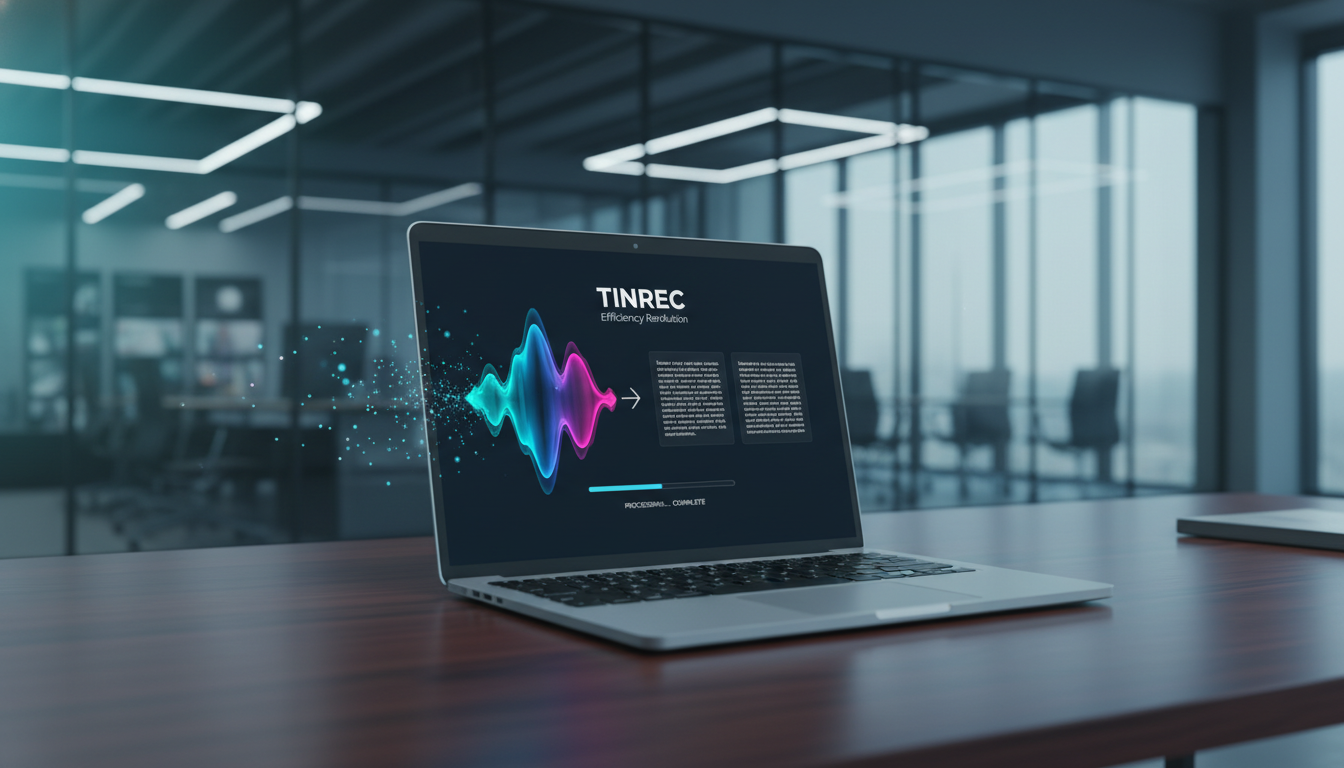
The Core Challenge of Cantonese to Written Chinese: Why Can't General AI Do It?
Cantonese and standard written Chinese (Modern Standard Mandarin) have significant differences in grammatical structure and vocabulary. For example, Cantonese phrases like "我睇緊書" (I am reading a book) or "搞掂" (completed) are often transcribed as word-for-word spoken records by standard voice recognition models, making them useless for formal writing.
Furthermore, the habit of code-mixing commonly seen in Hong Kong—mixing Cantonese and English—is a nightmare for AI. A sentence like "我想 present 嗰個 idea" (I want to present that idea) is often fragmented by traditional tools. The new generation of Cantonese to Written Chinese AI breaks through these limitations. By leveraging the understanding capabilities of large language models (LLMs), it can not only accurately recognize speech but also perform "intra-language translation," automatically correcting "嗰個" to "那個" (that) and "係" to "是" (is), directly outputting usable text.
A Boon for Creators: Accurate AI Subtitle Generation
For video creators (YouTubers) or media professionals, tools like Subanana showcase AI's powerful potential in the subtitle domain. The core advantage of such tools lies in their focus on streamlining the tedious post-production process:
- Direct spoken-to-written conversion: Saves the time of manually editing each subtitle line into written Chinese, crucial for creators aiming to reach a broader Chinese-speaking audience.
- Noise resistance: Maintains high recognition accuracy even when recording outdoors or with background music.
- Multilingual translation: After generating written Chinese subtitles, further translates them into English or other languages, breaking down language barriers.
Stop organizing recordings by hand
Upload audio or video and automatically get a transcript, summary, and action items

These tools address the "viewing" need, making video content easier to distribute. But if your requirements shift from "video post-production" to "business scenarios"—such as recording an important phone call or summarizing a multi-hour meeting—you need a more comprehensive productivity tool.
Business Upgrade: From "Plain Text" to "AI Smart Summaries"
In a workplace environment, we often face not edited videos but real-time calls, lengthy audio recordings, or even YouTube competitor analyses that need quick key points. In such cases, TinRec (秒聽錄音) becomes a superior choice.
TinRec is more than just a transcription tool; it is a versatile AI meeting minutes assistant that perfectly combines "recording" and "understanding":
- Comprehensive recording support: Unlike general subtitle software that only supports file uploads, TinRec supports call recording to text, a killer feature for lawyers, journalists, and salespeople. Whether it's a phone call or an on-site meeting, it captures in real time.
- Intelligent understanding and summarization: Raw transcripts are often lengthy and hard to read. TinRec has a powerful AI meeting summary function that automatically extracts "meeting summaries," "action items," and "key decisions" after transcription. It can turn a Cantonese discussion into a well-organized written report, truly achieving "Cantonese input, professional report output."
- Multimedia format compatibility: Besides recordings, it also supports MP3 to text and YouTube subtitle generation. If you need to quickly digest the content of a long video, just paste the link and TinRec generates a summary for you.
How to Build an Efficient AI Workflow?

After understanding the strengths of different tools, we can build the optimal workflow based on actual needs:
Input Phase:
- For live meetings or phone calls, use TinRec (秒聽錄音) directly for recording, ensuring clear audio and no missed details.
- For existing audio/video files (e.g., MP3 or MP4), you can also import them into TinRec for fast transcription.
Processing Phase:
- Utilize AI's natural language processing to convert Cantonese spoken content into structured written text. TinRec's AI engine excels at handling code-mixed professional terminology, significantly reducing subsequent proofreading time.
- Use the AI meeting summary function to quickly generate meeting minutes and send them directly to team members.
Output and Application:
- Use the generated text for project management, content marketing materials, or archival records. AI intervention reduces what used to be hours of "audio typing" to just minutes.
Conclusion: Choose the Right Smart Assistant for You
The development of Cantonese-to-written Chinese technology is redefining how we process information. If you focus on the visual presentation of video subtitles, tools like Subanana are a great starting point; but if you seek comprehensive business efficiency, need to handle call recordings, meeting minutes, and multi-format content conversion, then the powerful TinRec (秒聽錄音) is undoubtedly a tool to enhance workplace competitiveness.
Embrace AI tools. Don't let language barriers become stumbling blocks to efficiency. Turn every conversation into valuable textual assets.
Turn every recording into actionable outcomes
Get 60 free transcription minutes when you sign in. No credit card required.
Related Reading
You might also like

4 AI Meeting Note Tools Tested for 2026: Which Saves the Most Time for Chinese Meetings?
Still spending two hours writing meeting notes after the meeting? This article compares four AI meeting note tools, breaking down Chinese and mixed Chinese-English recognition, meeting recording methods, post-meeting summaries and action items, cross-platform export, and team member management. It also lists four key pitfalls to avoid when choosing a tool, helping you find a solution that truly saves time.

2026 Guide: Convert Audio to Transcripts — Stop Typing Manually & Auto-Generate Meeting Minutes with AI
Don't want to type transcripts by hand? This guide covers two scenarios—live meetings and pre-recorded files—and outlines 4 key buying factors. We tested Tinrec's bot-free meeting recording, AI summaries, and Q&A workflow, compared Notta, Granola, and PLAUD, and included the most common pitfalls to avoid.

4 AI Recording Tools Tested for 2026: Which Saves the Most Time on Chinese Meeting Notes?
Recorded a meeting but never have time to organize it? This hands-on comparison looks at four common approaches—built-in phone features, free online tools, AI recording hardware, and dedicated AI meeting note tools—and tests Tinrec on Chinese meeting transcription, summaries, and action items. Includes 6 buying considerations and FAQs.

2026 Medical Meeting Transcription Tools Compared: Which AI Saves You the Most Time with Chinese Transcripts and Summaries?
For professionals juggling over a dozen meetings a week and still stuck with post-meeting notes, which tool should you use? This article dives into practical decision points, covering 5 key factors for choosing a medical meeting transcription tool. We tested Tinrec's bot-free recording, AI summaries, action item extraction, and AI Q&A, and briefly review alternatives like Notta, Otter.ai, and PLAUD. We also provide a guide to avoid common pitfalls and final recommendations.
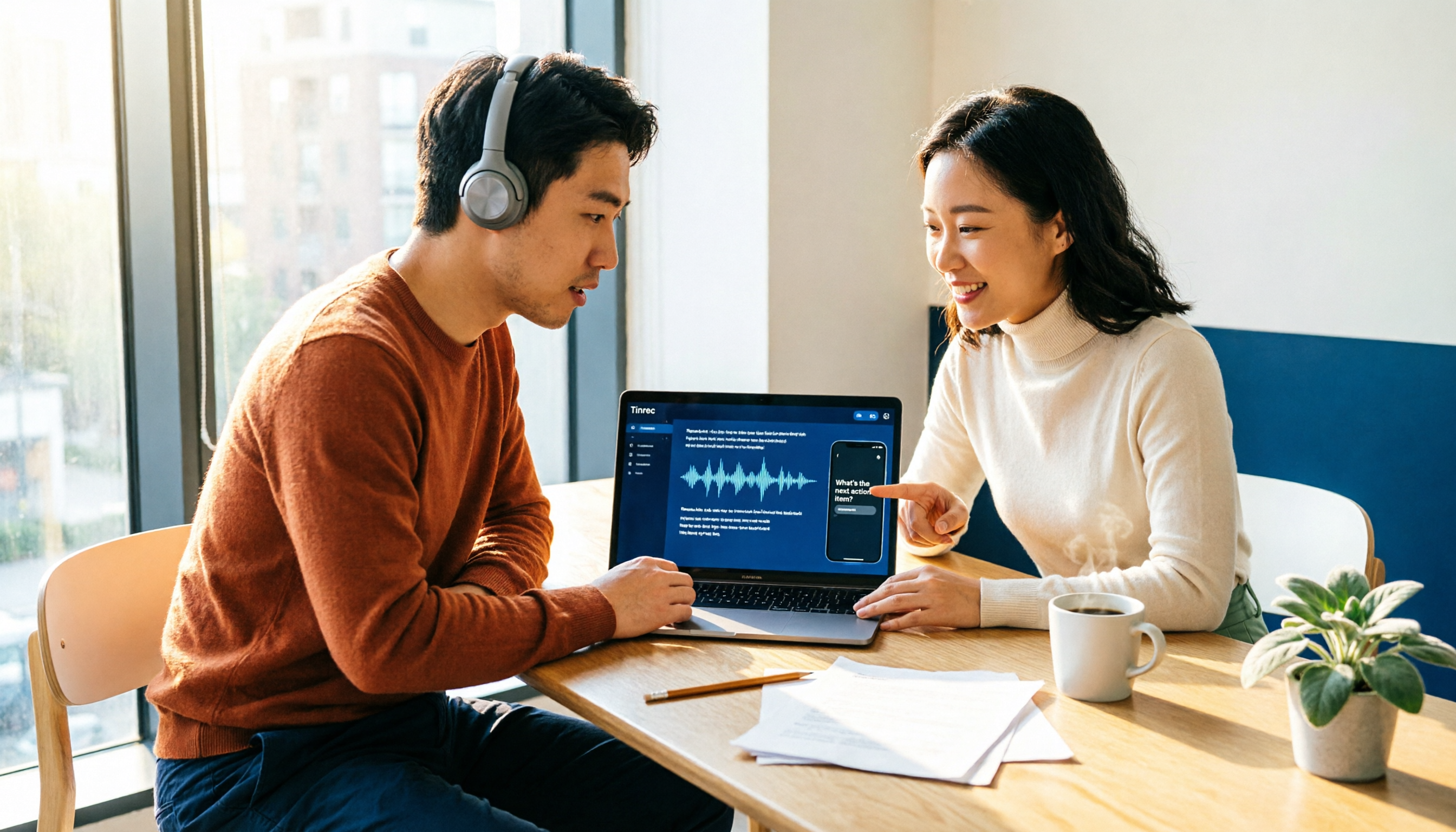
How to Choose an Automatic Transcription Tool in 2026: 5 Steps to Compare Yating Transcription and Tinrec
How do you choose an automatic transcription tool? Starting from the actual checklist I use when picking tools, I compare Yating Transcription and Tinrec across five dimensions, covering online meeting recording methods, post-meeting organization depth, AI Q&A, cross-platform team collaboration, and quota pricing, to help you determine which one better fits your workflow.

4 Best Audio-to-Text Apps in 2026: Which One Actually Saves You Post-Meeting Time?
A mid-level manager who attends 15 meetings a week shares hands-on experience. From online meeting recording methods and transcription performance for Chinese and mixed Chinese-English to post-meeting summaries and action item organization, this breaks down the differences among four types of audio-to-text apps and explains how Tinrec uses bot-free recording, AI summaries, action item extraction, and team spaces to turn meetings into searchable, collaborative, actionable data.
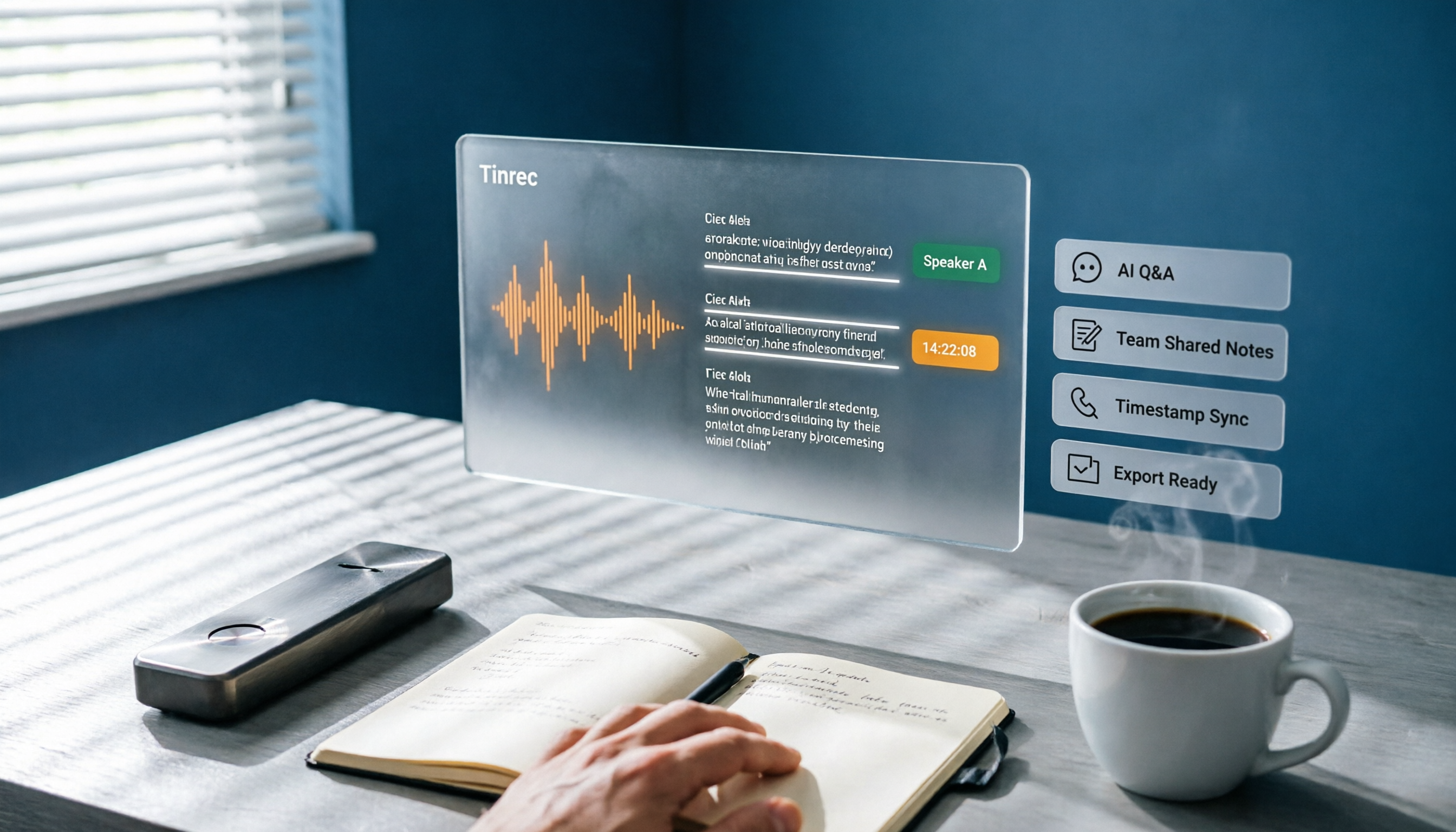
4 Interview Transcription Tools Compared in 2026: From Recording to Citable Text
After an interview, organizing the transcript often feels more exhausting than the interview itself. This article starts from 'recording to citable text' and compares 4 interview transcription tools, covering speaker labeling, AI Q&A, audio retention, and team sharing, plus common pitfalls and selection advice.
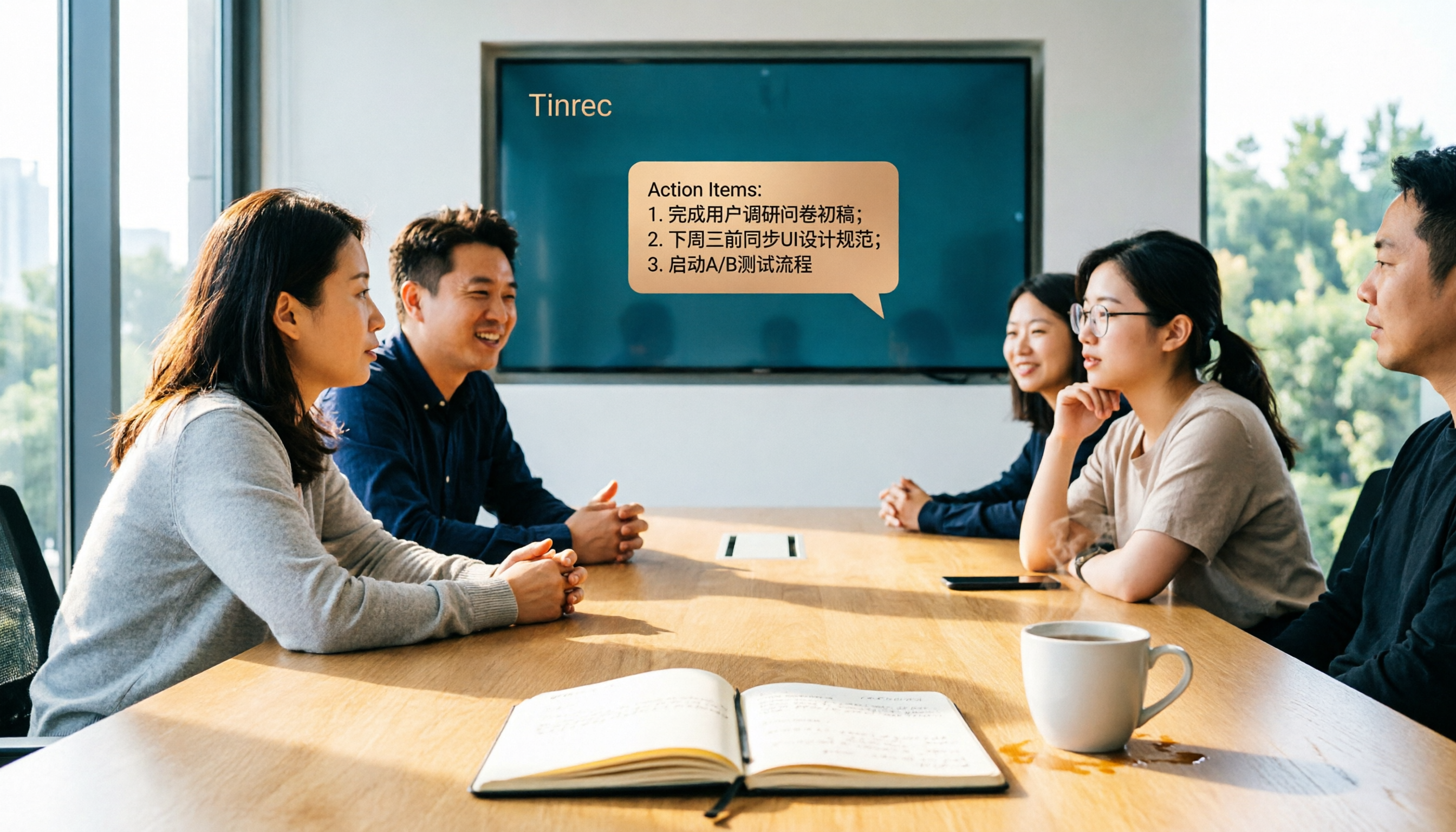
Tinrec vs Notta 2026: 5-Dimension Comparison for Chinese Meeting Transcription Tools
Starting from the decision focus of 'Do you want transcription, or usable meeting data?', this article compares Tinrec and Notta across 5 dimensions, covering selection criteria, a full breakdown of Tinrec, other options, and pitfalls to avoid, helping Chinese meeting users make a quick choice.

5 Transcription Tools Tested and Compared in 2026: Transcription Takes Too Long—Which One Actually Saves Time?
Transcription takes too long, and the problem is often not typing speed but the "listen, type, re-read" workflow. This article tests 5 transcription and AI meeting note tools, covering how to judge accuracy, post-meeting organization, audio retention and export, free quotas, and team seat licensing. It provides criteria you can follow directly and analyzes Tinrec's actual performance in bot-free recording, AI Q&A, and team knowledge retention.