
Turn recordings into transcripts and summaries in minutes
Upload audio or video for multilingual transcription, AI notes, and action items
"I just wrote down the last sentence, and my manager's next key point is already missed," "A one-hour cross-border meeting recording took three hours to manually transcribe" — these are everyday pain points for many professionals and graduate students. In 2025, speech-to-text technology has evolved from simple "verbatim typing" to "AI smart summaries," but with so many tools on the market, which one fits your scenario?
This article will do more than just list apps; we'll guide you through three core dimensions — recognition accuracy, AI summary capability, and cross-device convenience — to quickly filter the best productivity tool for you. We'll provide a detailed specification comparison table and give specific recommendations for different needs; we'll also demonstrate how to use next-gen AI tools (like Tinrec) to convert lengthy recordings directly into actionable task lists.
Quick Navigation Conclusions:
- Prioritize team collaboration and ecosystem: Consider Feishu Minutes or DingTalk Flash Notes.
- Professional-grade accuracy and hardware integration: If budget allows, choose iFlytek iRec.
- Seeking AI Q&A and action item extraction: Recommend trying Tinrec.
- For content creator video subtitles: NetEase Vision Workstation is a solid free choice.
1. Why You Need a "Modern" Recording-to-Text Tool
Traditional voice recorders or built-in phone recorders have one major problem: extremely low information density. To find a specific decision point in a 60-minute audio file, you often need to scrub back and forth endlessly, wasting significant time.
Modern AI recording-to-text apps solve three core pain points:
- Information visualization: Convert audio to text, shifting from "linear listening" to "scanning reading," boosting retrieval efficiency by over 10x.
- Language barriers: For cross-border meetings or dialects (e.g., Cantonese, Taiwanese), AI can instantly recognize and translate, lowering comprehension thresholds.
- Decision gaps: Evolve from "just recording what was said" to "extracting what needs to be done (Action Items)," preventing key tasks from being forgotten after meetings.
2. 2026 Hot Meeting Recording-to-Text Apps In-Depth Comparison
Based on market popularity and feature completeness, we selected several representative tools for a side-by-side comparison. Each has its strengths; the key is your primary use case: "meetings," "writing," or "video production."
1. Feishu Minutes: All-Round Team Collaboration Player
Feishu Minutes promises "meeting minutes generated as soon as the meeting ends." Its core advantage lies in a robust collaboration ecosystem. According to public info, it supports translation between 19 languages including Chinese, English, and Japanese, and can optimize for professional terms like "financial compliance" and "chip architecture." Its most praised feature is the "Smart Review" function: clicking text jumps to the corresponding audio segment. Suitable for enterprise teams deeply embedded in the Feishu (Lark) ecosystem.
2. iFlytek iRec: Veteran Tech, Top Accuracy Choice
As a veteran in speech recognition, iFlytek iRec boasts extremely high accuracy for Mandarin Chinese and excellent support for dialects like Cantonese and Sichuanese. It supports real-time transcription and translation, making it ideal for serious business settings. However, its pricing model is more traditional (per-minute billing or VIP subscription), making long-term costs higher for individual users.
3. Tinrec: From Recording to Action with AI
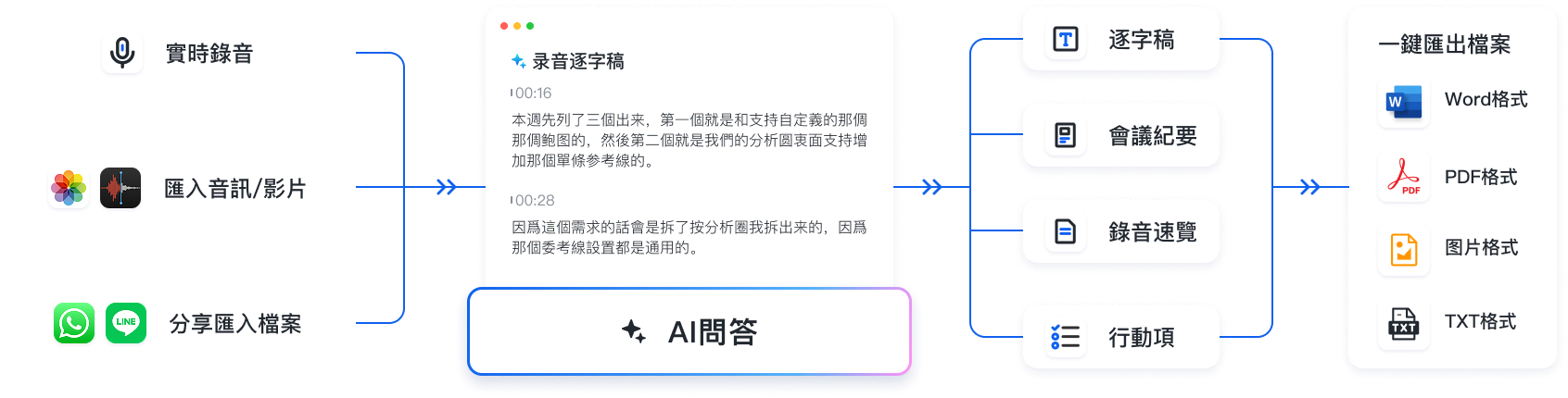
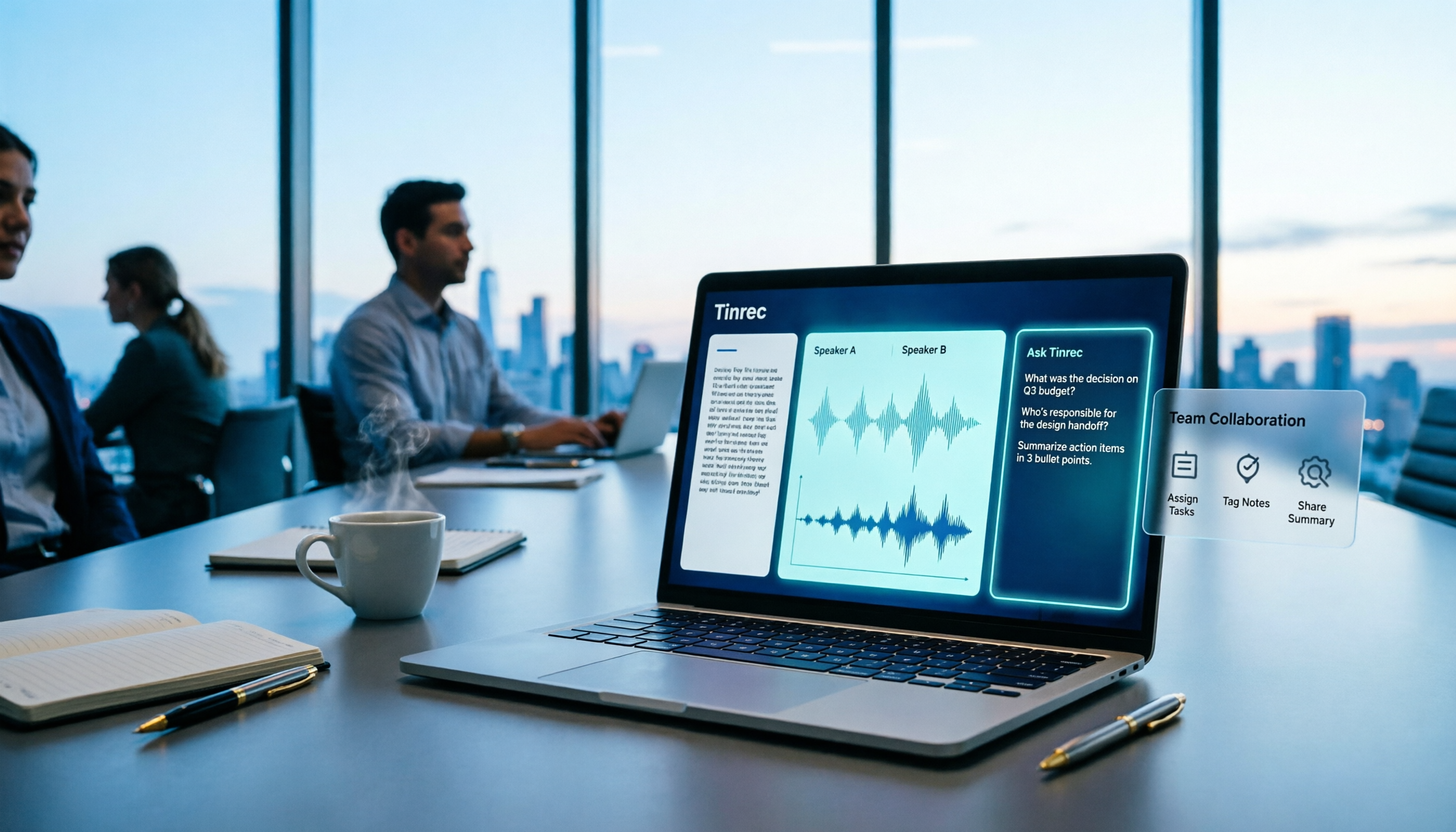
Tinrec is a tool focused on the complete workflow of "record → understand → act." Unlike traditional tools, Tinrec not only provides verbatim transcripts but emphasizes AI-driven "conversational query." Users can directly ask the AI: "What was the conclusion about the budget in this meeting?" without having to search through ten thousand words themselves. It supports iOS, Android, and Web syncing, making it user-friendly for those who switch devices frequently.
4. NetEase Vision Workstation: Captioning Tool for Video Creators
If you're a YouTuber or video content creator, NetEase Vision Workstation is a powerful tool for generating subtitles. It automatically creates SRT subtitle files with timestamps, saving you the pain of "listen a sentence, type a sentence" in traditional editing software. While not as strong in real-time meeting transcription, it excels in the vertical scenario of "audio/video to subtitles."
5. Tencent Meeting / DingTalk Flash Notes: Natives of Meeting Scenarios
These two tools are built directly into their respective meeting apps. If 90% of your meetings use Tencent Meeting or DingTalk, using the built-in "cloud recording to text" is the most convenient option. The upside is seamless integration; the downside is weaker support for "offline in-person meetings" or "cross-platform recordings (e.g., Meet/Zoom)," and file management is relatively closed.
3. Specification Comparison Table of 6 Mainstream Tools
To help you decide quickly, here's a comparison table of core dimensions:
Stop organizing recordings by hand
Upload audio or video and automatically get a transcript, summary, and action items
| Dimension | Tinrec | Feishu Minutes | iFlytek iRec | NetEase Vision | Tencent Meeting | Recording to Text Assistant |
|---|---|---|---|---|---|---|
| Core Positioning | AI Recording Notes & Action Item Management | Team Collaboration & Document Archiving | Professional High-Accuracy Transcription | Video Subtitle Creation | Online Meeting Real-time Recording | Lightweight Phone Recording |
| Multilingual Support | Chinese/English/Japanese/Korean/Cantonese/Taiwanese, etc. (10 languages) | 19-Language Translation | Supports Multiple Languages & Dialects | 8 Foreign Language Transcriptions | Primarily Chinese/English | Basic Chinese/English |
| Real-time Transcription | Supported (App/Web) | Supported | Supported | Not Supported (Upload Only) | Supported (During Meetings) | Not Supported |
| AI Smart Features | Summaries, Action Items, Conversational Q&A | Keyword Extraction, Speaker Diarization | Full Summary, Chapter Overview | Basic Transcription | Smart Summary | None |
| Special Input | YouTube/Podcast Link Parsing | Local Files, Live Recording | Local Files, Live Recording | Media File Upload | In-Meeting Recording Only | Local Files |
| Free Allowance | 100 minutes per month | 300 minutes per month (Basic Plan) | Trial for New Users / Payment-based | 2 hours per day | Limited Free / Paid Membership | Small daily limit / Lots of ads |
4. Tinrec In-Depth Review: More Than Transcripts, an AI Thinking Companion
Among the many tools, Tinrec aims to solve the problem of "what to do after recording." Often we get the transcript but are too lazy to read through the lengthy content. Tinrec's design logic focuses on enhancing "post-processing" efficiency.
1. Real-time Transcription & Multi-device Sync
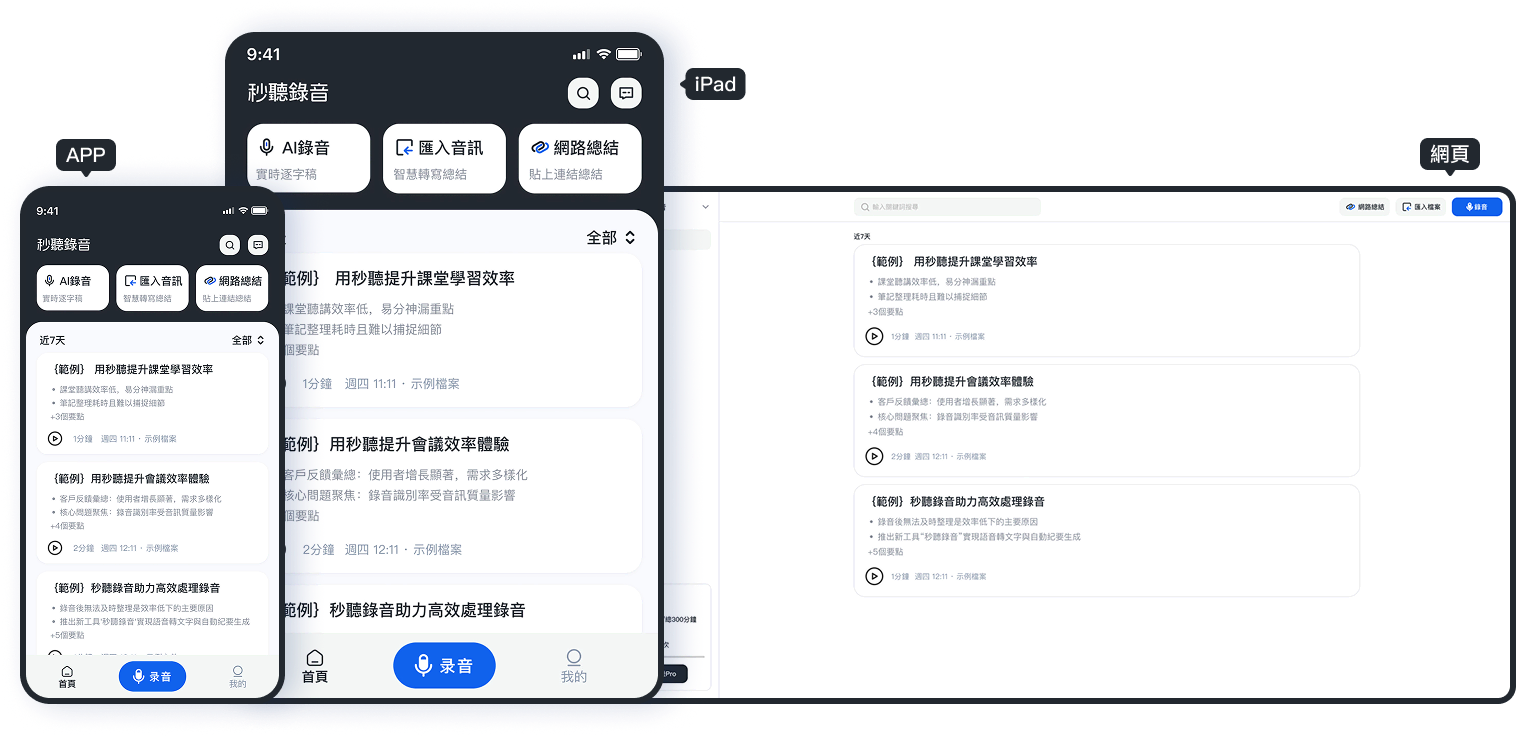
Tinrec supports iOS and Android mobile apps, perfect for jotting down ideas or sudden meetings on the fly. During recording, text appears on screen in real-time. The best part is that data syncs to the web version, so you can edit or copy content on your computer afterward, solving the closed ecosystem issue of iPhone recordings being hard to export.
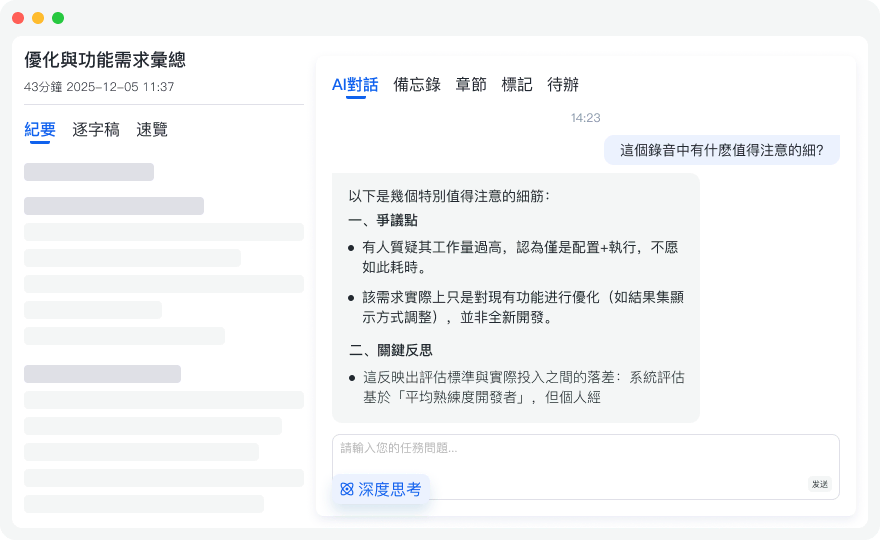
2. AI Conversational Query: Find Answers by Asking
This is the biggest differentiator from traditional tools. For a 2-hour interview recording, you can type directly into Tinrec's AI Chat window: "What is the interviewee's view on market trends?" The system will summarize answers based on the recording content, offering better semantic understanding than using Ctrl+F to search keywords.
3. Diverse Content Input
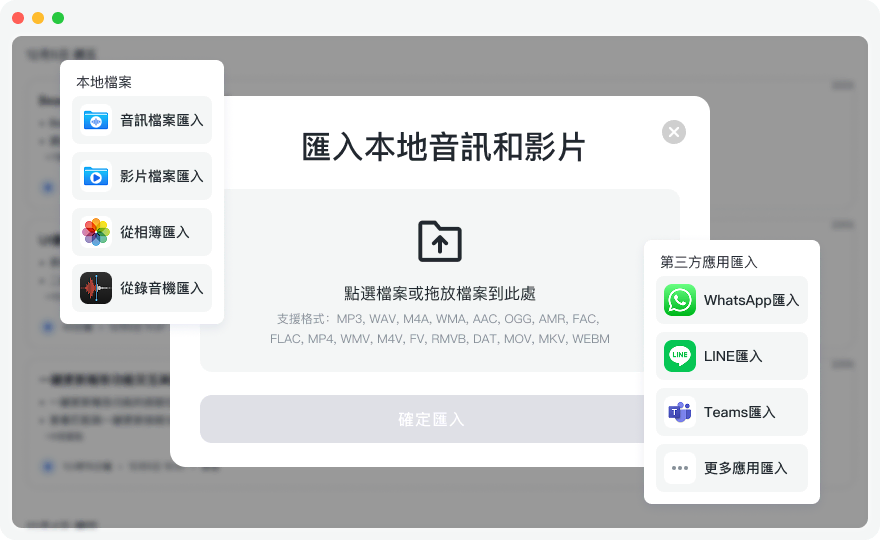
In addition to live recording, Tinrec supports uploading audio/video files, and even inputting YouTube or podcast links. This is a very efficient feature for students organizing online course notes or content creators analyzing competitor videos.
5. Practical Tutorial: How to Summarize a 1-Hour Meeting in 5 Minutes with AI Tools
Below, using Tinrec as an example, we demonstrate a high-efficiency meeting note workflow:

Step 1: Start Recording or Import Audio File
- In-person meeting: Open the app or web version, click the "Real-time Recording to Text" button. It's recommended to place the device close to the speaker.
- Online meeting/file: If you have a pre-recorded MP3/MP4 file or a Zoom/Teams recording, use the "Audio File to Text" feature to upload. For public online learning resources, use "Podcast/Online Video to Text" to paste the link.
Step 2: Wait for AI Recognition and Speaker Diarization
The system automatically performs speech recognition and attempts to differentiate speakers (Speaker Diarization). Tinrec supports 10 languages including Chinese, English, Japanese, Korean, etc., and can handle mixed-language meetings.
Step 3: Use AI to Extract Action Items
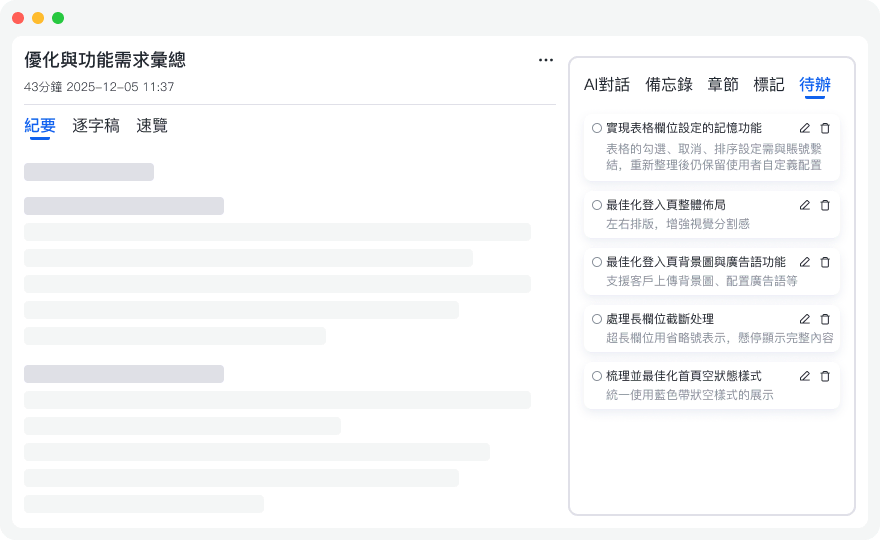
After transcription, don't rush to read the transcript. Directly view the system-generated "AI Summary" and "Action Items." Tinrec automatically analyzes semantics to convert statements like "need to submit the report by next Wednesday" into a concrete To-Do List.
Step 4: Query Details Conversationally
If details are missing from the summary, use the "AI Conversational Query" feature. For example, type: "Confirm the reason for the release date delay mentioned by the product manager," and the AI will locate the specific segment and summarize the reason.
Step 5: Export and Share
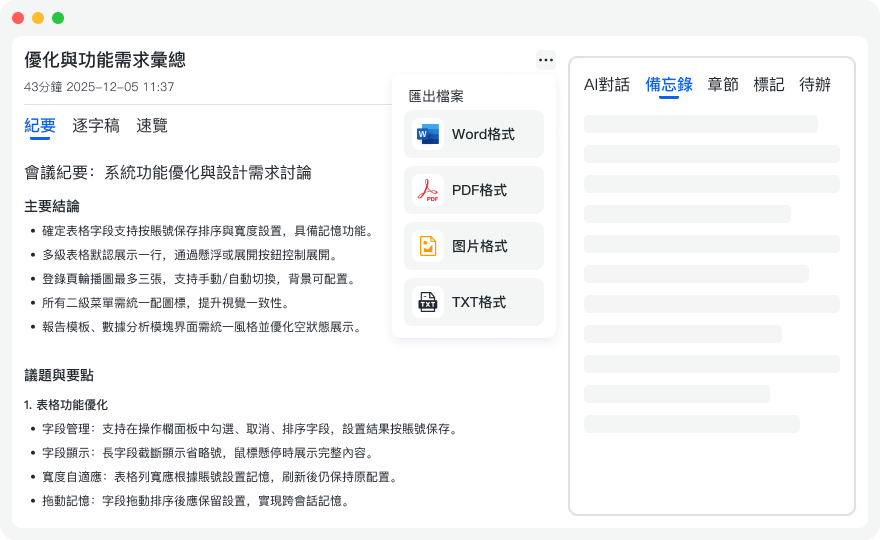
After confirming the content is correct, export the notes as TXT, PDF, or Word format and share with team members.
6. Frequently Asked Questions (FAQ)
Q1: Are there any limitations when using these apps on iPhone? Due to iOS's strict privacy permissions, most third-party apps (including Tinrec, iFlytek) cannot record directly during phone calls. It is recommended to use speakerphone for recording, or use the computer web version for transcription during video conferences (Teams/Meet/Zoom).
Q2: What are the usual limitations of free versions? Most tools impose "time limits" or "feature limits." For example, Feishu Minutes Basic Plan offers 300 minutes per month; Tinrec Free offers 100 minutes per month. For students or light users, these limits are usually enough for weekly key meetings; heavy users may want to consider a Pro subscription.
Q3: How accurate are the transcriptions? Can dialects be understood? Currently, mainstream tools achieve over 95% accuracy for Mandarin Chinese. However, gaps widen in scenarios with "Chinese-English mix," "many proper nouns," or "dialects (Taiwanese/Cantonese)." iFlytek iRec and Tinrec are relatively well-rounded in multilingual and dialect support. It's recommended to test with free credits on your specific scenario (e.g., medical/legal terms).
Q4: Will my meeting data be leaked? When choosing a tool, pay attention to privacy policies. Reputable vendors like Tinrec and Feishu typically use encrypted transmission and storage. For highly confidential business negotiations, consider enterprise-grade services or hardware that supports offline deployment (e.g., iFlytek recorders).
Q5: Can I directly convert YouTube videos to text? Not all tools support link parsing. NetEase Vision and Tinrec support this feature; just copy the YouTube link, and the system will fetch the audio track and transcribe it. This is very useful for organizing language learning notes or competitor analysis.
Q6: Does a noisy recording environment affect performance? Yes. Although AI has noise reduction, the physical environment has the biggest impact. Try to sit close to the microphone during meetings or use a directional recording device. When using the app to record, ensure your phone's microphone is not blocked by documents.
Turn every recording into actionable outcomes
Get 60 free transcription minutes when you sign in. No credit card required.
Related Reading
You might also like

What Is Real-Time Transcription in 2026: Definition, 4 Key Factors, and Tool Comparison
What is real-time transcription and how does it differ from transcribing recordings? This article explains the definition and how it works in plain language, outlines 4 key factors to consider, and compares Google Live Transcribe, Yating, Notta, and Tinrec in Chinese meetings, post-meeting organization, and team collaboration, with scenario-based recommendations.

4 Meeting Transcription Tools Tested: Which AI Saves the Most Time on Chinese Transcripts and Summaries?
After a meeting, do you spend another two hours organizing the audio recording? This article compares four meeting transcription tools—Tinrec, Notta, Otter.ai, and Granola—on Chinese transcription, AI summaries and action items, bot-free recording, team collaboration, and pricing to help you find the most time-saving solution.

3 iPhone Audio-to-Text Apps Tested in 2026: How Long Can You Record and Which Saves the Most Time After Meetings?
How long can an iPhone actually record? This article first breaks down the storage, battery, and file interruption risks of the built-in Voice Memos app, then compares 3 audio-to-text tools from a student's perspective—covering free quotas, single-recording limits, post-meeting organization, and AI Q&A capabilities—to help you decide whether the built-in recorder is enough or if you need an AI recording assistant that delivers key points right after recording.
Google Live Transcribe vs Tinrec in 2026: 5-Dimension Comparison — Which Is Better for Meeting Notes?
Google Live Transcribe & Sound Notifications is an Android accessibility tool known for being free, providing real-time transcripts, and sending environmental sound alerts. Tinrec focuses on meeting notes and team collaboration. This article compares them across 5 dimensions—transcription and organization, online meeting recording, AI Q&A, audio file import, and team management—to help you decide which one to use for meeting notes.

3 iPhone Call Recording Solutions Compared: iOS 18 Built-in vs Tinrec in 2026
iPhone call recording finally has a built-in solution with iOS 18, but regional restrictions, legal issues, and post-call organization are the real pain points. This article compares 3 solutions: iOS 18 built-in call recording, Tinrec, and PLAUD Note with Otter.ai, helping you understand how to record calls and quickly turn them into transcripts, summaries, and action items.

2026 Real-Time Recording Tools Compared: Which Can Transcribe While Recording?
How do you choose a real-time recording tool? This article tests and compares Tinrec, free online voice recorders, Bandicam, and Granola in real meeting scenarios, explaining why what happens after recording is key, plus 4 buying tips, pitfalls to avoid, and scenario-based recommendations.

5 Meeting Recording Apps Compared in 2026: From Transcripts to Team Collaboration
Meeting recording apps aren't just about audio quality—they're about what happens after the meeting. This guide breaks down five common tool approaches, covering live transcription, AI summaries, action item extraction, AI Q&A, team spaces, and seat management. Using Tinrec as an example, we walk through bot-free online meeting recording, Chinese transcription, summaries, and exports, and compare the free, Pro, and Team plans to help you decide which solution fits your meeting needs.

What Is Instant Messaging in 2026? 5 Steps to Understand the Definition and Choose Tools
What does instant messaging (IM) mean? This article starts with the definition, history, and message storage methods to help you understand the essence of synchronous communication, 4 key points for choosing tools, and compares meeting and communication organization tools like Tinrec, Otter.ai, Notta, and Granola. Finally, a pitfall guide helps you choose the right tool.

Can You Share a Recording with Others in 2026? 5 Key Legal Points and How Tinrec Helps You Organize
Whether you can share a recording with others depends on your role, purpose, and content. This article summarizes key legal points on invasion of privacy and personal data protection, and explains how to use Tinrec to turn recordings into transcripts or summaries so you only share necessary information, reducing privacy and legal risks.