
Turn recordings into transcripts and summaries in minutes
Upload audio or video for multilingual transcription, AI notes, and action items
Facing all-English cross-border meetings or foreign language classes? Do you often feel anxious because you can't take notes fast enough or can't understand accents? Re-listening to recordings later is time-consuming, and organizing them into Chinese transcripts is a nightmare.
This article will solve the following problems for you:
- Tool Selection Guide: Evaluate 6 popular tools from four dimensions: accuracy, transcription speed, price, and use case.
- Spec Comparison: A single table shows free quotas and feature differences at a glance.
- Hands-on Tutorial: How to use AI tools to transcribe recordings in real time and automatically generate Chinese summaries.
Quick Navigation Conclusions:
- Prefer physical hardware: Consider Plaud Note, suitable for those who dislike phone recording.
- Need video captions: cSubtitle or MyEdit offer better timeline support.
- Value software flexibility and post-recording search: Tinrec offers cross-platform recording and AI chat query, ideal for professionals who need deep content organization.
- Taiwanese accents: Yating Transcript is optimized for local tones.
Why Do We Need AI Recording-to-Transcript Tools? (Current Pain Points)
In traditional workflows, processing "audio" information is extremely costly. Especially in English meeting scenarios, we often face three major pain points:
- Low information density, wasted replay time: To find a key decision in an hour-long meeting, you often need to drag the progress bar back and forth repeatedly.
- Language barriers and memory gaps: While focusing on understanding English content, it's hard to take complete Chinese notes simultaneously, leading to missed action items after the meeting.
- Lack of structured records: Plain recordings cannot be searched, becoming "dead data" over time.
Modern AI tools go beyond simple "speech-to-text" (STT) to include "semantic understanding" and "auto-summarization," turning long recordings into searchable, readable structured documents.
2026 Top 6 English Recording-to-Chinese Transcript Tools Review
Based on market discussion and features, here are 6 tools suitable for different scenarios:
1. Plaud AI (Note / NotePin)
Best for: Business professionals who prefer physical devices.
Plaud is a popular hardware recording solution, focusing on a recording card/capsule with an app. It supports 112 language recognition and uses GPT-4 for summaries.
- Pros: High-quality hardware, supports call recording (via physical attachment or conduction), stable long recording.
- Cons: Requires purchasing hardware (approximately NT$ 5,490 ~ $170), and you need to carry it. Free trial is usually tied to hardware purchase (300 minutes/month).
2. Vocol.ai
Best for: Enterprise users who need team collaboration.
Vocol is a voice collaboration platform emphasizing "collaboration." Besides transcription, it offers to-do item tagging and discussion features.
- Pros: Feature-rich, suitable for teams to discuss transcripts within the platform.
- Cons: Interface and credit system are relatively complex (about NT$ 320 / 300 credits), learning curve for individuals, occasional speaker diarization errors.
3. Tinrec
Best for: Students and professionals who value "post-recording applications" and "multi-device sync."
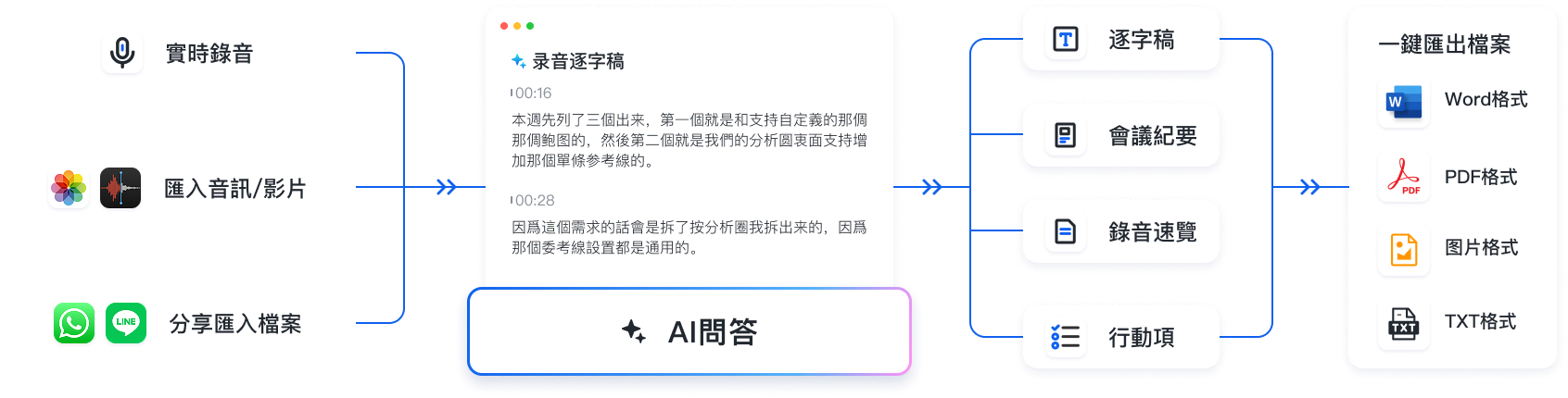
Tinrec is a software-first AI recording assistant, emphasizing a complete workflow from "recording" to "understanding" to "action." It doesn't force hardware, supporting iOS, Android, and web sync.
- Pros:
- Real-time: Supports live transcription while recording; you can see content during meetings.
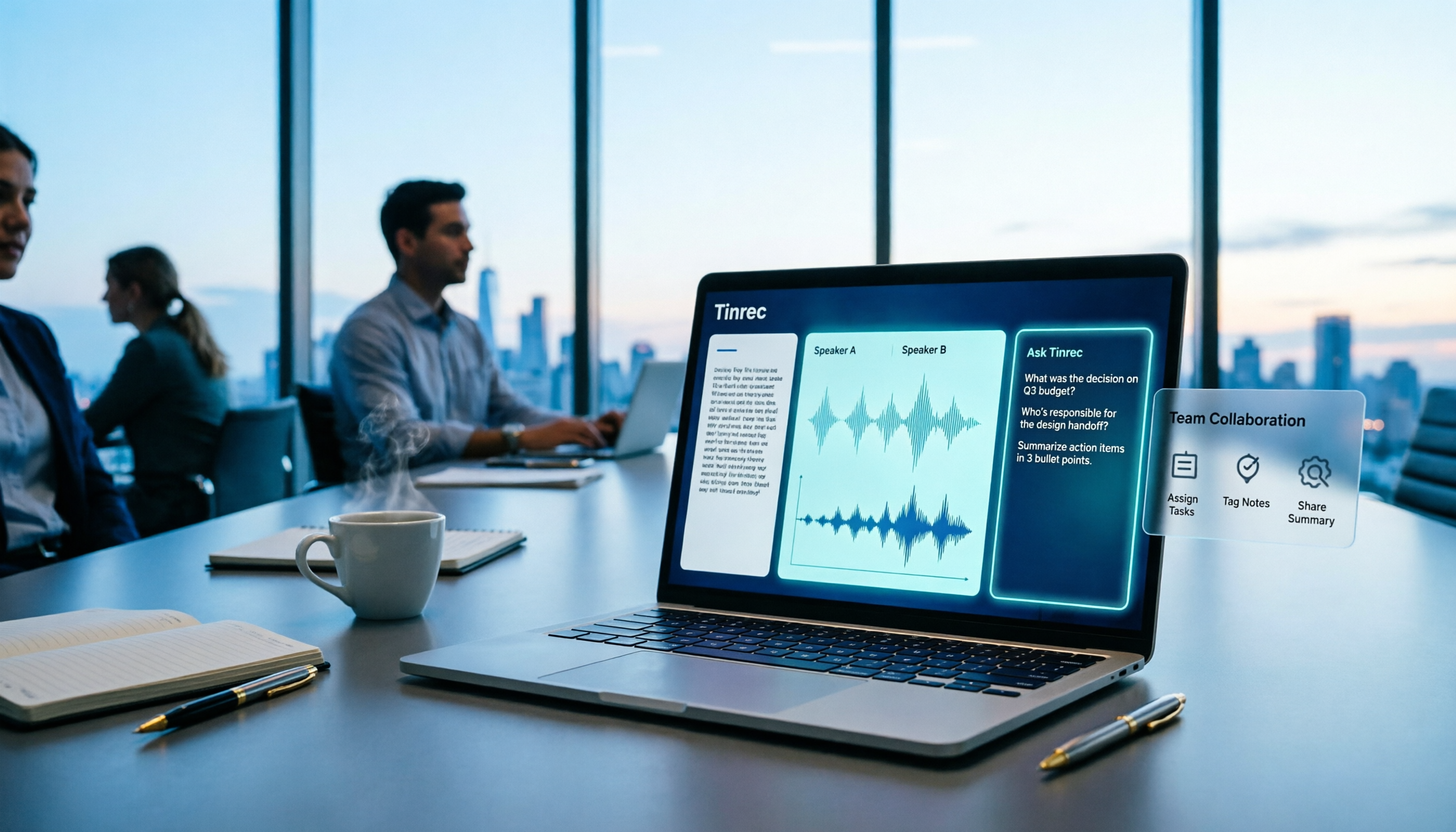
- AI Chat Query: This is its key differentiator; you can directly ask AI in Chinese: "What was the budget number the CEO just mentioned?" The system answers based on the recording content, saving you from reading line by line.
- Multi-source support: Besides recording, it also supports uploading audio files or inputting YouTube/Podcast links for transcription and summarization.
- Pricing: 100 minutes free per month; subscription barrier is low (Basic version about $4.9/month).
4. Yating Transcript
Best for: Scenarios involving Traditional Chinese (Taiwan) and mixed Minnan (Taiwanese).
Developed by a Taiwan team, specially optimized for local accents and code-mixing (Chinese-English).
Stop organizing recordings by hand
Upload audio or video and automatically get a transcript, summary, and action items
- Pros: Strong local recognition, supports Taiwanese (Minnan).
- Cons: Transcription speed is relatively slow; main focus is on "transcription" rather than AI summaries or action items. Free quota must be used within the first month of registration.
5. cSubtitle
Best for: Video creators, subtitle production.
Specializes in "video caption" generation, with precise timeline alignment.
- Pros: Accurate timeline, suitable for users who need SRT subtitle files.
- Cons: Medium transcription speed; interface leans toward video post-production rather than meeting records.
6. MyEdit
Best for: Lightweight online editing needs.
Online audio editing tool offering 3 minutes free trial per day.
- Pros: No installation needed, fast transcription, auto-segmentation.
- Cons: Very limited free quota (only 3 minutes/day), suitable for short audio only, not for long meetings.
Comparison Table: Specifications and Features of 6 Tools
| Dimension | Tinrec | Plaud AI | Vocol.ai | Yating Transcript | cSubtitle | MyEdit |
|---|---|---|---|---|---|---|
| Main Form | Software (App/Web) | Hardware + App | Web Platform | App/Web | Web Tool | Web Tool |
| Core Advantage | AI Chat Query, Multi-device sync, Media link parsing | Hardware recording, Call recording | Team collaboration, Comment features | Taiwanese accent, Minnan support | Subtitle timeline | Online quick editing |
| Chinese/English Recognition | Yes (auto-detect 10 languages) | Yes (112 languages) | Yes (Chinese/English/Japanese) | Yes (Chinese/English/Minnan) | Yes (Chinese/English) | Yes (9 languages) |
| AI Summary/Action Items | Yes (Meeting minutes/To-dos) | Yes | Yes | No | No | No |
| Free Trial | 100 minutes/month (recurring) | Hardware purchase required (includes 300 min) | 200 minutes (one-time) | 300 minutes (first month limited) | First 3 minutes/segment | 3 minutes/day |
| Price Barrier | Low (subscription) | High (hardware ~$170) | Medium (credit system) | Medium (pay-per-minute) | Medium (pay-per-minute) | Low (credits/subscription) |
Hands-on Tutorial: How to Quickly Convert English Meetings into Chinese Key Points?
Using Tinrec as an example, here's how to turn a 1-hour English meeting into Chinese meeting minutes and action items in 5 minutes:
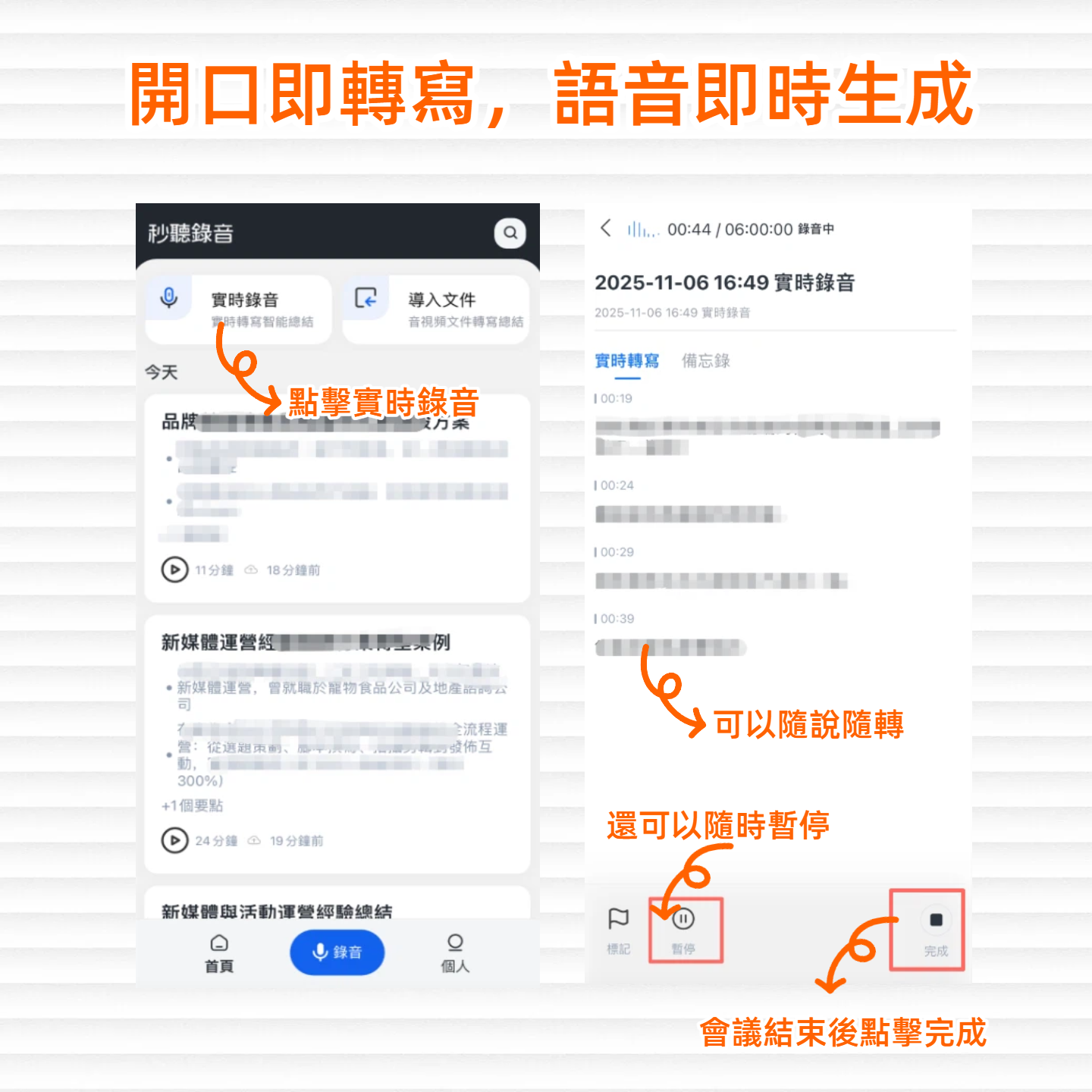
Step 1: Start Recording or Import File
- Live meeting: Open the app or web, click Real-time Transcription. The system automatically identifies speakers and transcribes in real time.
- Online meeting/recording file: If you have a Zoom or Teams recording, use Audio File to Text to upload; for public YouTube meeting recordings, use Web Video to Text and paste the link.

Step 2: Review Transcript and Identify Speakers
After recording, the system automatically generates a timestamped transcript and differentiates speakers (Speaker A, Speaker B). For English content, you can read it directly or use the translation feature to assist understanding.
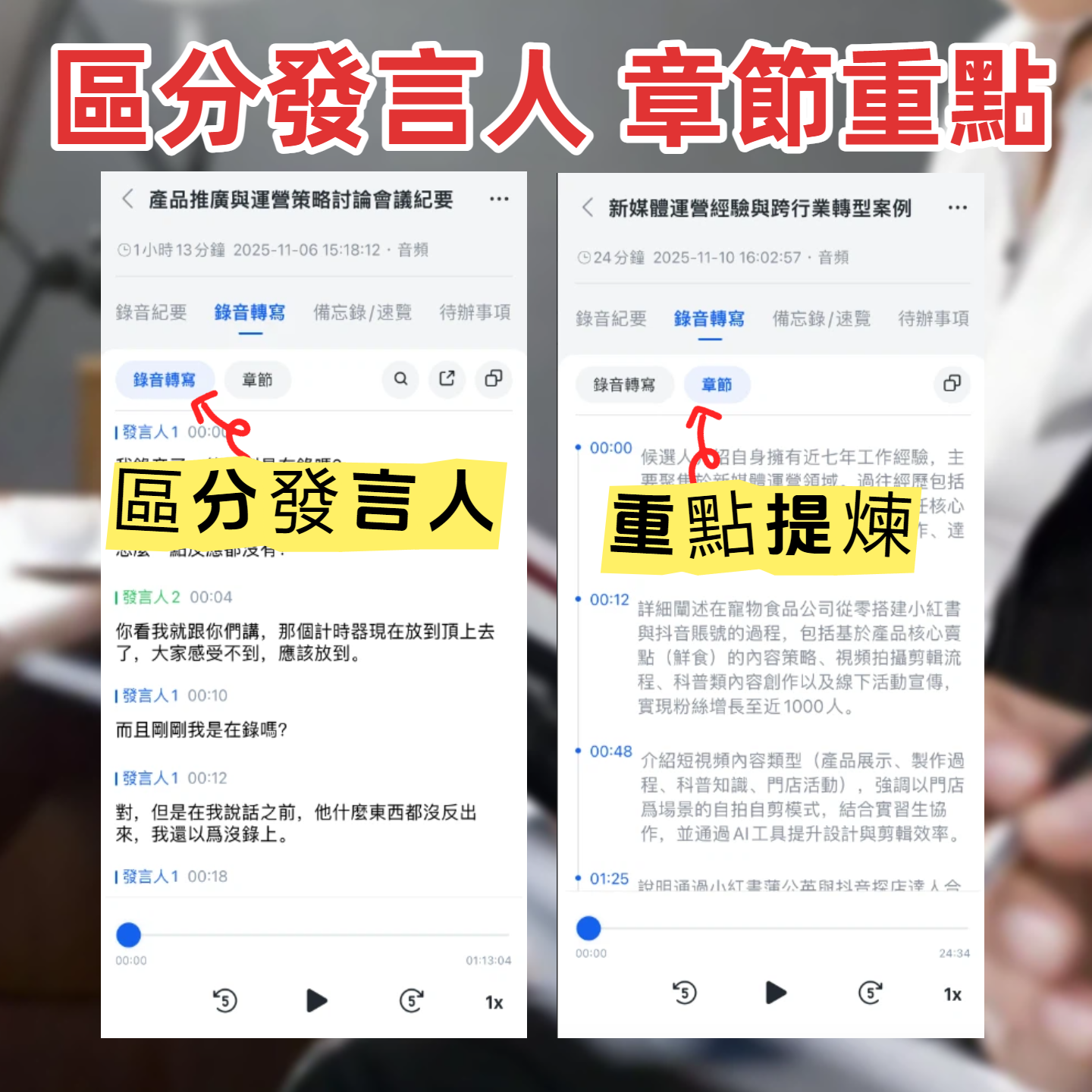
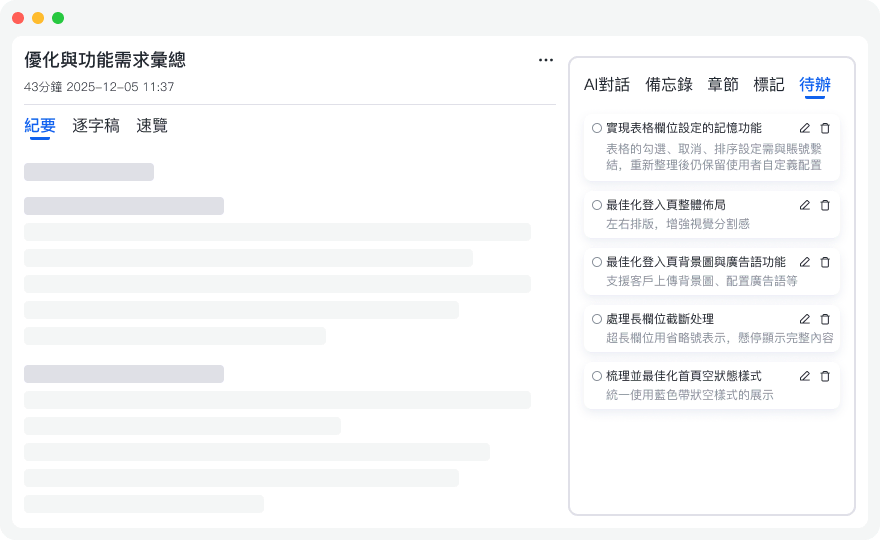
Step 3: One-click AI Meeting Summary
This is the most crucial step. Don't waste time re-reading everything; directly check the AI-generated "Smart Summary." Tinrec structures the content into:
- Summary: Core meeting topic.
- Chapter Highlights: Detailed breakdown by agenda items.
- Action Items: AI automatically extracts "who" needs to do "what" by "when."
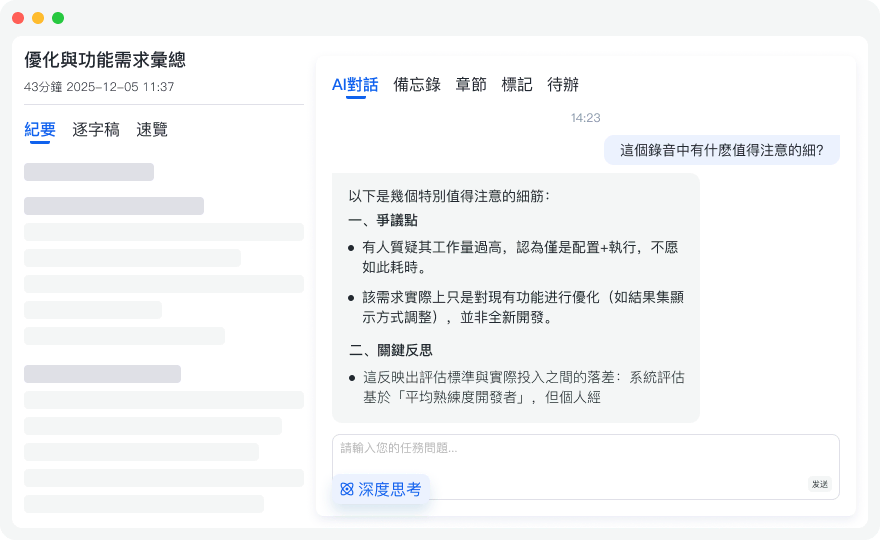
Step 4: Use AI Chat to Query Details
If the summary doesn't include details you need (e.g., "What was the deadline for the project mentioned last time?"), use the AI Chat Query feature. Ask in Chinese directly, and the AI will search the entire English recording and answer in Chinese. This is more precise than traditional Ctrl+F keyword search.
FAQ
Q1: After upgrading to iOS 18, do I still need a separate recording app?
Although iOS 18 allows call recording, it has clear limitations: 1. It forces a notification to the other party (may be awkward); 2. Only supports the Phone app, not Line, Messenger, or Zoom calls. Therefore, using an app like Tinrec that supports background execution or multi-device sync still offers advantages in recording flexibility and privacy.
Q2: If the English accent is very heavy, is the AI transcript accurate?
Current mainstream tools like Plaud and Tinrec have powerful voice models with high recognition for general business English. However, for extremely special accents or jargon, choose a tool that supports "editing" and use AI summaries to grasp the gist rather than obsessing over every word's accuracy.
Q3: Are the free versions of these tools sufficient?
It depends on your usage frequency. MyEdit's 3 minutes per day is only for testing; Vocol offers one-time credits; Tinrec offers 100 minutes per month of recurring free credits, which is relatively generous for students or individual workers with 1-2 short meetings per week.
Q4: Can I directly transcribe Google Meet or Teams meetings into text?
Yes. You can use Tinrec's web version to record (system audio) on your computer, or download the meeting recording and upload it via the "Import File" feature.
Q5: Is it safe to upload data to the cloud?
When choosing a tool, check the privacy policy. Most paid tools (like those introduced here) encrypt data during transmission and storage. For highly confidential legal or medical meetings, confirm whether the tool supports data deletion or on-premise processing.
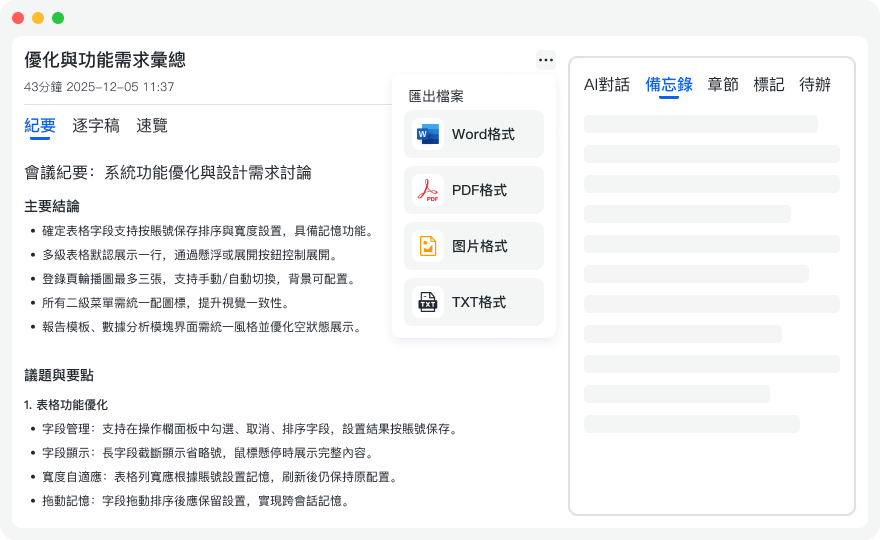
Q6: What output formats are supported?
Usually TXT, Word, PDF, SRT (subtitle). If you need video subtitles, choose a tool that supports SRT export (like Tinrec or cSubtitle).
Turn every recording into actionable outcomes
Get 60 free transcription minutes when you sign in. No credit card required.
Related Reading
You might also like

2026 Top 5 Real-Time AI Meeting Notes Compared: Tinrec vs Notta vs Plaud — Which One Should You Choose?
The real pain point of meeting notes isn't whether they can be transcribed, but how to use them after transcription. This article starts with common misconceptions, outlines the positioning of 5 highly discussed real-time AI meeting note tools, and focuses on the differences between Tinrec, Notta, and Plaud. It compares meeting capture methods, post-meeting outputs, audio retention, team governance, and pricing plans to help you decide which one fits your meeting scenario.

2026 AI Meeting Notes Guide: Tinrec's Bot-Free Recording & Auto-Generated To-Dos
How do you choose an AI meeting notes tool? This article examines Chinese recognition, recording methods, post-meeting organization, and team data ownership, comparing Tinrec, Notta, Otter.ai, and Granola, plus four common pitfalls to help you find a solution that truly saves time after meetings.

5 Best Meeting Notes Apps of 2026: Which Free Version Is Actually Enough?
Still spending an hour after every meeting writing up notes? This comparison puts five common meeting notes app approaches side by side—covering Chinese recognition, how meetings are captured, post-meeting organization, team permissions, and pricing—and explains how Tinrec handles recording, transcription, summaries, action items, and AI Q&A within its free tier.

2026 Meeting Recording Tools: Bot-Free Recording + AI Action Item Management
A mid-level manager who attends 15 meetings a week shares hands-on insights: starting from the decision point of whether to let a meeting bot join, this article breaks down 4 key factors for choosing a meeting recording tool, and explains the real-world experience, limitations, and use cases of Tinrec's desktop bot-free recording, AI summary and action items, Q&A, and team plan roles and seat management.

Tinrec vs Otter.ai: Which AI Transcription Tool Is Right for You in 2026?
Choosing an AI transcription tool isn't just about speed—it's about language support, meeting capture methods, post-meeting organization, and team data governance. This comparison of Tinrec and Otter.ai breaks down key dimensions to help you decide which tool fits your meeting needs.

What Is Real-Time Transcription in 2026: Definition, 4 Key Factors, and Tool Comparison
What is real-time transcription and how does it differ from transcribing recordings? This article explains the definition and how it works in plain language, outlines 4 key factors to consider, and compares Google Live Transcribe, Yating, Notta, and Tinrec in Chinese meetings, post-meeting organization, and team collaboration, with scenario-based recommendations.

4 Meeting Transcription Tools Tested: Which AI Saves the Most Time on Chinese Transcripts and Summaries?
After a meeting, do you spend another two hours organizing the audio recording? This article compares four meeting transcription tools—Tinrec, Notta, Otter.ai, and Granola—on Chinese transcription, AI summaries and action items, bot-free recording, team collaboration, and pricing to help you find the most time-saving solution.

3 iPhone Audio-to-Text Apps Tested in 2026: How Long Can You Record and Which Saves the Most Time After Meetings?
How long can an iPhone actually record? This article first breaks down the storage, battery, and file interruption risks of the built-in Voice Memos app, then compares 3 audio-to-text tools from a student's perspective—covering free quotas, single-recording limits, post-meeting organization, and AI Q&A capabilities—to help you decide whether the built-in recorder is enough or if you need an AI recording assistant that delivers key points right after recording.
Google Live Transcribe vs Tinrec in 2026: 5-Dimension Comparison — Which Is Better for Meeting Notes?
Google Live Transcribe & Sound Notifications is an Android accessibility tool known for being free, providing real-time transcripts, and sending environmental sound alerts. Tinrec focuses on meeting notes and team collaboration. This article compares them across 5 dimensions—transcription and organization, online meeting recording, AI Q&A, audio file import, and team management—to help you decide which one to use for meeting notes.