
Turn recordings into transcripts and summaries in minutes
Upload audio or video for multilingual transcription, AI notes, and action items
2026 Hands-on Review of 2 Google Meet Recording Tools: Who Can Make Perfect Meeting Notes After Muting Unwanted Speakers?
During a Google Meet, hosts can mute noisy participants to keep the meeting smooth. But after the meeting ends, you're left with a recording. How do you quickly turn that discussion into text highlights? This article compares two popular AI transcription tools: Tinrec (秒聽錄音) and Otter.ai, to see which one can convert your meeting recordings into clear, searchable meeting notes.
Tinrec vs Otter.ai | Quick Overview
| Tool | Tinrec (秒聽錄音) | Otter.ai |
|---|---|---|
| One-line Positioning | Multi-source AI recording and audio/video processing workstation, covering not only meetings but also lectures, interviews, and online videos | AI meeting notes tool focused on online meeting recording and team collaboration |
| Supported Platforms | iOS, Android, Web | iOS, Android, Web |
| Key Difference | Provides summary, chapters, action items, AI Q&A, multi-format export, and supports parsing online video links | Automatically joins meetings, speaker identification, meeting summaries, suitable for English business meetings |
Below, we compare them across five key dimensions, including Chinese transcription ability, input source variety, AI features, pricing plans, and export flexibility.
Dimension 1 | Chinese Content Organization and Accuracy
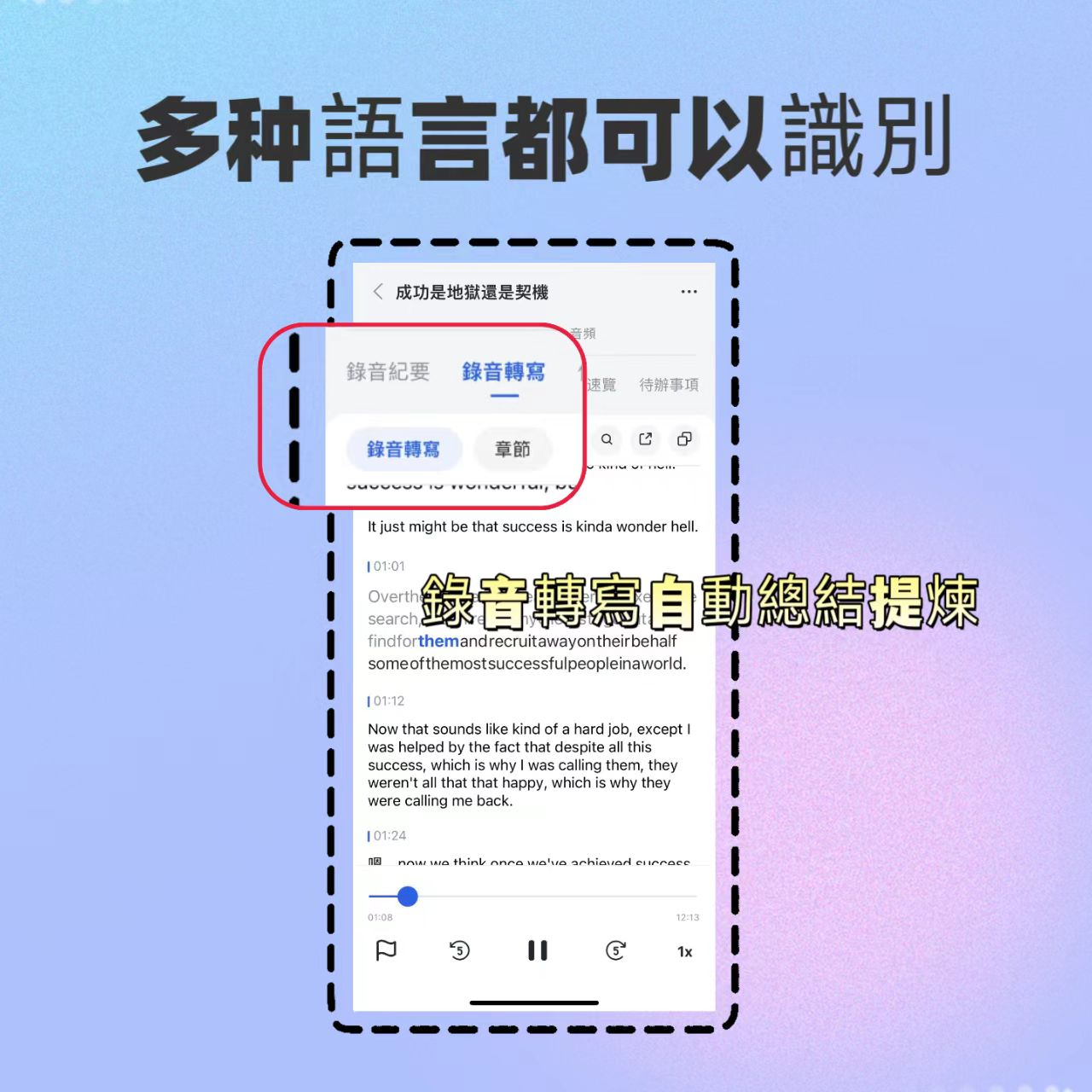
Otter.ai excels in English, but its support for Chinese is relatively weak. When encountering Chinese-English mixing, Taiwanese accents, or background noise, the transcription error rate increases significantly. I tested both tools with the same 10-minute Google Meet Chinese meeting recording (standard Mandarin, slight background noise). Otter often missed words or misjudged, and proper nouns were skipped.
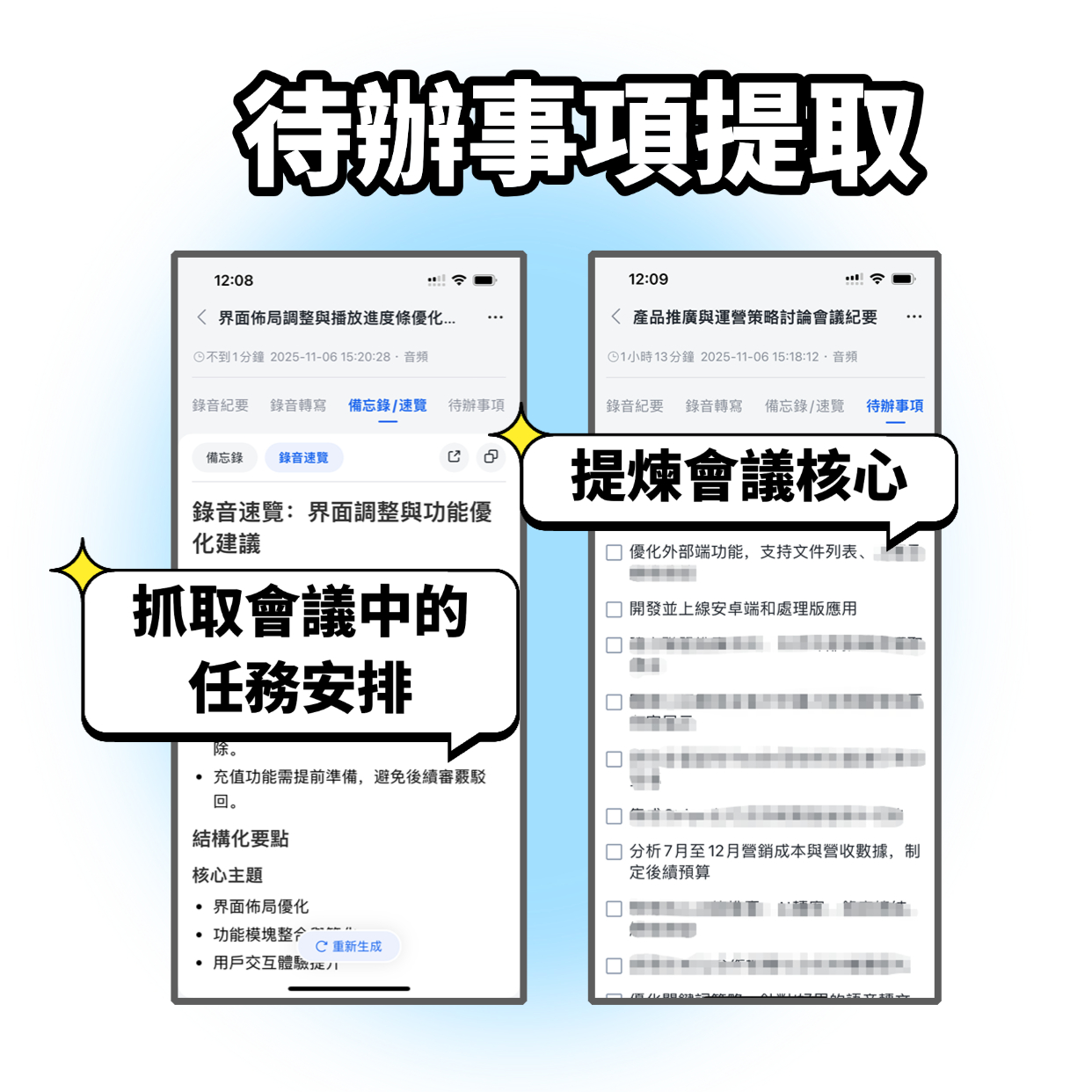
Tinrec, on the other hand, is optimized for Chinese. With the same recording, its transcription completeness is much higher, and it correctly identifies terms like "OKR" and "KPI" (mixed Chinese-English). It can even organize spoken content into structured chapters.
→ This dimension: Tinrec clearly wins, as it delivers better results for Chinese-dominated meetings.
Dimension 2 | Input Source Diversity
Otter.ai primarily captures audio via microphone or automatically joining meetings. Although it also allows uploading audio/video files, the free plan only supports 3 file imports per month, and it does not support online video links.
Tinrec is much more flexible: you can record live, upload audio/video files from your phone or computer, or even paste links from YouTube, TikTok, Bilibili, and other online videos to transcribe text. This means you can not only process Google Meet recordings but also unify pre-meeting reference videos and post-meeting interview recordings in one tool.
→ This dimension: Tinrec wins, suitable for users who need to process multiple audio/video sources.
Stop organizing recordings by hand
Upload audio or video and automatically get a transcript, summary, and action items
Dimension 3 | AI Conversation Query and Post-Processing
After transcription, Otter.ai automatically generates meeting summaries and keywords, and provides an AI Chat feature for asking questions about the meeting content, but it is limited to that single meeting and cannot search across recordings.
Tinrec goes further: besides summaries, it automatically splits chapters, extracts action items, and has an "AI Conversation Query" feature. You can ask questions across historical recordings like a database, e.g., "What was the budget mentioned in the last meeting?" or "What were the client's reactions to the new feature?" This is very useful for those who need to accumulate meeting knowledge over time.
→ This dimension: Tinrec wins, moving from transcription to true content understanding with higher usability.
Dimension 4 | Pricing Plans and Free Allowance
Otter.ai's free plan offers 300 minutes of transcription per month, which is sufficient for light users, but note that it is mainly suited for English; Chinese transcription accuracy is compromised. The Pro plan costs $8.33 per month (billed annually) and provides 1,200 minutes.
Tinrec's free plan also provides basic transcription allowance without requiring a credit card to try live recording, file import, and online video parsing. If you need more minutes, you can choose weekly, monthly, or annual cards, adding flexibility based on your monthly meeting volume. For Chinese users, the free version is enough for processing a few meetings per week, offering higher cost-effectiveness.
→ This dimension: Tinrec is more flexible, especially for budget-conscious individuals or small teams.
Dimension 5 | Export and Workflow Integration
Otter can export TXT, PDF, and SRT subtitle files, and integrates with Slack, Zoom, and other tools for team collaboration.
Tinrec supports export to TXT, DOCX, SRT, PDF, and can also sync content to Notion, Google Docs, OneNote, Dropbox, and other common tools. More importantly, it offers "Agent Post-Processing," which can automatically generate meeting minutes, reports, tables, etc., based on the recording content, saving manual effort.
→ This dimension: Tinrec wins, with more export formats and the ability to directly produce deliverable documents.
What Unique Advantages Does Each Have?
Tinrec's Unique Advantages
- Online video link parsing: Paste public video URLs from YouTube, TikTok, etc., to get transcripts and summaries instantly, perfect for organizing pre-meeting reference materials.
- AI cross-recording query: Ask questions across all historical recordings like a search engine, e.g., "Summarize all action items from this month's meetings."
- Multi-format export and Agent post-processing: Not just transcription, but also generates meeting minutes, mind maps, turning them into deliverable work products.
- Cross-platform and excellent Chinese experience: Available on iOS, Android, and Web, with outstanding Chinese transcription and organization capabilities.
Otter.ai's Unique Advantages
- Meeting bot auto-join: Once linked to your calendar, Otter automatically joins Zoom and Google Meet meetings and records them without manual activation.
- Team collaboration features: Suitable for multi-user collaborative editing of meeting notes and assigning action items, practical for English business teams.
Conclusion: Which One Should You Choose?
- If your meetings are mainly in Chinese, you need to transcribe recordings and online videos, or want to build a searchable meeting knowledge base → Choose Tinrec
- If you only have an iPhone, want to quickly transcribe Google Meet recordings, and often organize YouTube content → Choose Tinrec (online video parsing is something Otter lacks)
- If you need AI to extract action items from recordings or ask questions about historical meeting content → Choose Tinrec
- If you are in a purely English environment, rely on meeting bots to auto-join, and have high team collaboration needs → Otter.ai is more suitable
Simply put, for most Chinese users, small teams, or individuals, Tinrec is the more complete choice. You can download the free version of Tinrec and test it with your own Google Meet recordings.
Turn every recording into actionable outcomes
Get 60 free transcription minutes when you sign in. No credit card required.
Related Reading
You might also like

2026 In-Depth Comparison of 3 AI Transcription Tools: Essential for Saving Time in Google Meet Meetings
Tired of spending hours after Google Meet calls transcribing meeting minutes? This article tests three AI transcription tools that work with Google Meet, comparing Cantonese accuracy, AI Q&A features, and free tiers to help you find the best option. Tinrec stands out overall.

Best Google Meet Screen Sharing Meeting Notes Tools: 3 Tested in 2026, Top Pick for Traditional Chinese
Struggling with meeting notes after Google Meet screen sharing? We tested 3 voice-to-text tools on accuracy, Chinese support, AI features, and pricing to find the best solution for Traditional Chinese users.
2026 Side-by-Side Test of 2 Google Meet Recording Methods: Which Saves More Post-Meeting Effort?
This article compares Google Meet's built-in recording with AI tool Tinrec for meeting capture and post-meeting organization. It analyzes recording thresholds, Chinese subtitles, AI summaries, task extraction, and cross-platform sharing to determine which method saves you more time.

2026 Google Meet Recording: No Hardware License Needed + AI Auto Meeting Minutes
Worried about Google Meet hardware license costs? Actually, you can use Tinrec to record meetings directly on your computer, automatically generating transcripts, summaries, and action items—no hardware needed. This guide walks you through setup to save on licensing fees.
2026 Hands-On Comparison of 3 Google Meet Meeting Recording Methods: Which Is the Most Discreet and Efficient?
Worried about Google Meet detecting screen recording? This article tests three meeting recording methods—built-in recording, manual note-taking, and AI voice-to-text—and analyzes which is the most discreet and efficient, recommending Tinrec for secure meeting capture.
2026 Google Meet Built-in Transcription vs Tinrec: 5-Dimension Showdown – Which One Fits Your Meeting Notes?
Still debating whether to buy a Google Meet advanced subscription just for transcription? Pseric puts Google Meet's built-in transcription head-to-head with Tinrec, comparing accuracy, AI summaries, cross-platform support, multi-source compatibility, and pricing to help you find the best meeting notes solution.
Tutorial: 2026 Google Meet Screen Sharing Meeting Minutes – Real-Time Transcription + AI Auto Summary
This tutorial shows how to record Google Meet sessions while screen sharing using Tinrec, automatically transcribe meetings, generate AI summaries and action items, helping students and professionals efficiently capture meeting highlights.

2026 Comparison of 4 Google Meet Meeting Recording Tools: Can AI Notes Really Help You Leave on Time?
Tired of spending hours after Google Meet calls transcribing recordings and working overtime? We tested 4 AI recording tools and found that upgrading your webcam isn't the answer—choosing the right recording app is. Tinrec stands out with its AI conversation search and Cantonese accuracy. Want to know which tool saves the most time and lets you skip the late nights? Read on.

2026 Head-to-Head Comparison of 3 Google Meet Breakout Room Recording Tools: Tinrec Makes Sure No Group Discussion Content Is Lost
Struggling to consolidate discussion content from Google Meet Breakout Rooms? This article tests 3 tools to turn group recordings and meeting content into searchable, summarizable actionable knowledge.