
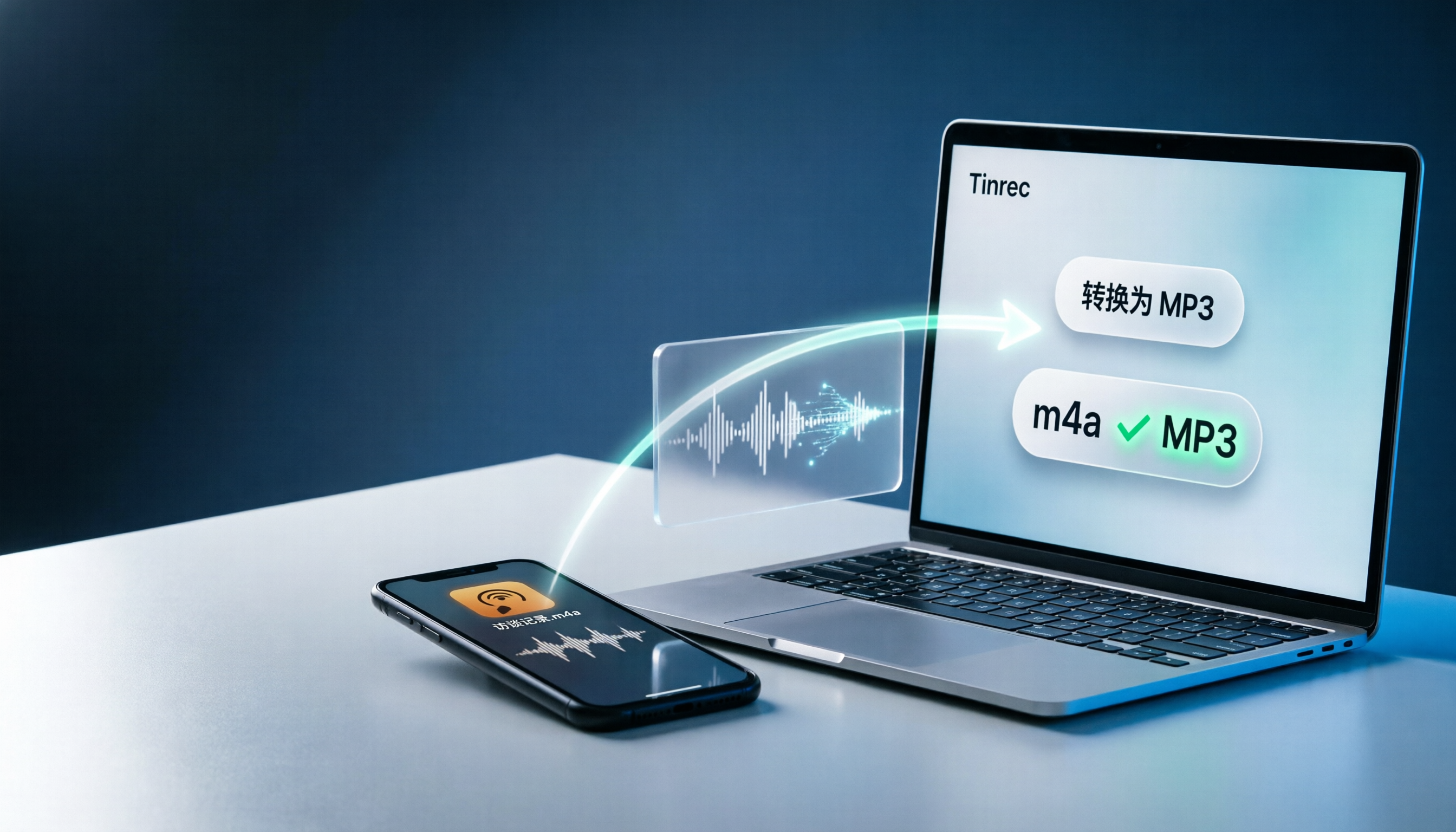
Turn recordings into transcripts and summaries in minutes
Upload audio or video for multilingual transcription, AI notes, and action items
What Format Are iPhone Voice Recordings?
When you record with the built-in Voice Memos app on iPhone, the default file format is M4A.
This isn't some hidden setting—it's been Apple's default approach since the early days of iOS. Every recording you see in Voice Memos, once exported to the Files app, will have an .m4a extension.
M4A is a type of MPEG-4 audio file that uses AAC encoding. The upside is that it offers decent sound quality while taking up much less space than WAV. But the downside is straightforward: many Windows PCs, older media players, some car stereos, and certain voice recorders don't recognize this format.
So whenever someone asks, "What format are iPhone voice recordings?" the next question is usually, "How do I convert them to MP3?"
First, Figure Out Where Your Recording Is
Before converting, you need to know where your recording is currently stored.
Scenario 1: The recording is still in the Voice Memos app and hasn't been exported.
Scenario 2: You've already exported it to the Files app—maybe in iCloud Drive, On My iPhone, or the Downloads folder.
Scenario 3: The recording has already been transferred to your computer via AirDrop, LINE, email, or iCloud web.
Confirm the location first so you don't waste effort later.
Exporting a Recording from Voice Memos
If you haven't exported yet, follow these steps:
- Open the Voice Memos app.
- Tap the recording you want to process.
- Tap the "…" or share button in the top-right corner.
- Select "Save to Files."
- Choose a folder, such as "Downloads" or iCloud Drive.
- Tap "Save."
Your recording will then appear in the Files app as an M4A file.
Honestly, this step isn't hard. The tricky part is converting M4A to MP3.
Method 1: Use an Online Converter—No Storage Needed
This option suits those who don't want to install extra apps on their computer or phone.
Here's the typical process:
- Upload the M4A file to an online audio converter website.
- Select MP3 as the output format.
- Click convert.
- Download the resulting MP3 file.
The advantage is that it works on both phone and computer without installing anything.
The downside is also clear: if your recording contains meetings, interviews, or sensitive content, uploading it to a free online service might make you uneasy. Free tools often keep files on their servers for a while, so be aware of that.
Method 2: Use Desktop Software or iTunes
If you prefer handling files on your computer, this method is reliable.
Windows users can use well-established audio converter software to import M4A and convert to MP3. macOS users can use built-in tools or third-party apps.
Stop organizing recordings by hand
Upload audio or video and automatically get a transcript, summary, and action items
The benefit is that your files don't get uploaded to someone else's server, offering better privacy.
The downside is that there are more steps, and each software interface is different. If you only convert a file occasionally, booting up your computer just for that can be a hassle.
Method 3: Use a Mobile App for Conversion
This is what I find to be the most convenient approach.
Many iOS converter apps now let you convert M4A to MP3 directly on your phone. The process is roughly:
- Select the M4A recording from the Files app.
- Choose MP3 as the output format.
- Convert.
- Save it back to the Files app or share it.
Everything happens on your phone—no need to turn on a computer or upload files to a third-party website.
If you just need the recording to play on Windows, share with colleagues, or feed into other tools, this method is more than enough.
Will the File Get Smaller After Converting to MP3?
Not necessarily.
Many people assume MP3 is always smaller than M4A. In reality, M4A's AAC encoding often produces smaller files than MP3 at the same quality level.
So if you're converting to MP3 to save space, the effect might be minimal.
If you truly want to free up space, instead of obsessing over conversion, consider deleting old recordings you no longer need. When your iPhone storage is nearly full, removing a few old recordings is more practical than converting files.
If What You Need Isn't MP3, but Text
This is another point I really want to make.
Many people convert to MP3 simply because they need to replay recordings on their computer and transcribe them. But honestly, a one-hour meeting recording could take you three hours to replay and type up.
If your goal is to organize content rather than just change formats, a more practical approach is to feed the recording directly into an AI transcription tool. Tools like Tinrec let you upload M4A or MP3 files and convert them into transcripts, complete with summaries, key points, and action items.
You don't need to convert the file yourself or listen to the entire recording again.
Summary: iPhone Recordings Are M4A—Converting to MP3 Depends on Your Needs
First, remember this: iPhone Voice Memos recordings are saved as M4A by default.
If you just need the file to play on more devices, pick any conversion method that feels convenient—mobile app, online site, or desktop software all work.
But if what you really want is "turning recording content into text," converting to MP3 isn't a necessary step. Just feed the M4A directly into an AI transcription tool, and you'll save far more time than you would researching conversion methods.
My advice: if you only convert a file occasionally, a mobile app is the easiest. If you regularly need to process meeting or interview recordings, stop worrying about MP3 and find an AI tool that can handle M4A directly.
References
- Export Voice Memos recordings to Files on iPhone - Apple Support (Taiwan)
- [Phone Tips] How to Upload/Save Voice Memos from iPhone to Computer and Convert to MP3? - Jyes Communication
- How to Convert iPhone Voice Memos to MP3? 3 Ways to Convert M4A to MP3! - Tech Girlz
- iPhone recordings too large, any smaller format? - Mobile01
- Want to Efficiently Convert iPhone Voice Memos to MP3? These AI Transcription Tools in 2026 Will Boost Your Productivity - Tinrec Blog
Turn every recording into actionable outcomes
Get 60 free transcription minutes when you sign in. No credit card required.
Related Reading
You might also like

for mac google meet: Audio Permissions, Recording, and Transcript Handoff for Google Meet on Mac
Recording Google Meet on a Mac usually gets stuck not because you cannot find the record button, but because macOS separates 'capture system audio' and 'use microphone' into two independent authorizations. This article proceeds in three parts—permission setup, recording, and post-meeting organization—explaining how to determine which layer is causing meeting audio not to be recorded, and how to organize the recording into a transcript, summary, and to-dos and hand it off to a colleague.

How to Change Your Google Meet Background on Mobile: Check Account and Version Requirements First, Then Follow the Pre-Meeting or In-Meeting Path
When you're told to join a client-facing meeting and only have your phone on hand, the last thing you want is to discover five minutes before the call that you can't find the background option. This article first explains what's required to use backgrounds on mobile (account type, app version, device permissions), then walks through two paths step by step—one before you join the meeting and one during it—and closes with a pre-meeting checklist and alternatives if you can't find the option.

Google Meet 2026 APK Installed: Choosing a Meeting Notes Tool on Android — First Look at the Mobile vs. Desktop Organization Gap
Installing the Google Meet 2026 APK is just the first step. This article uses four dimensions to narrow down meeting notes tools that claim to 'support Google Meet' to two or three options, focusing on the real-world gap between Android mobile and desktop post-meeting organization. Each dimension includes specific questions you should confirm with the product page or vendor.

Google Meet 2026 Meeting Notes Capability Review: Where Built-in Transcription Ends and How to Split Post-Meeting Action Items and Deliverables
A practical mid-level manager's review of Google Meet 2026 recording and transcription coverage, explaining the responsibility boundaries for post-meeting summaries, action items, and deliverables, with recommendations for Chinese and mixed Chinese-English meetings, data storage, and team handoffs.

Which Google Meet 2026 APK Should You Install? Android Install Source Guide, Meeting Prerequisites, and Backup Recording Handoff Order When Nothing Was Recorded
When you're assigned to join a Google Meet on an Android phone and handle post-meeting notes, first clarify whether you're attending, hosting, or responsible for organizing. Then decide whether to install from the official app store or a third-party APK source, what prerequisites are needed to sign in, and how to use audio recording and transcription in order to fill in the transcript and action items and hand them off when the meeting wasn't recorded.

Google Meet 2026 Meeting Notes Capabilities: Where Built-In Transcription Ends and How to Split Post-Meeting To-Dos and Deliverables
Google Meet 2026 recording and transcription are not automatically enabled by default, and post-meeting summaries, to-dos, and deliverables still have coverage boundaries. This article walks through the actual workflow to assess built-in platform capabilities, explains the differences in organizing Chinese and mixed Chinese-English meetings, the distinction between data storage and team spaces, and offers recommendations for dividing post-meeting to-dos, deliverables, and data storage.

How to Choose a Google Meet Note-Taking Tool for Windows: Four Dimensions to Narrow Down from Cross-Device Gaps to Two or Three Options
Meetings happen on Google Meet on a Windows PC, but organizing often gets picked up on a phone or another device. This article uses four dimensions (how audio gets in, how far post-meeting output goes, the organizing gap between Windows and phone, and whether data stays in a personal or team space) to narrow down candidate tools to two or three, with specific questions to ask product pages or vendors for each dimension.
How to Choose a Google Meet Meeting Notes Tool for PC: Narrow a Dozen Options to Two or Three with Four Dimensions, and What to Confirm with Vendors for Each
After a Google Meet call on a Windows PC, what you actually need to deliver is decisions, owners, deadlines, and an archivable record. This article uses four dimensions to help you narrow a dozen tools that claim Google Meet support down to two or three, with specific questions to confirm on product pages or with vendors for each dimension.

What You Need for Google Meet: Pre-Meeting Role Checklist and Post-Meeting Handoff
From the perspective of administrative assistants and project coordinators, this guide breaks down the prerequisites for joining or hosting a Google Meet by role, including account requirements, organizational settings, recording permissions, and extra conditions for external attendees. It also provides a pre-meeting checklist and a post-meeting handoff sequence for transcripts, decisions, and action items.