
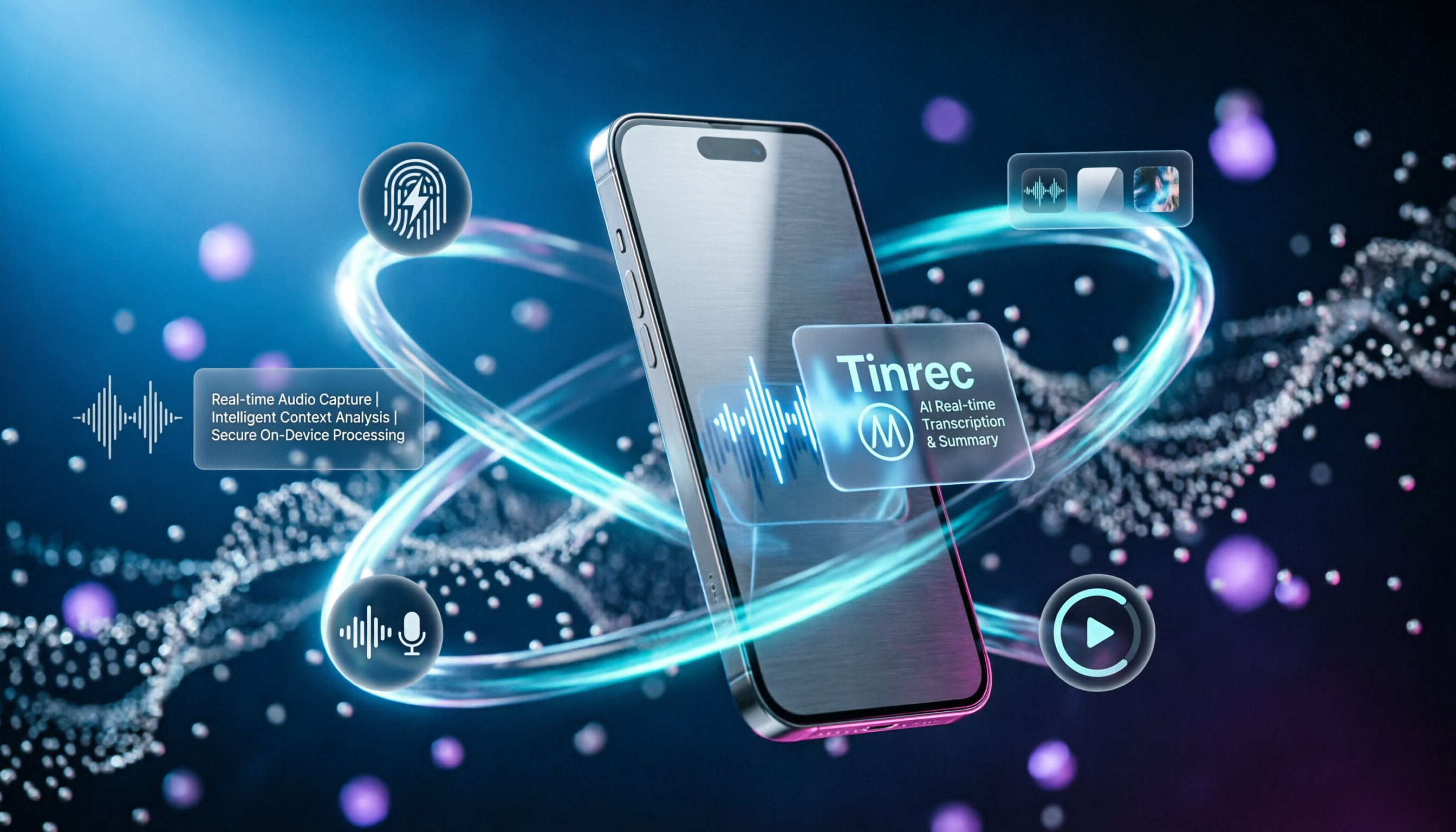
Turn recordings into transcripts and summaries in minutes
Upload audio or video for multilingual transcription, AI notes, and action items
What You Need Isn't Just "Recording"—It's "Capturing the Moment"
Many iPhone users have experienced this: the meeting has already started for 5 minutes, and you're still flipping through your home screen trying to find where "Voice Memos" is tucked away. Once you find it and hit the record button, the key points are already gone.
What's more troublesome is what happens after recording. The built-in Voice Memos app can capture audio, but if you need a transcript, meeting highlights, or action items, a raw audio file means you'll have to listen to the whole thing again when you get home.
This article will first show you 4 ways to quickly start recording on iPhone, then help you decide: do you just need to "record it," or do you need "the recording to become usable data right away"?
Before Choosing a Recording Method, Consider These 3 Things
Are You Recording "Live Audio" or "Online Meetings"?
The built-in iPhone recorder is great for capturing live ambient sound, such as interviews, classes, or face-to-face discussions. However, if you're recording online meetings like Zoom, Google Meet, or Teams, iPhone recording is limited by speaker playback and usually yields poor results. In such cases, it's better to use a desktop recording tool that captures system audio directly.
After Recording, Do You Want "Audio" or "Text"?
If you just need to replay a conversation, Voice Memos is sufficient. But if you need to produce meeting minutes, organize interview highlights, or find out "who said the budget needs to be cut last time," a raw audio file will force you to spend hours manually re-listening.
Will You Need to Continue Working on Different Devices?
If you record on iPhone and then need to transfer the file to your computer for editing or share it with colleagues, the back-and-forth file transfer can be annoying. Some tools support cloud sync and cross-device editing, while others only store files on your phone.
Built-in iPhone Recording: 4 Quick Launch Methods
Method 1: Open the "Voice Memos" App Directly
The most basic approach. Voice Memos is located in the "Utilities" folder on iPhone. Tap the red record button to start, and tap "Done" when finished—it will be saved automatically.
By default, recordings are named "New Recording" or based on your location. You can tap the recording name to rename it for easier searching later.
Method 2: Back Tap to Start Recording
This trick is ideal for situations where you need to start recording "discreetly" or "with one hand." Here's how to set it up:
- Go to "Settings" > "Accessibility" > "Touch" > "Back Tap."
- Choose "Double Tap" or "Triple Tap."
- Scroll down to the "Shortcuts" section and find "Start Recording."
Once set up, just double-tap or triple-tap the back of your iPhone to start recording immediately.
Note that Back Tap requires you to create a corresponding shortcut first. You can add an action in the "Shortcuts" app: search for "Voice Memos," select "Start Recording," and then Back Tap will recognize this option.
Method 3: Add Recording to Control Center (iOS 18 or Later)
If you're used to swiping down from the top-right corner to open Control Center, you can add the recording function there. Steps:
- Swipe down to open Control Center.
- Long-press on an empty area to enter edit mode.
- Tap "Add a Control."
- Search for "Voice Memos" and add it.
After that, just swipe down Control Center and tap the recording icon to start.
Method 4: Lock Screen Shortcut (iOS 18 or Later)
iOS 18 allows you to customize the two shortcuts at the bottom of the Lock Screen. By default, they are "Camera" and "Flashlight," but you can change one of them to "Voice Memos."
Once set, you can long-press the recording icon on the Lock Screen to start recording with one tap, without unlocking your phone. This is especially useful for situations that require quick reactions.
Tinrec (秒听录音): If You Need More Than Just an Audio File
One-Line Positioning
Tinrec is an AI meeting notes and collaboration tool that supports iOS, Android, desktop, and web. It doesn't just record—it converts recordings into transcripts, summaries, and action items, and lets you ask follow-up questions about the meeting content.
After Recording, Tinrec Does 3 Extra Things
With iPhone Voice Memos, you get an audio file. With Tinrec, after recording or importing an audio file, it automatically generates a transcript and summary. If you have a 2-hour meeting, you don't need to re-listen to 2 hours—just read the summary to grasp the key points.
Stop organizing recordings by hand
Upload audio or video and automatically get a transcript, summary, and action items
Even better is the AI Q&A feature. You can directly ask Tinrec: "Who mentioned the budget in this meeting?" It understands the meeting content semantically and gives you the answer directly, rather than just throwing keyword search results at you. This is especially useful for historical recordings—you don't need to remember which day you recorded it; just remember "someone mentioned something," and you can ask.
Tinrec also supports exporting results to tools like Notion, Google Docs, and OneNote. Once your meeting notes are organized, you can send them straight into your existing workflow without copy-pasting.
No Extra Hardware, Cross-Device Use
Some AI recording solutions require purchasing dedicated recording hardware, such as the PLAUD NotePin or Note Pro, priced around USD 159 to 189, with membership plans sold separately. Tinrec doesn't require extra devices—you can use it on your phone, computer, or web. If you only record meetings occasionally, there's no need to buy an extra machine just for recording.
Limitations Should Be Stated Clearly
Tinrec's free version has basic usage limits, and heavy users will need to pay. Accuracy can be affected by recording quality, background noise, accents, and overlapping speech, so it's not recommended as a 100% accurate transcription tool. For important content, you should still replay the recording to verify.
Who Is It For?
If you only record a memo occasionally, the built-in iPhone Voice Memos is more than enough. But if you have meetings every week, need to organize notes after recording, or want to quickly find key points from a pile of historical recordings, AI recording tools like Tinrec can save you a ton of time re-listening and manually organizing.
Beyond Tinrec: What Other Options Are There?
Otter.ai
A mature choice for English meeting scenarios. The free plan offers 300 minutes per month, which is generous for light users. However, Chinese meeting support isn't its strong suit, making it suitable for those who primarily record English content. If you only need English transcripts, Otter.ai might even be more cost-effective than Tinrec; but if your meetings are mixed Chinese-English or primarily Chinese, Tinrec will be smoother.
Notta
Positioned similarly to Tinrec, also supporting multi-platform transcription and translation. Notta excels at document transcription and subtitle processing, but Tinrec offers more complete AI Q&A and team knowledge management capabilities. If you're an individual user who just needs to convert audio to text, Notta is worth considering; if you need to ask follow-up questions about meeting content and organize action items, Tinrec is a better fit.
PLAUD NotePin
A hardware recording solution. Its advantages are portability and long battery life—you don't need to pull out your phone. But the downside is the extra cost for the device, and hardware recording can't directly handle online meetings. Tinrec doesn't require extra hardware, and its desktop version can record system audio from Zoom, Meet, and Teams without a bot.
Pitfall Guide: 3 Most Common iPhone Recording Mistakes
Mistake 1: Relying Only on Built-in Recording but Expecting Meeting Notes
Voice Memos is a good tool, but its job is "recording," not "organizing." If you need transcripts or meeting summaries, you'll have to figure out how to process it after recording. Instead of recording first and then looking for a transcription tool, it's better to choose an integrated recording-plus-transcription solution from the start.
Mistake 2: Placing Your Phone Next to the Computer Speaker When Recording Online Meetings
This is something many people do, but it works poorly. The phone's microphone picks up speaker playback along with ambient noise, resulting in muffled audio. For online meetings, you should use a desktop tool to capture system audio directly—the sound quality is much cleaner, and you won't pick up keyboard clicks either.
Mistake 3: Not Naming or Organizing Recordings, Then Can't Find Them Three Months Later
The default name for iPhone Voice Memos is "New Recording." If you record a dozen clips without renaming them, finding a specific meeting later becomes a nightmare. Get into the habit: rename immediately to "Date + Topic," or use a tool with automatic summaries so at least each recording has some context.
Summary: Which One Should You Choose?
If you need to "quickly capture live audio," the built-in iPhone Voice Memos, combined with Back Tap or Lock Screen shortcuts, is sufficient.
If you need "no re-listening after recording, direct transcripts and highlights, and searchable meeting history," then Tinrec is a more complete choice:
- Primarily Chinese meetings, don't want to wrestle with an English interface → Tinrec
- Want to ask AI "What was the meeting conclusion?" after recording → Tinrec
- Need cross-device use across phone, computer, and web → Tinrec
- Only recording English, zero budget → Otter.ai free plan
We recommend starting with the built-in iPhone recorder to confirm whether your need is "recording" or "organizing." If you find yourself manually re-listening and typing transcripts every time, try Tinrec's free version to experience the workflow of recording plus AI organization, then decide whether to pay.
References
- iPhone Recording Made Easy: One-Tap Quick Capture for Critical Moments
- Record audio in Voice Memos on iPhone - Apple Support (Taiwan)
- Record audio and video on iPhone - Apple Support (Taiwan)
- r/iphone on Reddit: How do you record voice on your iPhone?
- iPhone Recording Shortcut Setup Guide: 3 Ways to Quickly Start Recording - Tech Girlz
Turn every recording into actionable outcomes
Get 60 free transcription minutes when you sign in. No credit card required.
Related Reading
You might also like

for mac google meet: Audio Permissions, Recording, and Transcript Handoff for Google Meet on Mac
Recording Google Meet on a Mac usually gets stuck not because you cannot find the record button, but because macOS separates 'capture system audio' and 'use microphone' into two independent authorizations. This article proceeds in three parts—permission setup, recording, and post-meeting organization—explaining how to determine which layer is causing meeting audio not to be recorded, and how to organize the recording into a transcript, summary, and to-dos and hand it off to a colleague.

How to Change Your Google Meet Background on Mobile: Check Account and Version Requirements First, Then Follow the Pre-Meeting or In-Meeting Path
When you're told to join a client-facing meeting and only have your phone on hand, the last thing you want is to discover five minutes before the call that you can't find the background option. This article first explains what's required to use backgrounds on mobile (account type, app version, device permissions), then walks through two paths step by step—one before you join the meeting and one during it—and closes with a pre-meeting checklist and alternatives if you can't find the option.

Google Meet 2026 APK Installed: Choosing a Meeting Notes Tool on Android — First Look at the Mobile vs. Desktop Organization Gap
Installing the Google Meet 2026 APK is just the first step. This article uses four dimensions to narrow down meeting notes tools that claim to 'support Google Meet' to two or three options, focusing on the real-world gap between Android mobile and desktop post-meeting organization. Each dimension includes specific questions you should confirm with the product page or vendor.

Google Meet 2026 Meeting Notes Capability Review: Where Built-in Transcription Ends and How to Split Post-Meeting Action Items and Deliverables
A practical mid-level manager's review of Google Meet 2026 recording and transcription coverage, explaining the responsibility boundaries for post-meeting summaries, action items, and deliverables, with recommendations for Chinese and mixed Chinese-English meetings, data storage, and team handoffs.

Which Google Meet 2026 APK Should You Install? Android Install Source Guide, Meeting Prerequisites, and Backup Recording Handoff Order When Nothing Was Recorded
When you're assigned to join a Google Meet on an Android phone and handle post-meeting notes, first clarify whether you're attending, hosting, or responsible for organizing. Then decide whether to install from the official app store or a third-party APK source, what prerequisites are needed to sign in, and how to use audio recording and transcription in order to fill in the transcript and action items and hand them off when the meeting wasn't recorded.

Google Meet 2026 Meeting Notes Capabilities: Where Built-In Transcription Ends and How to Split Post-Meeting To-Dos and Deliverables
Google Meet 2026 recording and transcription are not automatically enabled by default, and post-meeting summaries, to-dos, and deliverables still have coverage boundaries. This article walks through the actual workflow to assess built-in platform capabilities, explains the differences in organizing Chinese and mixed Chinese-English meetings, the distinction between data storage and team spaces, and offers recommendations for dividing post-meeting to-dos, deliverables, and data storage.
How to Choose a Google Meet Note-Taking Tool for Windows: Four Dimensions to Narrow Down from Cross-Device Gaps to Two or Three Options
Meetings happen on Google Meet on a Windows PC, but organizing often gets picked up on a phone or another device. This article uses four dimensions (how audio gets in, how far post-meeting output goes, the organizing gap between Windows and phone, and whether data stays in a personal or team space) to narrow down candidate tools to two or three, with specific questions to ask product pages or vendors for each dimension.
How to Choose a Google Meet Meeting Notes Tool for PC: Narrow a Dozen Options to Two or Three with Four Dimensions, and What to Confirm with Vendors for Each
After a Google Meet call on a Windows PC, what you actually need to deliver is decisions, owners, deadlines, and an archivable record. This article uses four dimensions to help you narrow a dozen tools that claim Google Meet support down to two or three, with specific questions to confirm on product pages or with vendors for each dimension.

What You Need for Google Meet: Pre-Meeting Role Checklist and Post-Meeting Handoff
From the perspective of administrative assistants and project coordinators, this guide breaks down the prerequisites for joining or hosting a Google Meet by role, including account requirements, organizational settings, recording permissions, and extra conditions for external attendees. It also provides a pre-meeting checklist and a post-meeting handoff sequence for transcripts, decisions, and action items.