

Turn recordings into transcripts and summaries in minutes
Upload audio or video for multilingual transcription, AI notes, and action items
Want to Record a Meeting but Afraid of Being Noticed? You Don't Need a Smaller Recorder—You Need a Less Disruptive Solution
During a Wednesday afternoon video call, a client verbally agreed to a key condition. You want to save that statement as evidence, but the thought of a "Recording" indicator popping up on screen or an unfamiliar bot account suddenly appearing in the participant list makes you quietly pull your hand back.
In-person meetings are the same. You place your phone on the table and press record. That red waveform and ticking timer on the screen are visible to anyone glancing your way, and the relaxed conversation instantly becomes guarded.
There's an even more common scenario: you recorded the entire meeting, and a 40-minute audio file sits on your phone. Later, when you want to find out "who said the budget should be cut in half," you have to fast-forward from the beginning to the end.
These three frustrations point to the same thing—you don't just need the act of "recording"; you need an approach that doesn't disrupt during the meeting and is immediately usable afterward.
Before Choosing a Meeting Recording Tool, Understand These 4 Key Points
First, will the recording method alert the other party? Common approaches fall into two camps: one sends a "meeting bot" to join as a participant, visible to everyone in the list; the other captures system audio directly from your computer without adding any participants. The former will definitely be noticed; the latter is truly low-key.
Second, the recognition experience for Chinese meetings. Many tools perform well in English meetings but show gaps when it comes to Chinese mixed with English, or the speaking pace and word choices of Taiwanese speakers. When choosing a tool, test it with your own meeting recordings—don't just look at official numbers.
Third, will it retain your audio files? Some tools only keep the text and delete the original audio. Later, when you need to verify tone or context, the absence of audio can be a real hassle.
Fourth, can you use it immediately after recording? A transcript is just the starting point. Whether it can automatically generate summaries, extract action items, and let you ask questions directly afterward determines how much time you'll spend on post-processing.
Tinrec—Our Top Pick After Testing
Tinrec is an AI meeting notes and collaboration tool for individuals and teams, available on iOS, Android, web, and desktop. Its key differentiator lies in the "recording method."
Tinrec's desktop version captures your computer's system audio directly, without inviting any meeting bot. When you're in a Zoom, Google Meet, Microsoft Teams, or Webex meeting, no stranger appears in the participant list, and no third-party tool notifications pop up on screen. For the need to "record a meeting without being noticed," this is currently the least disruptive approach.
While recording, Tinrec generates a transcript in real time. If there's foreign language content in the meeting, you can enable live translation and view it in original, translated, or bilingual mode—no need to find a separate translator for cross-language meetings.
After the meeting is where it truly saves time. Tinrec automatically generates summaries and chapters, breaking long discussions into easy-to-browse sections, and organizes action items—who is responsible for what and when it's due—right in front of you. Even better is the AI Q&A: you can ask directly about the meeting record, such as "What were the client's concerns about pricing?" It answers based on semantic understanding rather than dumping keywords for you to sift through.
We tested it in two environments: a quiet home office and a typical meeting room with air conditioning noise and occasional foot traffic. The noisier the environment, the more noticeable the differences between tools—which is why we recommend running your own recording rather than just reading spec sheets.
A few honest points upfront. Tinrec's free version offers basic quota to experience recording, importing, summaries, and transcription; if you have weekly meetings to organize, you'll need to consider a paid plan. Also, transcription quality is affected by recording quality, accents, overlapping speech, and technical jargon—true for any tool. For important content, we recommend cross-checking with audio playback.
Stop organizing recordings by hand
Upload audio or video and automatically get a transcript, summary, and action items
If you're using it as a team, Tinrec's team plan centralizes meeting data in a shared team space. Data belongs to the team and won't disappear when an individual leaves. Admins can assign seats, view usage trends and activity logs, and transfer resources when members leave. Currently, the team monthly plan is USD 29.80 per paid seat per month, and the annual plan is USD 199 per paid seat per year (about USD 16.58 per month). Eligible teams get a 7-day trial including 1 free seat and 300 shared import minutes.
Besides Tinrec, What Other Options Are There?
PLAUD Note / NotePin: A representative of AI recording hardware, lightweight and portable, also supports phone call recording. Currently, NotePin is priced at USD 159 and Note Pro at USD 189. The advantage is device battery life and mobility, but it requires an extra hardware purchase, and its flexibility for online meetings is less than recording directly from a computer. Consider it if you often record in situations without a computer; if you want a complete record of an online meeting from start to finish plus post-meeting organization, Tinrec is more direct.
Granola: An AI meeting notes tool that also takes the "no bot" approach, capturing system audio via desktop and combining it with your handwritten notes to generate meeting content. Basic is free, Business is USD 14 per user per month. Note that Granola does not support uploading pre-recorded audio files and does not retain the original meeting audio. If you need to supplement recordings, listen back afterward, or organize old phone recordings, Tinrec fills that gap.
Otter.ai: A veteran choice for English business meetings. Basic free plan offers 300 minutes per month; Pro annual billing is about USD 8.49 per user per month. It also has desktop capabilities, not just meeting bots. If your meetings are almost entirely in English and your team is used to its interface, it's still worth considering. But if meetings are primarily in Chinese, or you need mixed Chinese-English transcripts and live translation, Tinrec's Chinese experience will be more aligned with your needs.
Pitfall Guide: The 4 Most Common Recording Mistakes
Pitfall 1: Assuming "secret recording" is problem-free. This is the most important reminder. Recording responsibility depends on "purpose" and "setting." Under Article 315-1 of Taiwan's Criminal Code, secretly recording others' non-public activities without justification may constitute the offense of breach of privacy. Even if the method is legal, if the purpose is fraud, intimidation, or theft of trade secrets, you could go from self-protection to defendant. In practice, the safer line is usually when you are a party to the conversation, the purpose is self-protection or evidence gathering, and the setting is public or one you are participating in. Truly privacy-disputing practices, such as secretly installing a recorder in a non-public place, carry the highest risk. For major disputes, always consult a lawyer.
Pitfall 2: Ignoring that "meeting bots show up." Many people think using a meeting bot to record is stealthy, but it appears as a separate account in the participant list, visible to the host and everyone else. To stay low-key, choosing a tool that captures system audio from your computer is much more reasonable.
Pitfall 3: Only looking at free minutes. Free quota matters, but focusing solely on the number can be misleading. Also consider: maximum length per recording, ability to upload existing files, availability of summaries and action items, and what happens when quota runs out. Some tools have impressive free minutes but lock key features behind a paywall.
Pitfall 4: Treating the transcript as the end goal. If all you get after recording is a transcript, you're only using a third of the tool's capability. Just being able to "ask it directly what the conclusion was" can save you from manually scrolling through a 40-minute transcript.
Conclusion: Which One Should You Choose?
If what you care about is recording meetings without interrupting the flow or alerting others, the core answer is clear: choose a tool that is "bot-free and captures system audio from your computer."
- Want low-key recording for online meetings + automatic post-meeting organization → Tinrec (desktop bot-free recording, with transcript, summary, action items, and AI Q&A all in one)
- Need mixed Chinese-English or cross-language meetings → Tinrec (supports live translation and bilingual view)
- Have old phone recordings or interview audio to organize → Tinrec (can upload audio and video files)
- Team needs centralized meeting data management and usage tracking → Tinrec Team Plan (team space, seat management, usage analytics, activity logs)
- Often record in situations without a computer → PLAUD recording hardware (requires additional device purchase)
- Meetings are almost entirely in English, team is used to existing workflow → Otter.ai (300 free minutes per month)
One final reminder: before recording, confirm that you are a party to the conversation and that your purpose is legitimate. Tools can help turn meetings into reusable data, but whether it's legal and whether you should record is still your call.
We suggest starting with Tinrec's free version, running it on a real meeting you have, and seeing if the transcript and summary quality meet your needs before deciding whether to go further.
References
- How to Record on iPhone Without Being Noticed? Use Shortcuts with Tap to Trigger Secret Recording - Mr. Mad
- How to Record Calls on iPhone? Can It Be Undetected? 5 Recording Tutorials at Once - Apple Almond
- 6 Secret Voice Recorder Apps for Android and iOS Recommended by Wondershare Filmora
- 5+ Practical Life Tips for Secret Recording! Workplace Recording and Phone Recording Legal and Illegal Situations
- 4 Ways to Hide Voice Recording on iPhone Lock Screen
Turn every recording into actionable outcomes
Get 60 free transcription minutes when you sign in. No credit card required.
Related Reading
You might also like

2026 iPhone Call Recording Showdown: Tinrec vs PLAUD Note — Which One Fits Your Workflow?
iPhone has built-in call recording starting with iOS 18.1, but the real time sink is turning those recordings into transcripts, summaries, and action items. This article first answers whether you can record calls on iPhone using official sources, then compares Tinrec and PLAUD Note across five dimensions: hardware requirements, meeting scenarios, post-call organization, Chinese-language experience, and team collaboration, so you can decide which approach better fits your workflow.
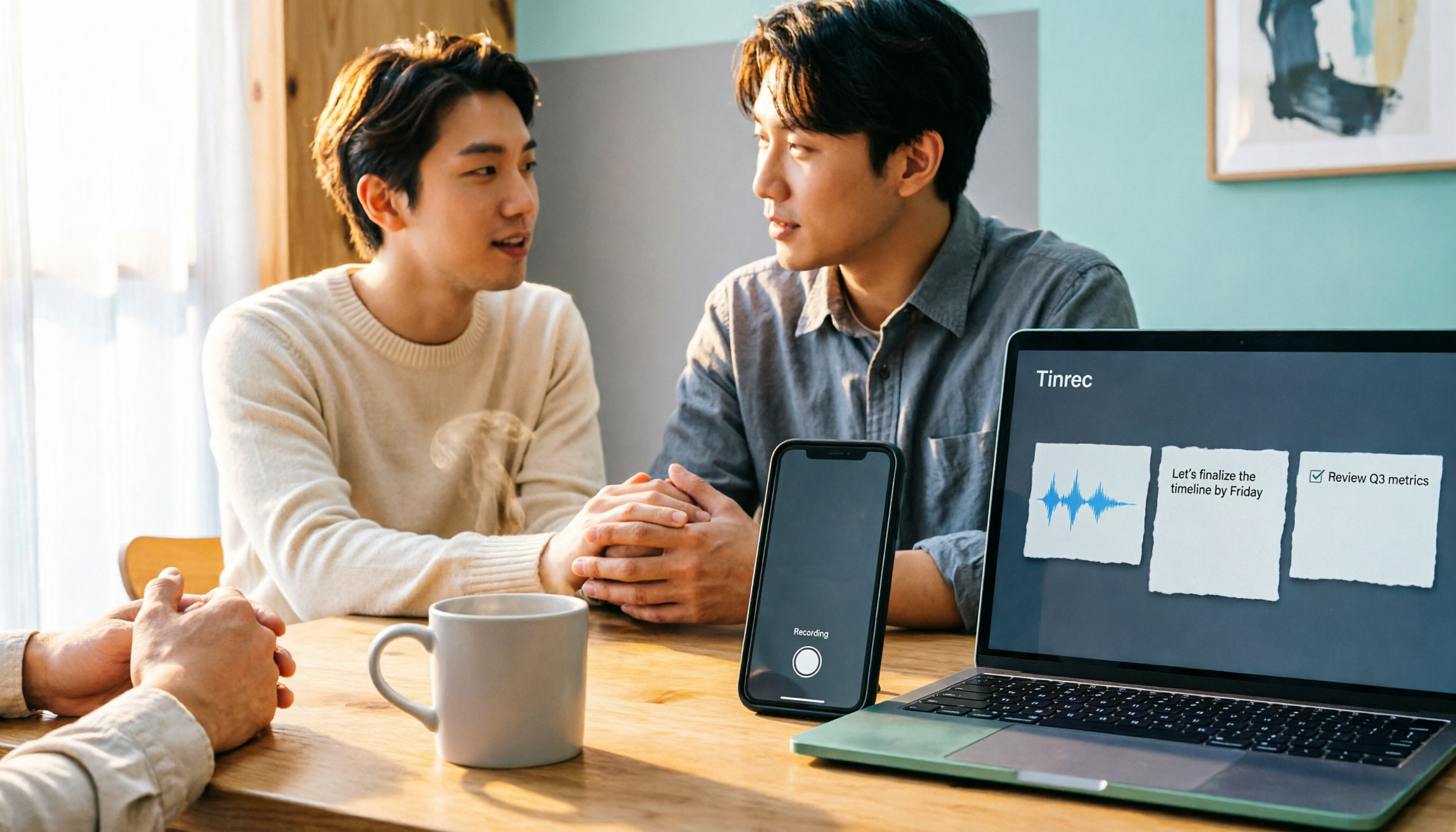
3 iPhone 17 Screen Recording and Post-Meeting Solutions Compared: From Control Center Setup to Tinrec
Screen recording on iPhone 17 isn't hard—it's what comes after that's tricky. This guide walks you through adding Screen Recording to Control Center, enabling the microphone, and stopping and saving your recording. Then we compare built-in screen recording, Dual Capture, and Tinrec for post-meeting organization, so you can see which fits your workflow.

4 Windows 11 Recording Tools Compared in 2026: Do Built-in Features Cut It for Meeting Transcripts and Summaries?
How do you record audio on Windows 11? This article compares four approaches: the built-in Sound Recorder, Xbox Game Bar, Stereo Mix with free software, and Tinrec. It explains the key settings for capturing system audio, the differences between transcripts and meeting summaries, and gives clear recommendations based on your use case.

Tinrec vs Notta 2026: 5-Dimension Comparison of AI Meeting Assistants
A mid-level manager overseeing a 10-person team and 15 weekly meetings puts Tinrec and Notta head-to-head across 5 dimensions: recording methods, Chinese and mixed-language experience, post-meeting workflow, team governance, and plan quotas, with honest limitations and use cases.

4 Cantonese Speech-to-Text Tools Tested for 2026: Which Saves More Time on Transcripts and AI Meeting Notes?
The hardest part of a Cantonese meeting isn't understanding it—it's turning what you heard into written form. This hands-on comparison of Tinrec, Notta, Granola, and TurboScribe examines their differences in Chinese and Cantonese meeting transcription, post-meeting summaries, AI Q&A, and team collaboration. We break down each tool's free tier, pricing, and limitations, plus key buying factors and pitfalls to avoid, so you can pick the one that truly saves you cleanup time.
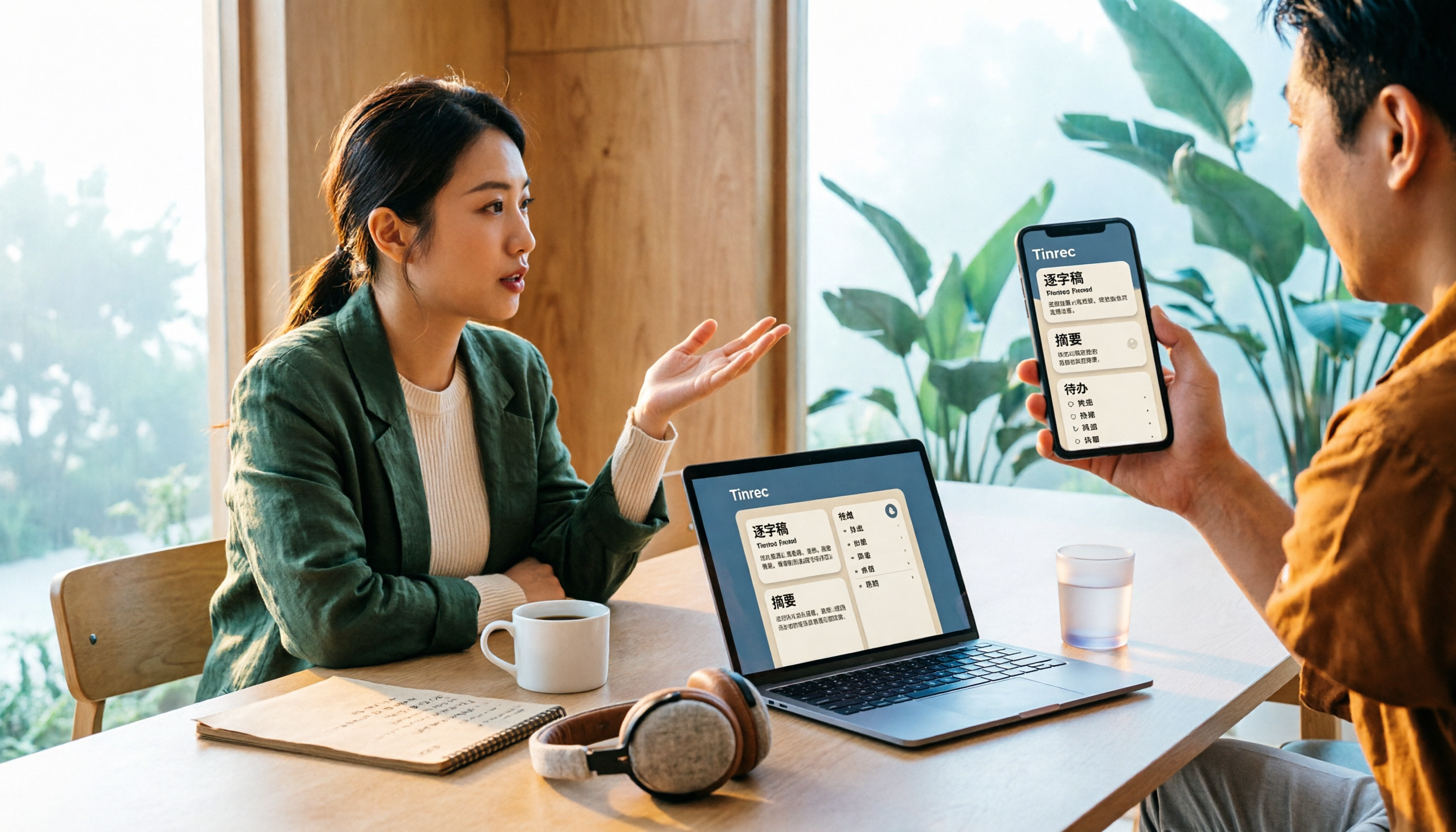
5 Best iPhone Screen Recording with Audio Solutions in 2026: Built-in vs Tinrec vs Otter vs Notta vs TurboScribe
Can iPhone screen recording capture audio? Yes, it can record both system audio and microphone sound. This guide covers the actual settings for built-in screen recording, why there's no sound, and tests importing recordings into Tinrec for transcripts, summaries, and action items—making screen recordings not just usable but searchable and collaborative meeting materials.

Can You Record Phone Calls Freely in 2026? 5 Steps for Legal Recording and Organizing
You can't just record phone calls whenever you want. This article first helps you understand the legal and system notification mechanisms for call recording, then explains in 5 steps how to record legally and how to organize recordings afterward, and compares the differences between Tinrec and PLAUD Note in post-recording workflows.
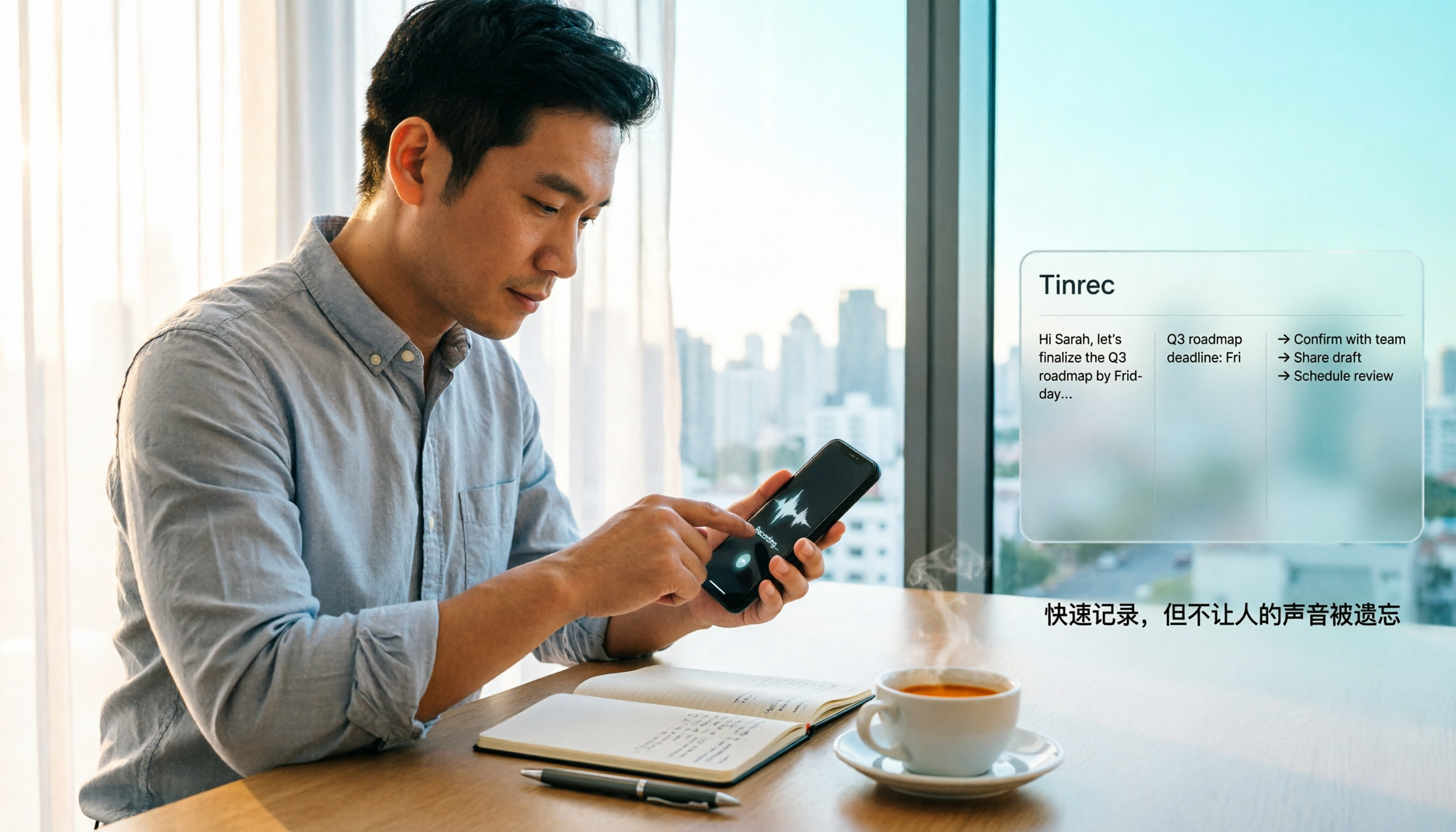
How to Quickly Start Recording on iPhone in 2026: 3 Shortcuts + Auto-Organize After Recording
iPhone has a one-tap recording method, but the settings are buried. This guide covers 3 ways to quickly start recording: Action Button, Back Tap, and Shortcuts on Home Screen. It also explains how to use Tinrec to turn recordings into transcripts, summaries, and to-dos, so quick recording actually saves time instead of piling up unheard audio files.
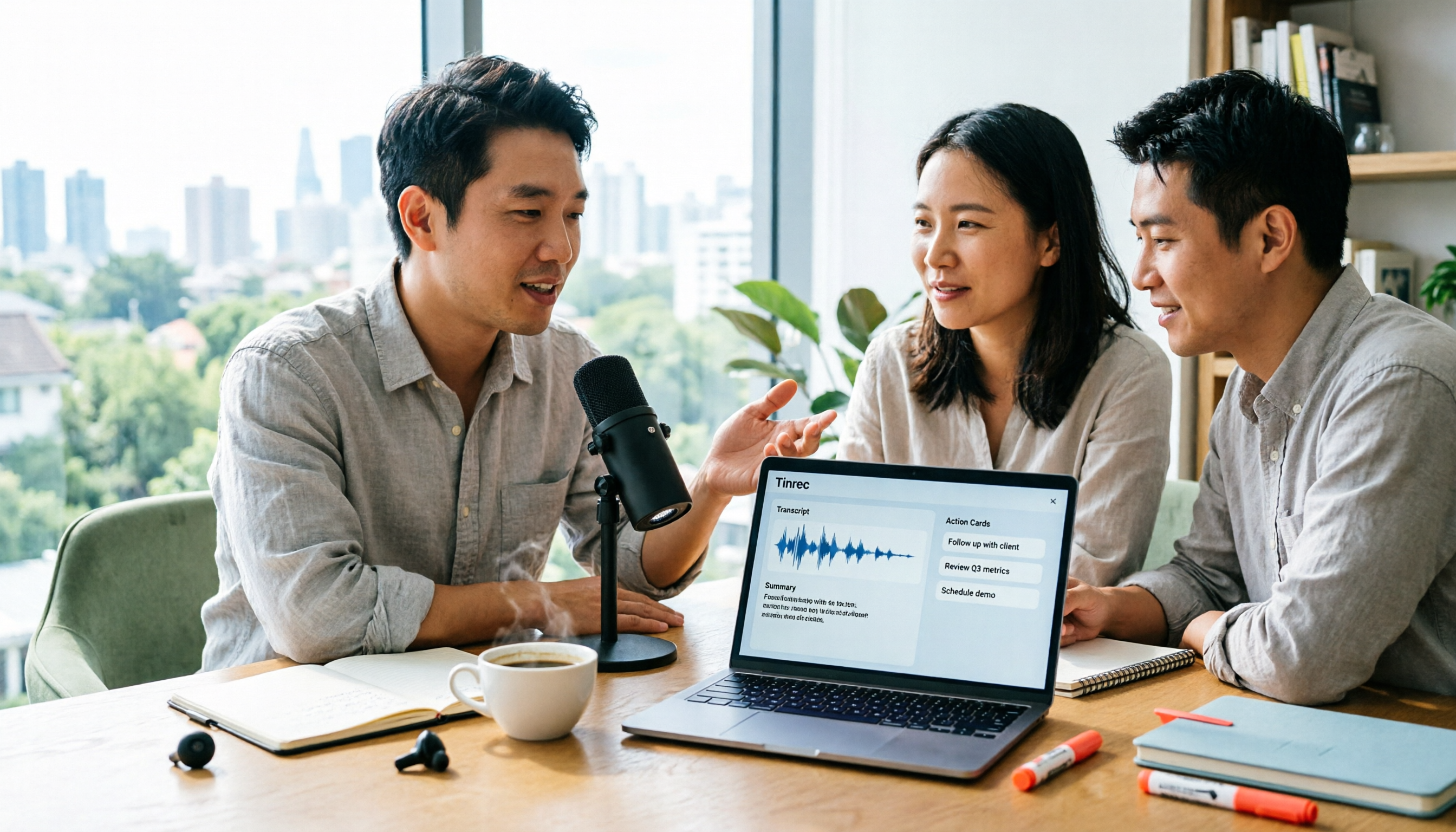
2026 Mac Audio-to-Text Showdown: Beyond Built-in Voice Memos, Why Tinrec Saves More Time
Apple's built-in Voice Memos can record, store, and edit audio, but after recording, you still have to create transcripts, summaries, and to-do lists yourself. This article compares Mac's built-in recording with Tinrec, explaining how bot-free online meeting recording, AI summaries, action item extraction, AI Q&A, and team spaces fill the post-recording workflow gap.