

Turn recordings into transcripts and summaries in minutes
Upload audio or video for multilingual transcription, AI notes, and action items
2026 Real-Time Transcription Tools Compared: Chinese Recognition, AI Q&A, and Free Tiers
At 2 PM, people file out of the meeting room, and you have a 90-minute recording on your phone.
To turn it into a deliverable meeting summary, you'd have to put on headphones, replay, pause, type, and usually spend another two or three hours.
What's worse, some interviews, client calls, and impromptu discussions can't be redone. You need to capture the content in the moment, not slowly piece it together afterward.
That's why "real-time transcription" has become so popular in recent years. This article rounds up several common tools, including my hands-on experience, differences in free tiers, and the most easily overlooked aspects when choosing one.
Why "Real-Time" Makes a Bigger Difference Than You Think
Many people assume transcription tools are all the same—just "upload audio, wait for text."
But real-time transcription solves a different problem: you're on-site and need to see text as you speak.
For example, in an online meeting, you listen to the other person while checking the transcript to confirm key numbers; or during an interview, you want to mark important sections immediately, not look back three hours later.
Tools that transcribe afterward are good for organizing already-recorded archives. Real-time tools handle content that's happening now.
If your work involves one or two meetings a day, you actually need both capabilities. Before choosing a tool, think about which scenario you encounter more often.
4 Key Points to Understand Before Choosing a Real-Time Transcription Tool
First, recognition performance for Chinese and mixed Chinese-English. Meetings in Taiwan are rarely pure Chinese. Half the sentences are in Chinese, interspersed with product roadmap, deadline, KPI—this mixed context is the ultimate test. I suggest trying your own recordings directly, not just relying on official claims.
Second, beyond real-time, can it be used afterward? Transcription is just the starting point. The real time-consuming part is organizing—extracting key points, writing summaries, listing action items. If the tool just dumps a wall of text, you still have to read through it yourself.
Third, does it require extra equipment or a meeting bot? Some tools require adding a bot to the meeting room, while others use a desktop app to capture computer audio directly. The former appears in the participant list, the latter doesn't—a clear practical difference.
Fourth, free tier and team collaboration. Whether the free version is enough depends on your meeting hours. If it's a tool for team use, you also need to consider whose account the data is under and whether it remains after a member leaves.
Tinrec — The Smoothest One in Practice
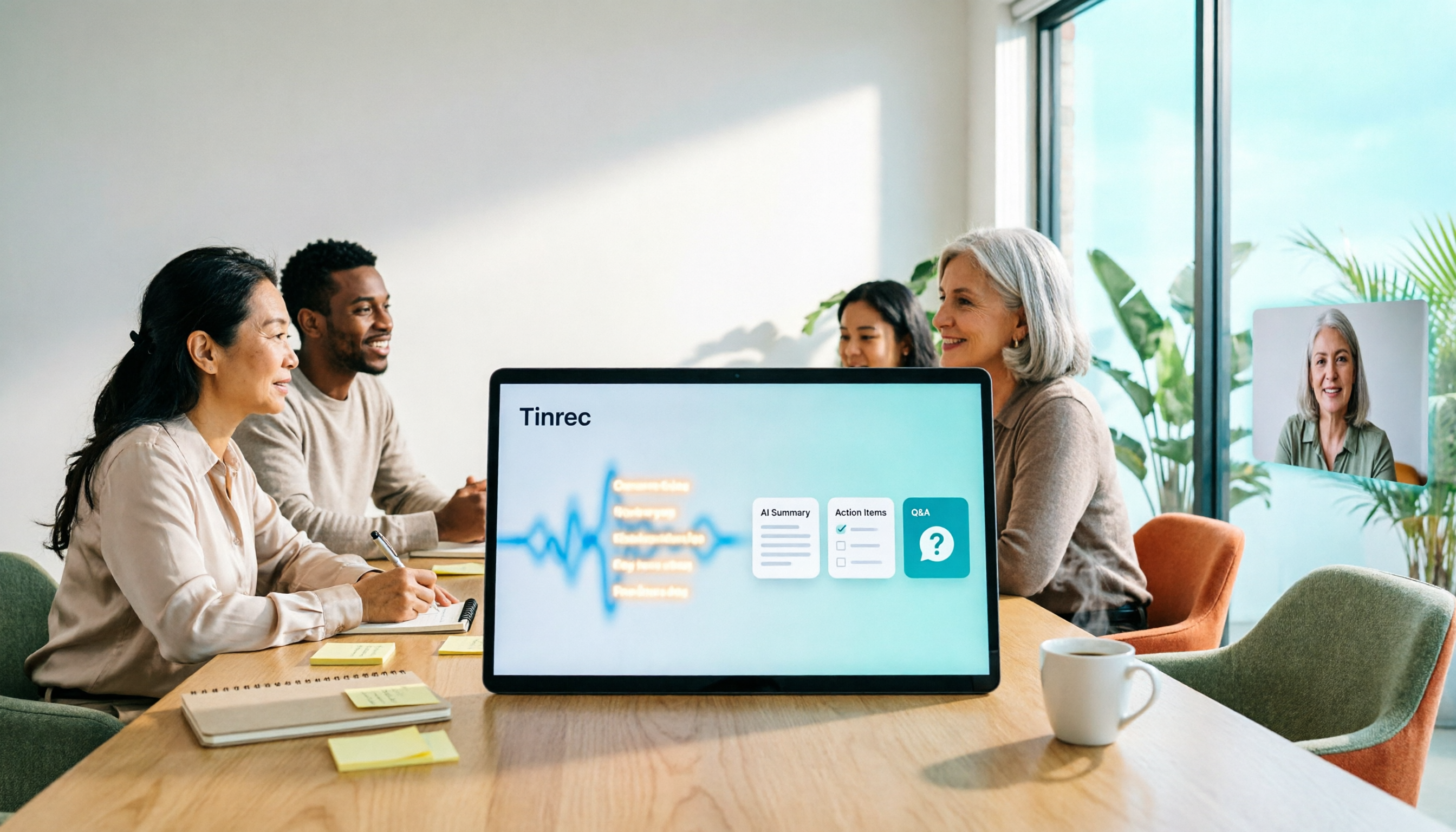
Tinrec is an AI meeting notes and collaboration tool for individuals and teams, supporting real-time recording to text, online meeting transcription, audio and video file import, and covering web, desktop, and mobile.
It doesn't just convert sound to text; it turns meetings into usable data.
During the meeting, it transcribes as you record. Open Tinrec to start recording or initiate meeting recording, and the transcript appears on screen in real time. For cross-language meetings, you can see both original and translation simultaneously, using bilingual comparison to confirm accuracy.
After the meeting, it organizes for you. This is where I find it saves the most time. After recording, Tinrec automatically generates summaries, chapters, and action items—who's responsible for what, what to follow up on next, all listed. Long meetings are split into sections, so you don't have to scroll from start to finish.
After recording, you can ask directly. This is where Tinrec differs most from ordinary transcription tools. You can ask questions about the meeting content, such as "What was the conclusion of the last meeting?" or "What concerns did the client mention?" It gives answers based on semantics, not a list of keyword search results. The more historical meetings accumulate, the more useful this feature becomes.
Stop organizing recordings by hand
Upload audio or video and automatically get a transcript, summary, and action items
No bot needed for online meetings. Tinrec's desktop version directly captures system audio, handling Zoom, Google Meet, Microsoft Teams, Webex, and other online meetings without adding an extra bot to the meeting room. No unfamiliar account appears in the participant list.
Output and collaboration. Organized results can be exported to common formats and taken to Notion, Google Docs, OneNote, Dropbox for further use. The team version centralizes meeting data in a team space, allowing members to view and reuse historical content, and administrators to manage roles, seats, usage, and audit logs.
Things to note. The free version provides basic quota to experience recording, import, summary, and transcription; once used up, you need to upgrade. If you have many meetings every week, you'll need a paid plan. Also, recording and transcription involve others' privacy; remember to comply with local regulations and obtain consent when necessary.
Who it's for. If you frequently handle Chinese or mixed Chinese-English meetings, want to ask key points directly after recording, and need to centrally manage meeting data from phone and computer, Tinrec is a very smooth choice in practice.
Besides Tinrec, What Other Options Are There?
Otter.ai A mature choice for English business meetings, with a free tier of 300 minutes per month and complete AI summaries and team features. If your meetings are almost entirely in English, it works well; but if your main focus is Chinese and mixed Chinese-English content, Tinrec's experience in Chinese meeting organization and team data accumulation is more aligned with your needs.
Notta A multi-platform transcription tool supporting file import, translation, and team plans, with a free tier of 120 minutes per month and up to 3 minutes per single session. It overlaps significantly with Tinrec, but the difference is that Tinrec emphasizes bot-free desktop online meeting recording and post-meeting AI Q&A and Agent post-processing workflows.
Yating Transcription A veteran local Taiwanese tool with targeted optimization for Taiwanese Mandarin, Taiwanese Hokkien, and mixed Chinese-English contexts, supporting audio file upload, real-time recording, speaker diarization, and automatic segmentation. If you specifically need Taiwanese Hokkien recognition, it's worth trying; but if you want team shared spaces, seat management, and permission governance for meeting data, Tinrec's design is more complete in this regard.
Pitfall Guide: 3 Most Common Mistakes When Choosing a Real-Time Transcription Tool
Pitfall 1: Only looking at official accuracy claims. Many tools claim "98% accuracy," but that's usually measured in quiet environments with standard accents. Real meetings have air conditioning noise, keyboard sounds, and multiple people talking over each other—performance will differ significantly. I suggest testing with your own recordings before deciding.
Pitfall 2: Treating transcription as the end goal. If you only use the tool as "audio to text," you're only using part of its capabilities. For example, Tinrec's AI Q&A lets you ask "What was the conclusion of this meeting?" directly after recording, much faster than scrolling through a 40-minute transcript yourself.
Pitfall 3: Ignoring team data ownership. Personal accounts are convenient, but when meeting records are scattered across everyone's phones, they can disappear entirely when a member leaves. If this is a tool for team use, check whether data is stored in personal or team spaces, and how handover works when members change.
Conclusion: Which One Should You Choose?
Simply put, first look at your meeting language and collaboration needs.
- Need real-time transcription for Chinese and mixed Chinese-English, want to ask key points directly with AI after recording → Tinrec
- Don't want to add a meeting bot for online meetings, want desktop direct recording → Tinrec
- Need team space, member seats, and usage auditing → Tinrec Team
- Zero budget, meetings almost entirely in English → Otter.ai free version can be used first
- Specifically need Taiwanese Hokkien recognition → Yating Transcription is worth trying
Tinrec's personal free tier lets you experience recording, import, summary, and transcription. Try it with a familiar meeting recording, and consider upgrading if it feels right—no need to pay from the start.
References
- Yating Transcription
- Online AI voice, video, audio file auto-transcription - Free trial - cSubtitle
- Live transcription service | Transcribe App & Web Editor
- Want to transcribe audio files for free? 5 must-recommend transcription tools to help you get it done quickly
- No more transcription hassle! AI transcription tools help you! Comparison review of 9 major transcription tools
Turn every recording into actionable outcomes
Get 60 free transcription minutes when you sign in. No credit card required.
Related Reading
You might also like

4 Smart Meeting Collaboration Tools Tested and Compared in 2026: How to Use Them and Which One Your Team Should Choose
How do smart meeting collaboration tools actually work? Starting from the real pain points of meeting notes, this article outlines 5 key purchasing criteria, fully breaks down the workflow of Tinrec (Miao Ting Lu Yin) from starting a meeting, transcription, AI summaries, action items, to team spaces, and compares the differences between Granola, Otter.ai, and Notta, finally providing clear selection recommendations for different scenarios.

4 Smart Meeting Collaboration Tools Tested in 2026: Which One Turns Meetings into Actionable Tasks?
Want to understand how smart meeting collaboration works? This article starts with how meetings are captured and how post-meeting data becomes a team asset. It compares four tools—Tinrec, Otter.ai, Granola, and Notta—and outlines 4 key purchasing factors and 4 common pitfalls to help you find a solution that truly saves post-meeting organization time.

Best Free AI Meeting Collaboration Tools in 2026: 4 Options Compared
How do you approach smart meeting collaboration? This article starts with the three most common mistakes, outlines four key points to understand before choosing a tool, and compares the free plans and post-meeting AI capabilities of Tinrec, Notta, Otter.ai, and Granola, with a guide to avoiding pitfalls and a quick-start checklist.

6 Live Transcription Tools Compared for 2026: Free vs. Paid Plans
How do you choose a live transcription tool? This comparison covers 6 popular options—Tinrec, Otter.ai, Notta, Granola, TurboScribe, and PLAUD—with free tiers, supported languages, post-meeting AI summaries, and pricing, plus selection advice and FAQs.

Best AI Meeting Collaboration Tools in 2026: We Tested 5, and This One Handles Chinese Meetings Best
How do you run smart meeting collaboration? Most people think the problem is the device or the software, but the real bottleneck is what happens after the meeting. We tested 5 tools—Tinrec, Otter.ai, Granola, Notta, and TurboScribe—comparing them across recording method, Chinese recognition, post-meeting output, and team sharing. We also break down the 3 most common buying mistakes to help you find the solution that actually keeps meetings moving forward.

2026 Smart Meeting Collaboration Platforms Compared: Which Is Best for Chinese Meetings and Team Knowledge Retention?
What is a smart meeting collaboration platform? This article explains in plain language how it differs from smart meeting rooms and meeting room booking systems, then compares Tinrec, Otter.ai, Notta, and Granola across four key areas: how meeting audio is captured, what you get after the meeting, Chinese language performance, and team data ownership. It also covers the four most common pitfalls when adopting these tools.
3 Smart Meeting Collaboration Tools Tested in 2026: Complete Tinrec Tutorial and Buying Guide
How do smart meeting collaboration tools work? This article focuses on Tinrec, covering the actual workflow for bot-free online meeting recording, real-time transcription, AI summaries and action items, AI Q&A, export and Agent post-processing. It also breaks down the differences between Personal and Team plans, seat and quota details, plus 5 key points to consider when buying and answers to common questions.

Tinrec vs Notta 2026: 5-Dimension Comparison for Smart Meeting Collaboration in Chinese Scenarios
What is smart meeting collaboration in English? Understand smart meeting collaboration, hybrid meeting, AI meeting assistant, and meeting transcription. Then, from a mid-level manager's hands-on perspective, compare the positioning, pricing, and target users of 6 solutions: Tinrec, Otter.ai, Notta, Granola, PLAUD, and TurboScribe.

2026 Live Transcription AI Comparison: Which Tool Saves the Most Time on Chinese Meeting Notes?
Live transcription AI isn't about who transcribes fastest—it's about who stays with you after the meeting ends. This article tackles three common misconceptions, outlines 5 key selection criteria, and compares Tinrec, Otter.ai, Granola, and Notta on Chinese meeting support, post-meeting Q&A, and team collaboration, plus a pitfalls guide and scenario-based recommendations.