

Turn recordings into transcripts and summaries in minutes
Upload audio or video for multilingual transcription, AI notes, and action items
2026 One-Click AI Summarizer Comparison: Meeting & Long-Form Tools That Actually Save Time
"One-click AI summarization" sounds simple: press a button, and the summary appears.
But when I help teams optimize their workflows, the most common problem is never "is the button easy to press?"
It's "what happens after you press it?"
So I'm not starting with a feature list.
I want to confirm one judgment with you first: Do you want a "reading accelerator key" or a "process that turns sound into usable data"?
These are two different things, and the direction for choosing a tool is completely different.
If you just occasionally want to shorten a long article, many free extensions can do the job.
But if you have several meetings, client interviews, and course recordings every week, and you need to go back and check "who said they wanted to change the quote?", then you actually need to check four decision points.
First, what input sources can it handle?
Second, is its summary "condensed into a paragraph" or "structured key points"?
Third, after the summary is generated, can you ask it questions?
Fourth, where does this data ultimately reside—on personal devices or in a team space?
After testing a round myself, my approach is to use Tinrec as the backbone of this process, then break down each decision point.
(Screenshot: Desktop and browser side by side, arrow pointing to record button and live transcript generation area)
What Can One-Click AI Summarization Do for You?
Let me start with the conclusion: what it really solves is not "reading speed" but "the time gap in organizing."
Scenario 1: After a meeting, the notes are almost ready
Previously, after a two-hour meeting, you'd still spend time recalling, piecing together, and proofreading.
Now, the transcript is generated alongside the meeting.
Take Tinrec as an example: the desktop version directly captures the computer's system audio, without needing to invite a meeting bot to join Zoom, Google Meet, Microsoft Teams, or Webex.
You actively press start recording, and it begins working; when the meeting ends, the summary, chapters, and action items are roughly formed.
Scenario 2: For a one-hour video, see the structure first, then the content
Import a video or audio file into Tinrec, and AI summaries and chapters automatically break long content into logical sections.
You no longer drag from start to finish; instead, you look at the structure first, then decide which sections are worth a closer look.
Scenario 3: Interview recordings become citable material
The most troublesome part of an interview isn't recording—it's finding things.
Tinrec's AI Q&A lets you ask directly with semantics: "In this interview, what were the interviewee's concerns about pricing?" "How many times did they mention competitors?"
It goes back to the transcript to find answers, not just keyword matching.
Scenario 4: Historical recordings are no longer disposable
Recordings are stored in the same space, searchable and re-askable.
For team use, Tinrec's team version keeps this data in a unified team space, so when members leave, the data doesn't go with them.
What Are the Core Capabilities of One-Click AI Summarization?
I break down the criteria into five capabilities. Each corresponds to a real pain point.
1. Live transcription: text appears while recording, not after
Tinrec's live transcription lets you see the text synchronously during the meeting, so if you notice a missed point, you can ask right away.
The value isn't in "speed" but in "you're still present."
2. AI summary and chapters: structured, not condensed
Many people think summarization is "turning a long article into a short one."
But what's truly useful is structure: what topics were discussed in this meeting, what were the conclusions for each, and what remains unresolved.
Tinrec's summary is divided into chapters and key points, rather than dumping a large block of text on you.
3. Action items and key point extraction: turning discussion into action
The most common tragedy after a meeting is "everyone agreed, but no one remembers what to do."
Action item extraction organizes commitments from the discussion—who is responsible, for what—at a glance.
4. AI conversational query: being able to follow up is what makes it smart
This is what I care about most.
Transcription is only the first step; whether you can continue asking afterward determines if this data has a second life.
Here's a prompt I often use that you can copy directly:
"Based on this transcript, please summarize the 3 main conclusions and list all action items that mention an owner or deadline. If an item has no clear owner, mark it as TBD."
After asking, the results can be exported to Notion, Google Docs, OneNote, or Dropbox for further processing.
5. Export and post-processing: connecting back to your original workflow
Tinrec supports multiple export formats and can use Agent post-processing to generate reports, tables, and documents from meeting content.
For those who need to submit weekly reports, meeting minutes, or project documents, this step saves the time of "retyping."
(Screenshot: AI Q&A dialog box, showing the response after entering the above prompt)
Practical Use Cases
Scenario 1: Weekly project meetings
Use Tinrec desktop version to record online meetings without a bot, and get transcripts, summaries, and action items directly after the meeting.
Before the next meeting, ask "How are the three commitments from last time progressing?"—much faster than scrolling through group messages.
Scenario 2: Courses and online learning
Stop organizing recordings by hand
Upload audio or video and automatically get a transcript, summary, and action items
Import course videos into Tinrec, read the chapters first, then decide whether to rewatch a section.
When preparing for exams or taking notes, you can ask questions about the transcript, turning passive viewing into active organization.
Scenario 3: Client interviews and requirements meetings
What clients say is the most easily forgotten asset.
Use Tinrec to keep transcripts, then follow up on requirements, objections, and commitments, and export them as material for subsequent proposals.
Scenario 4: Team knowledge retention (Team version)
When meetings shift from individual to team activities, the problem changes from "how to record" to "how to manage."
Tinrec Team version provides an independent team space where you can invite members, set roles (Owner, Admin, Member), assign seats, and view usage analytics and audit logs.
Team resources belong to the team; when a member leaves or is removed, they need to hand over their responsible resources to other active members.
Accidentally deleted audio can be restored from the recycle bin, with a current retention period of 30 days.
5 Things to Consider When Choosing a One-Click AI Summarization Tool
1. Can it handle your input sources?
Some people only need to process web articles, while others need to handle online meetings, phone recordings, existing audio and video files.
First list the sources you'll actually use, then check if the tool covers them.
Tinrec supports live recording, desktop online meeting recording, audio and video file import, and mobile recording, covering most daily scenarios.
2. Is the summary condensed or structured?
If the summary just turns 3,000 words into 300 words, you still have to reread it yourself.
Pay attention to whether the tool produces chapters, key points, and action items. Tinrec handles summaries, chapters, and action items separately, making them easy to use directly.
3. Can you follow up afterward?
This is the dividing line for the word "smart."
Tinrec's AI Q&A allows you to continue asking about single or multiple meeting data, especially useful for those who need to verify later.
4. Chinese and multilingual processing
If, like me, your meetings mix Chinese and English and occasionally include technical terms, pay attention to language support.
Tinrec covers Chinese, Traditional Chinese, and multilingual scenarios, supports live translation and original/translation/bilingual views, and the team version can maintain team hotwords to make technical term recognition more stable.
5. Where does the data ultimately reside?
For personal use, it's fine, but for team use, you need to ask clearly: who owns the data, who can view it, who can edit it.
Tinrec Team version uses roles to control governance and seats to control usage rights; members without a seat can still view, play, and read, but cannot upload, edit, or export.
One thing to clarify upfront: currently, sharing visibility is at the team level, not file-level granular permissions.
Confirm this meets your expectations before discussing pricing.
(Screenshot: Team member and seat management page, arrow pointing to seat allocation field)
Frequently Asked Questions
Q1: What exactly is one-click AI summarization?
It refers to the process of converting long articles, videos, or recordings into readable key points with a single operation.
But today's tools vary greatly: some only do text summarization, some can handle meeting recordings, and some can further produce action items and reports. Tinrec belongs to the latter, focusing on organization and reuse after transcription.
Q2: Is the free version enough?
Tinrec's free version provides basic quota, suitable for trying out recording, import, summarization, and transcription.
If you only occasionally organize a recording, the free version is usually sufficient; if you have steady needs every week, Pro is smoother; for short-term intensive meetings or interviews, consider a weekly pass; for long-term data accumulation, the annual pass has a lower monthly equivalent.
Q3: Which online meetings are supported?
Tinrec desktop version captures system audio, so it can handle meeting audio played on a computer from platforms like Zoom, Google Meet, Microsoft Teams, and Webex.
Note: this is not "automatically joining all calendar meetings," but you initiating the recording yourself. Also, supporting platform recording does not mean official partnership with these platforms.
Q4: How accurate is the summary?
Actual results are affected by recording quality, ambient noise, accents, overlapping speakers, and technical terms.
A more practical statement: it can significantly reduce the burden of manual note-taking and organization, but for important content, it's advisable to cross-check with transcript timestamps and recording playback.
Q5: What's the difference between the team version and personal version?
Personal version data is managed by the individual account.
The team version is an independent team space with additional member invitations, role and seat management, shared benefits, usage analytics, audit logs, audio recycle bin, and team hotwords.
The team's first eligible trial is 7 days, 1 free seat, 300 minutes of team shared import quota; paid seats currently offer 2,000 minutes of team shared import quota per seat per month. Under an active team plan and active seat, live recording is not deducted by minutes. Actual prices and benefits are subject to the official purchase page.
Q6: What should I pay attention to before recording?
Please comply with local laws and obtain consent from participants when necessary. This is not a tool issue but a user responsibility.
Conclusion
Back to the initial judgment: Do you want a reading accelerator key or a reusable workflow?
If it's just the former, many lightweight tools can satisfy.
But if you face meetings, interviews, and courses every day, what truly sets things apart is not "how fast the summary is" but "whether you can continue using it after the summary."
This is why I ultimately chose Tinrec as the backbone: it strings together live transcription, summary chapters, action items, AI Q&A, export, and team space into one line.
Without a meeting bot, you can turn online meetings into searchable, collaborative, actionable data.
Quick Start (6 steps)
- First use the free version to record a daily meeting or course and experience live transcription.
- After the meeting, open the summary and chapters to confirm if the structure matches your reading habits.
- Test AI Q&A with one sentence, e.g., "What are the three main conclusions of this meeting?"
- Export the action item list to your original tools to see if the workflow connects.
- When you need mixed Chinese and multilingual, try live translation and bilingual view once.
- If the team wants to use it together, open a team space and think through role and seat allocation first.
You don't need to learn everything at once; start with one meeting.
Test gradually, and you'll master this method step by step.
References
Turn every recording into actionable outcomes
Get 60 free transcription minutes when you sign in. No credit card required.
Related Reading
You might also like

2026 Comparison of 2 English Meeting Minutes Tools: Tinrec vs Otter.ai — Which Is Better for Chinese Teams?
How do you write English meeting minutes? This article compares Tinrec and Otter.ai, covering bot-free recording, mixed Chinese-English support, post-meeting AI Q&A, team collaboration, and pricing, to help you decide which tool is better for Chinese teams that need to produce English meeting minutes. It also covers standard formats and common phrases for English meeting minutes.

4 Best Speech-to-Text Tools in 2026: iFlytek Recorder, Tinrec, and Online Options Compared
When searching for 'iFlytek speech to text,' you might be torn between a voice recorder and software solutions. This article starts with key buying factors, compares iFlytek Recorder, Tinrec, Notta, and Granola, and shares pitfalls to avoid and scenario recommendations to help you find the right tool for meeting notes, interview transcripts, and team collaboration.
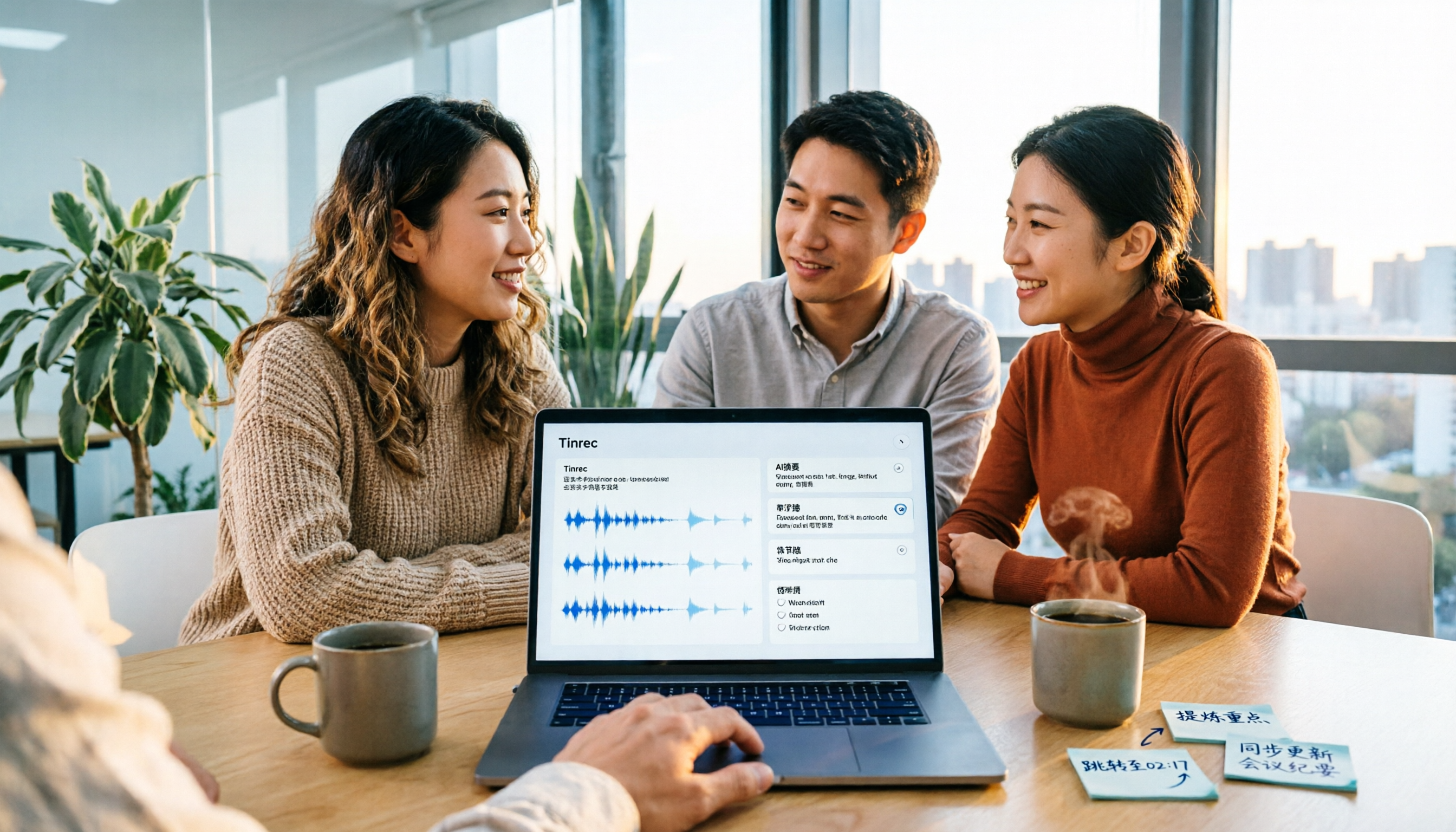
2026 Video Summarization Tools Compared: Which One Actually Saves You from Rewatching?
How to choose a video summarization tool? This article breaks down 4 common approaches, provides 5 practical purchasing checkpoints, and uses Tinrec to illustrate the complete workflow from transcription to AI summary, chapters, action items, and team spaces. It also includes pricing and quota details for personal and team plans to help you find the best fit.

4 Best Free Online Text-to-Speech Tools in 2026: Which Free Version Is Enough?
We compare four free online text-to-speech tools—TTSMaker, Luvvoice, Vidnoz AI, and Toolbang—covering language support, commercial licensing, output formats, and customization options to help you decide which one fits your needs for learning, voiceover, or accessibility reading.

2026 Comparison of 5 Online Voice Tools: Is Google Text-to-Speech Free Version Enough?
It's 11 PM, the video is finally edited, but the voiceover still isn't recorded. An hour after a meeting ends, the transcript is still blank. This article starts from two needs—'speak out' and 'write down'—and compares free online text-to-speech options like Google Cloud Text-to-Speech, Sound of Text, and Chrome text-to-speech extensions. It also shares hands-on experience with Tinrec for speech-to-text, including free limitations and team pricing.

How to Choose a Voice Tool in 2026: Meeting Transcription + Multilingual Translation Comparison
Many people search for "voice tools" to read text aloud, but meetings and interviews really need to turn audio into usable text data. This article first clarifies the difference between text-to-speech readers and meeting transcription tools, then compares Tinrec and Otter.ai across five dimensions: Chinese and multilingual recognition, bot-free recording, post-meeting workflow, team governance, and pricing. Finally, it offers clear recommendations for different needs.

4 Best Voice Memo Transcription Tools in 2026: Is iPhone Built-in Enough?
Recorded a meeting, class, or interview but never have time to listen back? We tested 4 voice memo transcription methods, including iPhone's built-in Voice Memos and Notes apps, Tinrec, Otter.ai, and PLAUD recording hardware. We compare Chinese transcription quality, cross-platform capabilities, post-meeting workflows, and free tiers, plus provide selection criteria and 3 common pitfalls to help you find the most time-saving solution.

How to Transcribe iPhone Voice Memos in 2026: Built-in Transcription + Tinrec AI Organization
iPhone has a free built-in way to transcribe voice memos, but many people don't know about it or only discover its limits after trying. This article starts with common misconceptions and compares Apple's built-in Voice Memos transcription with Tinrec, helping you find the best transcription workflow for your needs.

5 AI Meeting Minutes Tools Tested for 2026: Which One Actually Saves You Post-Meeting Time?
Two-hour meeting, then another hour to write up the minutes? This article compares 5 AI meeting minutes tools in real-world scenarios, covering 4 key points to consider before choosing and 4 common pitfalls to avoid. It also takes a deep dive into Tinrec's bot-free online meeting recording, AI summaries, AI Q&A, export options, and team workspace management, helping Hong Kong office workers find the one that truly saves post-meeting time.