

Turn recordings into transcripts and summaries in minutes
Upload audio or video for multilingual transcription, AI notes, and action items
Tinrec vs Otter.ai in 2026: 5-Dimension Comparison — Which Is Better for Chinese-Language Meetings?
The only decision you really need to make is this: Are your meetings primarily in English or primarily in Chinese?
That sounds simple, but it's where most people choose the wrong tool. Many teams see Otter.ai's high ratings in the English-speaking world and its smooth Zoom integration, sign up right away, and then still spend 40 minutes manually editing every Chinese meeting transcript — meaning they're only getting half the value from the tool.
First, let's clarify one thing: people who Google "Otter Chinese" fall into two groups. One group is looking up the word — they want to know whether an otter is a river otter or a sea otter — and they need an authoritative dictionary like Cambridge, which has nothing to do with this article. The other group is asking, "Does Otter.ai support Chinese?" This article addresses the latter: the purchasing decision for a Chinese meeting transcription tool.
Tinrec vs Otter.ai | Quick Overview
Otter.ai is a veteran name in AI meeting transcription, founded in 2016 by former Google engineers. It started with a meeting bot that joins Zoom, Meet, and Teams, and it has a mature English-language experience and a complete ecosystem. Tinrec focuses on Chinese meetings, bot-free recording, and post-meeting knowledge retention as an AI meeting notes and collaboration tool.
| Item | Tinrec | Otter.ai |
|---|---|---|
| Core positioning | AI meeting notes and team collaboration | AI meeting assistant and meeting automation |
| Chinese-language scenarios | Chinese, Traditional Chinese, mixed Chinese-English, multilingual, and real-time translation | English-centric; Chinese requires extensive editing |
| Meeting capture | Desktop app captures system audio; no bot required | Primarily meeting bot; also has a desktop app |
| Team capabilities | Spaces, roles, seats, usage, audit logs, recycle bin | Business plan offers team and enterprise management |
| Pricing | Personal: free / weekly pass / Pro; Team: per paid seat | Basic free; Pro annual billing equivalent to USD 8.49/user/month |
Here are the five dimensions we compared: Chinese recognition, meeting capture method, post-meeting outputs, team governance, and pricing and quotas.
Dimension 1 | Chinese and Mixed Chinese-English Recognition
Otter.ai's underlying models have long been English-centric, which is why it excels in English meetings. But according to multiple 2026 reviews from Taiwanese users, in pure Traditional Chinese meetings, meetings with Taiwanese Hokkien mixed in, or code-switching technical meetings, Otter's error rate rises noticeably. Proper nouns, company names, and Chinese abbreviations are especially prone to misrecognition, and in practice you often need to edit sentence by sentence.
Tinrec treats Chinese meetings as its home turf: it supports Chinese, Traditional Chinese, and multilingual meeting transcription, can organize mixed Chinese-English content, and offers team hotwords to maintain common terminology, making recognition of product names, job titles, and industry abbreviations more stable. Note that actual performance still depends on recording quality, accents, background noise, and overlapping speakers — no tool should promise a fixed accuracy rate.
→ This dimension: For Chinese-dominant teams, Tinrec clearly wins.
Dimension 2 | Meeting Capture: Bot vs. No Bot
Otter is best known for its meeting bot: it automatically joins meetings as a participant. This was key to its explosive growth in 2020 and is very convenient for multinational teams and all-English meetings. However, the bot adds an extra identity to the participant list, which may not always be appropriate for external client meetings, interviews, or sensitive discussions.
Tinrec takes a different approach: the desktop app directly captures computer system audio for online meetings on Zoom, Google Meet, Microsoft Teams, Webex, and others, without requiring an extra bot to join the meeting. The user starts recording and generates a transcript in real time. To be clear, this is not the same as "automatically joining all calendar meetings," nor is it an official partnership with these platforms.
→ This dimension: If you don't want an extra participant and often run Chinese meetings, Tinrec is a better fit; if your meetings are purely English and you rely heavily on automated workflows, Otter still has an advantage.
Dimension 3 | Post-Meeting Outputs and AI Follow-Up
Otter provides summaries, action items, AI Chat, and workflows after meetings. Its quality for organizing English content is quite stable, which is the foundation of its 15 million user base.
Stop organizing recordings by hand
Upload audio or video and automatically get a transcript, summary, and action items
Tinrec extends the "after transcription" phase further: transcripts, AI summaries, chapters and highlights, to-do extraction, mind maps, and AI Q&A across single or multiple meetings, plus Agent post-processing to generate reports, tables, and documents. On the output side, it supports multi-format export to Notion, Google Docs, OneNote, and Dropbox for further processing; for cross-language meetings, you can view the original text, translation, or bilingual content during recording.
→ This dimension: Both are on par for summaries and Q&A, but Tinrec edges ahead on output formats and bilingual review.
Dimension 4 | Team Knowledge Retention and Governance
Otter's Business plan offers unlimited meeting recordings and more complete team management. Its enterprise capabilities are mature and suit organizations already using tools like Slack and Salesforce.
Tinrec's Team plan clearly separates "roles" and "seats": roles determine who can manage the team, members, and audits; seats determine whether a member can record, upload, edit, and import/export. Members who are active but have no seat can still view, play, and read team data. Administrators can view team usage trends, member rankings, and details, query and export audit logs, and restore accidentally deleted audio from the recycle bin (currently retained for 30 days). When a member leaves or is removed, their team resources must be handed over to other active members, so data doesn't disappear when people leave.
→ This dimension: For seat governance and Chinese team knowledge retention, Tinrec is more granular; however, it is team-level sharing, not file-level granular permissions — make that clear when purchasing.
Dimension 5 | Pricing and Quota Structure
Otter's official pricing page currently shows: Basic is free with 300 minutes per month; Pro annual billing is equivalent to USD 8.49/user/month, including 1,200 minutes of in-app recording per month and 10 file imports; Business offers unlimited meetings and in-app recording, more imports, and management capabilities. Actual prices may be affected by promotions. Refer to Otter's official pricing page.
Tinrec's Personal plan offers a free version, weekly pass, Pro monthly, and Pro annual, chosen by usage task: use the free version for occasional recording organization, the weekly pass for short bursts of intensive meetings, Pro for steady weekly use, and the annual plan for long-term knowledge retention. The Team plan offers a 7-day trial for first-time eligible users, 1 free seat, and 300 minutes of shared import quota; monthly billing is USD 29.80 per paid seat per month, annual billing is USD 199 per paid seat per year (equivalent to about USD 16.58/month), each paid seat provides 2,000 minutes of team shared import quota per month, and real-time recording under an active plan is currently not deducted by minute.
→ This dimension: For pure English and light use, Otter Basic/Pro has a low barrier to entry; for long real-time recording plus Chinese team sharing, Tinrec's quota structure is easier to budget.
What Unique Advantages Does Each Have?
Tinrec's unique advantages
- No bot + Chinese home turf: The desktop app captures system audio without inviting a bot, and organizing Chinese and mixed Chinese-English meetings is a core design focus.
- Complete post-meeting workflow: Summaries, chapters, to-dos, mind maps, AI Q&A, and bilingual review, all the way through to report and table generation.
- Clear team governance granularity: Separation of roles and seats, usage analytics, audit logs, audio recycle bin, and team hotwords — suitable for departments that need to retain meeting assets.
- No extra hardware required: Available on web, desktop, and mobile; handles both historical audio files and online meetings.
Otter.ai's unique advantages
- Mature for English business meetings: Long-standing reputation for transcription and summary quality in all-English meetings and multinational teams, with complete speaker identification and workflows.
- Deep ecosystem integration: Long experience integrating with Zoom, Google Meet, Microsoft Teams, and other meeting platforms, with low switching costs for organizations already deeply using Slack and Salesforce.
Conclusion: Which Should You Choose?
Back to the decision focus from the beginning — your meeting language structure determines your tool choice:
• If more than 80% of your meetings are in Chinese, or often mix Chinese and English → Tinrec; Chinese recognition and post-meeting organization are the real value you're buying. • If you don't want an extra bot participant in client meetings → Tinrec (desktop app records without a bot). • If you need to use AI to follow up on key points right after recording and produce reports and tables → Tinrec (Agent post-processing and multi-format export). • If you need to manage a team with staff turnover and require seats, usage, and audits → Tinrec Team plan (separate roles and seats, resource handover). • If your meetings are almost entirely in English, your team is deeply tied to Slack/Salesforce, and you only need a mature meeting notes workflow → Otter.ai remains a reasonable choice.
To answer "which is better for Otter Chinese" in one sentence: If you're asking about Otter.ai's Chinese capability, it's strong for English meetings and weak for Chinese meetings; what Chinese scenarios need is a tool that reliably produces readable transcripts and post-meeting data — that's exactly Tinrec's design goal. We recommend starting with the free version and testing it with your own real recordings, seeing how much the transcript needs editing, and then deciding whether to move to a paid plan — that's more accurate than any review score.
References
- Which Otter Chinese Translation Is Best? 2026 Test of 4 Options, Cambridge Dictionary Most Complete - Tinrec Blog
- Otter.ai Doesn't Support Chinese? 2026 Best Chinese Speech-to-Text and AI Meeting Notes Alternatives - Tinrec Blog
- Is Otter.ai Good for Chinese? 2026 In-Depth Review by Taiwanese Users (Including Alternatives)
- Can Otter.ai Be Used in Chinese? 2026 Chinese Speech-to-Text Tool Review and Recommendations - Tinrec Blog
- What Is Otter Chinese? 2026 AI Speech-to-Text Tool Review and Alternative Recommendations - Tinrec Blog
Turn every recording into actionable outcomes
Get 60 free transcription minutes when you sign in. No credit card required.
Related Reading
You might also like

Otter Chinese Alternatives in 2026: 3 Tools Tested, Tinrec Best for Chinese Meetings
Otter.ai has limited Chinese support. This article addresses two search intents behind 'which Otter Chinese is best' and compares Tinrec, Notta, and TurboScribe in Chinese meeting transcription, post-meeting organization, and team collaboration to help you choose the right tool.

4 Chinese Subtitle Tools Worth Trying in 2026: Alternatives for Otter Users
Otter officially supports only English, Spanish, and French—no Chinese interface and no Chinese subtitles. Based on real-world use, this article explains Otter's Chinese limitations and compares Tinrec, Otter, Notta, and TurboScribe on Chinese transcripts, mixed Chinese-English speech, post-meeting organization, and team collaboration to help you choose a truly usable Chinese subtitle solution.

Tinrec vs Otter.ai 2026: 5-Dimension Comparison for Chinese Meeting Notes
Can Otter.ai handle Chinese? This article compares Tinrec and Otter.ai across 5 practical dimensions: Chinese and Traditional Chinese recognition, online meeting recording methods, post-meeting outputs, team collaboration governance, and pricing quotas, helping teams decide which is better suited for their meeting scenarios.

Otter in Chinese: 2026 Guide to 6 Chinese Books and Transcription Tools
People searching for "Otter Chinese" have two needs: finding a meeting transcription tool that understands Chinese, or looking up the Chinese meaning of otter or related Chinese books. This article covers 6 practical options, including Tinrec, Otter.ai, Notta, TurboScribe, plus free dictionary and book-finding resources, with pricing and buying advice.

Otter.ai Chinese Free Trial Guide 2026: 6 AI Meeting Tools Tested and Recommended
Can Otter.ai really handle Chinese, and what are the free trial limitations? Based on real meeting scenarios for mid-level managers, this article breaks down Otter's Simplified Chinese support status, the Basic free 300 minutes and 3 lifetime import credits, and compares the Chinese performance, pricing, and use cases of 6 tools including Tinrec, Notta, TurboScribe, Granola, and PLAUD—so you can test with a real meeting before paying for a subscription.

4 Otter Chinese Alternatives Compared in 2026: Why Tinrec Handles Chinese Meeting Notes Better
Otter.ai is a mature English meeting assistant, but Chinese transcription has long been a pain point for Chinese-speaking users. This article starts from the real-world usage scenarios of mid-level managers and compares Tinrec, Otter.ai, Notta, and Granola in Chinese-language meeting settings. It also reviews Tinrec's real-time transcription, AI Q&A, action item extraction, and team spaces for post-meeting organization, helping you decide which tool is better suited for Chinese meetings.

Free Otter Chinese Subtitles in 2026: 6 Tools Compared
Many people download Otter hoping to generate Chinese subtitles for free, only to find that the language list shows Simplified Chinese and the free plan only exports plain text. This article reviews six options that can handle Chinese transcripts and subtitles, including completely free tools and those with free quotas, and honestly outlines their limitations and pricing.
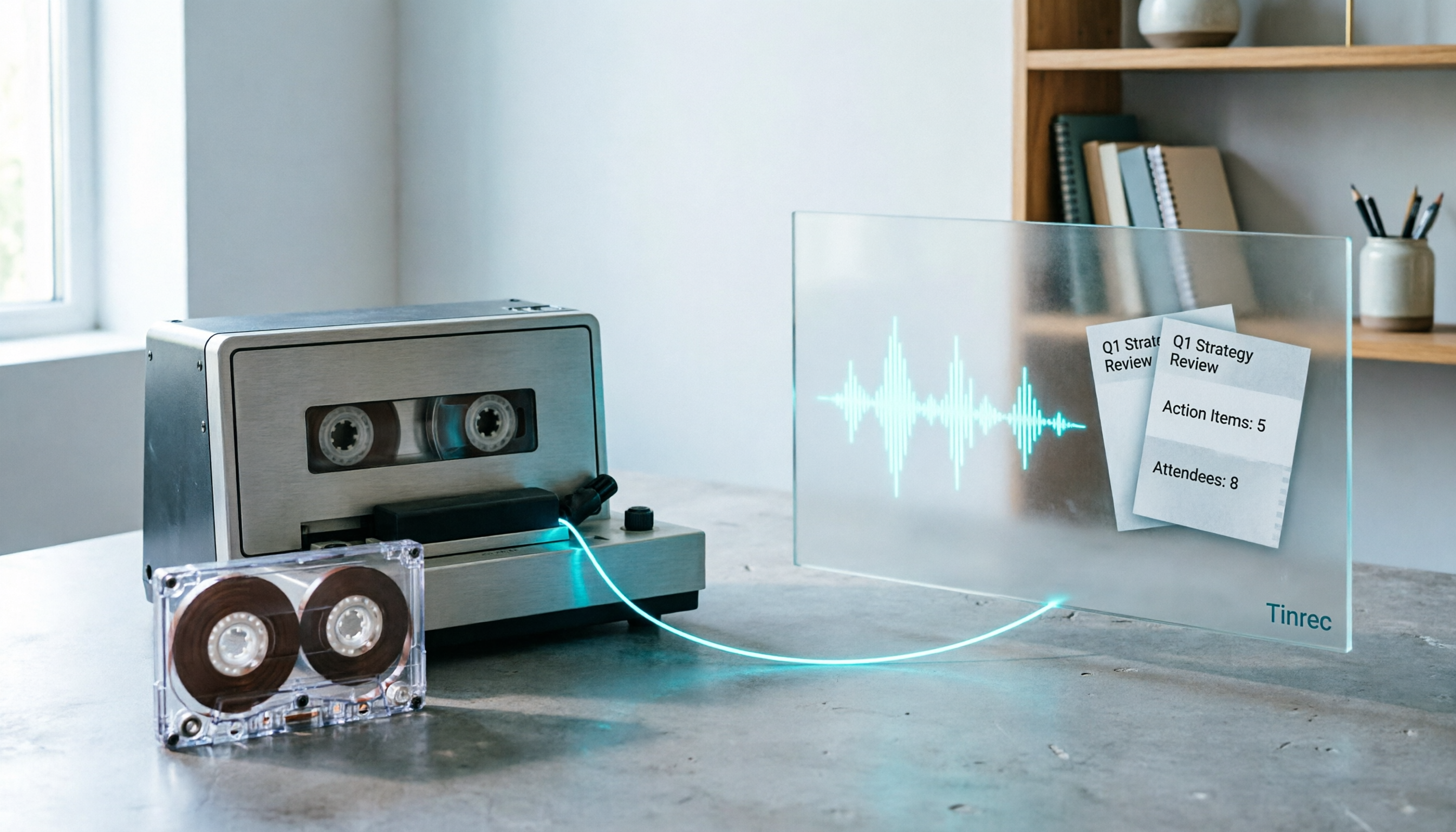
2026 Good Tapes Compared: Cassettes, Reel-to-Reel, and Audio Transcription — How to Choose
People searching for "2026 good tapes" are either looking for blank cassettes or packing tape. This guide first distinguishes four types of tape, then focuses on recording cassettes and reel-to-reel: the state of new production lines in 2026, what specs to check when choosing tapes, how to pick a vintage deck, and how to turn cassette recordings into searchable, queryable, deliverable transcripts and meeting notes with Tinrec.

Otter Chinese Free Plan 2026: 6 Meeting Transcription Tools Compared
People searching for "Otter Chinese free version" often face the same question: Otter.ai offers a generous free tier, but can it actually transcribe Chinese? This article first clarifies Otter's current Chinese support and free plan limitations, then compares the free quotas, pricing, and use cases of 6 meeting transcription tools to help you choose the right one.