

Turn recordings into transcripts and summaries in minutes
Upload audio or video for multilingual transcription, AI notes, and action items
Why Do You Need iPhone Speech-to-Text?
A 50-minute meeting ends, you casually record it with Voice Memos, and when you get back to your desk you realize: listening again, typing it up, and organizing it into key points your boss can understand will probably take another hour.
This situation is very common. Classes, interviews, client calls, ideas that pop into your head while driving—recording first is the easiest part; the hard part is always what comes after.
The good news is that starting with iOS 18, Apple added transcription to Voice Memos for iPhone 12 and later, so recordings can be converted to text directly. For people who only need it occasionally, this is already enough.
But if you have meetings every week, need to handle mixed Chinese-English content, or need to leave data for your team, the built-in features will hit their ceiling. This article covers 5 of the most commonly compared iPhone speech-to-text solutions right now, from free to paid, from phone to team collaboration, so you can pick one that fits your situation.
Solution 1 | Tinrec — The Most Complete AI Meeting Notes and Team Collaboration Tool
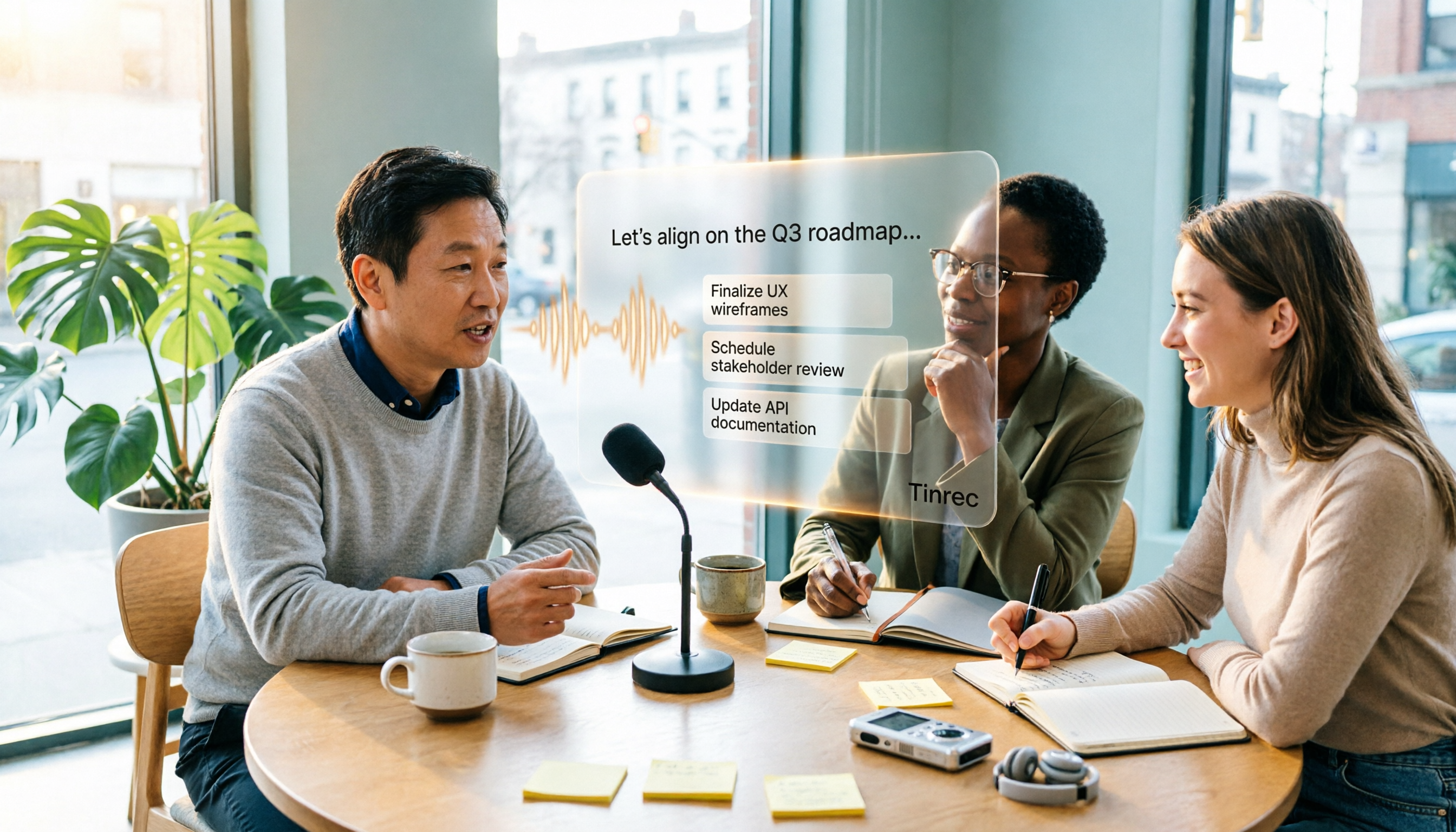
Tinrec is an AI meeting notes and collaboration tool for individuals and teams. It doesn't just turn audio into text; it puts recording, transcription, organization, and reuse into a single workflow.
Record online meetings without inviting a meeting bot. The desktop version directly captures your computer's system audio, handling meetings on Zoom, Google Meet, Microsoft Teams, and Webex without needing an extra bot account to join. The mobile app is suitable for going out, offline interviews, and quick notes.
Transcription is just the beginning. Beyond the transcript, it generates summaries, chapters, key points, and action items. For a 48-minute meeting, you don't need to listen through the whole thing again to know what the conclusions were.
You can keep asking questions about the meeting content. AI Q&A lets you directly ask "What were the three concerns the client mentioned?" saving you the time of digging through the transcript yourself. This is where I think it differs most from ordinary transcription tools.
Mixed Chinese-English and real-time translation. For cross-language meetings, you can switch between original text, translation, or bilingual view, and teams can add frequently used terms to a glossary to reduce misheard technical terms.
The team version keeps data within the team. This is most practical for department managers: meeting data belongs to the team, members are distinguished by roles and seats, and administrators can view usage trends and audit logs. When a member leaves or is removed, resources can be transferred to other members instead of disappearing with the individual account.
For plans, the personal version has a free tier, weekly pass, Pro monthly, and Pro annual, depending on usage frequency; the team version offers a 7-day trial for first-time eligible users, 1 free seat, and 300 minutes of shared import quota, with monthly billing at USD 29.80 per paid seat per month, and annual billing at USD 199 per paid seat per year (equivalent to about USD 16.58 per month), with each paid seat providing 2,000 minutes of team shared import quota per month. Actual prices and benefits are subject to the official purchase page.
Who it's for: People who have meetings to organize every week, those who need Chinese meeting notes without letting a bot join the meeting, and small teams who want to turn meetings into team knowledge.
Solution 2 | iPhone Voice Memos — The Free Option That Requires No App Installation
If you only occasionally need to turn a recording into text, don't rush to download anything. After iOS 18, Voice Memos itself has built-in transcription.
The operation is intuitive: open Voice Memos and record, then tap into the file and tap the transcript button in the top right corner, and the system will start recognizing and adding punctuation and paragraphs. When playing the audio, the corresponding text is highlighted in sync, making it easy to check against.
To copy the text, tap the "..." in the top right corner and you'll see "Copy Transcript." Also, recording directly in the Notes app can be converted to text as well.
Note that there are quite a few limitations: the system must be iOS 18 or later, and the device must be iPhone 12 or newer; and it mainly handles audio files recorded within the app. If you want to transcribe an external mp3, you'll need to convert it to a compatible format first.
Who it's for: People who only transcribe one or two recordings a week, don't want to pay, and don't want to learn a new tool.
Solution 3 | iPhone Keyboard Dictation — Just Say What's on Your Mind
The microphone icon on the keyboard is the "Dictation" feature, which is real-time voice input: you speak in the input box of any app, and the text appears directly at the cursor position.
Before using, make sure it's enabled: Settings → General → Keyboard → turn on "Enable Dictation," then go to "Dictation Languages" and select your preferred language. Currently supported on iPhone SE and later models.
Its biggest advantage is that it's completely free and fast, especially useful for elderly people or those who have trouble typing. The downside is also clear: it only keeps the text, not the audio file, so you can't go back and verify, and it's not suitable for content longer than a few minutes.
Who it's for: People who reply to messages, write short notes, or temporarily input a sentence without needing to keep the original recording.
Stop organizing recordings by hand
Upload audio or video and automatically get a transcript, summary, and action items
Solution 4 | Notta — A Veteran Tool with Multilingual Transcription and Team Plans
Notta overlaps quite a bit with Tinrec, both covering multi-platform transcription, meeting notes, file import, translation, and team plans. The difference is that Notta leans more toward "transcription and translation" itself, while Tinrec focuses on summaries, Q&A, and team knowledge retention after transcription.
Current official plans are: free version with 120 minutes per month, up to 3 minutes per item; Pro annual billing equivalent to about USD 8.17 per month, 1,800 minutes per month; Business annual billing equivalent to about USD 16.67 per seat per month, offering unlimited transcription, role permissions, and usage reports.
Who it's for: People who need multilingual transcription and subtitles and already have a fixed workflow.
Solution 5 | TurboScribe — Specializing in Long Files and Batch Transcription
TurboScribe's positioning is clear: a cost-effective file transcription tool focused on long files, batch uploads, subtitles, and translation.
Free version: 3 files per day, up to 30 minutes per file; Unlimited annual billing at USD 120 (equivalent to about USD 10 per month), paid version supports up to 10 hours or 5 GB per file, and up to 50 files uploaded at once.
It's not a meeting collaboration tool—no real-time recording, no team space—but if you have a bunch of already-recorded audio files to transcribe, its processing capacity does have an advantage.
Who it's for: Researchers or content creators with a large number of historical audio files that need batch conversion to text.
Solution 6 | PLAUD NotePin — Wear Your Recording Hardware
PLAUD takes a different path: buy a standalone recording device. NotePin is priced at USD 159 on the US official website, with membership plans ranging from Starter at 300 minutes per month, to USD 99.99 per year (1,200 minutes per month), to Unlimited at USD 239.99 per year.
Its value lies in portability and long battery life, suitable for phone call recording or people who are out all day. However, you have to carry an extra device and use an extra app, and handling online meetings is not its strong suit.
Who it's for: People who frequently visit clients and need a physical recording device.
With So Many Options, How Should You Choose?
- Want summaries, Q&A, and action items after transcription → Tinrec (these features are in the same workflow)
- Need Chinese meetings, mixed Chinese-English, and don't want a bot joining the meeting → Tinrec (desktop version captures system audio)
- Need to leave meetings for the team, manage members and usage → Tinrec team version (roles, seats, usage, and audit)
- Need to continue on phone, computer, and web → Tinrec (multi-platform, data in the same space)
- Only transcribe one or two recordings a week, zero budget → iPhone built-in Voice Memos (free, but limited by device and system version)
- Just replying to messages and writing short sentences → iPhone keyboard dictation (fastest, but doesn't keep audio)
- Have a bunch of long audio files for batch processing → TurboScribe (up to 10 hours per file)
- Need a physical device for recording on the go → PLAUD NotePin (requires buying extra hardware)
4 Things to Know Before Using iPhone Speech-to-Text
1. First check your device and system version. Built-in transcription requires iOS 18 or later and iPhone 12 or later; keyboard dictation supports iPhone SE and later models. If you don't meet these, it's faster to look at third-party solutions.
2. A transcript is not the same as meeting minutes. Getting a big block of text still means you have to read through it and pick out the key points. Tools like Tinrec automatically generate summaries, chapters, and action items after transcription—that's the step that truly saves time.
3. Recording quality determines recognition results. No tool can guarantee a fixed accuracy rate; background noise, accents, overlapping speakers, and technical terms all affect it. For important numbers and commitments, it's recommended to listen back to the original recording at the corresponding transcript timestamp to verify.
4. Get consent before recording. Recording meetings and interviews involves local regulations and others' rights; you should inform when necessary. For team use, also think clearly: who owns the data, who can see it, and how to hand over when members leave.
Conclusion
iPhone's built-in features have improved a lot in recent years, and for occasional transcription you really don't need to install an app anymore.
But once your recordings start to increase, get longer, and need to be shown to others, the real time-consuming part is not "converting to text" but "organizing into usable data." That's why I'd suggest putting Tinrec first on your list to try: it connects transcripts, summaries, action items, Q&A, and team space together—more like a meeting data organization hub than a transcription tool.
If your budget is limited, start with the free Voice Memos, and when you find yourself manually organizing every time, it's not too late to move to the next stage.
FAQ
Q: Is iPhone's built-in speech-to-text free?
Yes. After iOS 18, Voice Memos transcription and keyboard dictation are built-in system features with no extra cost, but they don't have summaries, Q&A, or team sharing capabilities.
Q: Can older iPhones use it?
Built-in transcription requires iOS 18 or later and iPhone 12 or later; keyboard dictation supports iPhone SE and later models. If your device isn't supported, you'll have to use third-party tools or a hardware recording device.
Q: Does Tinrec require a bot to join meetings?
No. Tinrec's desktop version directly captures computer system audio to record online meetings; users must actively start recording, and it does not automatically join all calendar meetings.
Q: What's the difference between Tinrec's team version and personal version?
Personal version data belongs to the individual account; the team version is an independent team space with additional members, roles, seats, sharing benefits, usage analysis, audit logs, and an audio recycle bin. Members without a seat can still view and play data, but need a seat to record, upload, and edit.
Q: Can the generated transcript be submitted directly as meeting minutes?
Not recommended to submit directly. AI may miss or misunderstand details, so it's best to verify against the summary and original recording, especially numbers, deadlines, and responsible persons.
Q: Can captured meeting audio files be exported to other tools?
Yes. Tinrec supports exporting results to common file formats and can also be brought to Notion, Google Docs, OneNote, Dropbox, and other tools for further editing.
References
- iPhone Speech-to-Text Setup Tips: 5 Methods to Convert Recordings to Text - Mr. Mad
- iPhone's Speech Recognition Feature: Voice Memos, Automatic Punctuation and Paragraphing - Let's Write
- iPhone Speech-to-Text Practical Guide
- [iPhone Voice Memos to Text] Complete Guide to 3 Methods! iOS Built-in, App, Voice Recorder—Which Is Best?
- iPhone Speech-to-Text Tutorial: Easily Done Without Third-Party Apps
Turn every recording into actionable outcomes
Get 60 free transcription minutes when you sign in. No credit card required.
Related Reading
You might also like

Tinrec Voice-to-Text AI 2026: No-Bot Recording + AI Summaries & Action Items
Want to turn meeting recordings into usable transcripts fast? Using Tinrec as an example, this guide explains what voice-to-text AI can do, its core capabilities, real-world use cases, and what to consider when choosing a tool. It also compares the free, Pro, and Team plans to help you decide if it's right for you.

2026 Comparison of 3 Online Audio-to-Text Tools: How to Choose for Chinese Transcripts and Post-Meeting Organization
Starting from the real pain points of meeting recordings and file transcription, this article uses Tinrec to demonstrate 5 steps for online audio-to-text conversion, compares the suitable scenarios for cSubtitle and MyEdit, and includes FAQs, team plan benefits, and purchasing advice.
2026 Comparison of 4 Free Speech-to-Text Tools: Which Free Tier Is Most Sufficient?
There are many free speech-to-text tools, but the real questions are whether the free quota is sufficient, whether they can understand mixed Chinese-English speech, and how much time you still need to spend organizing the transcript. This article tests four tools—Tinrec, Notta, TurboScribe, and Granola—from four angles: free quota, Chinese recognition, post-meeting organization, and team collaboration, and highlights the most common pitfalls when choosing.

6 Speech-to-Text Apps Tested in 2026: Which One Turns Recordings into Usable Transcripts and Action Items?
Starting from common pitfalls, this comparison covers the positioning, features, pricing, and limitations of 6 speech-to-text apps—Tinrec, Notta, TurboScribe, SoundType AI, Atter, and Yating Transcript—to help you choose the right tool for meetings, interviews, long audio files, and team collaboration.

Tinrec vs Notta 2026: 5-Dimension Comparison — Which Free Speech-to-Text Tool Is Better for Students?
Recording lectures during the semester and reviewing for finals — how do you choose a free speech-to-text AI? Based on real student scenarios, I compare Tinrec and Notta across five dimensions: free quota calculation, single-recording length limits, post-meeting organization, cross-platform support, and Chinese recognition. I also cover use cases for MyEdit and Otter.ai to help you pick the right tool without wasting money.

2026 Speech-to-Text Tools Compared: Which Saves the Most Time on Chinese Transcripts and Post-Meeting Notes?
From meeting recordings to usable transcripts and post-meeting materials, this article uses the same buying criteria to examine Tinrec, Notta, TurboScribe, and PLAUD, explaining differences in Chinese transcription, AI Q&A, team seats, and export capabilities to help you decide which one fits your meeting workflow.

iPhone Voice Memos vs Tinrec in 2026: 5-Dimension Comparison — Which Is Better for Transcripts?
iPhone's built-in Voice Memos can transcribe recordings starting with iOS 18, and Chinese requires iOS 18.4 or later. This article compares it with Tinrec across 5 dimensions: post-meeting organization, online meetings, cross-device use, multilingual support, and team collaboration, plus a 4-step tutorial and scenario-based recommendations.

4 Free Speech-to-Text Tools Tested in 2026: Is the Free Version Enough, and When Should You Upgrade?
Every so often, someone on Dcard asks, "Are there any free speech-to-text tools?" This article starts from real meeting scenarios, outlines 4 key points to consider before choosing a free tool, and compares the free quotas, meeting recording methods, and post-meeting organization capabilities of Tinrec, Notta, Otter.ai, and TurboScribe. It helps you decide whether the free version is sufficient and when it's worth upgrading.

4 LINE Voice-to-Text Solutions Compared for 2026: iPhone Users' Options from Shortcuts to AI Summaries
LINE voice messages on iPhone don't have a built-in transcription button, and most people get the first step wrong. This article starts with common misconceptions, compares iPhone Voice Memos transcription, Shortcuts scripts, third-party transcription tools, and Tinrec, and explains from a student's perspective whether free tiers are sufficient and which scenario suits which option.