

Turn recordings into transcripts and summaries in minutes
Upload audio or video for multilingual transcription, AI notes, and action items
2026 Comparison of 4 Note-Taking Recording Tools: Is Built-in Transcription Enough?
"Can Notes record audio?" Most people get stuck on three misconceptions
The first misconception is thinking Notes is only for typing. In reality, Notes on iPhone, iPad, and Mac can all record audio directly, and the recording is attached to the same note where you can continue writing text and adding checklists.
The second misconception is assuming a transcript is generated automatically after recording. Transcription depends on the device model, OS version, and device language. Audio transcription on Mac requires an M1 or newer chip, and the device language must be one of the supported languages (Traditional Chinese is on the list); iPad and iPhone also have their own minimum requirements. If the button doesn't appear, it's not user error—the conditions simply aren't met.
The third misconception is the most common: assuming that "recording it" means "it's handled." A two-hour meeting recording won't tell you what the conclusions were or who is responsible for what.
The difference was never about whether you can record—it's about whether that content can be used directly after recording.
To judge if built-in recording is enough, look at these four key points first
1. Do you want a file, or usable content? If you're just jotting down a quick idea or recording highlights from a class, built-in Notes is completely sufficient. But if you need "a summary and action items right after the meeting," then you need to check whether the tool has post-meeting processing capabilities.
2. Transcription support conditions. Apple's transcription isn't available on all models and languages, and some features won't work when using a non-iCloud Notes account. Before buying a new device, confirm whether your device combination can support it.
3. Cross-device and cross-platform. Apple Notes works smoothly within the Apple ecosystem, but if your work computer is Windows and your colleagues use Android, you'll need another way to transfer data.
4. Data ownership and team collaboration. Personal recordings belong to the individual—that makes sense. But once team meeting notes are involved, you'll face questions like "If someone leaves, do the recordings stay?" and "Who can edit versus who can only view?"
Tinrec—A meeting database you can query right after recording
Tinrec is an AI meeting notes and collaboration tool for individuals and teams, supporting iOS, Android, desktop, and web. It focuses on "after recording": after converting to a transcript, it organizes summaries, chapters, and action items, and you can continue asking questions about the content.
When you open Tinrec desktop during a meeting, it directly captures your computer's system audio to record online meetings on Zoom, Google Meet, Microsoft Teams, Webex, and more—no need to send a bot into the meeting room. No unfamiliar account appears in the participant list, which is especially noticeable in client-facing meetings.
After the meeting, the transcript is already there. AI summaries and chapters break long meetings into readable sections, and action items are organized as well. Even better is the AI Q&A: you can directly ask "Who mentioned the budget in the last meeting?" or "What were the client's concerns about pricing?" and it will search the meeting content for answers instead of giving you a bunch of keyword search results.
It also supports audio and video file uploads, real-time translation, and bilingual viewing, so online meetings, offline interviews, and historical recordings can all be collected in one place. For output, you can export to Notion, Google Docs, OneNote, Dropbox, and other tools, or directly generate reports, tables, and meeting minutes.
Three advantages I find most practical:
First, the cost of post-meeting organization is cut significantly. It used to be "record for two hours, organize for two hours"; now you open the summary to see conclusions first, and click the corresponding timestamp in the transcript to replay details when needed.
Second, data doesn't scatter across your phone and become digital clutter. All meetings are centralized in one space, searchable by keyword, queryable, and you can go back to find that commitment from three months ago.
Third, the team version solves the "people leave and data leaves" problem. Meeting data in team spaces belongs to the team; when members leave or are removed, resources can be handed over to other active members.
Stop organizing recordings by hand
Upload audio or video and automatically get a transcript, summary, and action items
Pay special attention to the difference between roles and seats in the team version:
Roles determine who can manage the team, members, and audit logs; seats determine whether members can record, upload, edit, import, and export. Active members without a seat can still view, play, and read team data, but cannot perform resource usage operations. This is easily misunderstood during purchasing, so it's safer to ask clearly first.
For the current team plan, eligible teams can try 7 days free with 1 free seat and 300 minutes of shared team import quota; monthly billing is USD 29.80 per paid seat per month, and annual billing is USD 199 per paid seat per year (about USD 16.58 per month), with each paid seat providing 2,000 minutes of shared team import quota per month. Under an active team plan and active seat, real-time recording is currently not deducted by minutes, while file and web imports consume the shared team quota. Actual prices and promotions are subject to the official purchase page.
Limitations should also be stated honestly:
The team version currently focuses on team-level sharing—all active members can read team data—and is not a file-level granular permission system. Additionally, transcription quality is affected by recording environment, accents, overlapping speech, and technical terminology; for important content, it's recommended to cross-check with transcript timestamps and audio playback. The personal version offers a free tier, weekly pass, monthly pass, and annual pass, with quotas varying by plan; light users can start with the free version.
Who it's for:
People who frequently hold Chinese-language meetings, need post-meeting summaries and action items, want to use it across phone and computer, or want to accumulate team meeting data.
Besides Tinrec, what other Notes recording options are there?
Apple Notes built-in recording If you only need to "record it and keep it with your notes," this is the most hassle-free approach. It works on iPhone, iPad, and Mac, and you can continue typing in the note during recording. However, transcription depends on device model and language conditions, and there's no cross-platform AI Q&A, nor can multiple meetings be linked into a queryable database.
Apple Voice Memos A standalone recording app built in from early on, supporting stereo and spatial audio, with pause, resume, and later trimming and enhancement. Suitable for pure recording needs such as classes, inspiration, or ambient sound. But its positioning is that of a recorder—it won't generate summaries and action items, nor organize data for team sharing.
Notta Good multilingual transcription and file import capabilities, and it has a team plan, suitable for those who already have a large number of existing audio files to process. However, if your need is "record online meetings without installing a meeting bot, and be able to query content afterward," Tinrec's desktop system audio capture and post-meeting Agent output will be closer to that workflow.
Pitfall guide: The four most common mistakes when recording with Notes
Pitfall 1: Recording an entire important event without testing first. When using a tool to record a speech or client meeting for the first time, it's advisable to record a short segment and play it back to check volume and ambient noise. Air conditioning, keyboard sounds, and projector fan noise may not be obvious in person but will be very noticeable in the recording.
Pitfall 2: Assuming a transcript means you don't need to listen back. A transcript is an aid, not a legal document. Names, numbers, and technical terms are most prone to errors; for important decisions, you should still click back to the corresponding section and listen to the original audio.
Pitfall 3: Deleting recordings without saving the transcript first. According to Apple's user guide, when you delete a recording, the corresponding transcript is also deleted. If you need to keep the text, add it to a note or copy it to another document before deleting the audio.
Pitfall 4: Only using half the capability—just "recording." If you're using a tool with AI summaries but still listen from the beginning every time, you're only using a third of its features. Look at the summary first to grasp conclusions, then replay sections you're unsure about—you'll save a lot of time.
Conclusion: Which one should you actually use?
If you only occasionally jot down an idea or take a class → Apple Notes built-in recording is enough; no need to install anything else.
If you need stereo, ambient sound, or post-editing of audio files → Voice Memos is more suitable.
If you have a bunch of existing audio files to batch transcribe → Transcription tools like Notta are more convenient.
If you have meetings every week and need transcripts, summaries, action items, and want to go back and ask "What was that conclusion last time?" → A tool like Tinrec that turns recordings into searchable data will be more hassle-free than simple recording.
If you're a team and meeting data needs to accumulate, with someone managing seats and usage → Look directly at Tinrec's team version, first confirm the difference between roles and seats, then assess how many paid seats you need.
Honestly, whether Notes can record audio was never the question. The question is whether, after recording, that recording can become something you'll actually use.
References
- Record and transcribe audio in Notes on Mac - Apple Support (Taiwan)
- Record and transcribe audio in Notes on iPhone - Apple Support (Taiwan)
- 2026 Comparison of 4 Audio-to-Text Apps: Tinrec Makes Chinese Meeting Minutes Less Painful - Tinrec Blog
- Record audio in Voice Memos on iPhone - Apple Support (Taiwan)
- How to use iPad Notes recording? Transcript and summary tutorial | PingGO
Turn every recording into actionable outcomes
Get 60 free transcription minutes when you sign in. No credit card required.
Related Reading
You might also like

Free Mobile Voice-to-Text Options in 2026: 5 Methods Compared
Mobile voice-to-text actually covers two distinct scenarios: real-time dictation and transcribing existing recordings—and that's where most people get stuck. Drawing on a mid-level manager's real-world experience, this article outlines five mobile voice-to-text approaches, explains the limits of built-in dictation on iPhone and Android, how to transcribe existing audio files, and how Tinrec is used in practice for meeting notes, action items, and client interviews.
Can Word Record Video? 4 Audio-to-Text Tools Compared for 2026 (Pricing & Features)
Word does not have a screen recording feature. Its built-in Dictate/Transcribe can only convert speech to text, which is often mistaken for video recording. This article clarifies three easily confused recording functions in Word, then compares four audio-to-text tools—Tinrec, Otter.ai, Notta, and Granola—covering their positioning, limitations, and pricing to help you choose the right tool for your needs.

How to Choose a Vocal AI in 2026: Meeting Transcription + AI Q&A in One Go
People searching "Is Vocal AI good?" are split between music and vocals, and turning meeting recordings into usable data. This article focuses on meeting transcription, covering 4 key buying factors, then hands-on testing Tinrec's bot-free recording, post-meeting AI Q&A, and team spaces, with brief reviews of Otter.ai, Notta, and Granola, ending with clear recommendations by scenario.

2 Free iPhone Recording Transcription Methods in 2026: Where to Find Voice Memos Transcripts and Their Limitations
A guide to where iPhone recording transcripts are located and how to enable them, covering the two free entry points—Voice Memos and the Notes app—along with device, OS version, language, and region restrictions. It also provides troubleshooting steps when transcripts are missing, how to copy them, and tips for further organization.

Is Recording at Work Legal in 2026? 5 Real Workplace Scenarios Compared: What Protects You and What Gets You in Trouble
Is secretly recording at work legal? This article compares five common workplace scenarios against Article 315-1 of the Criminal Code, the Communication Security and Surveillance Act, and practical legal interpretations. It outlines four key factors for determining recording legality and provides a tested workflow for using recordings, including Tinrec's real-time transcription and AI Q&A, so you can gather evidence while staying compliant.

5 Free Transcription Tools Compared in 2026: Free Tiers and Post-Meeting Workflows
Compare the free plans of five transcription tools—Yating, Tinrec, Notta, Otter.ai, and TurboScribe—from free quotas and sign-up requirements to post-meeting organization capabilities. Learn which meeting and interview scenarios each tool suits, along with data verification dates and usage limits.
4 Recording Organizer Tools Tested and Compared in 2026: Is a Recording Evidence? Key Points for Legal Evidence Collection and Transcript Retention
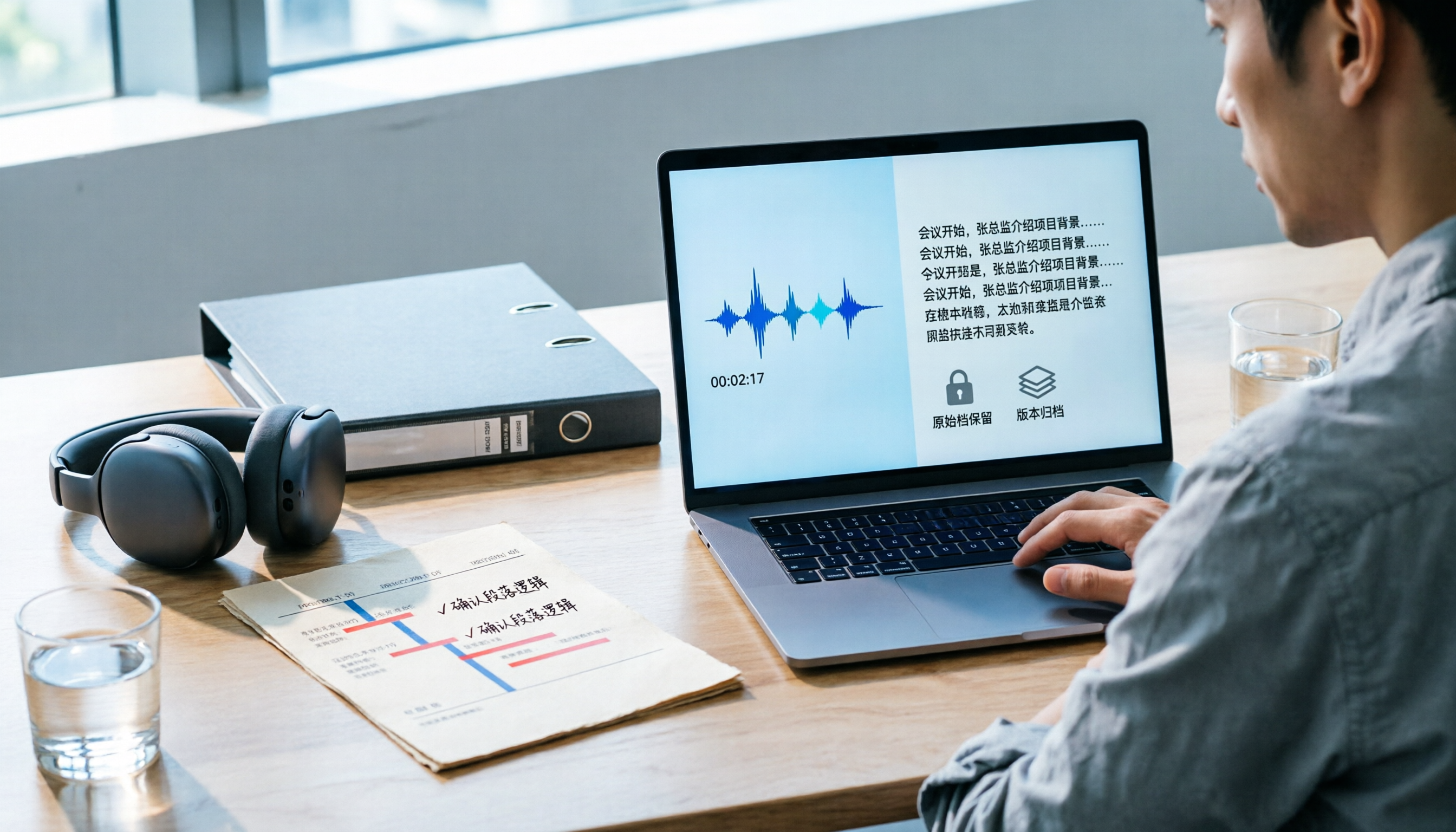
Whether a recording can be used as evidence depends not on the tool, but on whether the method of acquisition is legal, whether you are a party to the conversation, and whether the recording is complete. This article uses real scenarios to explain common court judgments and compares recording organizer tools such as Tinrec, Otter.ai, TurboScribe, and Notta, teaching you to preserve original files and organize transcripts to avoid unintentionally breaking the law.

2026 Comparison of 4 Meeting Notes Tools: What to Record in Meeting Minutes and Which AI Notes Tool Is Enough?
What exactly should meeting minutes include? This article first breaks down the 5 essential fields of meeting minutes (topic, discussion summary, decisions, action items, future issues), then compares Tinrec, Otter.ai, Notta, and Granola from a senior student's hands-on perspective on differences in Chinese meetings, AI summaries, post-meeting follow-up questions, and free quotas, along with the 4 most common pitfalls for beginners and selection advice.

2026 Comparison of 4 Audio-to-Text Tools: Free Tiers, Chinese Support, and Post-Meeting Organization
Can audio files be converted to text? This article addresses common misconceptions and compares Tinrec, Notta, TurboScribe, and Otter on input sources, free tiers, Chinese support, and post-meeting organization capabilities. Fields not timed under identical conditions are clearly marked, helping you choose tools based on needs rather than marketing claims.