

Turn recordings into transcripts and summaries in minutes
Upload audio or video for multilingual transcription, AI notes, and action items
"Speech-to-Text" (STT) has become an essential skill for many professionals. However, for users in Hong Kong and the Guangdong region, finding a tool that accurately recognizes Cantonese has always been a major challenge. Most mainstream software excels at English recognition but often struggles with Cantonese's unique nine tones, colloquial slang, and the habit of code-switching (mixing Chinese and English).
Entering 2026, with breakthroughs in AI models, we finally have several powerful tools that truly understand "Hong Kong-style Cantonese." This article will analyze the current market landscape and highlight a standout tool that has recently garnered attention—TinRec (秒聽錄音).
Why Is Cantonese Speech-to-Text So Difficult?
If you've ever tried transcribing a Cantonese meeting with a standard voice input method, you've likely experienced the frustration of "lost in translation." The challenges of Cantonese transcription mainly manifest in three areas:
- Separation of Spoken and Written Language: Cantonese's "spoken form" (e.g., "咁樣") often differs from its "written form" (e.g., "這樣"). A good tool needs to decide whether to "transcribe verbatim" or "translate" into written Chinese, requiring high semantic understanding from AI.
- Code-switching: In workplace communication, Hongkongers often insert English words into Cantonese (e.g., "You send the file for me to check"). Traditional monolingual models struggle to seamlessly switch between Chinese and English within a single sentence.
- Complex Modal Particles: Particles like 啦, 啫, 喎, 㗎—if transcribed in full, the text becomes lengthy; if omitted, the emotional tone may be lost. Finding the right balance tests AI intelligence.
2026 Market Overview: A Multitude of Options
Between 2025 and 2026, numerous solutions have emerged. OpenAI's Whisper model has undeniably improved overall accuracy, enabling developers to train better Cantonese models. Current options fall into three categories:

- Hardware Recorders: e.g., Plaud Note, which combines a physical recording card, ideal for heavy meeting users but with higher hardware costs.
- International Tech Giants: e.g., Google Live Transcribe and iOS Voice Memos (after iOS 18 update), free and convenient but lack advanced meeting summarization features.
- Professional SaaS: The most flexible choice, balancing accuracy and post-processing capabilities, with TinRec standing out as the top recommendation.
Stop organizing recordings by hand
Upload audio or video and automatically get a transcript, summary, and action items
Product Focus: How TinRec (秒聽錄音) Solves Pain Points
After testing multiple tools, TinRec (秒聽錄音) has become a 2025 productivity powerhouse thanks to its Cantonese-optimized recognition engine and comprehensive feature integration. It's more than just a transcription tool—it's an AI meeting secretary.
1. Core Feature: Call Recording Transcription & MP3 Conversion
TinRec's greatest strength lies in its flexibility. Whether you need to record live calls or transcribe existing MP3 files, it handles both effortlessly.
- Accuracy: Specially optimized for Cantonese-English mixed scenarios, significantly reducing gibberish during code-switching.
- Format Support: Imports various audio formats, convenient for journalists' interviews or lecture note organization.
2. AI Meeting Summaries & Minutes
A plain "verbatim transcript" is often too long to read. TinRec's built-in AI meeting summary function automatically extracts key points, decisions, and action items after transcription. This means you don't need to re-listen to a one-hour recording; just spend 3 minutes reading the AI-generated summary to grasp the essence of the entire meeting.
3. YouTube Subtitle Generation & Content Learning
For content creators or YouTube learners, TinRec offers a killer feature: YouTube subtitle generation. Simply paste a video link, and it quickly generates subtitle files with timestamps, and even summarizes the video's content. This is a huge time-saver for YouTubers needing Cantonese subtitles or viewers wanting to absorb long-form video content quickly.

How to Choose the Right Transcription Tool
When selecting a tool, consider the following dimensions:
- Accuracy First: If you handle many recordings with proper nouns or code-switching, TinRec's optimized model outperforms generic tools like Google Input.
- Feature Integration: If you need an all-in-one "record + transcribe + summarize" service, paid software with AI analysis is more cost-effective than free standalone transcribers, as it saves your precious "organizing time."
- Privacy and Security: Ensure the tool has a clear privacy policy, especially for business meeting recordings.
Conclusion: Free Your Hands with AI
Cantonese speech-to-text technology has matured in 2025, no longer a distant high-tech fantasy. Using smart tools liberates you from tedious typing, allowing you to spend time on valuable thinking and decision-making.
If you're looking for an accurate, powerful, Cantonese-savvy AI assistant, try TinRec (秒聽錄音) and experience the efficiency revolution firsthand.
Experience Efficient Work Mode Now: 👉 Visit TinRec Official Website (https://tinrec.com/)
Turn every recording into actionable outcomes
Get 60 free transcription minutes when you sign in. No credit card required.
Related Reading
You might also like

4 AI Meeting Note Tools Tested for 2026: Which Saves the Most Time for Chinese Meetings?
Still spending two hours writing meeting notes after the meeting? This article compares four AI meeting note tools, breaking down Chinese and mixed Chinese-English recognition, meeting recording methods, post-meeting summaries and action items, cross-platform export, and team member management. It also lists four key pitfalls to avoid when choosing a tool, helping you find a solution that truly saves time.

2026 Guide: Convert Audio to Transcripts — Stop Typing Manually & Auto-Generate Meeting Minutes with AI
Don't want to type transcripts by hand? This guide covers two scenarios—live meetings and pre-recorded files—and outlines 4 key buying factors. We tested Tinrec's bot-free meeting recording, AI summaries, and Q&A workflow, compared Notta, Granola, and PLAUD, and included the most common pitfalls to avoid.

4 AI Recording Tools Tested for 2026: Which Saves the Most Time on Chinese Meeting Notes?
Recorded a meeting but never have time to organize it? This hands-on comparison looks at four common approaches—built-in phone features, free online tools, AI recording hardware, and dedicated AI meeting note tools—and tests Tinrec on Chinese meeting transcription, summaries, and action items. Includes 6 buying considerations and FAQs.

2026 Medical Meeting Transcription Tools Compared: Which AI Saves You the Most Time with Chinese Transcripts and Summaries?
For professionals juggling over a dozen meetings a week and still stuck with post-meeting notes, which tool should you use? This article dives into practical decision points, covering 5 key factors for choosing a medical meeting transcription tool. We tested Tinrec's bot-free recording, AI summaries, action item extraction, and AI Q&A, and briefly review alternatives like Notta, Otter.ai, and PLAUD. We also provide a guide to avoid common pitfalls and final recommendations.
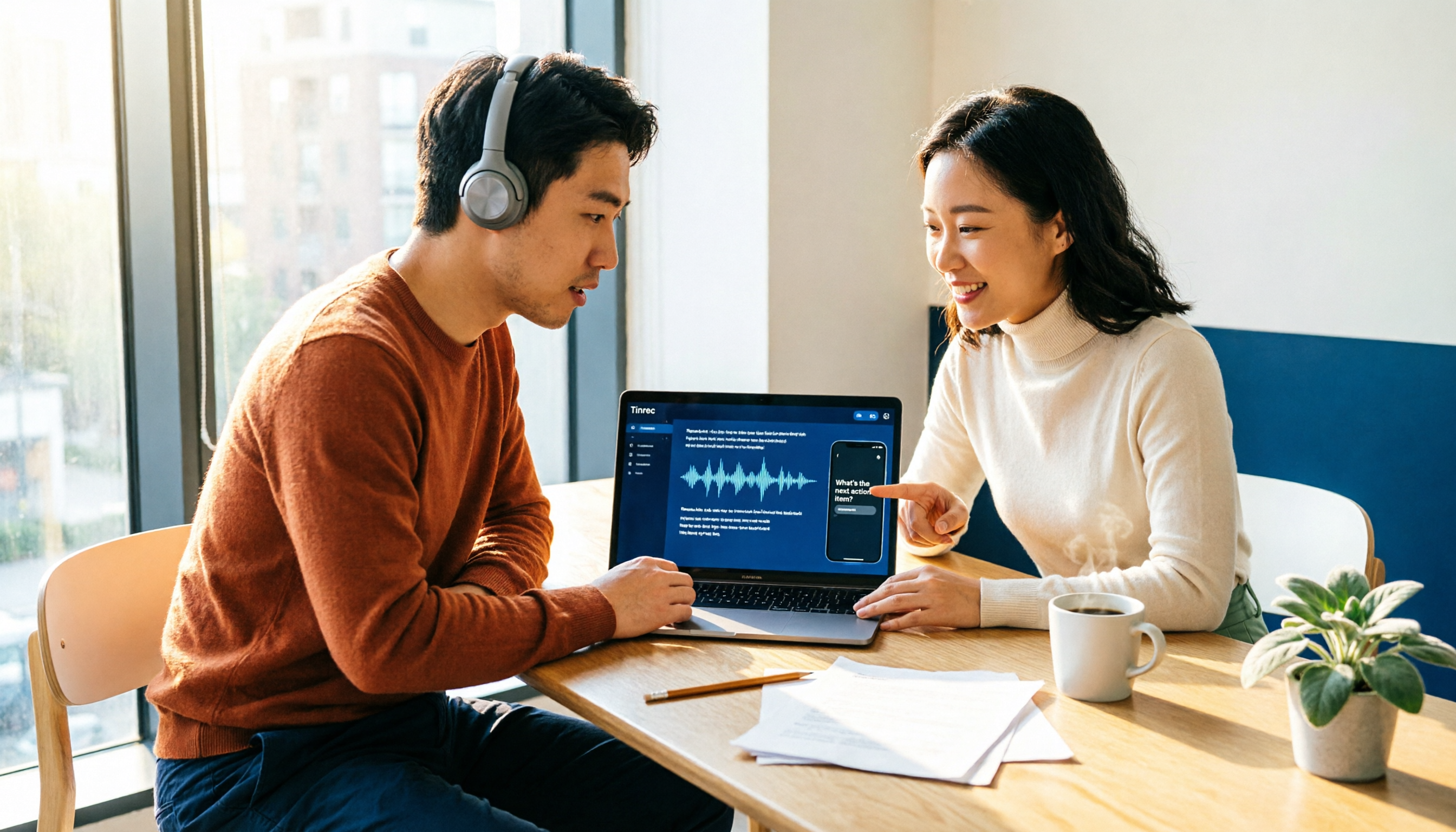
How to Choose an Automatic Transcription Tool in 2026: 5 Steps to Compare Yating Transcription and Tinrec
How do you choose an automatic transcription tool? Starting from the actual checklist I use when picking tools, I compare Yating Transcription and Tinrec across five dimensions, covering online meeting recording methods, post-meeting organization depth, AI Q&A, cross-platform team collaboration, and quota pricing, to help you determine which one better fits your workflow.

4 Best Audio-to-Text Apps in 2026: Which One Actually Saves You Post-Meeting Time?
A mid-level manager who attends 15 meetings a week shares hands-on experience. From online meeting recording methods and transcription performance for Chinese and mixed Chinese-English to post-meeting summaries and action item organization, this breaks down the differences among four types of audio-to-text apps and explains how Tinrec uses bot-free recording, AI summaries, action item extraction, and team spaces to turn meetings into searchable, collaborative, actionable data.
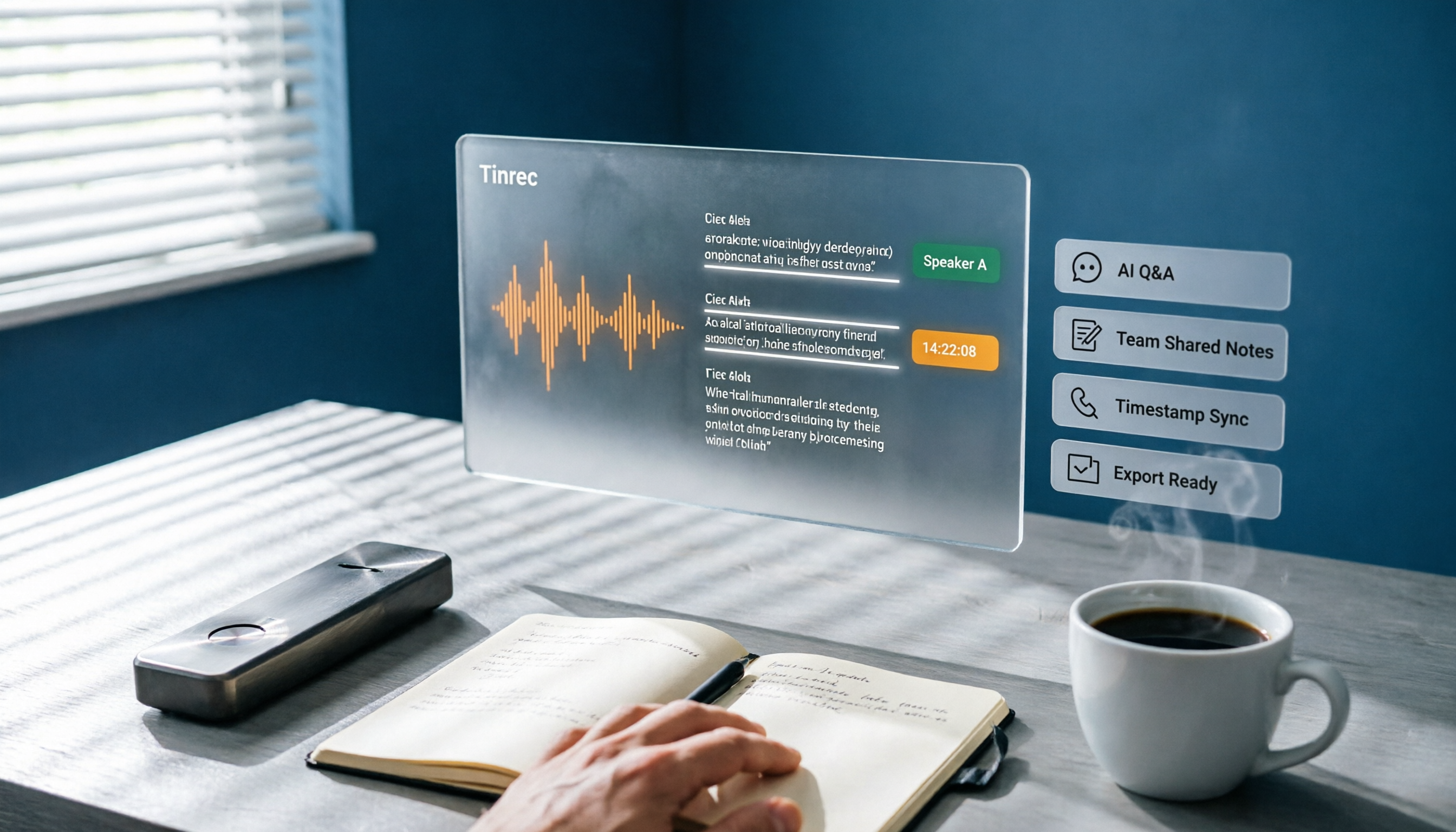
4 Interview Transcription Tools Compared in 2026: From Recording to Citable Text
After an interview, organizing the transcript often feels more exhausting than the interview itself. This article starts from 'recording to citable text' and compares 4 interview transcription tools, covering speaker labeling, AI Q&A, audio retention, and team sharing, plus common pitfalls and selection advice.

Tinrec vs Notta 2026: 5-Dimension Comparison for Chinese Meeting Transcription Tools
Starting from the decision focus of 'Do you want transcription, or usable meeting data?', this article compares Tinrec and Notta across 5 dimensions, covering selection criteria, a full breakdown of Tinrec, other options, and pitfalls to avoid, helping Chinese meeting users make a quick choice.

5 Transcription Tools Tested and Compared in 2026: Transcription Takes Too Long—Which One Actually Saves Time?
Transcription takes too long, and the problem is often not typing speed but the "listen, type, re-read" workflow. This article tests 5 transcription and AI meeting note tools, covering how to judge accuracy, post-meeting organization, audio retention and export, free quotas, and team seat licensing. It provides criteria you can follow directly and analyzes Tinrec's actual performance in bot-free recording, AI Q&A, and team knowledge retention.