
Turn recordings into transcripts and summaries in minutes
Upload audio or video for multilingual transcription, AI notes, and action items
In multinational companies or tech industries in Taiwan, the most common scene in meeting rooms is not all-English or all-Chinese conversations, but a uniquely local 'mixed language' mode. 'We might need to confirm that project schedule again, otherwise the deadline won't make it...' This kind of Chinese-English mixing (code-switching), jokingly called 'Chinglish,' has become the norm in workplace communication. However, this is a nightmare for administrative staff responsible for meeting notes or workers relying on traditional speech recognition tools.
The Hidden Pain Point in Taiwanese Workplaces: Why Can't Traditional Recognition Software Understand?
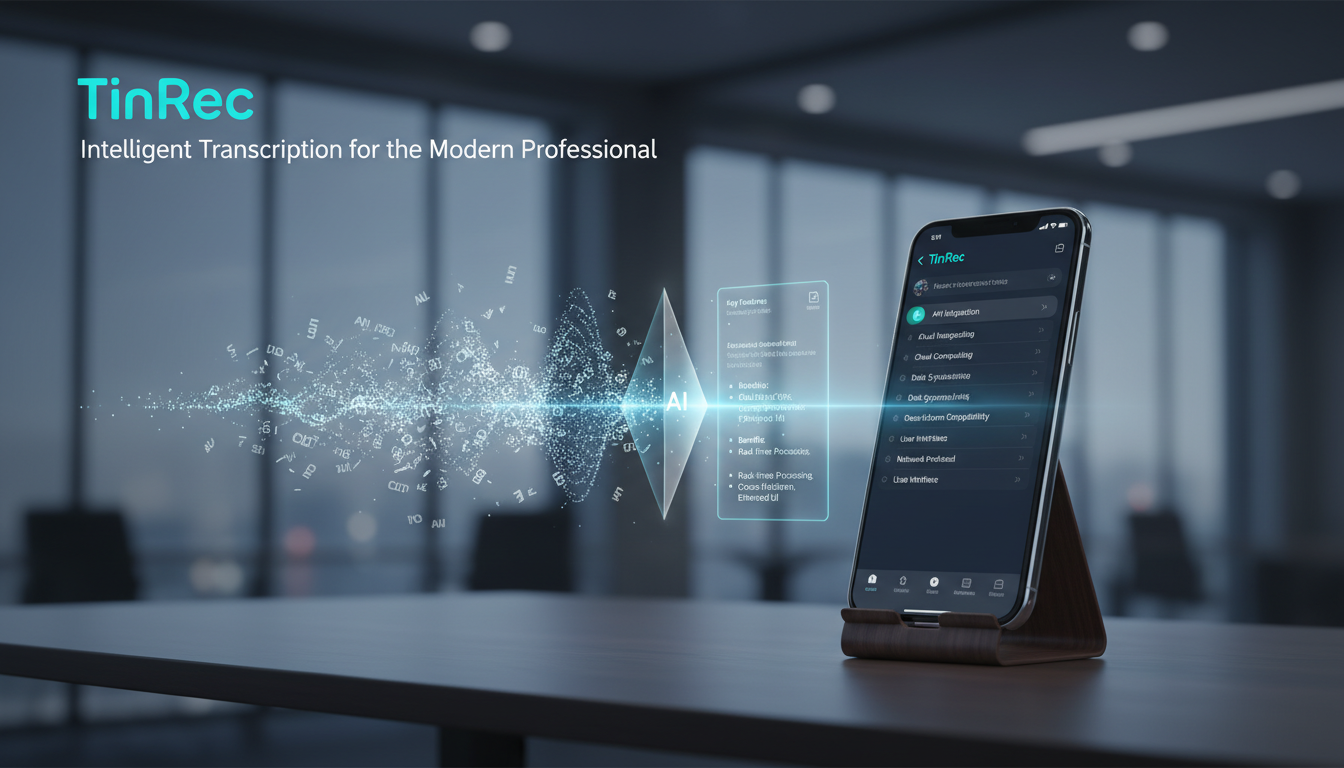
In the past few years, speech-to-text (STT) technology has become quite common, but most engines perform well on single languages. Once they encounter 'Chinese-English mixing,' accuracy drops sharply. Traditional acoustic models often require pre-setting a 'primary language.' When an English word like 'Presentation' or 'KPI' suddenly appears in a Chinese sentence, the system often fails to switch spectral features quickly enough, resulting in misrecognition of English words as similar-sounding Chinese characters (e.g., 'App' becoming '爱普') or simply skipping them. This not only increases post-editing time but also risks losing key data or proper nouns.
Technological Evolution: How New AI Tackles the Bilingual Switching Challenge
With the maturity of end-to-end deep learning models, new-generation speech recognition technology can mimic the human brain's auditory mechanism. These advanced models no longer rely on acoustic dictionaries of a single language. Instead, through massive multilingual training data, they learn to automatically detect language and switch recognition logic within milliseconds. This breakthrough lays the foundation for new AI tools like TinRec, enabling machines to finally understand the most natural way Taiwanese people speak—whether it's rapid conversation in meetings or technical discussions loaded with jargon—achieving unprecedented recognition accuracy.
Stop organizing recordings by hand
Upload audio or video and automatically get a transcript, summary, and action items
TinRec: A Comprehensive Business Voice Solution
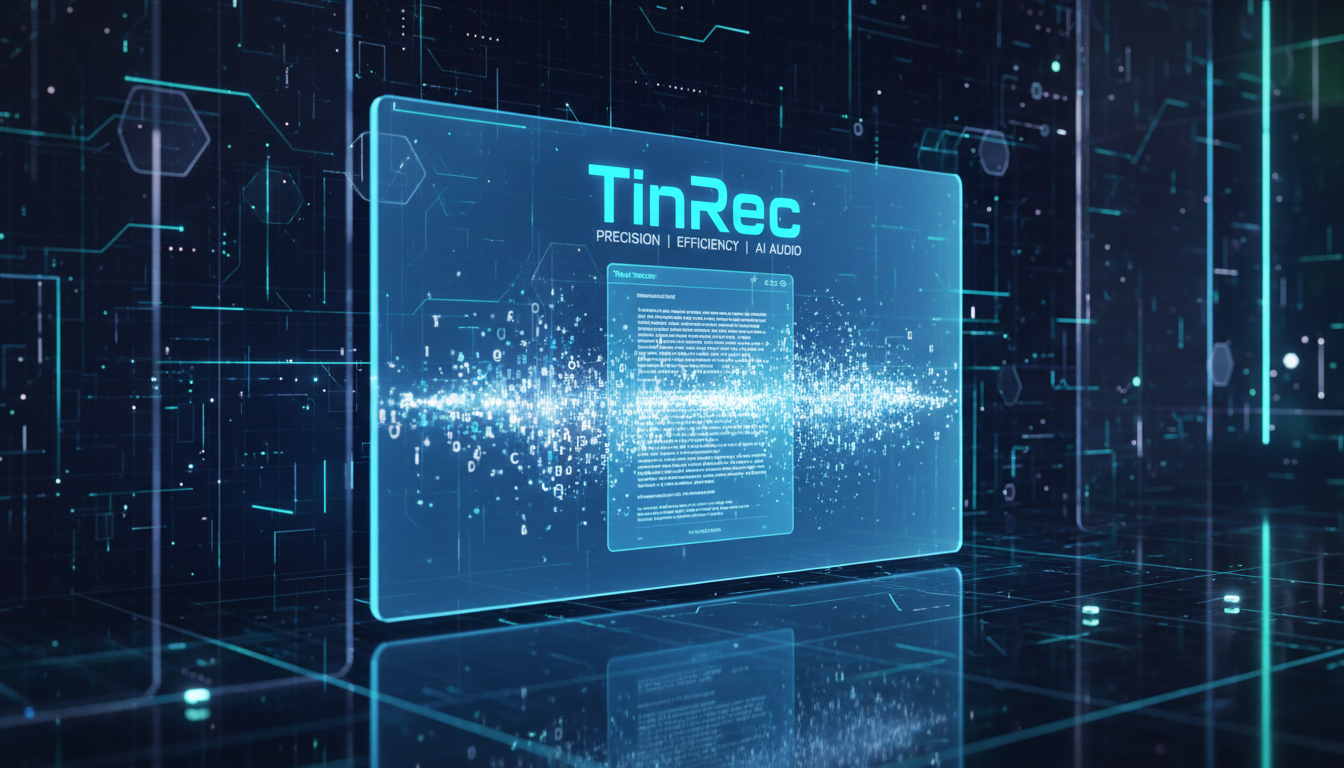
Among many emerging tools, TinRec demonstrates strong adaptability to complex contexts. It's not just a simple transcription tool but an intelligent workstation integrating 'recording, transcription, and summarization.' For business professionals who frequently have international conference calls, TinRec's call recording transcription feature solves a long-standing documentation problem. Users no longer need to take handwritten notes during calls; the system automatically captures both sides' dialogue and accurately reproduces Chinese-English mixed sentences.
Additionally, for existing audio files, its MP3 to text function supports high-accuracy bilingual recognition. Simply upload the audio file to https://tinrec.com/, and the system generates a transcript in a short time, automatically differentiating speakers, greatly reducing the time media workers or researchers spend organizing interview material.
From Transcript to Smart Insights: AI Meeting Summaries and Content Creation
Having an accurate transcript is just the first step; extracting value from lengthy conversations is key. The AI meeting summary and AI meeting minutes features are designed for information overload. Using large language models, TinRec automatically analyzes hours of meeting content, quickly summarizing 'key discussion points,' 'decisions,' and 'action items.' This means meeting notes that once took a full day to compile can now be drafted in minutes, allowing teams to focus on execution rather than documentation.

For content creators, this technology also extends to video platforms. TinRec's YouTube subtitle generation feature quickly parses audio from videos and generates accurate time-coded subtitles. This is a boon for creators looking to expand internationally, as it easily handles common Chinese-English mixed speech, making subtitle creation no longer a bottleneck to posting frequency.
Embracing Efficient Work Modes
In today's fast-paced workplace, tool choice often determines efficiency. From solving the code-switching recognition challenge to automatically generating structured meeting summaries, advances in AI voice technology are reshaping how we process information. Solutions like TinRec not only save typing time but also free up mental bandwidth, allowing us to focus on more creative and strategic thinking. In future workplaces, leveraging these AI assistants will become a key differentiator in professional competitiveness.
Turn every recording into actionable outcomes
Get 60 free transcription minutes when you sign in. No credit card required.
Related Reading
You might also like

4 AI Meeting Note Tools Tested for 2026: Which Saves the Most Time for Chinese Meetings?
Still spending two hours writing meeting notes after the meeting? This article compares four AI meeting note tools, breaking down Chinese and mixed Chinese-English recognition, meeting recording methods, post-meeting summaries and action items, cross-platform export, and team member management. It also lists four key pitfalls to avoid when choosing a tool, helping you find a solution that truly saves time.

2026 Guide: Convert Audio to Transcripts — Stop Typing Manually & Auto-Generate Meeting Minutes with AI
Don't want to type transcripts by hand? This guide covers two scenarios—live meetings and pre-recorded files—and outlines 4 key buying factors. We tested Tinrec's bot-free meeting recording, AI summaries, and Q&A workflow, compared Notta, Granola, and PLAUD, and included the most common pitfalls to avoid.

4 AI Recording Tools Tested for 2026: Which Saves the Most Time on Chinese Meeting Notes?
Recorded a meeting but never have time to organize it? This hands-on comparison looks at four common approaches—built-in phone features, free online tools, AI recording hardware, and dedicated AI meeting note tools—and tests Tinrec on Chinese meeting transcription, summaries, and action items. Includes 6 buying considerations and FAQs.

2026 Medical Meeting Transcription Tools Compared: Which AI Saves You the Most Time with Chinese Transcripts and Summaries?
For professionals juggling over a dozen meetings a week and still stuck with post-meeting notes, which tool should you use? This article dives into practical decision points, covering 5 key factors for choosing a medical meeting transcription tool. We tested Tinrec's bot-free recording, AI summaries, action item extraction, and AI Q&A, and briefly review alternatives like Notta, Otter.ai, and PLAUD. We also provide a guide to avoid common pitfalls and final recommendations.

How to Choose an Automatic Transcription Tool in 2026: 5 Steps to Compare Yating Transcription and Tinrec
How do you choose an automatic transcription tool? Starting from the actual checklist I use when picking tools, I compare Yating Transcription and Tinrec across five dimensions, covering online meeting recording methods, post-meeting organization depth, AI Q&A, cross-platform team collaboration, and quota pricing, to help you determine which one better fits your workflow.

4 Best Audio-to-Text Apps in 2026: Which One Actually Saves You Post-Meeting Time?
A mid-level manager who attends 15 meetings a week shares hands-on experience. From online meeting recording methods and transcription performance for Chinese and mixed Chinese-English to post-meeting summaries and action item organization, this breaks down the differences among four types of audio-to-text apps and explains how Tinrec uses bot-free recording, AI summaries, action item extraction, and team spaces to turn meetings into searchable, collaborative, actionable data.
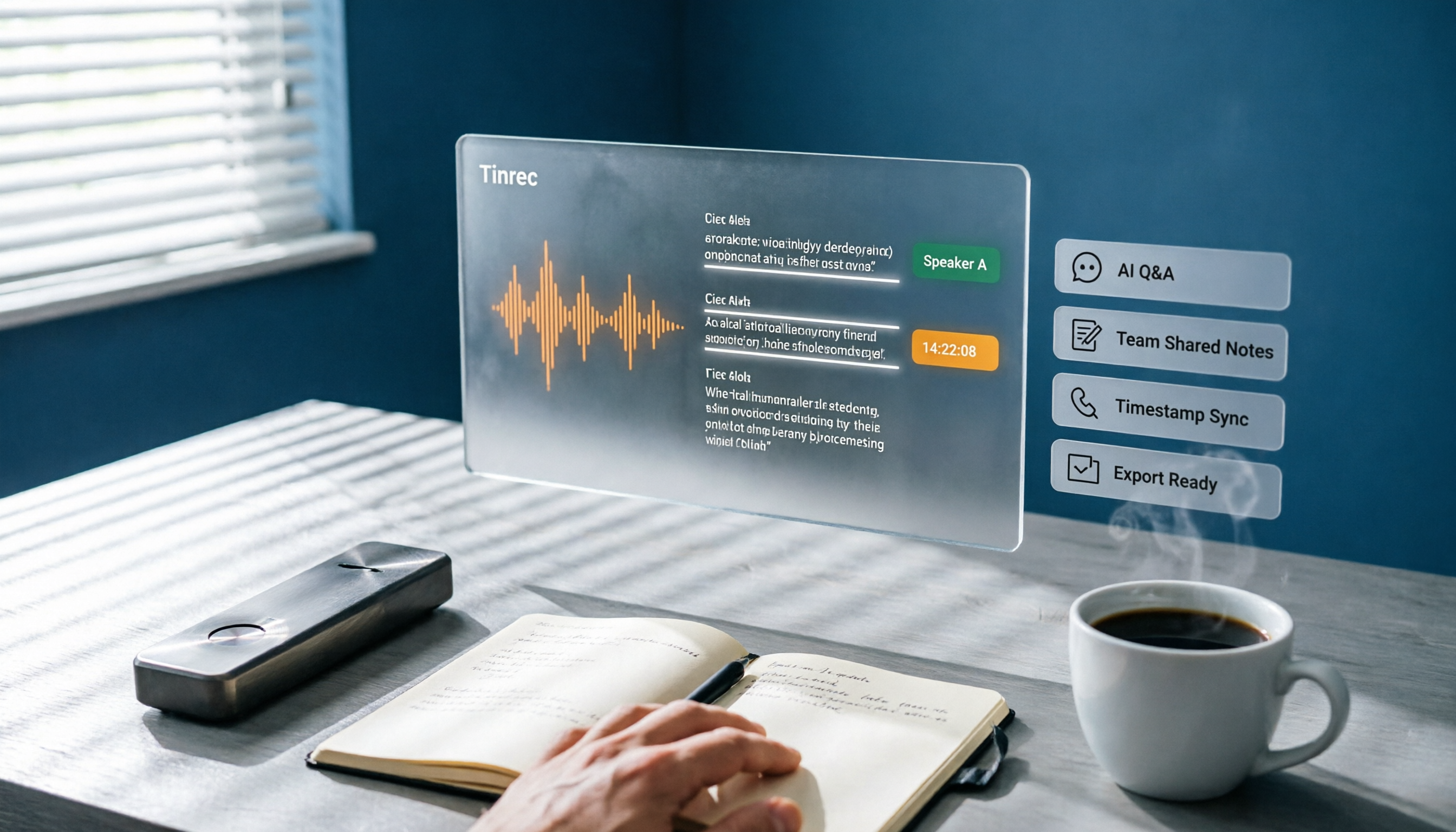
4 Interview Transcription Tools Compared in 2026: From Recording to Citable Text
After an interview, organizing the transcript often feels more exhausting than the interview itself. This article starts from 'recording to citable text' and compares 4 interview transcription tools, covering speaker labeling, AI Q&A, audio retention, and team sharing, plus common pitfalls and selection advice.

Tinrec vs Notta 2026: 5-Dimension Comparison for Chinese Meeting Transcription Tools
Starting from the decision focus of 'Do you want transcription, or usable meeting data?', this article compares Tinrec and Notta across 5 dimensions, covering selection criteria, a full breakdown of Tinrec, other options, and pitfalls to avoid, helping Chinese meeting users make a quick choice.

5 Transcription Tools Tested and Compared in 2026: Transcription Takes Too Long—Which One Actually Saves Time?
Transcription takes too long, and the problem is often not typing speed but the "listen, type, re-read" workflow. This article tests 5 transcription and AI meeting note tools, covering how to judge accuracy, post-meeting organization, audio retention and export, free quotas, and team seat licensing. It provides criteria you can follow directly and analyzes Tinrec's actual performance in bot-free recording, AI Q&A, and team knowledge retention.