
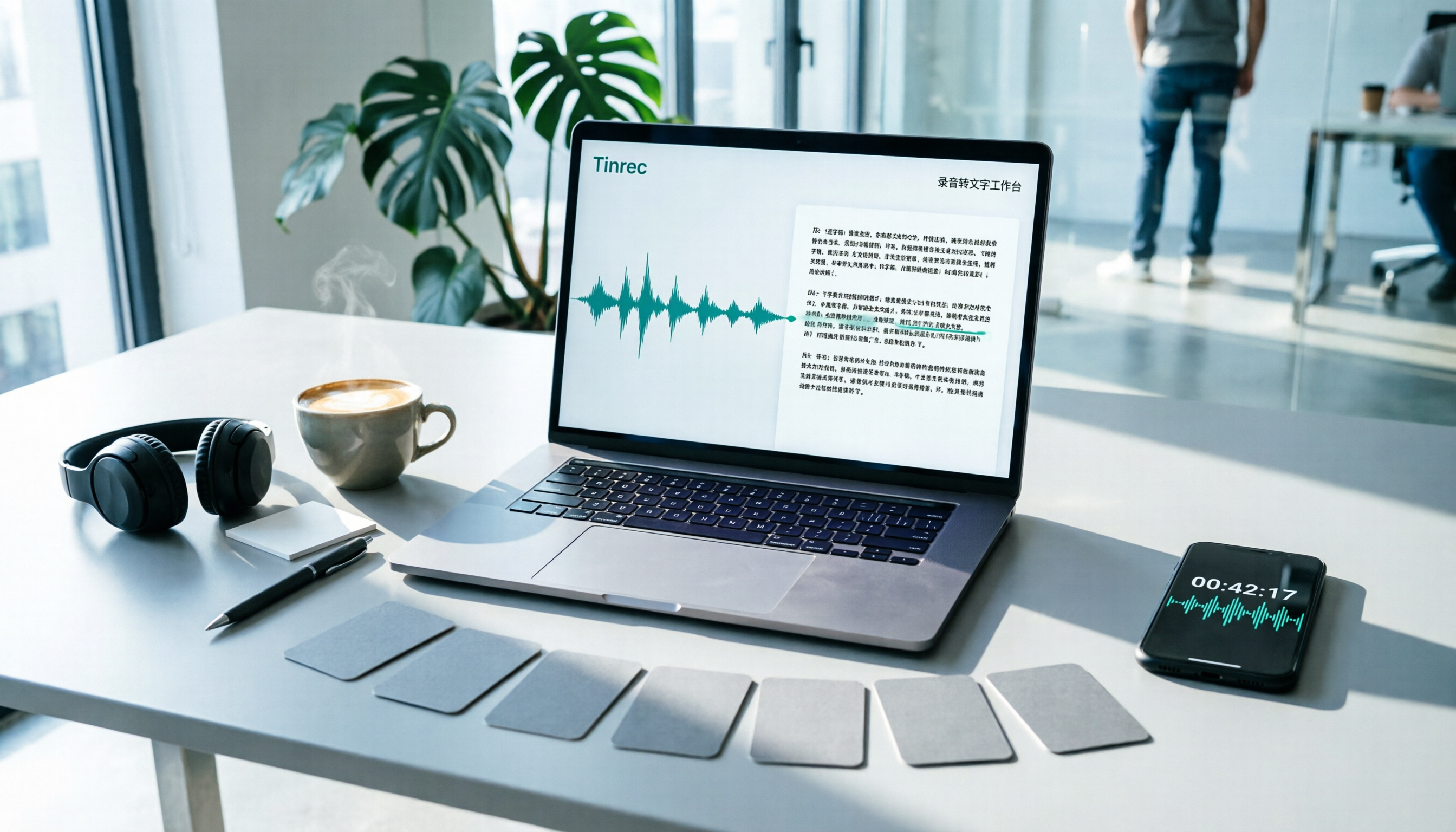
Turn recordings into transcripts and summaries in minutes
Upload audio or video for multilingual transcription, AI notes, and action items
7 Best Free Audio-to-Text Transcription Tools in 2026: A Complete Comparison
"The meeting's over—send me the notes when you get a chance." You look at your phone and there's a 90-minute recording sitting there. Your handwritten notes? Three lines.
This is a daily reality for many professionals. Typing up a two-hour meeting manually takes four to six hours. And finding a tool usually means not wanting to commit to a monthly subscription right away. That's why most people start by searching for "free audio to text transcription" to see what free tiers actually offer.
I've put together 7 commonly used tools, each with clear details on free limits, paid pricing, and who it's best for. You can pick one and start trying it right away.
Why Do You Need Audio-to-Text Transcription?
Transcription needs come up more often than you'd think: meeting notes, client interviews, class lectures, presentation summaries, even adding subtitles to your own videos.
AI speech recognition has matured to the point where you can "upload a file and get text in minutes." The real question usually isn't whether it can transcribe—it's whether the free tier gives you enough minutes.
Below, Tinrec is the top recommendation, while the other tools each have their own strengths. The final section will help you choose based on your needs.
Option 1 | Tinrec — The Most Complete AI Recording and Meeting Assistant
Tinrec is an AI meeting notes and collaboration tool for individuals and teams. Its focus isn't just converting audio to text—it's turning meetings into searchable, queryable, reusable data.
It supports four common input sources:
- Live recording: For in-person meetings, interviews, and on-site notes—transcribes as you record.
- Online meetings: The desktop app captures system audio directly, so you don't need to invite a bot to Zoom, Google Meet, Microsoft Teams, or Webex.
- Audio and video files: Great for organizing existing meetings and archived recordings.
- Mobile recording: Capture notes on the go or during impromptu conversations.
The post-transcription workflow is what sets it apart from basic transcription tools:
- Automatically generates summaries, chapters, and action items—no need to read through a long meeting from start to finish.
- AI Q&A lets you ask follow-up questions about a single meeting or across multiple meetings, like "What budget did the client mention?"
- Real-time translation during recording, with original text, translation, or bilingual side-by-side view.
- Export results as documents or send to Notion, Google Docs, OneNote, Dropbox for further editing. You can also use Agent post-processing to generate reports and tables.
For plans, the personal version has a free tier to try recording, importing, summaries, and transcription. There's also a weekly pass, Pro monthly, and Pro annual—choose based on how often you use it. Occasional transcription? Start with free. A short burst of meetings? Try the weekly pass. Regular weekly use? Go Pro.
If your whole department needs to share meeting data, the team version offers a dedicated team space with member roles and seat management, usage tracking, and audit logs. Team pricing is USD 29.80 per paid seat per month, or USD 199 per paid seat per year (about USD 16.58/month). Eligible first-time users can try 7 days with 1 free seat and 300 shared import minutes. Actual pricing and benefits are subject to the official purchase page.
Best for: People who need Chinese meeting transcripts, don't want a bot joining their meetings, and want to turn meeting content into team knowledge.
Option 2 | MyEdit — Online Transcription Tool with Daily Free Credits
MyEdit is an online audio/video editing tool. Its speech-to-text feature requires no software download—just open the webpage and import an audio file. Unlike Tinrec, MyEdit focuses on file-to-text conversion and doesn't offer live meeting recording or post-meeting AI Q&A.
The main highlight is easy access to free credits: log in daily to earn credits and transcribe for free. It supports 9 languages including Chinese, English, and Japanese. You can edit transcripts freely, choose whether to add timestamps, and export as plain text (.txt) or subtitle files (.srt).
For paid plans, upgrading to Audio Pro gives you 360 credits per month and unlocks other AI audio tools.
Best for: People who occasionally need to transcribe a recording or create subtitles on a tight budget.
Option 3 | cSubtitle — Online Subtitle and Transcription Tool Focused on Chinese
cSubtitle is a popular online speech-to-text service specializing in Mandarin Chinese recognition. Upload a video or audio file and start converting—no account required. Compared to Tinrec, it's more of an "upload file, get file" tool without team collaboration or meeting management features.
One highlight is broad format support: upload MP4, MOV video files, or MP3, WAV, M4A, OGG, WMA audio files up to 4GB and 5 hours per file. Output includes standard text files and Word transcripts with automatic punctuation and paragraph breaks, plus timestamped .sub and .vtt subtitle files for easy proofreading.
The free version is officially described as a lightweight "quick 3-minute" option. Longer files and conversion history are Pro features.
Best for: People who need Chinese transcripts or video subtitle files and prefer uploading files for processing.
Option 4 | Otter.ai — A Mature Choice for English Business Meetings
Otter is one of the earliest AI meeting assistants, supporting Zoom, Microsoft Teams, and Google Meet with live transcription, speaker identification, AI Chat, and team management. Its English business meeting experience is mature—if your meetings are almost entirely in English, Otter is a very intuitive choice. Tinrec, on the other hand, focuses more on Chinese meetings, bot-free desktop recording, and post-meeting knowledge retention.
Stop organizing recordings by hand
Upload audio or video and automatically get a transcript, summary, and action items
The free Basic plan offers 300 minutes per month. Pro annual billing works out to about USD 8.49 per user per month, including 1,200 minutes of in-app recording and 10 file imports per month. Business offers unlimited meetings and in-app recording. Pricing subject to the official page.
Best for: Teams with primarily English meetings who want a bot to automatically record.
Option 5 | Notta — Multilingual Transcription and Team Plans
Notta overlaps significantly with Tinrec, covering multi-platform transcription, meeting notes, file imports, and translation. The difference is that Notta leans more toward a transcription and translation tool—post-meeting AI Q&A, action item extraction, and team data governance aren't its main focus.
The free plan offers 120 minutes per month with a 3-minute limit per recording. Pro annual billing is about USD 8.17 per month for 1,800 minutes per month. Business annual billing is about USD 16.67 per seat per month with unlimited transcription, role permissions, and usage reports. Pricing subject to the official page.
Best for: Users who need multilingual transcription and basic team permission management.
Option 6 | TurboScribe — Affordable Choice for Long Files and Batch Transcription
TurboScribe is a cost-effective file transcription tool focused on long audio files, batch uploads, and subtitle translation. If you need to throw a bunch of files in at once, its rules are more lenient than Tinrec's. But live meeting recording and post-meeting Q&A aren't its strengths.
The free plan allows 3 files per day, up to 30 minutes each. Unlimited annual billing is USD 120 (about USD 10/month). Paid plans support files up to 10 hours or 5GB and up to 50 files per upload. Pricing subject to the official page.
Best for: People with a batch of recordings or videos that need to be transcribed at once.
Option 7 | Granola — Bot-Free AI Meeting Notes
Granola also uses a bot-free approach, capturing system audio and microphone input on your desktop for live transcription, then combining it with your handwritten notes to generate meeting content. Its approach is similar to Tinrec's desktop version, but Granola emphasizes its own notes plus AI enhancement. It doesn't support uploading pre-recorded audio files and doesn't save meeting audio.
Pricing: Basic is free, Business is USD 14 per user per month, Enterprise is USD 35 per user per month. Subject to the official page.
Best for: People who like to type notes during meetings and don't need to keep audio files.
With So Many Options, How Do You Choose?
- Want to ask follow-up questions, organize action items, and generate reports after transcription → Tinrec (combines summaries, chapters, action items, AI Q&A, and Agent post-processing in one workflow)
- Don't want a meeting bot joining Zoom, Meet, or Teams → Tinrec (desktop captures system audio) or Granola (but Granola doesn't keep audio or accept uploaded files)
- Meetings are mainly in Chinese or mixed Chinese-English → Tinrec (covers Chinese, Traditional Chinese, and multilingual scenarios, with team hotwords support)
- Need to export transcripts to Notion, Google Docs, or OneNote for further editing → Tinrec (supports multiple formats and third-party exports)
- Whole department needs to share meeting data, manage seats and usage → Tinrec team version
- Zero budget, just occasional short recordings → MyEdit's daily free credits or cSubtitle's free version
- Have a batch of long audio files to transcribe at once → TurboScribe
4 Things to Know Before Using Audio-to-Text Transcription
1. Calculate your needs first, then decide whether to pay. Free plans are usually measured in minutes per month—for example, Otter Basic gives 300 minutes/month and Notta Free gives 120 minutes/month. If you only have two meetings a month, the free tier is probably enough. If you have meetings every day, it's worth comparing paid plan rates carefully.
2. Chinese recognition depends on recording conditions. Accents, background noise, multiple people speaking at once, and technical jargon all affect results. No tool should promise a fixed accuracy rate. If your team uses specific terminology, you can use Tinrec's team hotwords feature to improve recognition.
3. Confirm consent and legal requirements before recording. Taiwan and most regions have regulations around recording. It's best to inform participants at the start of a meeting and get consent when required.
4. A transcript usually isn't the end goal. Getting a few thousand words of transcript still means spending time reading through it. A more efficient approach is to generate summaries and action items at the same time—for example, use Tinrec to transcribe and directly generate chapters, key points, and action items, then export to your existing workflow.
Frequently Asked Questions
Q1: Are there truly completely free audio-to-text transcription tools? Yes, but most have limits. Common formats include monthly free minutes (Otter Basic: 300 min/month, Notta Free: 120 min/month), daily free credits (MyEdit), daily free file count (TurboScribe: 3 files/day), or feature-limited free versions. Check your usage frequency before choosing.
Q2: Where are free plan limits usually listed? Mostly on the pricing page or plan comparison table. Watch for three things: whether the free allowance is monthly or lifetime, whether there's a per-file length limit, and whether export formats are restricted.
Q3: What can Tinrec's free version do? You can try recording, importing, summaries, and transcription with the basic allowance. Once you confirm the workflow fits your needs, choose a weekly pass or Pro plan based on usage frequency.
Q4: I need to keep audio files—which tool should I choose? Tinrec supports audio retention. Granola doesn't save meeting audio and can't accept uploaded files. If you need to replay and verify later, pay special attention to this.
Q5: What should I consider for team use? A team plan is different from multiple people sharing one personal account. With Tinrec's team version, for example, meeting data belongs to the team, with distinct roles and seats: members without seats can still view and play team data, but only seat holders can record, upload, and edit. When a member leaves, their resources need to be handed over to other members.
Summary
Free audio-to-text transcription tools do exist—but the free allowances and feature completeness vary widely. Pure transcription can be handled by MyEdit, cSubtitle, or TurboScribe. But if your problem is "I still have to spend time organizing after the meeting," the focus isn't just transcription—it's whether you can directly generate summaries, action items, and searchable data afterward.
From that perspective, Tinrec puts recording, transcription, AI Q&A, action item extraction, and team spaces into a single workflow, making it the most complete option on this list. I recommend starting with the free tier to see if it fits your work habits before committing further.
References
- No Time Limit! 3 Free AI Transcription Tools, Highly Recommended! AI Voice Notes Generate Meeting Records, Presentations, Mind Maps | 104 Career Power
- Audio to Text - Free Speech-to-Text Tool
- Online AI Speech, Video, Audio File Auto-Transcription - Free Trial - cSubtitle
- Tested 4 Best "Speech-to-Text" Online Tools, Free Instant Audio-to-Transcript
- Online Speech-to-Text AI, Free MP3 or Audio File to Text Transcript - MyEdit
Turn every recording into actionable outcomes
Get 60 free transcription minutes when you sign in. No credit card required.
Related Reading
You might also like

Tinrec vs Otter.ai 2026: 5-Dimension Comparison — Who Manages Meeting Data Access Permissions Better?
Meeting data access permissions aren't just an IT issue — they're a team memory issue. Starting from the real-world pain of "who holds the data," this article reviews 6 solutions and compares Tinrec vs Otter.ai across 5 dimensions: team-level sharing, role and seat management, audit and recycle bin, data handover, and Chinese-language meeting experience — highlighting differences in meeting data access permissions and ideal use cases.

4 Meeting Notes Tools Tested in 2026: Which One Actually Builds a Team Knowledge Base?
Meeting notes shouldn't stay locked in personal accounts. We tested Tinrec, Otter.ai, Granola, and PLAUD across bot-free online meeting recording, post-meeting summaries and action items, AI Q&A, team spaces, roles, and seat management to help you find the tool that truly turns meetings into reusable team data.

Feishu Minutes Alternatives: 2026 Hands-On Comparison of 2 Tools, Tinrec Handles Chinese Meetings Better
Feishu Minutes free version has ASR time limits. This article compares Feishu Minutes and Tinrec in meeting recording, free quota, AI organization, export, and team collaboration to help users who meet across platforms and want to consolidate meeting materials find a more suitable alternative.

Notion AI Meeting Notes Alternative Tested: Tinrec's Bot-Free Workflow Review (2026)
Notion AI's meeting notes are well-integrated, but plan thresholds, device limits, and team sharing needs can still get in the way. From the perspective of a mid-level manager who runs 15 meetings a week, this hands-on review tests Tinrec as an alternative: bot-free recording, live transcription, AI summaries and action items, post-meeting Q&A, multi-format export, and team space roles and seat governance—plus an honest look at when it's not a good fit.

5 AI Meeting Tools Seat Management Tested for 2026: How Many Team Plan Seats Do You Really Need?
How many seats to buy for a team meeting tool is the biggest question most teams face before purchasing. This article uses Tinrec's team plan to demonstrate a replicable seat management process, explaining roles, seats, data ownership, and usage checks in 5 steps, along with FAQs and alternatives.

4 Best Audio-to-Text Tools for Chinese Meetings in 2026: Real-World Comparison
How to choose the right audio transcription tool? This article starts with common pitfalls, outlines 4 key buying factors, then compares Tinrec, Otter.ai, Granola, and TurboScribe in real-world tests for Chinese meeting transcription, bot-free recording, AI summary Q&A, and team data retention. It ends with a guide to avoid mistakes and recommendations based on your needs.

4 Meeting Transcription Tools Tested for 2026: Which One Actually Builds a Team Knowledge Base?
The real pain point with meeting notes isn't that nothing gets written down—it's that what's written down never gets used. Starting from real meeting scenarios, this article breaks down 4 key decision points for choosing a meeting transcription tool, compares Tinrec, Granola, Notta, and PLAUD in hands-on testing, and outlines the 3 most common buying mistakes, helping you turn scattered meeting content into a searchable, queryable, transferable team knowledge base.

2026 Comparison of 4 Meeting Transcription Tools: Who Does Permission Management Best?
Who should see meeting notes? This article examines four key points—roles and seats, team-level sharing, data ownership after member departure—and compares the permission management designs of Tinrec, Otter.ai, Fireflies.ai, and Granola, plus four common pitfalls to help you think clearly before adoption.

2026 Comparison of 4 Tencent Meeting AI Notes Alternatives: Which Handles Bot-Free Recording and Post-Meeting Q&A Best?
Tencent Meeting's built-in AI notes are sufficient for single-platform users, but when meetings span Zoom, Meet, and Teams, or when you need to process client-sent audio files, the issue isn't accuracy—it's whether the tool can handle all your sources. This article uses the same set of meeting materials to test four approaches, comparing input sources, recording methods, post-meeting Q&A, and team data retention, and highlights the three most common mistakes when choosing a tool.