

Turn recordings into transcripts and summaries in minutes
Upload audio or video for multilingual transcription, AI notes, and action items
2026 Comparison of 4 AI Meeting Tools: Which Offers the Best Free Tier and Post-Meeting Organization?
It's 3 PM on a Wednesday, and you've just finished a 50-minute cross-departmental meeting. Your notes fill two pages, but you've only captured half of the action items.
Then your boss asks, "Who said they'd update the specs?" You scroll through the chat history for ten minutes but still can't find that message.
Another common scenario is online meetings: the recording is stored in the cloud, but all you need is "what was decided, who's responsible, and when it's due"—yet you have to watch the entire 50-minute video from start to finish.
This article is my hands-on comparison of AI meeting tools after actually using them.
Meetings That Make You Question Everything—You Don't Lack Notes, You Lack Usable Meeting Data
Most people's problem isn't that they don't take notes—it's that the notes they take aren't usable.
Handwriting can't keep up with the conversation, and the most critical line—"Get this to me by Friday"—often gets missed. Built-in meeting transcription only gives you a long block of text with no segmentation or highlights, so you still have to re-read it afterward.
Then there are cross-language meetings: mixing Chinese and English, with occasional product codes thrown in. The transcribed text is understandable, but you still have to manually turn it into meeting minutes.
If you've experienced these situations, the problem usually isn't your diligence—it's that the tool only goes as far as "recording."
Before Choosing an AI Meeting Tool, Understand These 4 Key Points
1. How does meeting audio get in?
There are roughly two approaches: a bot joins the meeting, or a desktop app captures the computer's system audio directly. A bot will appear in the participant list, which some client meetings may frown upon; system audio capture doesn't add an extra participant. Think this through first, because it determines whether you can use it in client meetings.
2. What do you get after transcription?
Getting only a transcript versus getting a summary, chapters, and action items are completely different workloads. Don't just look at "how many languages it supports"—look at how well it organizes the data.
3. Is the audio file retained?
Some tools keep only text, not audio. If there's a transcription error, you have no original recording to check against. Few people notice this, but it makes a big difference when problems arise.
4. How is the free tier calculated?
Some give monthly minutes, others limit per-file length. Different quota calculations suit different usage frequencies. We'll list the actual numbers for each tool in the following sections.
Tinrec—The One I Open Most After Testing
Tinrec is an AI meeting notes and collaboration tool for individuals and teams, available on web, desktop, and mobile. It doesn't just convert speech to text—it turns meetings into data you can search, query, export, and further process.
During the meeting: transcribe as you record, no extra bot
For in-person meetings, just start real-time recording and the transcript appears as you speak. For online meetings, I use the desktop version, which captures system audio and works with Zoom, Google Meet, Microsoft Teams, and Webex—no extra account appears in the participant list. For those who frequently meet with external clients, this is quite practical.
After the meeting: summary, chapters, and action items all at once
This is where I find it saves the most effort. As soon as the meeting ends, the summary and chapters are already segmented, and action items are extracted from the discussion—who's responsible and what needs to be delivered, no need to replay the recording.
Post-meeting queries: just ask, no Ctrl+F needed
This is what sets it apart from most transcription tools. You can directly ask, "What was the conclusion about pricing in the last meeting?" and it will answer based on the content, rather than dumping a bunch of keywords for you to sift through. The more historical meetings accumulate, the more useful this feature becomes.
Cross-language and technical terms
Supports Chinese, Traditional Chinese, and multilingual meetings. During recording, you can switch between original text, translation, or bilingual view. For mixed Chinese-English meetings, it works fairly smoothly for me; for proper nouns like product codes, you can maintain team hotwords to improve recognition stability.
Hands-on observations (honestly)
Stop organizing recordings by hand
Upload audio or video and automatically get a transcript, summary, and action items
I tested a 20-minute recording of a mixed Chinese-English meeting with air conditioning background noise and two people interrupting each other. The transcript was generally readable; interruptions required replaying the audio to confirm; and I recommend double-checking proper nouns when they first appear. The official accuracy rate isn't published, and I wouldn't trust any "98%" claim—real meeting rooms are very different from recording studios.
Three pros
First, no extra hardware or meeting bot needed—works on web, desktop, and mobile. Second, output formats are complete: transcript, summary, chapters, action items, mind map, and you can use the Agent to further generate reports, tables, and documents. Third, multiple export options: Notion, Google Docs, OneNote, Dropbox—you're not locked in.
Limitations to be clear about
The personal plan has a free tier to try, but heavy use requires payment, with weekly, Pro monthly, and Pro annual plans—check the official website for actual prices. Also, the team plan currently offers team-level sharing, not file-level permissions, so don't expect to set individual visibility for a single file.
A note on the team plan
If a department uses it together, the team plan provides an independent space where meeting data belongs to the team. Members can view, play, and read data even without a seat, but recording, uploading, and editing require a seat. Currently, the team monthly plan is USD 29.80 per paid seat, and annual is USD 199 per paid seat (about USD 16.58/month). Each paid seat includes 2,000 minutes of team shared import quota per month; real-time recording under an active plan is currently not deducted by minutes. Eligible teams get a 7-day trial with 1 free seat and 300 minutes of shared import quota.
Who it's for
Those who frequently hold Chinese or mixed Chinese-English meetings, want to use AI to find answers directly after meetings, and need to turn meeting data into team assets—this is the best fit.
Besides Tinrec, Here Are 3 Other Options
Otter.ai: A veteran in English business meetings with a mature meeting assistant. The free version offers 300 minutes per month, which is quite generous, and Pro annual billing is about USD 8.49/user/month. If 90% of your meetings are in English, it's a reasonable choice. But it lacks Tinrec's combination of desktop bot-free system audio capture plus post-meeting team data accumulation, and Chinese meetings aren't its strong suit.
Notta: Offers multi-platform transcription, translation, and team plans—the most overlapping with Tinrec. Free version: 120 minutes per month, 3 minutes per file; Pro annual billing is about USD 8.17/month. Suitable for those who mainly transcribe files. But it lacks Tinrec's AI conversational queries and Agent post-processing workflow—you still have to generate reports yourself after meetings.
PLAUD Note/NotePin: AI recording hardware. NotePin is priced at USD 159, aimed at portable recording and phone call recording. Those who are often on the go and need a physical device can consider it. But it's hardware-oriented; online meetings, historical audio organization, and team collaboration aren't its focus—and those are exactly what Tinrec does without buying equipment.
Pitfall Guide: The 4 Most Common Mistakes When Choosing an AI Meeting Tool
Pitfall 1: Only looking at advertised accuracy. Those numbers are mostly measured in quiet environments. Real meeting rooms have air conditioning, keyboard sounds, and interruptions. Test with your own meeting recordings, don't just look at ads.
Pitfall 2: Ignoring that a meeting bot will appear in the participant list. Internal meetings don't matter, but client meetings can be awkward. In such cases, choose a solution that captures system audio on the desktop.
Pitfall 3: Using a transcription tool as a typewriter. Using it only to generate transcripts means you're only using part of its capabilities. With Tinrec's AI Q&A, asking "What was the conclusion of this meeting?" is much faster than scrolling through a 30-minute transcript.
Pitfall 4: Not checking whether audio is retained. Some tools keep only text. If a number or amount is transcribed incorrectly, you have no original recording to verify—you'll understand after experiencing it once.
Conclusion: Which One Should You Choose?
Overall, in 2026, the gap between these tools is no longer about "how accurate the transcription is," but "how much they can help you do after transcription."
- Chinese or mixed Chinese-English meetings, need summaries and action items → Tinrec, the one I open most
- Want to ask AI directly after meetings "who mentioned the budget last time" → Tinrec, few competitors in the same price range have this feature
- Don't want an extra bot in online meetings → Tinrec desktop version
- Meeting data should stay with the team, members may change → Tinrec team plan (roles, seats, usage, audit all included)
- Zero budget, only record English meetings → Otter.ai free version (it's indeed cost-effective for this)
I suggest trying Tinrec's free version for two or three meetings first to see if the transcript and summary fit your meeting style, then consider upgrading if it works well. Whether a tool is good or not, your own recordings are the best judge.
References
- 2026's Most Recommended AI Meeting Notes Tools, Time-Saving Must-Haves!
- AI Meeting Tool Price Recommendations - Feebee April 2026 Real-Time Price Comparison
- Home - Qmeeting Meeting Minutes Master - AI Meeting Tool
- AI Meeting Tool: Japanese Startup Uses ChatGPT + Whisper to Turn Google Meet into a Whiteboard Sticky Notes - INSIDE
- How to Choose an AI Meeting Notes Tool? A Look at These 9 Meeting AI Tools!
Turn every recording into actionable outcomes
Get 60 free transcription minutes when you sign in. No credit card required.
Related Reading
You might also like

2026 AI Meeting Notes Tools Compared: No Meeting Bot Required for Actionable Minutes
Most people compare AI meeting note tools only on transcription speed, overlooking what happens after the transcript: summaries, action items, and team handoff. This article examines three common pitfalls, breaks down four key buying criteria, and tests Tinrec, Otter.ai, Notta, and Granola on bot-free recording, audio retention, post-meeting output, and team governance. It concludes with clear recommendations based on budget and use case.
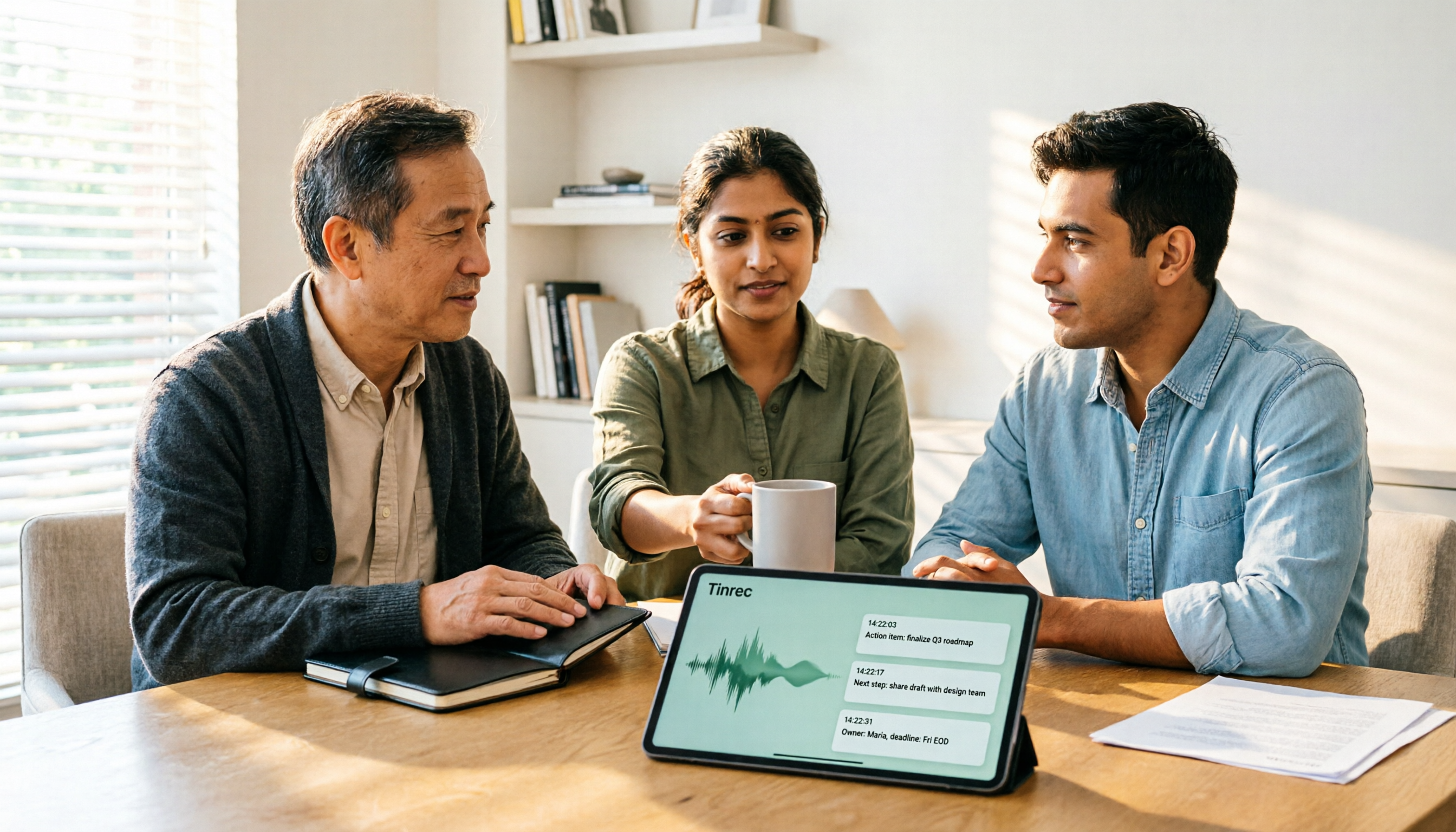
2026 AI Meeting Recorder Comparison: 4 Tools Tested—Which One Actually Saves You Time?
Tired of re-listening to recordings and cleaning up transcripts after every meeting? This review breaks down the decision into three key questions: how meeting audio gets into the tool, what happens after transcription, and who owns team data. We tested Tinrec, Otter.ai, Notta, and Granola, and compiled buying tips, common pitfalls, and selection advice.

How to Choose a Meeting Notes App in 2026: Tinrec's Bot-Free Recording + AI Summaries & Action Items
How do you pick a meeting notes app? This guide starts with the key question: do you need a record or a conclusion? It covers the practical uses of meeting notes apps, 7 core capabilities, 4 use cases, and 5 buying considerations. Using Tinrec as an example, it explains bot-free online meeting recording, AI summaries, action item extraction, AI Q&A, and team plan roles and seats, with pricing for the free and team plans.
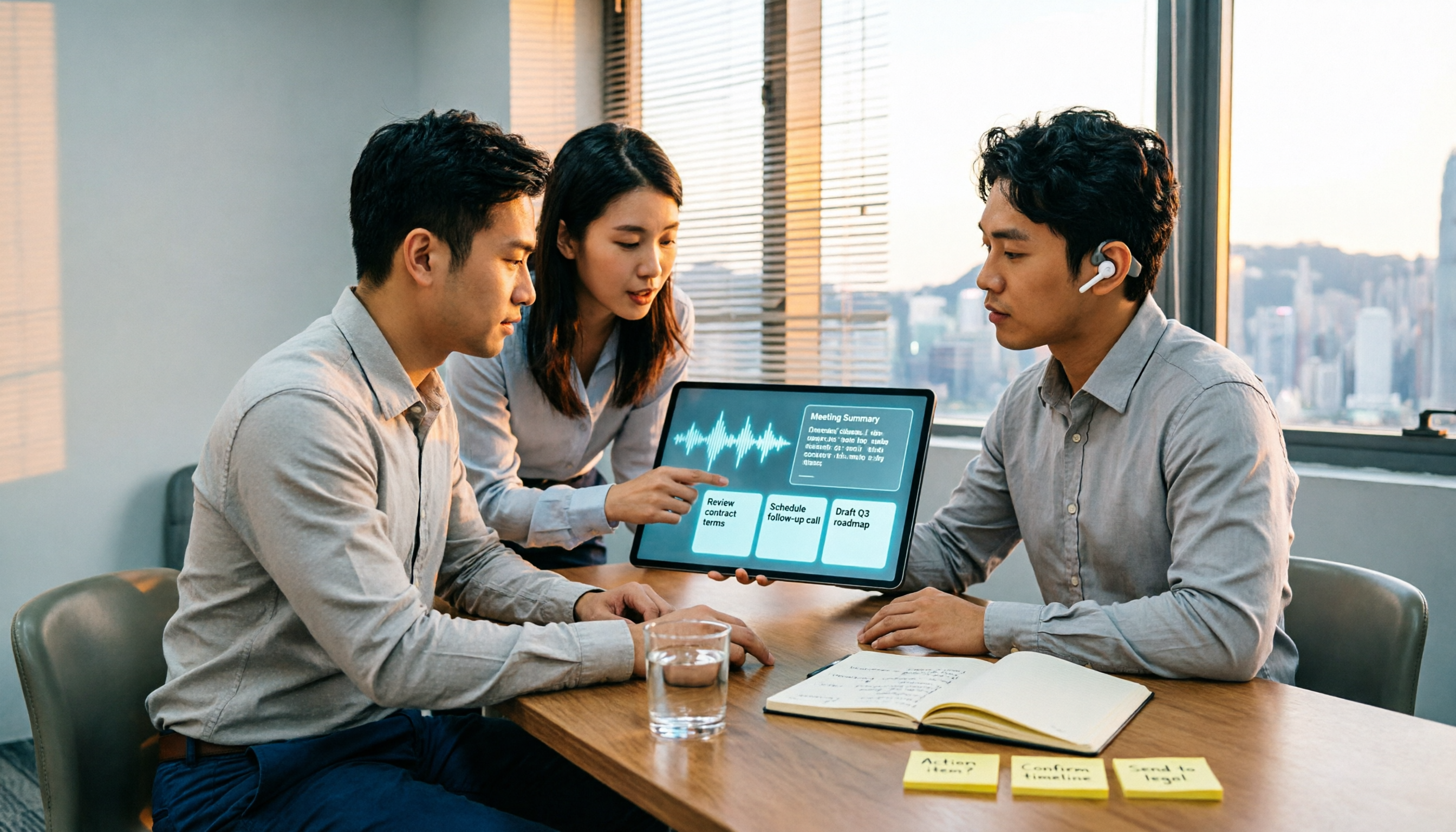
2026 Comparison of 4 Recording-to-Meeting-Notes Tools: Which AI Meeting Assistant Actually Saves You an Hour?
The meeting ends, but the real work begins. This article starts from the practical decision points Hong Kong office workers actually face, breaking down what recording-to-meeting-notes tools can do for you, what core capabilities they offer, and what to look for when choosing a tool. It uses Tinrec as a running example to demonstrate the complete workflow from recording to transcript, summary, action items, and team knowledge retention, while also explaining team plan roles and seat definitions.

2026 Comparison of 4 Meeting Recording AI Tools: Is the Free Tier Enough? That's the Key
How to choose a meeting recording AI? This article starts with common misconceptions and compares Tinrec, Otter.ai, Notta, and Granola through hands-on testing. It outlines four key criteria: recording method, post-meeting organization, data retention, and free tier limits, plus a guide to avoiding pitfalls and scenario-based recommendations.

2026 Comparison of 4 Meeting Recording Tools: Legal Self-Protection and Post-Meeting Organization—Which Performs Best?
The point of meeting recording is never just 'recording'—it's how you use it afterward. This article starts with the three most common misconceptions, outlines 4 key criteria for choosing a meeting recording tool, tests Tinrec's bot-free recording, AI summaries, and post-meeting Q&A workflow, compares the positioning of Otter.ai, Granola, and PLAUD, and finally covers the legal and practical pitfalls most easily encountered with recording for self-protection in Taiwan.

2026 Comparison of 4 AI Meeting Recorders: Free Tiers, AI Summaries, and Post-Meeting Q&A
Got dozens of unlistened recordings on your phone? This guide starts from real student scenarios, explains the 4 key factors to consider when choosing an AI meeting recorder, and then hands-on compares Tinrec, Otter.ai, Notta, and PLAUD Note—covering free tier limits, AI summary and Q&A usability, whether online meetings need a bot, and final recommendations for midterms and group projects.

2026 Comparison of 4 Meeting Recording AI Tools: Which One Actually Saves You Time?
This article starts with common misconceptions and explains that meeting recording AI should not be judged solely by transcription minutes; instead, consider capture, transcription, summarization, action items, Q&A, export, and team knowledge retention. It compares Tinrec, Notta, Otter.ai, and Meeting Ink on features, public pricing, and use cases, and provides buying criteria and pitfalls to help professionals choose a tool that truly saves post-meeting organization time.

2026 AI Meeting Notes App Comparison: Which Free Version Is Enough?
We tested four AI meeting notes apps in 2026, comparing meeting capture methods, post-meeting organization, Chinese language experience, team collaboration, and free tier limits. Tinrec was our primary test subject, and we also assessed Otter.ai, Notta, and PLAUD for their best-fit scenarios and key buying considerations.